

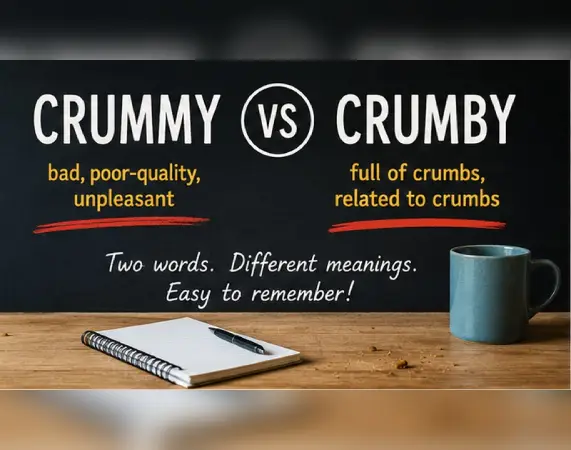
Crummy and crumby look and sound almost identical, but they are usually used differently in modern American English.
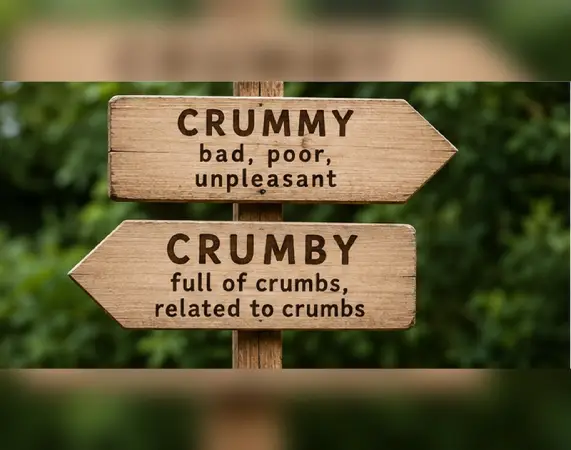
Use crummy when you mean bad, poor-quality, unpleasant, disappointing, or inferior:
We had a crummy experience at the hotel.
Use crumby when you mean full of crumbs, covered with crumbs, or related to crumbs:
The kitchen table was crumby after the kids ate cookies.
The distinction is slightly more complicated because some dictionaries also recognize crumby as a less common spelling variant of crummy. However, for clear modern US writing, crummy is the better choice when you mean “bad,” while crumby is most useful for a literal crumb-related meaning.
Quick Answer
Crummy is the standard choice when you mean bad, poor, inferior, unpleasant, or disappointing.
Crumby usually means full of crumbs, covered with crumbs, or related to crumbs. It may also appear as a less common variant spelling of crummy, but that use is less clear in everyday American writing.
Compare:
We had a crummy day.
= We had a bad day.
The counter was crumby.
= The counter had crumbs on it.
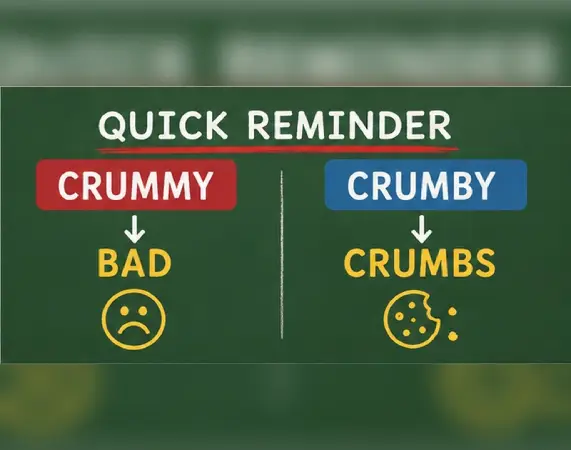
A simple memory trick is:
Crummy = bad.
Crumby = crumbs.
Why People Confuse Crummy and Crumby
The words are easy to mix up because they look almost identical and are commonly pronounced the same way. When you hear one aloud, spelling alone does not reveal which form the speaker intends.
Their meanings also overlap historically. Both are connected with crumb, and some dictionaries recognize crumby as an alternative spelling of crummy in certain senses.
That overlap does not mean the spellings are equally useful in every sentence.
When you describe a terrible movie, poor service, an unpleasant day, or an inferior product, crummy gives readers the clearest meaning:
The service was crummy.
When you describe a surface covered with cookie crumbs, crumby makes the literal meaning clearer:
The kitchen floor was crumby.
For modern writing, choosing the spelling that matches the intended meaning helps prevent unnecessary ambiguity.
Key Differences at a Glance
| Context | Best Choice | Why |
|---|---|---|
| Something bad or low-quality | crummy | Means poor, inferior, or unpleasant |
| A disappointing experience | crummy | Describes a negative situation |
| A surface covered with crumbs | crumby | Refers directly to crumbs |
| Food that produces many crumbs | crumby | Describes a crumb-related quality |
| A crumb-like or crumb-filled condition | crumby | Keeps the literal connection with crumbs |
| A less common spelling of “crummy” | crumby | Recognized in some dictionary usage |
The practical distinction is simple:
Crummy → bad, poor-quality, unpleasant, disappointing, or inferior.
Crumby → full of crumbs or related to crumbs; occasionally a less common variant of crummy.
Crummy Means Bad or Poor-Quality

In modern American English, crummy is an informal adjective used to describe something bad, unpleasant, disappointing, inferior, or of poor quality.
It can describe many situations and things, including:
a bad day
poor service
an unpleasant hotel
terrible weather
a disappointing movie
an inferior product
a poorly done job
Examples:
We had a crummy experience at the restaurant.
This is a crummy phone charger.
The weather was crummy all weekend.
He did a crummy job repairing the fence.
In each example, crummy carries a negative meaning similar to bad, poor, lousy, or unsatisfactory.
Because the word is informal, it appears most naturally in everyday conversation and casual writing.
Crumby Means Full of or Related to Crumbs
Crumby usually describes something that has crumbs on it, contains crumbs, or creates a noticeable amount of crumbs.
Examples:
The table was crumby after breakfast.
These cookies are delicious but very crumby.
The couch became crumby after movie night.
In these sentences, crumby relates directly to actual crumbs.
The word may also be used for a texture associated with crumbs:
The old bread had a dry, crumby texture.
However, crumbly is often more natural when the main idea is that something breaks apart easily into crumbs:
The cookie was soft and crumbly.
That gives us a useful distinction:
Crumby often focuses on the presence of crumbs.
Crumbly usually focuses on a texture that breaks apart easily.
Can Crumby Also Mean Bad?
Yes. Some dictionaries recognize crumby as a less common spelling variant of crummy.
You may therefore occasionally see a sentence such as:
It was a crumby deal.
Here, crumby means bad or unfair rather than covered with crumbs.
Still, this spelling is less useful when clarity matters. For a general American audience, crummy is the more familiar and predictable spelling when the intended meaning is “bad.”
Clearer:
It was a crummy deal.
When actual crumbs are involved, crumby becomes the more informative choice:
The snack table was crumby after the party.
Tone, Context, and Formality
Crummy is informal.
It works naturally in conversation, personal writing, casual reviews, social posts, and everyday speech:
That was a crummy way to treat a customer.
I had a crummy day at work.
The word can sound blunt, but it is not usually highly offensive or extreme. It simply expresses a negative judgment in a casual way.
In formal or professional writing, a more precise word may work better.
Possible alternatives include:
poor
inferior
unsatisfactory
substandard
disappointing
Compare:
Informal:
The contractor did a crummy job.
More formal:
The contractor performed substandard work.
Crumby, by contrast, usually has a literal descriptive function:
The table was crumby after the birthday party.
Because crumby is much less familiar in the “bad” sense, using it that way may cause readers to hesitate or reread the sentence.
Which One Should You Use?
Use crummy when you mean:
bad
poor-quality
inferior
unpleasant
disappointing
unsatisfactory
Examples:
We stayed in a crummy hotel.
She had a crummy morning.
The company gave us crummy customer service.
Use crumby when you mean:
full of crumbs
covered with crumbs
producing many crumbs
related to crumbs
having a crumb-like quality
Examples:
The kitchen counter was crumby.
This pastry is delicious but crumby.
The children left the couch crumby after eating crackers.
The easiest practical rule is:
If you mean bad, choose crummy.
If you mean crumbs, choose crumby.
When One Choice Sounds Wrong
Using the wrong spelling can make an otherwise simple sentence confusing.
Consider:
We had a crumby vacation.
A reader may eventually understand that the vacation was bad, especially because crumby can appear as a variant of crummy. Still, the spelling may momentarily suggest something involving crumbs.
For the meaning “bad,” write:
We had a crummy vacation.
Now consider:
The kitchen table was crummy after the children ate cookies.
Because crummy normally means bad or poor-quality, the sentence may sound as though the table itself was somehow unpleasant.
For a crumb-covered surface, write:
The kitchen table was crumby after the children ate cookies.
Context may sometimes make either form understandable, but the clearest spelling prevents readers from having to interpret your meaning twice.
Common Mistakes and Quick Fixes
Using Crumby to Mean Bad
Less clear:
That was a crumby movie.
Better:
That was a crummy movie.
When you mean bad, disappointing, or poor-quality, crummy is the clearest modern spelling.
Using Crummy for Something Covered With Crumbs
Less precise:
The table is crummy.
Clearer:
The table is crumby.
The second sentence directly suggests that crumbs are on the table.
Assuming Crumby Is Always a Misspelling
Crumby is a real word.
It can describe something related to crumbs, and some dictionaries also recognize it as a less common variant of crummy.
So the issue is not that crumby is automatically wrong. The important question is whether it clearly communicates the intended meaning.
Confusing Crumby With Crumbly
These words are related, but they are not always interchangeable.
Crumby can describe something covered with, containing, or producing crumbs.
Crumbly usually describes something that breaks apart easily.
Compare:
The cookie was crumbly.
This focuses on texture.
The counter was crumby.
This focuses on the presence of crumbs.
Using Crummy in Very Formal Writing
Crummy is common in casual English, but it may sound too conversational in formal reports or professional documents.
Casual:
The company provided crummy service.
More formal:
The company provided poor service.
Choose a more precise alternative when the context requires a professional tone.
Everyday Examples With Crummy
The hotel room was crummy and overpriced.
I had a crummy day at work.
That old laptop has a crummy battery.
The team played a crummy game last night.
We received crummy customer service.
The weather was crummy during our road trip.
He gave us a crummy excuse.
The movie had a crummy ending.
In each example, crummy expresses a negative judgment. It means something is bad, disappointing, inferior, or unpleasant.
Everyday Examples With Crumby
The kitchen counter was crumby after breakfast.
These crackers are tasty but very crumby.
The couch became crumby after the kids ate cookies.
The pastry left the plate crumby.
The car seat was crumby after the road trip.
The table looked crumby after the birthday party.
In these examples, crumby has a literal connection with crumbs.
Dictionary-Style Word Details
Part of Speech
Crummy is primarily an adjective.
It describes a person, thing, experience, condition, or situation negatively:
a crummy hotel
a crummy day
crummy service
Crumby is also primarily an adjective.
It usually describes something associated with crumbs:
a crumby table
a crumby pastry
Neither word is commonly used as a standard everyday verb in the meanings discussed here.
Noun Use
Crummy is not normally used as a noun when it means bad or poor-quality.
Crumby is also not commonly used as a noun in its crumb-related sense.
In this comparison, both words function mainly as adjectives.
Synonyms for Crummy
Depending on context, useful alternatives include:
bad
poor
lousy
inferior
unpleasant
disappointing
substandard
These words are not always exact replacements. For example, substandard sounds more formal, while lousy is strongly informal.
Alternatives for Crumby
Possible alternatives include:
full of crumbs
covered with crumbs
crumb-covered
crumb-filled
crumbly, when texture is the main meaning
The best replacement depends on whether you are describing visible crumbs, the production of crumbs, or a texture that breaks apart.
Example Sentences
Crummy
We had a crummy experience at the hotel.
The store sold us a crummy product.
The restaurant gave us crummy service.
I felt crummy after getting almost no sleep.
Crumby
The kitchen floor became crumby after the party.
This muffin is soft and very crumby.
The table was crumby after breakfast.
The back seat was crumby from all the snacks.
The first group uses crummy for negative quality or condition. The second uses crumby for something connected with actual crumbs.
Word History
Crummy and crumby are closely connected with the word crumb.
The spelling crumby keeps that connection visually obvious, which makes it especially useful when the meaning directly involves crumbs.
Over time, crummy became the familiar spelling for the informal sense meaning bad, poor, unpleasant, or inferior. Some dictionaries continue to recognize crumby as an alternative form in certain uses, which explains why both spellings still appear.
For modern American English, however, the most practical distinction remains:
crummy for “bad”
crumby for something involving crumbs
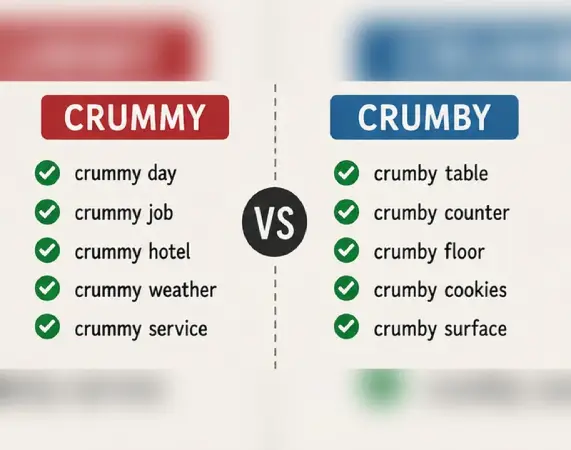
Common Phrases With Crummy
- crummy day
- crummy job
- crummy hotel
- crummy weather
- crummy movie
- crummy service
- crummy excuse
- crummy situation
These combinations use crummy to express a negative judgment.
Common Phrases With Crumby
- crumby table
- crumby counter
- crumby floor
- crumby couch
- crumby pastry
- crumby surface
- crumby texture
These expressions keep the meaning connected with crumbs or a crumb-like condition.
Frequently Asked Questions
Is it crummy or crumby?
Both spellings exist, but they are best used differently. Crummy usually means bad, unpleasant, or poor-quality. Crumby usually refers to something full of crumbs or related to crumbs.
Is crumby a real word?
Yes. Crumby is a recognized word with crumb-related meanings. Some dictionaries also recognize it as a less common variant spelling of crummy.
Which spelling means bad?
Use crummy when you mean bad, disappointing, unpleasant, or inferior. For example: We had crummy service at the restaurant.
Which spelling means covered with crumbs?
Use crumby for something covered with or full of crumbs. For example: The kitchen counter was crumby after breakfast.
What is the difference between crumby and crumbly?
Crumby often refers to the presence of crumbs, while crumbly describes something that easily breaks into crumbs. A counter can be crumby, while a dry cookie can be crumbly.
Is crummy formal English?
No. Crummy is informal and common in everyday speech. In formal writing, words such as poor, inferior, unsatisfactory, or substandard may be more appropriate.
Conclusion
Use crummy when you mean bad, poor-quality, disappointing, inferior, or unpleasant:
We had a crummy experience.
Use crumby when you mean full of crumbs, covered with crumbs, or otherwise related to crumbs:
The kitchen counter was crumby.
Although some dictionaries recognize crumby as a less common variant of crummy, the clearest modern American usage keeps the meanings separate whenever possible.
The easiest rule to remember is:
Crummy = bad.
Crumby = crumbs.