

Began and begun are both correct forms of the verb begin. However, they do not work in the same grammatical situations.
The simplest rule is:
- Began = simple past
- Begun = past participle
For example:
I began my homework after dinner.
However:
I have begun my homework.
The first sentence uses began because it describes a past action. The second uses begun because the helping verb have requires the past participle.
Quick Answer
Use began when you are describing an action that started in the past:
The meeting began at 9 a.m.
Use begun when the sentence needs a past participle, usually after has, have, or had:
The meeting has begun.
Therefore, the difference is mainly grammatical rather than a difference in basic meaning. Both forms relate to starting something or starting to happen.
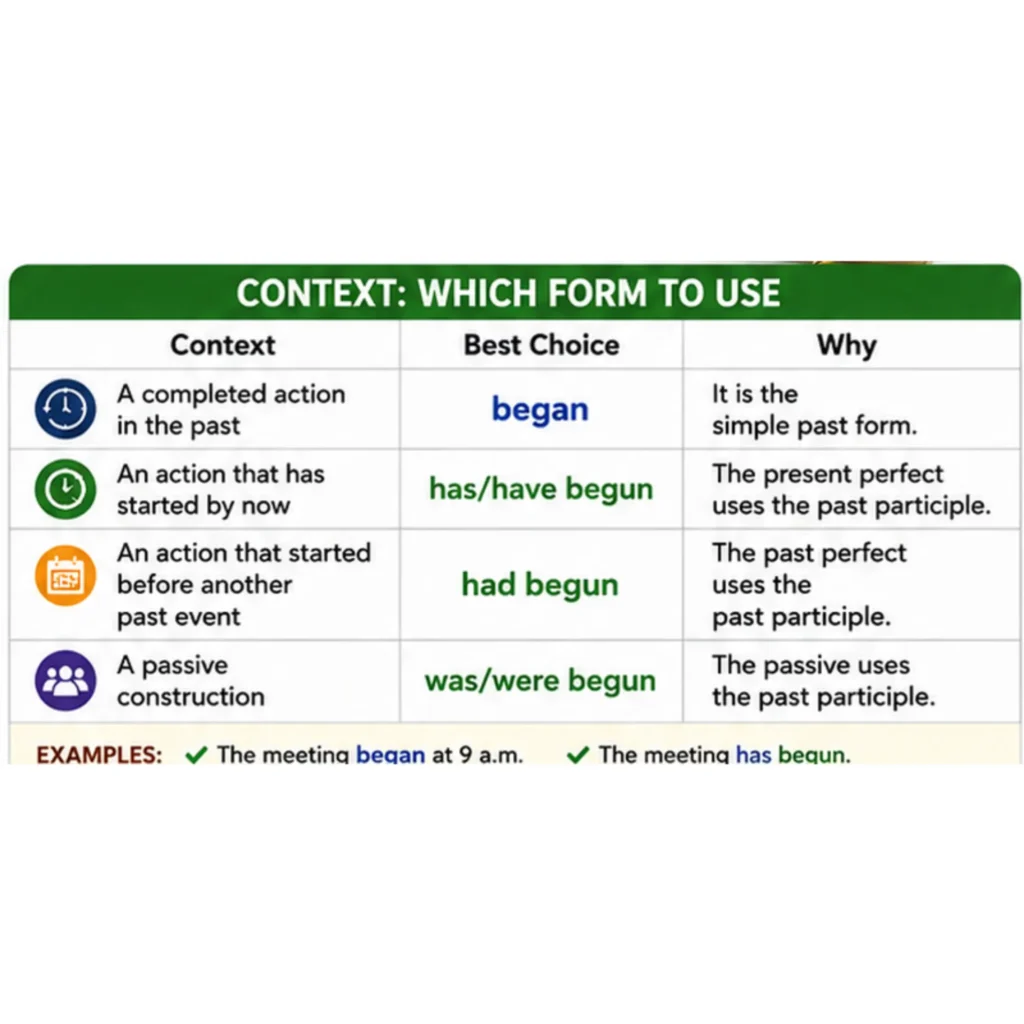
| Context | Best Choice | Why |
|---|---|---|
| A completed action in the past | began | It is the simple past form. |
| An action that has started by now | has/have begun | The present perfect uses the past participle. |
| An action that started before another past event | had begun | The past perfect uses the past participle. |
| A passive construction | was/were begun | The passive uses the past participle. |
For example:
- The meeting began at 9 a.m.
- The meeting has begun.
- The meeting had begun before I arrived.
- The project was begun last year.
Why People Confuse Them
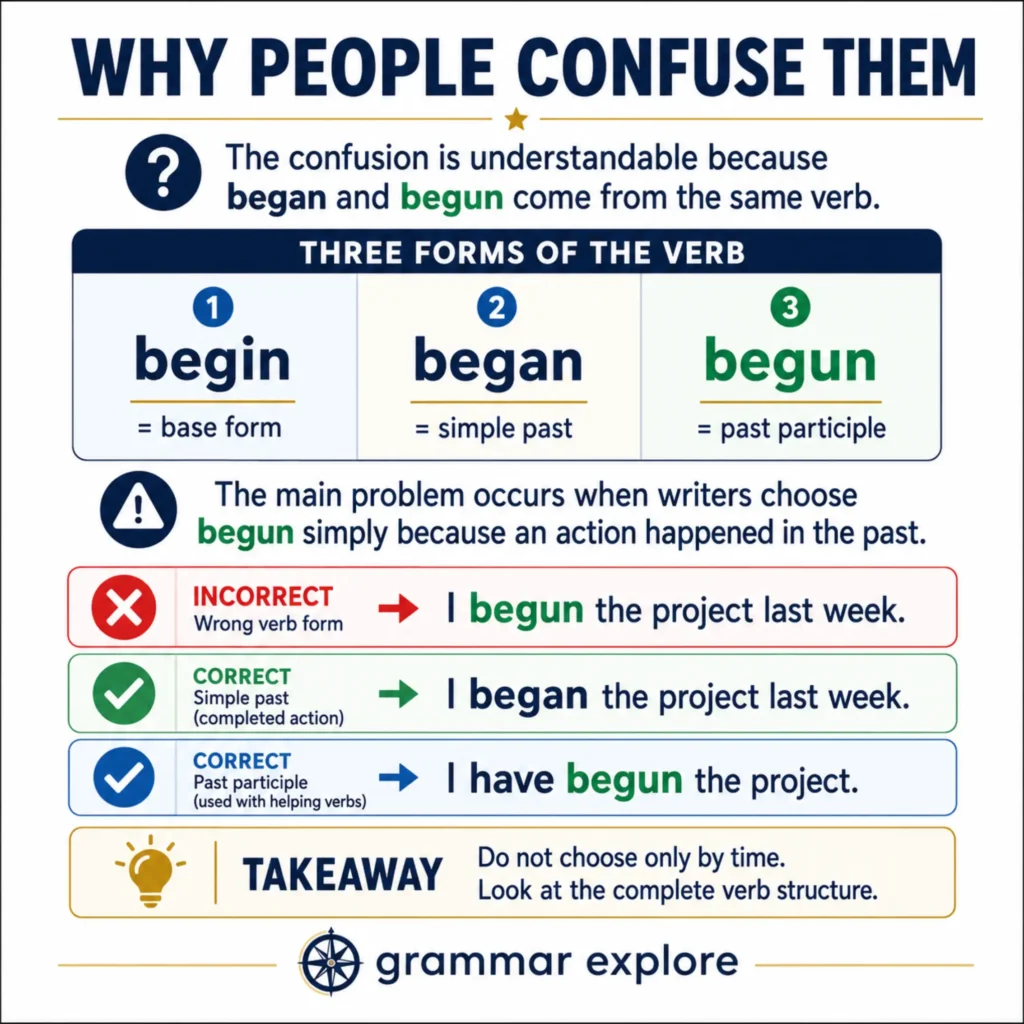
The confusion is understandable because began and begun come from the same verb. In addition, both forms describe the start of an action or event.
The three main forms are:
- begin , base form
- began , simple past
- begun, past participle
The main problem occurs when writers choose begun simply because an action happened in the past.
For example:
I begun the project last week.
This sentence is incorrect in standard US English. Instead, write:
I began the project last week.
However, begun is correct when a helping verb supports it:
I have begun the project.
Therefore, the choice does not depend only on when the action happened. Instead, you should look at the complete verb structure.
Key Differences At A Glance
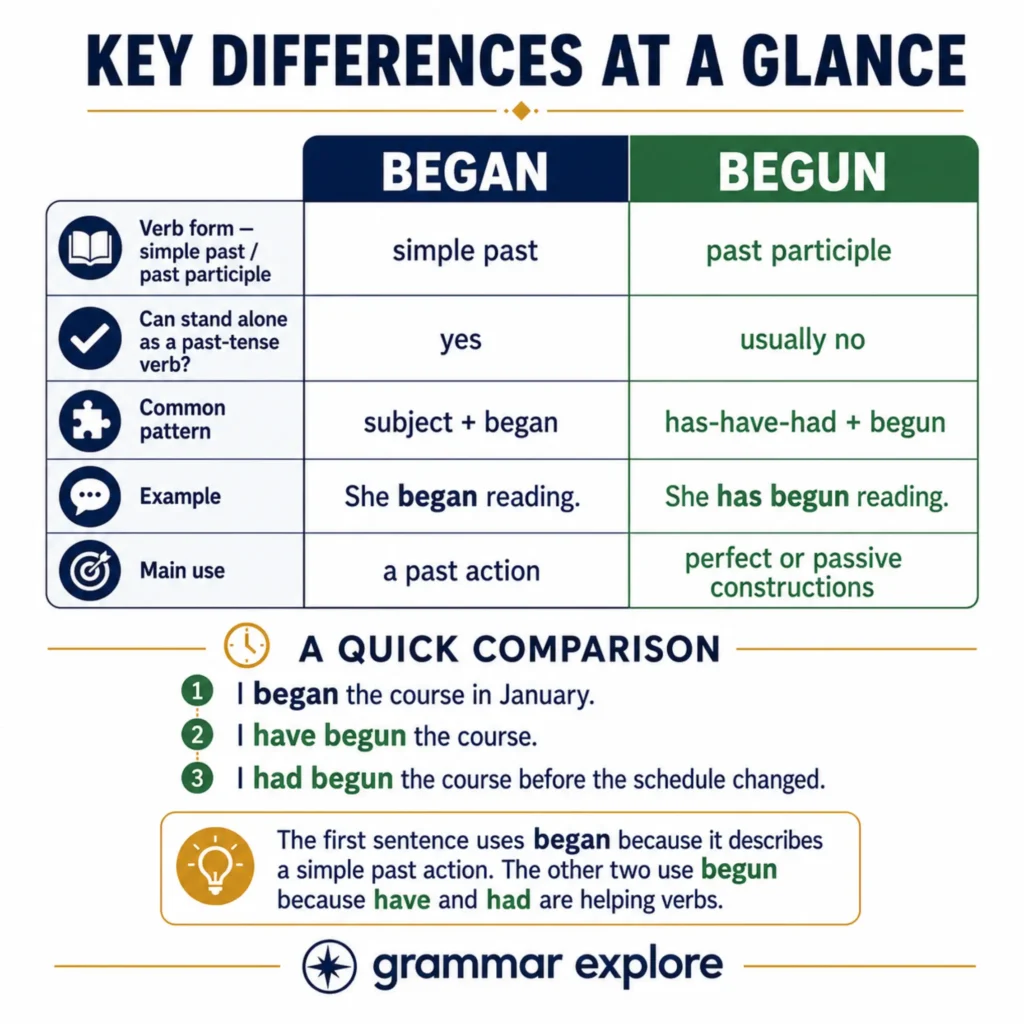
| Feature | Began | Begun |
|---|---|---|
| Verb form | Simple past | Past participle |
| Can stand alone as a past-tense verb? | Yes | Usually no |
| Common pattern | Subject + began | has/have/had + begun |
| Example | She began reading. | She has begun reading. |
| Main use | A past action | Perfect or passive constructions |
A quick comparison makes the difference clearer:
I began the course in January.
I have begun the course.
I had begun the course before the schedule changed.
The first sentence uses began because it describes a simple past action. By contrast, the other two use begun because have and had function as helping verbs.
Meaning And Usage Difference
Began and begun both come from begin, which means to start something or to start happening. However, each form has a different grammatical function.
Began
Began is the simple past form. Use it when you describe an action or event that started in the past.
For example:
- The concert began at 8 p.m.
- She began working at the company in 2022.
- We began the discussion after lunch.
- The rain began during the night.
In each example, began works as the main verb in a simple past sentence.
Begun
Begun is the past participle. Therefore, it usually appears with a helping verb.
For example:
- The concert has begun.
- She has begun working on the report.
- We had begun the discussion before the manager arrived.
- The rain had begun by midnight.
The most common patterns include:
- has begun
- have begun
- had begun
Additionally, begun can appear in passive constructions:
Construction was begun on the new library last year.
Here, was begun means that construction was started. Thus, begun is correct because the sentence uses a passive structure.
Tone, Context, And Formality
There is no important difference in tone or formality between began and begun.
Both forms can appear in:
- everyday conversation
- school writing
- business communication
- news writing
- professional documents
- formal writing
Instead, the choice depends on grammar.
For example:
The meeting began at noon.
This sentence uses the simple past.
On the other hand:
The meeting has begun.
This sentence uses the present perfect.
Both sentences can sound natural in professional writing. The difference is the verb structure, not the level of formality.
Which One Should You Use?
Choose began when you are describing a simple past action:
The class began at 9 a.m.
Choose begun when the sentence requires a past participle:
The class has begun.
A useful way to check your sentence is to look for a helping verb.
If the sentence uses has, have, or had, you will usually need begun:
- She has begun her presentation.
- They have begun the investigation.
- We had begun the meeting before the power went out.
By contrast, use began when you are simply describing what happened in the past:
- She began her presentation at 10 a.m.
- They began the investigation last week.
- We began the meeting after everyone arrived.
When One Choice Sounds Wrong
Some sentences sound incorrect because the verb forms do not match the sentence structure.
Incorrect: I Have Began The Assignment
The correct sentence is:
I have begun the assignment.
Because have is a helping verb, it requires the past participle begun.
Incorrect: They Had Began The Process
The correct sentence is:
They had begun the process before the deadline.
Similarly, had requires begun in the past perfect.
Incorrect: She Begun The Presentation
The correct sentence is:
She began the presentation at 9 a.m.
Since the sentence has no helping verb, began is the correct simple past form.
Therefore, compare these two sentences:
She began the presentation at 9 a.m.
She has begun the presentation.
Both are correct. However, they use different verb structures.
Common Mistakes (And Quick Fixes)
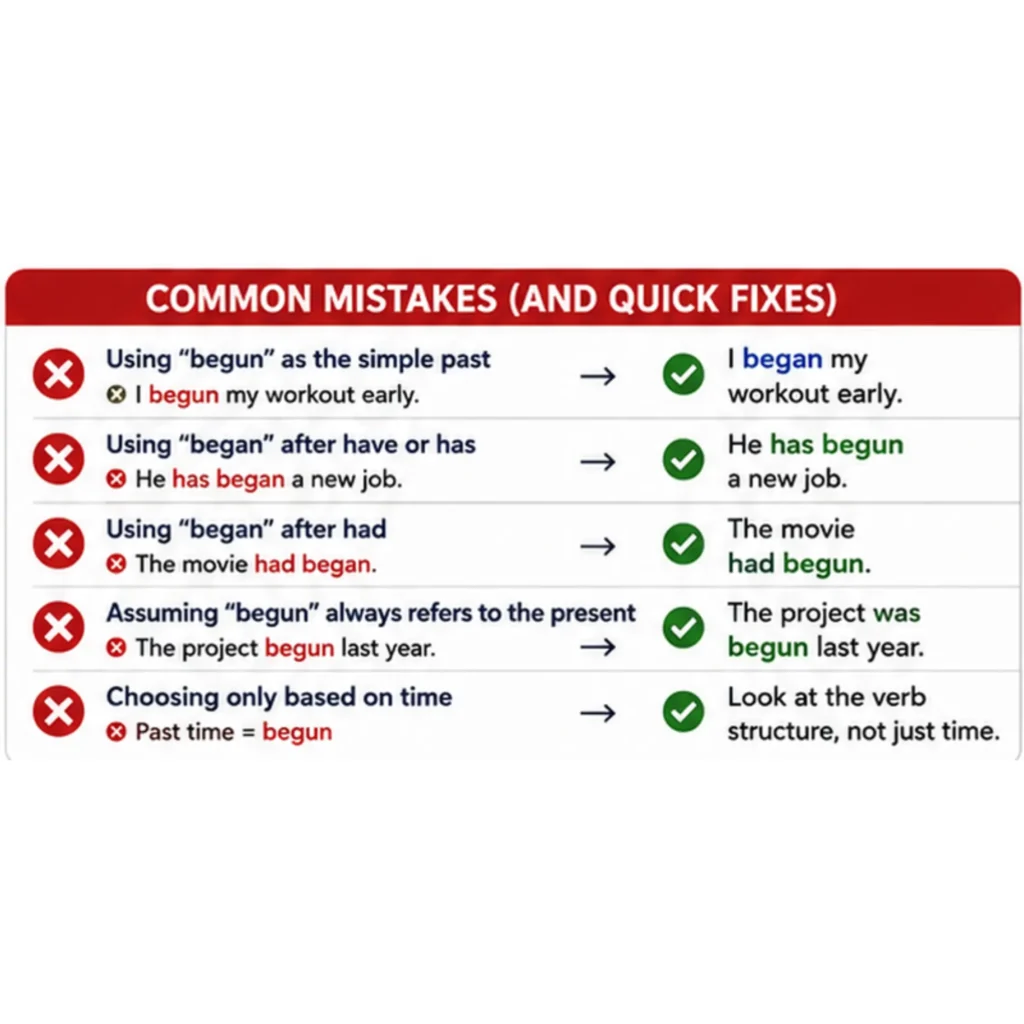
Mistake 1: Using Begun Alone As Simple Past
Incorrect:
I begun my workout early.
Correct:
I began my workout early.
Use began for a simple past action.
Mistake 2: Using Began After Have Or Has
Incorrect:
He has began a new job.
Correct:
He has begun a new job.
After has or have, use begun.
Mistake 3: Using Began After Had
Incorrect:
The movie had began before we arrived.
Correct:
The movie had begun before we arrived.
The past perfect requires had begun.
Mistake 4: Assuming Begun Always Refers To The Present
This assumption is incorrect.
For example:
The project had begun before the new director arrived.
Although the sentence describes past events, begun is correct because the sentence uses the past perfect structure had begun.
Mistake 5: Choosing Only Based On Time
The fact that an action happened in the past does not automatically mean you should use began.
Compare:
The meeting began at 10 a.m.
with:
The meeting had begun before I arrived.
Both sentences refer to past events. However, the first uses simple past, while the second uses the past perfect.
Everyday Examples
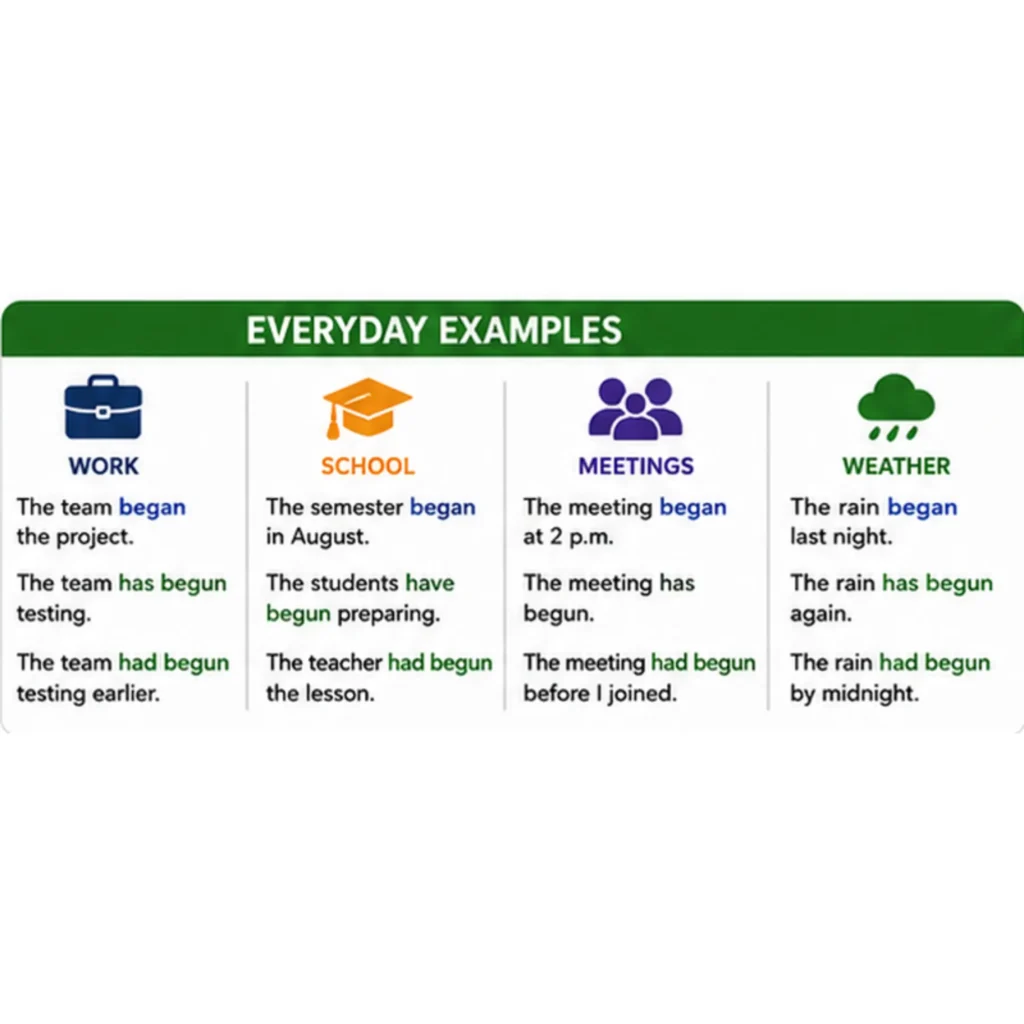
Work
- The team began the project on Monday.
- The team has begun testing the new design.
- The team had begun testing before the client arrived.
School
- The semester began in August.
- The students have begun preparing for finals.
- The teacher had begun the lesson before the fire alarm sounded.
Meetings
- The meeting began at 2 p.m.
- The meeting has begun, so please take your seat.
- The meeting had begun before I joined the call.
Weather And Events
- The snow began before sunrise.
- The storm has begun to move inland.
- The rain had begun by the time we left.
Daily Activities
- I began cleaning the kitchen after breakfast.
- I have begun organizing my office.
- I had begun cooking when the phone rang.
Dictionary-Style Word Details
Verb
Began: The simple past form of begin.
She began writing the report yesterday.
Begun: The past participle of begin.
She has begun writing the report.
Noun
Neither began nor begun functions as a standard noun in this comparison. Instead, both are verb forms of begin.
Synonyms
Because began and begun are forms of the same verb, their closest plain alternatives depend on the sentence.
- For began, possible alternatives include:
- started
- commenced
- got started
- For example:
The meeting began at noon.
The meeting started at noon.
For begun, the alternative must fit the complete verb structure:
The meeting has begun.
The meeting has started.
These alternatives can work in many contexts. However, they are not exact replacements in every sentence.
There is no single direct antonym for began or begun. Instead, the opposite depends on the context. For an action or event, ended or stopped may provide a true contrast when appropriate.
Example Sentences
Began:
- The movie began at 7 p.m.
- She began learning Spanish in college.
- The company began offering the service last year.
- The discussion began after everyone arrived.
Begun:
- The movie has begun.
- She has begun learning Spanish.
- The company had begun offering the service before the policy changed.
- The discussion had begun when we joined the call.
Overall, the pattern remains consistent: began works as the simple past form, while begun works as the past participle.
Word History
Began and begun are established forms of the verb begin. Their different forms reflect the irregular verb pattern used by the verb.
For modern writing, however, the most important point is grammatical: began is the simple past form, while begun is the past participle.
Phrases Containing
Common phrases with began include:
- began to work
- began to change
- began the process
- began the meeting
- began a new project
Common phrases with begun include:
- has begun
- have begun
- had begun
- has begun to change
- have begun to improve
- was begun
In most cases, the helping verb makes the correct choice clear.
Frequently Asked Questions
What is the difference between began and begun?
Began is the simple past form of begin, while begun is the past participle. Use began for a simple past action and begun after helping verbs such as has, have, or had.
Is “I have began” correct?
No. The correct form is “I have begun.” The helping verb have requires the past participle begun.
Is “I began” grammatically correct?
Yes. Use began when you describe a completed action in the simple past.
Example: I began my homework after dinner.
Can I use begun by itself?
Usually, no. Begun normally needs a helping verb such as has, have, or had.
Correct: The meeting has begun.
Which is correct: “had began” or “had begun”?
Had begun is correct. The past perfect tense uses had + begun.
Example: The movie had begun before we arrived.
Is “began vs. begun” a difference in meaning?
Not mainly. Both forms come from begin, which means “to start.” The main difference lies in their grammatical function: began is the simple past, while begun is the past participle.
Conclusion
Began and begun are both correct forms of begin. However, they have different grammatical jobs.
Use began as the simple past form:
I began the project yesterday.
Use begun as the past participle, usually after has, have, or had:
I have begun the project.
The easiest rule to remember is:
Began = simple past.
Begun = past participle.
Therefore, write:
She began the work.
But write:
She has begun the work.
Once you identify the sentence structure, choosing between began and begun becomes much easier.