

Sang and sung are both forms of the verb sing, but they do not work the same way in a sentence.
Use sang as the simple past form:
She sang at the concert last night.
Use sung as the past participle:
She has sung at that venue before.
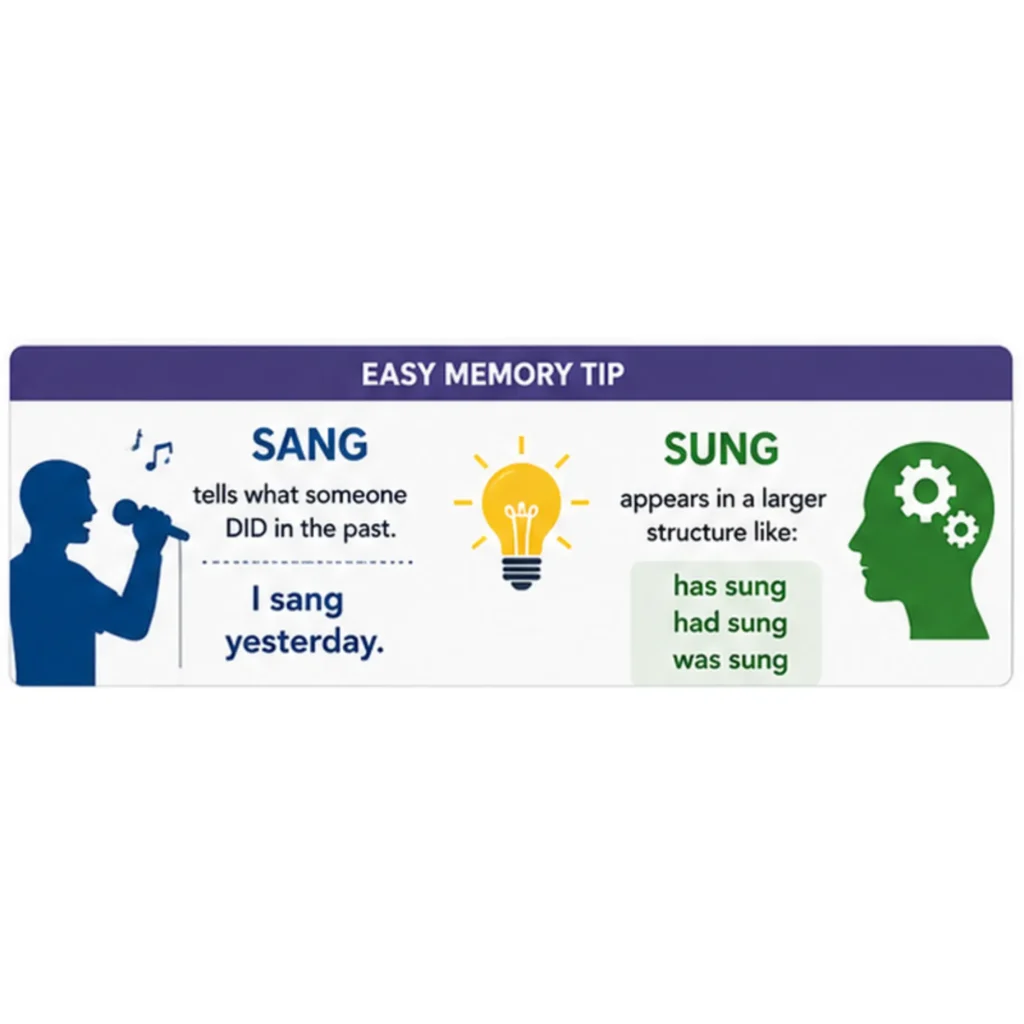
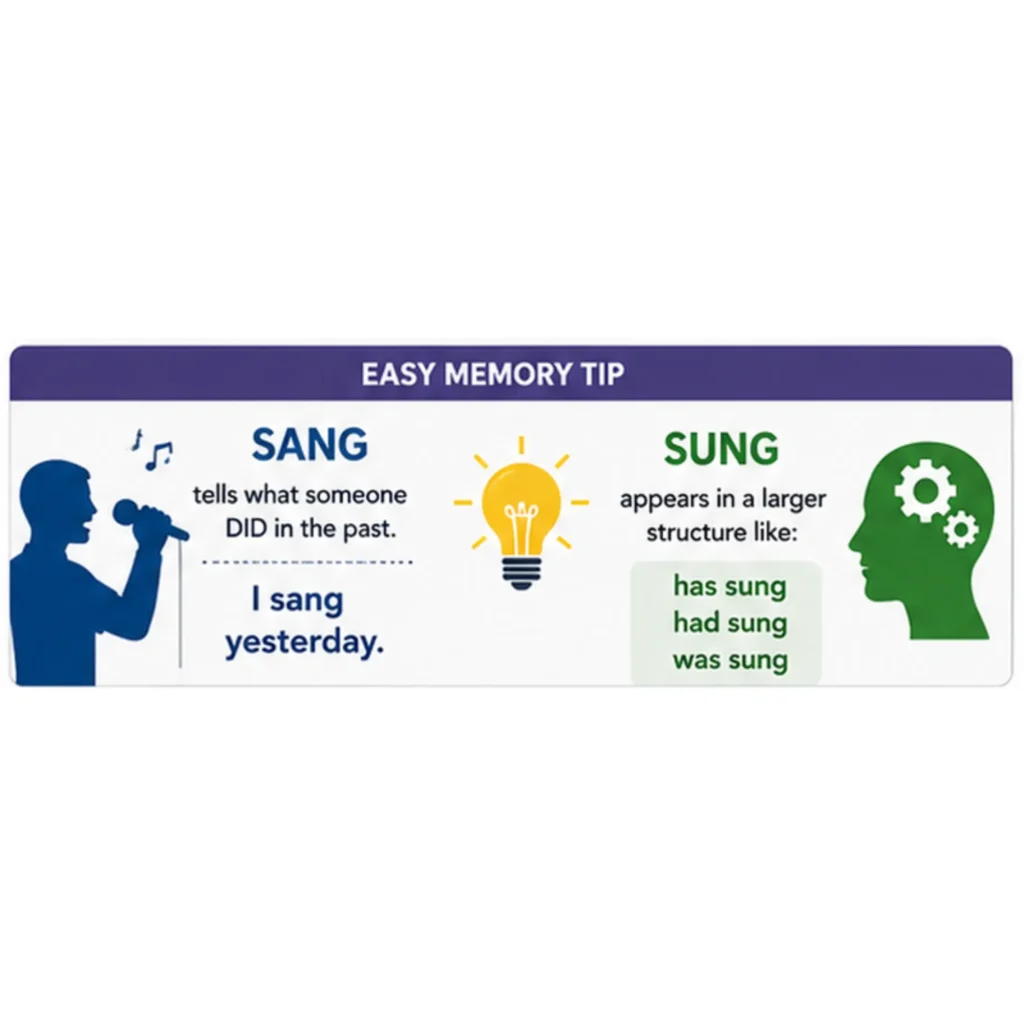
The easiest way to remember the difference is this: sang usually tells what someone did in the past, while sung usually appears in a larger verb structure such as “has sung” or “was sung.”
Quick Answer
Use sang for a completed action in the simple past.
I sang at the school assembly yesterday.
Use sung as the past participle of sing, commonly with forms of have or be.
I have sung that song many times.
The song was sung by the choir.
So:
- I sang = simple past
- I have sung = present perfect
- I had sung = past perfect
- It was sung = passive construction
The forms are not interchangeable in standard US English.
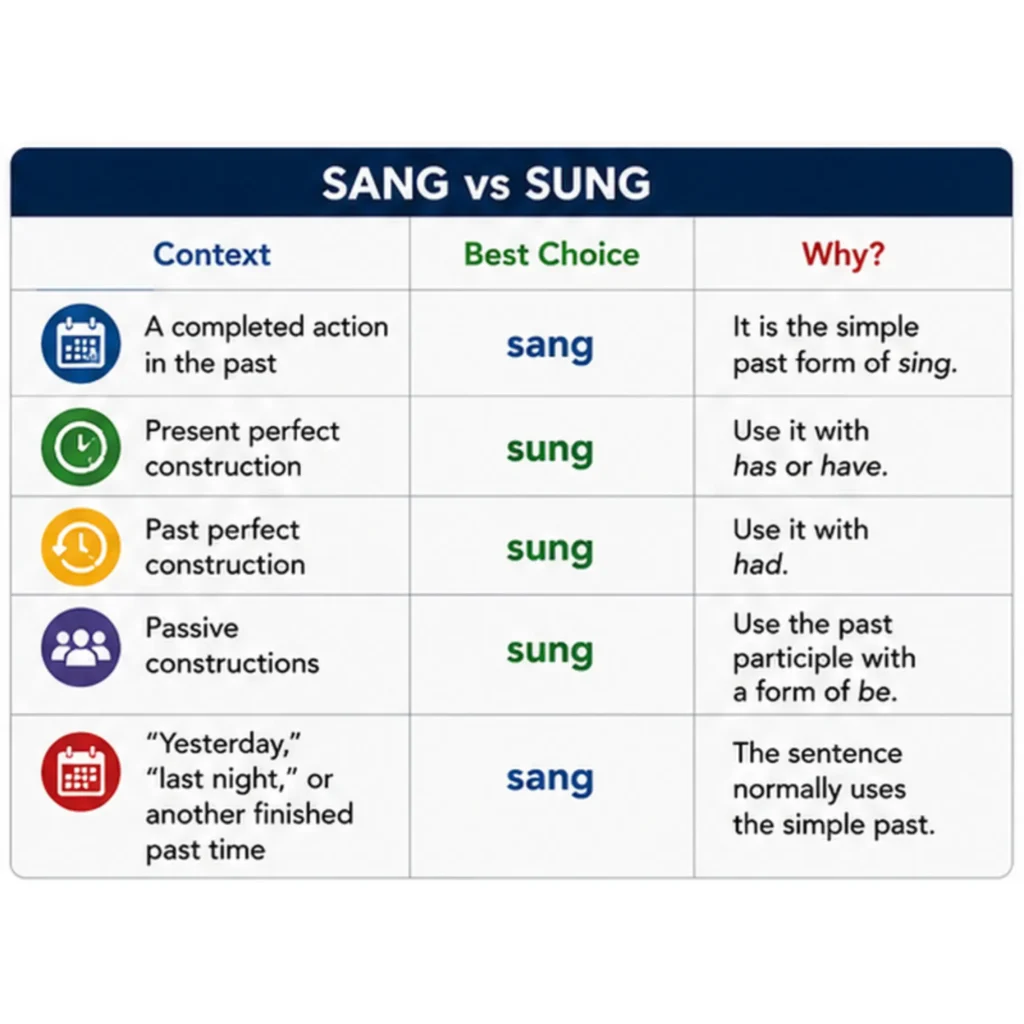
| Context | Best Choice | Why |
|---|---|---|
| A completed action in the past | sang | It is the simple past form of sing. |
| Present perfect construction | sung | Use it with has or have. |
| Past perfect construction | sung | Use it with had. |
| Passive construction | sung | Use the past participle with a form of be. |
| “Yesterday,” “last night,” or another finished past time | sang | The sentence normally uses the simple past. |
Why People Confuse Them
The confusion comes from the fact that sing, sang, and sung are three forms of the same irregular verb.
The pattern is:
sing → sang → sung
The first form is the base or present form. The second is the simple past. The third is the past participle.
Because both sang and sung refer to an action that happened in the past, writers sometimes use them as if they were interchangeable. They are not.
Compare:
She sang at the festival last weekend.
She has sung at the festival several times.
The first sentence simply reports a completed past event. The second uses a perfect construction and connects the past action to the present situation or experience.
The difference is therefore mainly grammatical. The two words describe the same basic action, but the sentence structure determines which form you need.
Key Differences At A Glance
| Feature | Sang | Sung |
|---|---|---|
| Verb form | Simple past | Past participle |
| Can normally stand alone as the main past-tense verb? | Yes | No, not in the same simple-past pattern |
| Common pattern | Subject + sang | have/has/had + sung |
| Passive pattern | Not used in standard passive construction | be + sung |
| Example | She sang yesterday. | She has sung before. |
A compact way to remember the difference is:
- Sang = someone did the singing.
- Sung = the sentence uses a participle structure, such as has sung or was sung.
Meaning And Usage Difference
Sang: The Simple Past Form
Sang is the simple past form of sing.
Use it when you are describing a completed action in the past.
Maya sang at the talent show.
The band sang three songs before the break.
We sang along with the radio during the road trip.
The sentence does not need have, has, or had before sang.
You can also use sang with a specific past-time expression:
He sang at the wedding last Saturday.
She sang the national anthem before the game.
They sang together when they were in college.
Sung: The Past Participle
Sung is the past participle of sing.
It commonly appears in perfect constructions with have, has, or had:
I have sung that song before.
She has sung in several local theaters.
They had sung for nearly an hour before the show ended.
The form sung also appears in passive constructions with forms of be:
The song was sung by the entire audience.
The anthem is sung before every home game.
Several traditional songs were sung during the ceremony.
This is why the simple rule “sang is past and sung is past participle” is more accurate than saying that sung merely means “more past.”
The forms have different grammatical jobs.
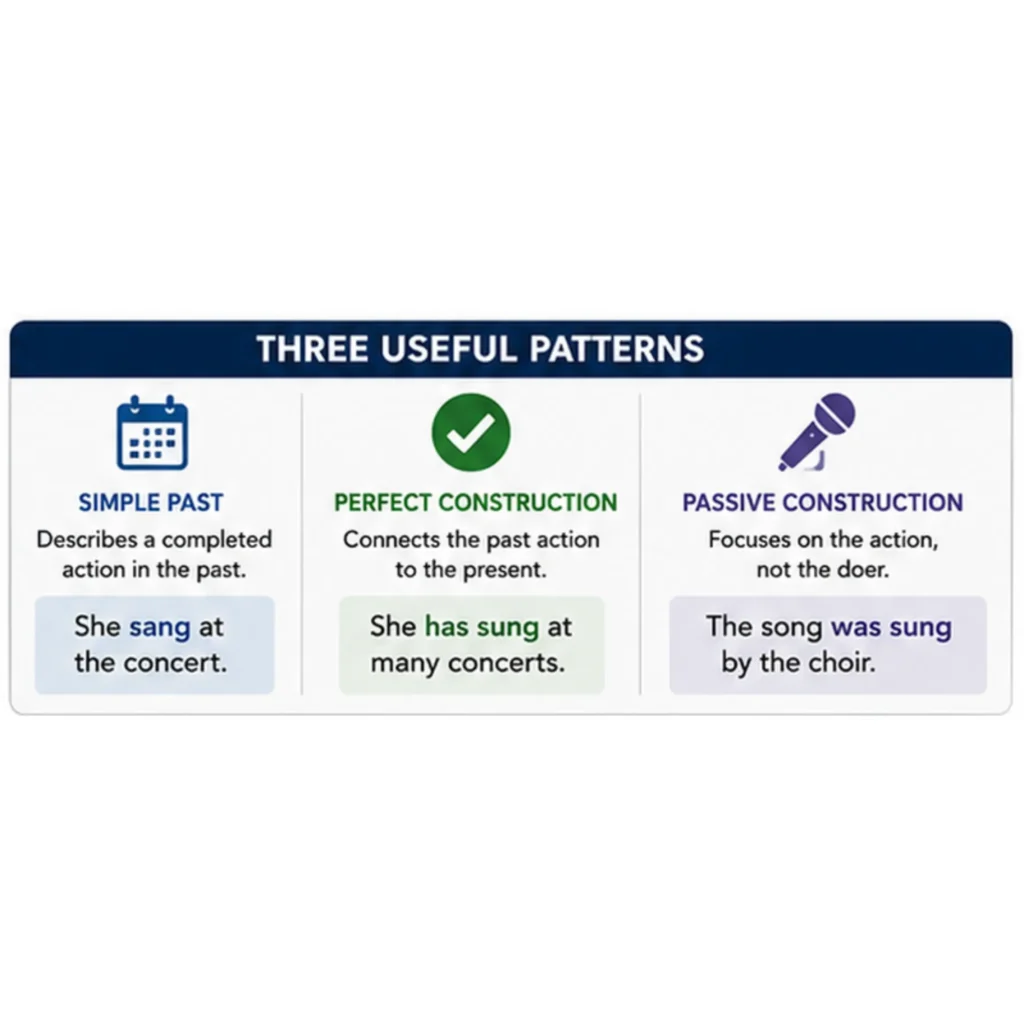
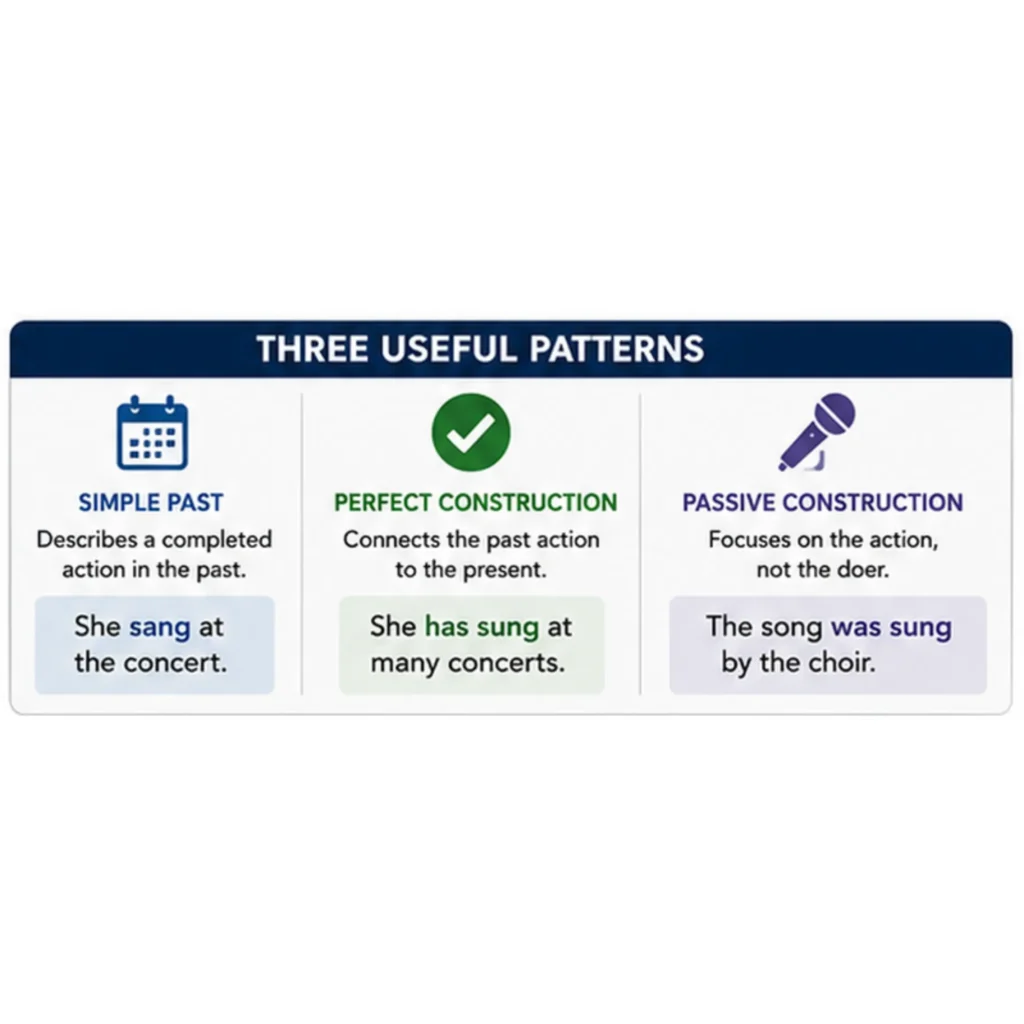
Three Useful Patterns
- Simple past: She sang at the concert.
- Perfect construction: She has sung at many concerts.
- Passive construction: The song was sung by the choir.
These three patterns cover most everyday questions about sang and sung.
Tone, Context, And Formality
There is no meaningful difference in formality between sang and sung.
Both forms work in casual conversation, school writing, professional writing, news reports, and formal documents. The correct choice depends on the sentence structure.
For example:
The children sang during the school assembly.
This uses the simple past.
The children have sung together for three years.
- This uses the present perfect.
The school song was sung before the ceremony began.
- This uses the passive voice.
The words themselves do not create different levels of formality. Grammar determines the correct form.
Which One Should You Use?
Choose sang when you are describing a completed past action directly.
I sang at the party last night.
She sang her favorite song yesterday.
The students sang during the performance.
Choose sung when the sentence uses a perfect construction or passive structure.
I have sung that song many times.
He had sung before the audience arrived.
The song was sung beautifully.
A quick question can help:
What comes before the verb?
If the sentence uses have, has, or had, choose sung.
She has sung before.
- If the sentence uses a form of be in a passive construction, choose sung.
The song was sung by the students.
- If you are simply describing what someone did at a finished time in the past, choose sang.
She sang yesterday.
When One Choice Sounds Wrong
Some mistakes are especially common because sang and sung both sound like natural choices.
“She Sung Yesterday”
Incorrect in standard US English:
She sung at the concert yesterday.
Correct:
She sang at the concert yesterday.
The word yesterday points to a completed past event, so the simple past form sang fits.
“I Have Sang That Song”
Incorrect:
I have sang that song before.
Correct:
I have sung that song before.
The verb have creates a perfect construction, so the past participle sung is required.
“The Song Was Sang”
Incorrect:
The song was sang by the choir.
Correct:
The song was sung by the choir.
The sentence uses a passive construction, which requires the past participle sung.
The key point is that sang and sung are not simply two optional ways to describe the same past action.
Common Mistakes (And Quick Fixes)
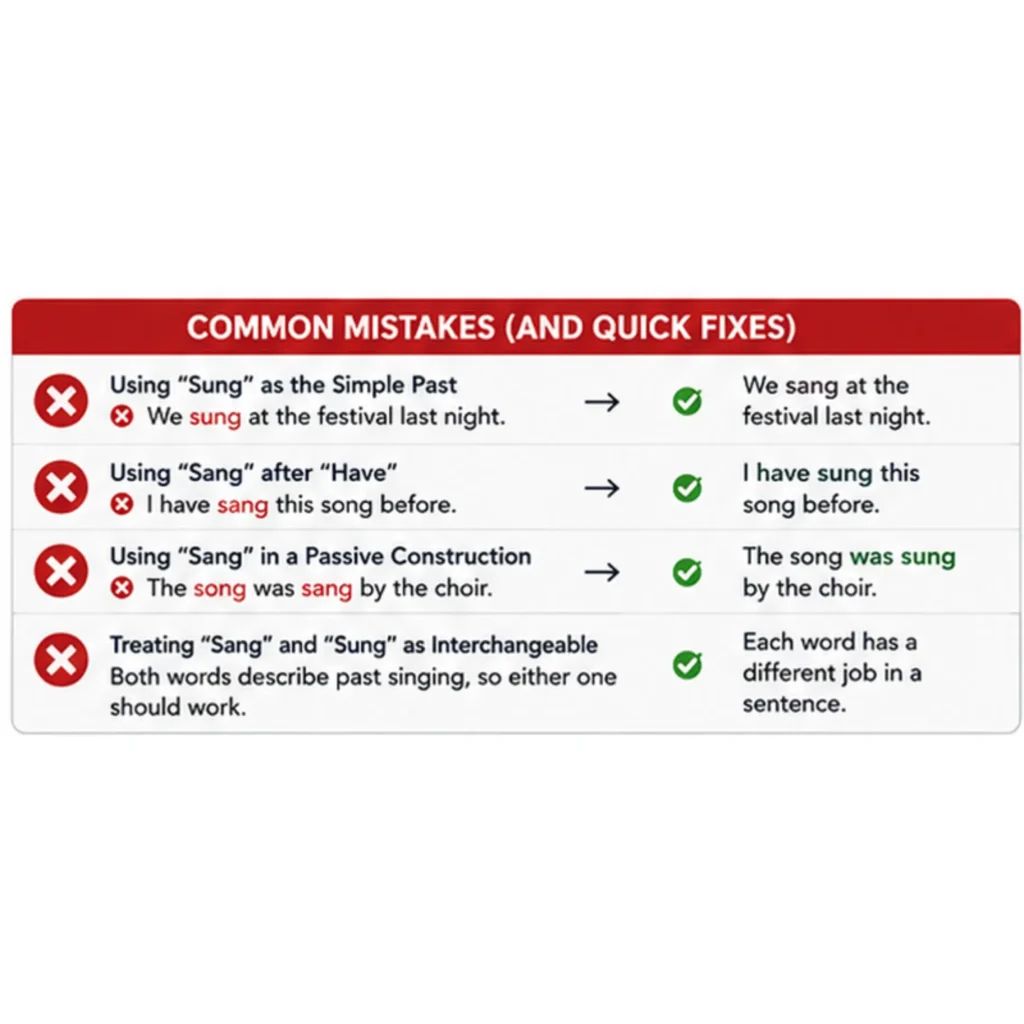
Mistake 1: Using “Sung” As The Simple Past
Incorrect:
We sung at the festival last night.
Correct:
We sang at the festival last night.
Use sang when the sentence directly reports a completed past action.
Mistake 2: Using “Sang” After “Have”
Incorrect:
I have sang this song before.
Correct:
I have sung this song before.
The pattern is:
have/has/had + sung
Mistake 3: Using “Sang” In A Passive Construction
Incorrect:
The song was sang by the school choir.
Correct:
The song was sung by the school choir.
The pattern is:
be + sung
Mistake 4: Treating “Sang” And “Sung” As Interchangeable
Incorrect reasoning:
Both words describe past singing, so either one should work.
Better reasoning:
Both words come from sing, but they perform different grammatical functions.
The sentence structure determines the correct form.
Mistake 5: Confusing The Past Participle With A Separate Verb
Sung is not a completely different verb from sing. It is one form of the same verb:
sing → sang → sung
Knowing the full pattern makes the difference easier to remember.
Everyday Examples
Simple Past: Sang
The crowd sang along with the performer.
My daughter sang in the school musical last spring.
We sang “Happy Birthday” before cutting the cake.
The singer sang three songs during the live stream.
Present Perfect: Has Or Have Sung
She has sung that song at many events.
I have sung in front of a large audience before.
They have sung together since high school.
Past Perfect: Had Sung
The choir had sung two songs before the guests arrived.
He had sung the melody several times before recording it.
Passive Constructions: Was Or Were Sung
The national anthem was sung before the game.
Several songs were sung during the ceremony.
The traditional hymn was sung by the entire congregation.
A Quick Side-By-Side Comparison
- She sang at the concert last night. → simple past
- She has sung at that concert venue before. → present perfect
- The song was sung by the choir. → passive construction
The action is related in all three sentences, but the grammar changes the verb form.
Dictionary-Style Word Details
Verb
Sang: The simple past form of the verb sing.
He sang at the event last Friday.
Sung: The past participle form of the verb sing.
He has sung at the event several times.
Neither sang nor sung is the base form of the verb. The base form is sing.
Noun
Sang: Not commonly used as a noun in standard US English in this comparison. It functions primarily as a verb form.
Sung: Not commonly used as a standalone noun in standard US English. It functions primarily as a past participle and can also appear in participial or adjective-like structures.
Synonyms
Because sang and sung are grammatical forms of the same verb, they do not have separate sets of exact synonyms.
For sang, closest plain alternatives depend on the sentence and may include:
- performed vocally
- used the voice to perform a song
- performed a song
For sung, the closest alternative depends on the construction:
She has sung the song before.
Possible plain alternative:
She has performed the song before.
The song was sung by the choir.
Possible plain alternative:
The choir performed the song.
These are context-based alternatives, not exact replacements in every sentence.
Neither sang nor sung has one universal antonym. The opposite idea depends on context, such as remained silent or did not perform, but these are not exact grammatical opposites.
Example Sentences
Sang:
She sang at the community event last weekend.
We sang together during the road trip.
The performer sang the final song before leaving the stage.
Sung:
I have sung that song many times.
He had sung before the audience entered.
The song was sung by a group of local musicians.
Word History
Sang and sung are established forms of the verb sing. Their modern roles are grammatical rather than differences in basic meaning.
The important pattern for modern writers is:
sing → sang → sung
The exact form depends on whether the sentence requires the simple past or the past participle.
Phrases Containing
Common phrases with sang include:
- sang a song
- sang at a concert
- sang along
- sang beautifully
- sang the national anthem
Examples:
The children sang along with the music.
She sang the national anthem before the game.
Common phrases with sung include:
- have sung
- has sung
- had sung
- was sung
- were sung
- a song sung by the choir
Examples:
I have sung that song before.
The anthem was sung before the ceremony.
They listened to a song sung by a local artist.
Frequently Asked Questions
What is the difference between sang and sung?
Sang is the simple past form of sing, while sung is the past participle. Use sang for a completed past action and sung with helping verbs such as has, have, or had.
Is “I sang” or “I sung” correct?
I sang is correct when you describe a simple past action.
Example: I sang at the school assembly yesterday.
Use I have sung when the sentence uses the present perfect tense.
Is “I have sang” correct?
No. The correct form is “I have sung.” The verb have requires the past participle sung.
Is “she sung yesterday” correct?
No, not in standard US English. The correct sentence is “She sang yesterday.” Use sang for a simple past action.
Which is correct: “was sang” or “was sung”?
Was sung is correct. Passive constructions use the past participle sung.
Example: The song was sung by the choir.
What are the three forms of the verb sing?
The three main forms are:
sing → sang → sung
Sing is the base form, sang is the simple past, and sung is the past participle.
Can sang and sung be used interchangeably?
No. Although both forms come from sing, they have different grammatical functions. Use sang as the simple past and sung in perfect or passive constructions.
Which is correct: “I had sang” or “I had sung”?
I had sung is correct. The past perfect tense follows the pattern had + sung.
Example: I had sung before the audience arrived.
Conclusion
Use sang as the simple past form of sing:
She sang at the concert last night.
Use sung as the past participle:
She has sung at many concerts.
The most useful patterns are:
- sing → present
- sang → simple past
- sung → past participle
Remember:
I sang yesterday.
I have sung before.
The song was sung by the choir.
If you are describing what someone did directly in the past, sang is usually the right choice. If the sentence uses a perfect or passive construction, sung is the form you need.