

Deep-seated is the standard form when you mean firmly established, deeply rooted, strongly felt, or difficult to change.
Deep-seeded is generally a mistaken form of the expression.
So write:
She has a deep-seated fear of public speaking.
Not:
She has a deep-seeded fear of public speaking.
The confusion is understandable because seated and seeded can sound very similar in American English. However, they are not interchangeable in this common expression.
Why Do People Confuse Deep-Seated And Deep-Seeded?
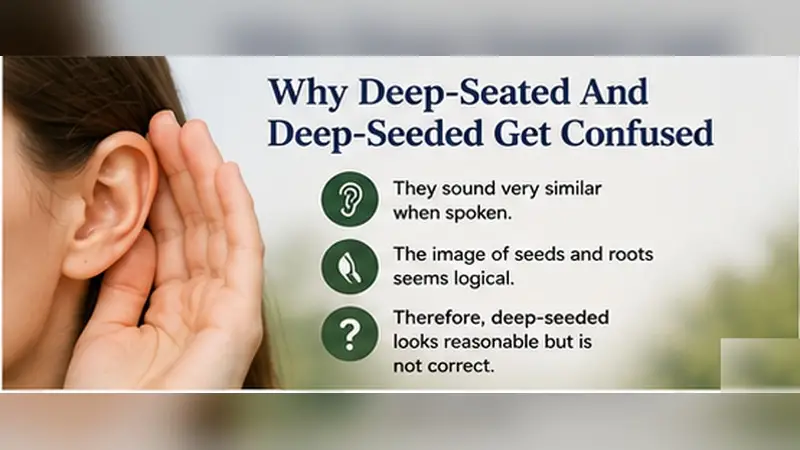
The main reason is pronunciation.
In American English, deep-seated is commonly pronounced approximately:
deep-SEE-tid
The ending can sound very similar to seeded, especially in rapid speech or in accents where the final t has a softer sound.
The meaning also encourages the mistake. A person may imagine that a fear or belief has been “seeded” deeply inside the mind. That image makes deep-seeded seem reasonable.
Even so, the standard written expression remains deep-seated. Merriam-Webster specifically identifies deep-seated as the correct term for something firmly established and notes that deep-seeded is a mistaken form.
Deep-Seated Vs Deep-Seeded At A Glance
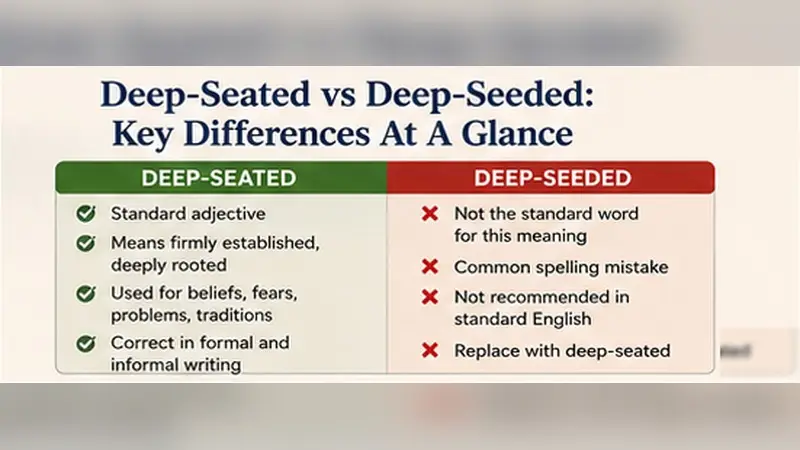
| Context | Best Choice | Why |
|---|---|---|
| A firmly established belief | deep-seated | It describes a belief that is strongly fixed |
| A long-lasting fear | deep-seated | The fear is deeply established |
| Strong resentment or mistrust | deep-seated | The feeling is deeply rooted |
| A serious underlying problem | deep-seated | The problem is difficult to remove or solve |
| A condition far below the surface | deep-seated | It has a literal deep location |
| “Deep-seeded” as the usual expression | Avoid it | It is generally a mistaken form of deep-seated |
What Does Deep-Seated Mean?
Deep-seated is an adjective that describes something firmly established at a deep level.
It commonly describes:
- beliefs
- fears
- feelings
- attitudes
- resentment
- mistrust
- traditions
- habits
- conflicts
- problems
For example:
The disagreement comes from deep-seated differences between the two groups.
This means the differences are not recent or superficial. They are firmly established and may be difficult to change.
The word can also have a more literal meaning:
The doctor suspected a deep-seated infection.
Here, deep-seated means located far below the surface.
The figurative meaning is especially common in everyday and professional writing. Cambridge defines the term as something strongly felt or believed and difficult to change or remove.
What Does Deep-Seeded Mean?
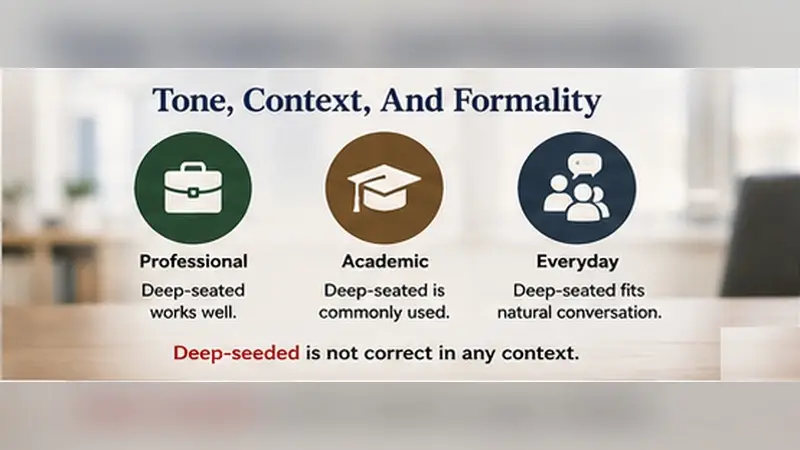
In the usual comparison, deep-seeded is the nonstandard form people use when they mean deep-seated.
For example:
Incorrect: The company has a deep-seeded culture of secrecy.
Correct: The company has a deep-seated culture of secrecy.
The mistake probably feels logical because seeds can be planted deeply. However, the standard expression for a deeply established feeling, belief, attitude, or problem is deep-seated.
The word seeded itself is a legitimate form of seed in other contexts. For example:
The farmer seeded the field in early spring.
The tournament seeded the top players based on their previous records.
That does not make deep-seeded the standard form of the common adjective meaning “firmly established.”
Deep-Seated Vs Deep-Seeded: The Key Difference
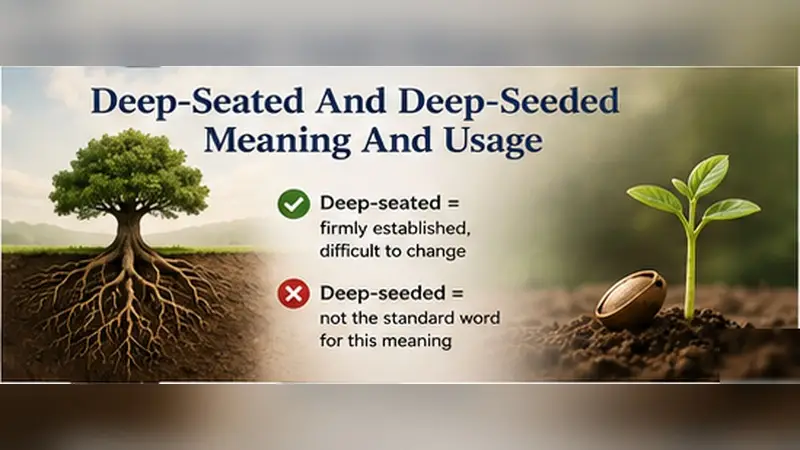
The difference is mainly one of standard usage, not a subtle difference in meaning.
Deep-Seated
Use deep-seated for something that is:
- firmly established
- deeply rooted
- strongly felt
- strongly believed
- difficult to change
- located far beneath the surface
Examples:
She has a deep-seated fear of failure.
The organization faces deep-seated financial problems.
The two sides have deep-seated mistrust of each other.
Deep-Seeded
Do not normally use deep-seeded as a replacement for deep-seated.
Incorrect: His deep-seeded resentment affected the negotiation.
Correct: His deep-seated resentment affected the negotiation.
Is It Deep-Seated Or Deep Seated?
The standard compound adjective is deep-seated, with a hyphen.
Use the hyphen when the phrase works together before a noun:
a deep-seated belief
a deep-seated fear
a deep-seated problem
The hyphen shows that deep and seated work together to modify the following noun.
When the phrase appears after a linking verb, style conventions can vary for compound adjectives, but deep-seated remains the standard dictionary form and the clearest choice in edited writing.
Deep-Seated Synonyms: Which Alternatives Fit?
The best synonym depends on what deep-seated describes.
Deep-Rooted
Use deep-rooted when you want to emphasize something firmly established over time.
The region has deep-rooted traditions.
Ingrained
Use ingrained for a habit, attitude, belief, or behavior that has become firmly established.
The company is trying to change its ingrained habits.
Firmly Established
Use firmly established as a plain, direct alternative.
The belief is firmly established in the community.
Strongly Held
Use strongly held for opinions, beliefs, and convictions.
She has a strongly held belief in personal responsibility.
Deeply Felt
Use deeply felt for emotions and personal reactions.
The community expressed deeply felt grief.
These alternatives overlap with deep-seated, but they are not interchangeable in every sentence. Cambridge lists related alternatives such as deep-rooted, established, fixed, and ingrained, while also grouping deep-seated with words describing powerful or strongly felt experiences.
Common Phrases With Deep-Seated
Some natural combinations include:
- deep-seated fear
- deep-seated belief
- deep-seated resentment
- deep-seated mistrust
- deep-seated prejudice
- deep-seated problem
- deep-seated conflict
- deep-seated tradition
- deep-seated habit
- deep-seated pain
- deep-seated opposition
- deep-seated differences
Examples:
The proposal faced deep-seated opposition from local residents.
Years of poor communication created deep-seated mistrust between the partners.
The coach realized that the team’s frustration came from a deep-seated belief that it was being treated unfairly.
Common Mistakes And Quick Fixes
Mistake: Writing Deep-Seeded Fear
Wrong:
He has a deep-seeded fear of flying.
Right:
He has a deep-seated fear of flying.
Mistake: Writing Deep-Seeded Belief
Wrong:
Her deep-seeded belief shaped her decision.
Right:
Her deep-seated belief shaped her decision.
Mistake: Leaving Out The Hyphen
Less clear:
a deep seated resentment
Standard compound form:
a deep-seated resentment
Mistake: Treating The Two Forms As Equal Choices
The two forms are not normally interchangeable in the common expression.
If you mean firmly established or deeply rooted, choose deep-seated.
Deep-Seated Examples In Everyday American English
Personal Feelings
He has a deep-seated fear of disappointing his family.
Her deep-seated resentment made it difficult to move forward.
Beliefs And Attitudes
The decision challenged a deep-seated belief about success.
The organization is working to change deep-seated attitudes about leadership.
Problems And Conflicts
The new policy cannot solve the department’s deep-seated problems by itself.
The negotiations exposed deep-seated differences between the two sides.
Traditions And Habits
The town has a deep-seated tradition of celebrating the holiday together.
His deep-seated habit of checking every detail helped him avoid mistakes.
Physical Conditions
The doctor ordered additional tests for the deep-seated pain.
The treatment targeted a deep-seated infection.
Deep-Seated And Deep-Seeded In A Sentence
| Feature | Deep-Seated | Deep-Seeded |
|---|---|---|
| Standard form for this meaning | Yes | No |
| Part of speech | Adjective | Not the standard form for this expression |
| Main idea | Firmly established or deeply located | Usually a mistaken replacement |
| Common collocations | Fear, belief, resentment, problem, tradition | No standard equivalent set |
| Pronunciation confusion | Often confused with “seeded” | Sounds similar to “seated” |
Dictionary-Style Word Details
Verb
Deep-seated: Not a verb. It is an adjective.
Deep-seeded: Not the standard adjective used for the meaning “firmly established.” The verb seed is valid in other contexts, such as seed a field or seed a tournament.
Noun
Neither deep-seated nor deep-seeded functions as a noun in the standard comparison.
Synonyms
For deep-seated, the closest alternatives depend on context:
- deep-rooted , firmly established
- ingrained , firmly fixed through habit or repeated experience
- firmly established , clear and neutral
- strongly held , especially for beliefs and opinions
- deeply felt , especially for emotions
Deep-seeded does not need a synonym in this comparison because it is generally the form to replace with deep-seated.
Example Sentences
Deep-seated:
The community has a deep-seated distrust of the company.
She developed a deep-seated belief in the value of education.
The team must address its deep-seated communication problems.
The patient reported deep-seated pain in the lower back.
Deep-seeded:
Incorrect: The company has deep-seeded problems.
Correct: The company has deep-seated problems.
Word History
The standard expression deep-seated connects the idea of something being situated deeply or firmly with the figurative idea of a feeling, belief, or condition becoming firmly established.
The spelling deep-seeded is understandable because seeded creates a natural image of something planted deep in the ground. However, that is not the established form of the common expression. Merriam-Webster specifically explains the connection between the literal sense of deep-seated and its figurative meaning.
Phrases Containing
Common phrases include:
- deep-seated fear
- deep-seated belief
- deep-seated resentment
- deep-seated mistrust
- deep-seated prejudice
- deep-seated problem
- deep-seated conflict
- deep-seated tradition
- deep-seated habit
- deep-seated pain
FAQ
Is deep-seeded a word?
Seeded is a real word, but deep-seeded is generally not the standard form of the common expression meaning “firmly established” or “deeply rooted.” In that context, use deep-seated.
What is the correct phrase: deep-seated or deep-seeded?
Deep-seated is the standard choice.
She has a deep-seated fear of failure.
What does deep-seated mean?
Deep-seated means firmly established, strongly felt, deeply rooted, or difficult to change. It can also describe something located far below the surface.
Is deep-seated hyphenated?
Yes. Deep-seated is the standard hyphenated form of the compound adjective.
Is deep-seated the same as deep-rooted?
They are often close in meaning when describing a belief, feeling, tradition, or problem that is firmly established. However, deep-seated can also describe something located far below the surface, while deep-rooted more strongly emphasizes roots, origins, or long-term establishment.
How do you pronounce deep-seated?
In American English, it is commonly pronounced approximately deep-SEE-tid. Its pronunciation can sound similar to deep-seeded, which is one reason the two forms are often confused.
Conclusion
When choosing between deep-seated vs deep-seeded, use deep-seated when you mean firmly established, deeply rooted, strongly felt, or difficult to change.
Use:
- a deep-seated belief
- a deep-seated fear
- a deep-seated problem
- deep-seated resentment
Deep-seeded is generally the mistaken form in these expressions. The confusion comes mainly from the similar sound of seated and seeded and from the appealing idea of something being planted deeply.
The reliable choice is simple:
Deep-seated = the standard form.
Deep-seeded = generally avoid when you mean “firmly established.”