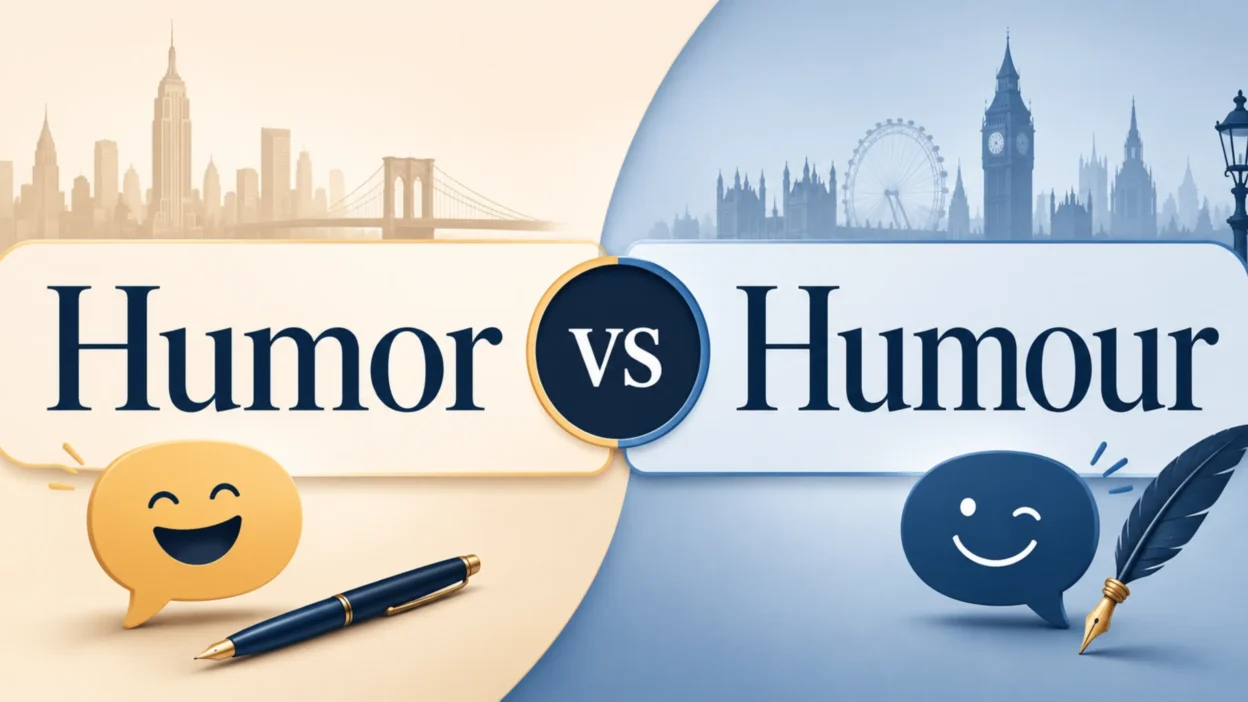
Humor vs humour is a common spelling comparison because both forms are correct, but they belong to different varieties of English. The word describes amusement, comedy, a sense of what is funny, and in some contexts a person’s mood or temperament.
Humor is the standard spelling in American English. Humour is the standard spelling in British English and other varieties that generally follow British spelling conventions. The meaning and pronunciation are essentially the same, so the correct choice depends mainly on the variety of English you are using.
Quick Answer
Use humor in American English.
Use humour in British English.
For example:
She has a great sense of humor. , American English
She has a great sense of humour. , British English
Both spellings refer to the same general idea. The main difference is the regional spelling convention.
Why People Confuse Them
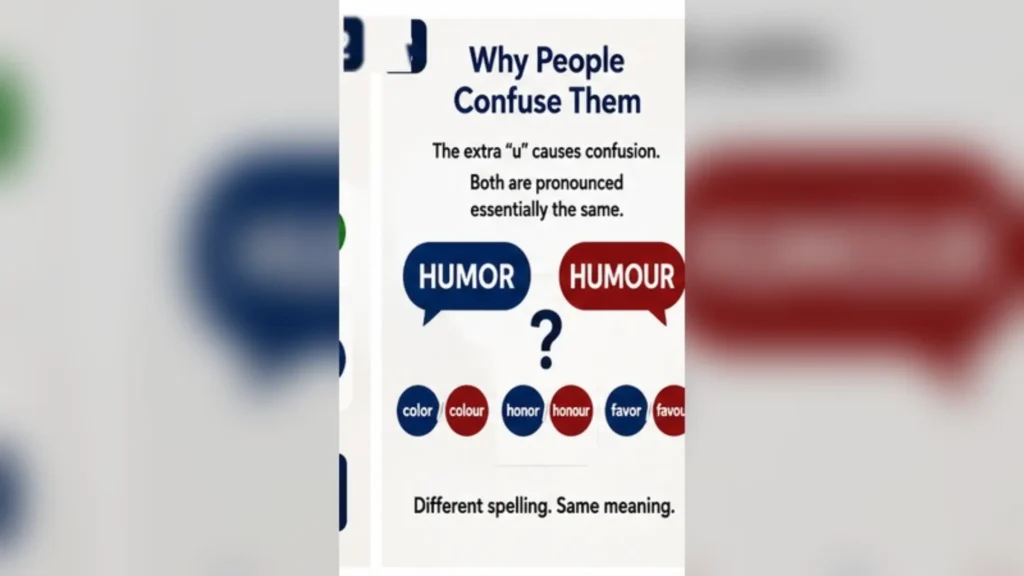
The confusion comes from the extra u in humour.
American English commonly uses shorter spellings in several words that traditionally contain -our in British English. This creates pairs such as:
- humor / humour
- honor / honour
- color / colour
- favor / favour
Because both humor and humour are widely used and pronounced essentially the same way, readers may wonder whether one spelling is incorrect.
The answer is no. Both are established spellings, but they belong to different regional conventions.
Key Differences At A Glance
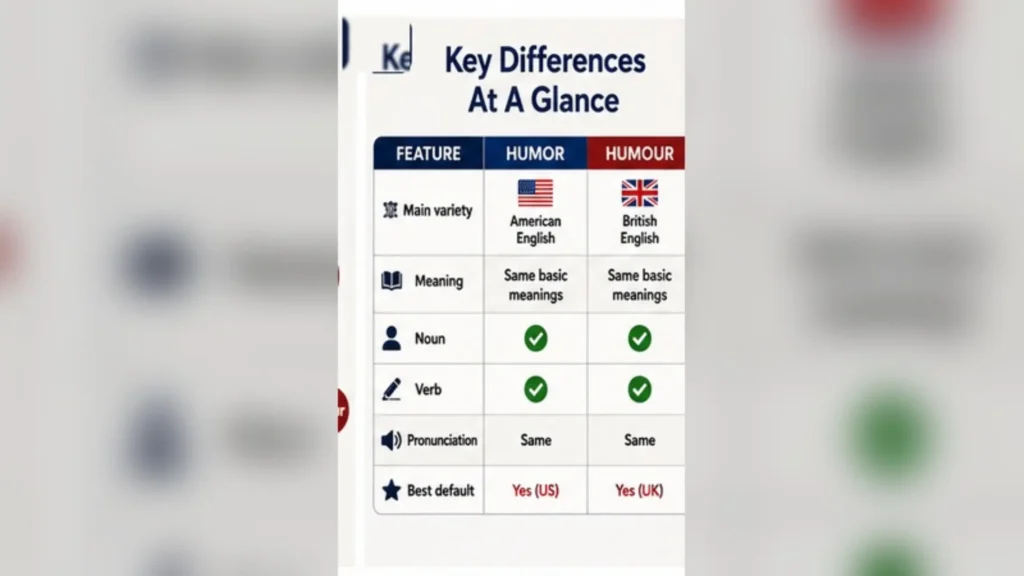
| Feature | Humor | Humour |
|---|---|---|
| Main variety | American English | British English |
| Meaning | Same basic meanings | Same basic meanings |
| Noun | Yes | Yes |
| Verb | Yes | Yes |
| Pronunciation | Generally the same | Generally the same |
| Standard US choice | Yes | No |
| Standard British choice | No | Yes |
The most important rule is simple: match the spelling to the variety of English you are using.
Meaning And Usage Difference
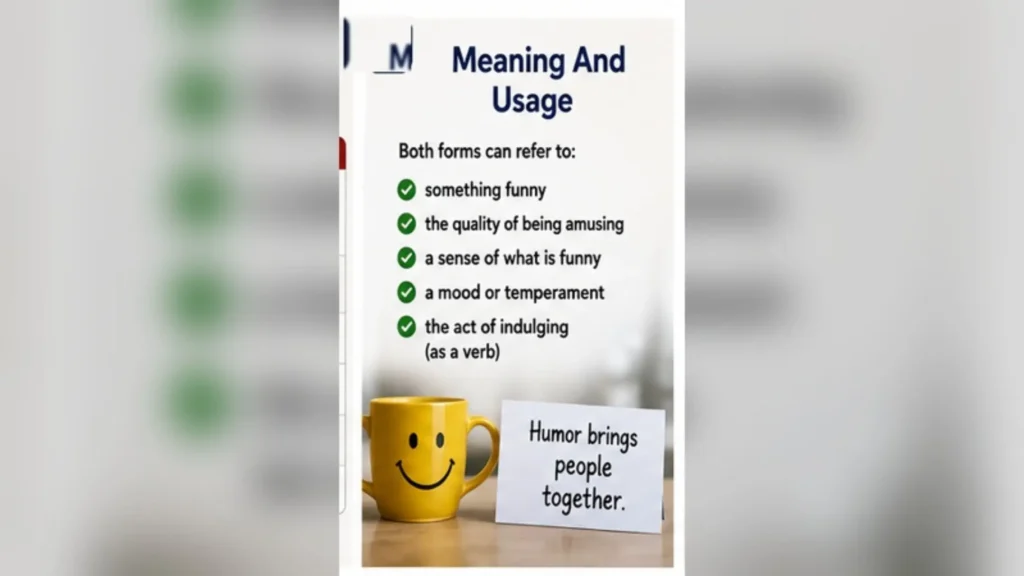
The basic meanings of humor and humour are the same.
The word can describe:
- something funny
- the quality of being amusing
- a person’s ability to appreciate or express comedy
- a mood or temperament
- the act of indulging or accommodating someone when used as a verb
For example:
The movie has a lot of humor.
The movie has a lot of humour.
The meaning does not change when the spelling changes.
The word also appears in the common phrase:
She has a great sense of humor.
In British English:
She has a great sense of humour.
Tone, Context, And Formality
Neither spelling is inherently more formal, more humorous, or more sophisticated than the other.
The choice depends on the variety of English used in the surrounding text.
For American readers:
The article uses humor to explain a difficult subject.
For British readers:
The article uses humour to explain a difficult subject.
The important point is consistency. A document written in American English should normally use humor, while a document following British spelling should normally use humour.
The pronunciation is generally the same, so this is primarily a spelling distinction.
Which One Should You Use?
| Context | Best Choice | Why |
|---|---|---|
| American English | humor | Standard US spelling |
| US school assignment | humor | Matches American spelling |
| US business writing | humor | Consistent with US English |
| British English | humour | Standard British spelling |
| British publication | humour | Matches British conventions |
| Mixed international audience | Follow the chosen style | Consistency matters |
If you are writing for a US audience, choose humor.
If you are writing in British English, choose humour.
When One Choice Sounds Wrong
The two spellings usually do not sound different when spoken. The problem appears in writing when a text mixes regional spelling systems without a clear reason.
For example, a document that consistently uses American spellings such as color and favor will usually look inconsistent if it suddenly uses humour.
Likewise, a British English document that uses colour, favour, and honour will normally use humour rather than humor.
This is a consistency issue, not a difference in meaning.
Common Mistakes And Quick Fixes
Mistake 1: Thinking Humour Is Incorrect
Humour is not a misspelling. It is the standard British spelling.
Quick fix: Use humor for American English and humour for British English.
Mistake 2: Thinking Humor Is Incorrect
Humor is the standard spelling in American English.
Quick fix: Do not add the u when writing standard US English.
Mistake 3: Assuming The Two Spellings Have Different Meanings
They generally have the same meanings and grammatical functions.
Quick fix: Choose based on regional spelling conventions.
Mistake 4: Mixing Spellings In The Same Document
Using humor and humour in the same piece can create an unnecessary spelling inconsistency.
Quick fix: Choose one regional spelling system and use it consistently.
Mistake 5: Forgetting The Verb
The word can also function as a verb.
American English:
I decided to humor him.
British English:
I decided to humour him.
In this use, the verb means to indulge someone or go along with them to avoid upsetting them.
Everyday Examples
Talking About Something Funny
The show uses humor to discuss serious issues.
The show uses humour to discuss serious issues.
Talking About A Person’s Sense Of Comedy
My brother has a great sense of humor.
My brother has a great sense of humour.
Describing Something Amusing
He was in a good humor after hearing the news.
He was in a good humour after hearing the news.
Using The Verb
I decided to humor her unusual idea.
I decided to humour her unusual idea.
Related Forms
American English commonly uses:
- humor
- humorous
- humorless
- humorously
British English commonly uses:
- humour
- humorous
- humourless
- humorously
Some related forms do not follow a simple one-letter change, so it is best to use the established spelling of each word rather than automatically adding or removing u.
Dictionary-Style Word Details
Verb
- Humor: To indulge, accommodate, or go along with someone. Example: “I decided to humor him.”
- Humour: The British spelling of the same verb. Example: “I decided to humour him.”
The verb is often used when someone chooses to accommodate another person’s ideas or behavior, sometimes without fully agreeing with them.
Noun
- Humor: Amusement, comic quality, a sense of what is funny, or, in some contexts, a mood or temperament.
- Humour: The British spelling of the same noun.
Examples:
The speaker used humor to connect with the audience.
The speaker used humour to connect with the audience.
Synonyms
The closest plain alternatives depend on the meaning.
When describing something amusing:
- comedy
- amusement
- fun
For a person’s mood or temperament:
- mood
- temper
- disposition
For the verb to humor/to humour:
- indulge
- accommodate
- go along with
These are not exact replacements in every sentence, so the best alternative depends on the specific context.
Example Sentences
American English:
She has a sharp sense of humor.
The comedian’s humor appealed to a wide audience.
I decided to humor his strange suggestion.
British English:
She has a sharp sense of humour.
The comedian’s humour appealed to a wide audience.
I decided to humour his strange suggestion.
The meaning remains the same; only the regional spelling changes.
Word History
Humor and humour are regional spellings of the same word. The word has a long history connected with ideas of moisture and bodily fluids before developing broader meanings related to mood, temperament, and amusement.
The spelling difference between humor and humour reflects the broader distinction between American and British spelling conventions.
Phrases Containing
Common American English phrases include:
- sense of humor
- good humor
- bad humor
- dry humor
- dark humor
- sense of humor
- humorless
Common British English equivalents include:
- sense of humour
- good humour
- bad humour
- dry humour
- dark humour
- humourless
The meaning remains the same, but the spelling follows the regional variety of English.
Frequently Asked Questions
Is humor or humour correct in American English?
Humor is the standard spelling in American English.
Is humour wrong?
No. Humour is the standard spelling in British English and other varieties that follow British spelling conventions.
Do humor and humour mean the same thing?
Yes. They generally have the same meanings and grammatical functions.
Are humor and humour pronounced the same?
Generally, yes. The two spellings usually have the same pronunciation.
Should I use humor or humour for a US audience?
Use humor for a US audience and in standard American English writing.
Can humor and humour be verbs?
Yes. Humor and humour can both mean to indulge or accommodate someone.
Conclusion
Humor and humour are two regional spellings of the same word.
Use humor in American English.
Use humour in British English.
Both forms can refer to amusement, comedy, a sense of what is funny, or a person’s mood. Both can also function as verbs meaning to indulge or accommodate someone.
Humor = American English.
Humour = British English.
The best choice is the one that matches the spelling system used throughout your writing.