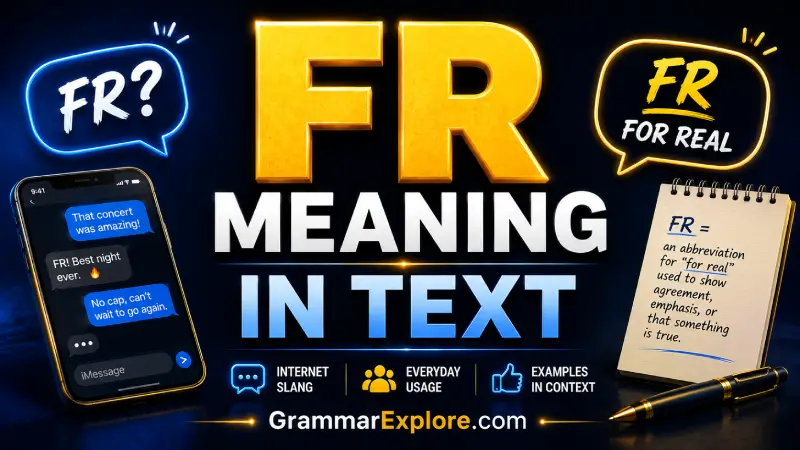
FR means “for real” in text messages and online conversations. People use it to show that they are serious, strongly agree with someone, confirm that something is true, or react with surprise or disbelief. Recent mainstream coverage of current slang also identifies fr as shorthand for “for real.”
The exact tone depends on how it appears in the message. “FR, that movie was amazing” shows agreement or emphasis, while “FR?” usually means “Seriously?” or “Is that really true?”
FR is highly informal and works best in texts, DMs, comments, gaming chats, and other casual conversations.
Quick Answer
FR stands for “for real” in texting slang. It can mean “seriously,” “really,” “I agree,” or “is that true?” depending on context. The full phrase for real is an informal way to emphasize that something is genuine or true, or to question whether someone is serious.
What Does FR Stand For?
In casual texting, FR stands for “for real.”
The abbreviation removes most of the letters while keeping the first letters of the two words:
- F = for
- R = real
For example:
“That restaurant was so good fr.”
means:
“That restaurant was so good, for real.”
In natural English, the speaker is saying that the restaurant was genuinely very good.
FR Meaning in Plain English
Depending on the sentence, FR can be understood as:
- seriously
- really
- honestly
- that’s true
- I agree
- is that really true?
The underlying phrase for real can describe something genuine or true and can also function as a question expressing surprise. Cambridge gives examples where “for real?” effectively asks whether something is actually true.
That flexibility explains why the same two letters can express several different reactions.
How Is FR Used in Text Messages?
FR commonly serves four purposes in texting.
1. To Show Agreement
Someone may reply fr when they strongly agree with another person’s statement.
Person A: This week has been exhausting.
Person B: Fr.
Here, FR means something like:
“Seriously, I agree.”
or:
“That’s so true.”
2. To Emphasize Sincerity
FR can show that someone genuinely means what they are saying.
“I need a vacation fr.”
Meaning:
“I really need a vacation.”
The abbreviation tells the reader that the speaker is not merely exaggerating or joking.
3. To Express Surprise
FR can be used as a question.
Person A: I got tickets for tonight.
Person B: FR??
Here, it means:
“For real?”
or:
“Seriously?”
The extra question marks may make the surprise feel stronger, but they do not change the basic meaning.
4. To Confirm Something Is True
FR can also emphasize that a statement is accurate.
“He actually quit his job fr.”
Meaning:
“He really did quit his job.”
Examples of FR in Text
Here are natural examples showing different uses.
“That song is so good fr.”
Meaning: The speaker genuinely thinks the song is very good.
“Fr, we need to leave early.”
Meaning: The speaker seriously agrees that leaving early is necessary.
“You met her yesterday? Fr?”
Meaning: “Really? Is that true?”
“I’m tired fr.”
Meaning: “I’m genuinely tired.”
“This class is harder than I expected fr.”
Meaning: The speaker strongly means what they are saying.
Person A: That ending made no sense.
Person B: Fr 😭
Meaning: Person B strongly agrees.
What Does “FR?” Mean?
When FR appears with a question mark, it usually means:
“For real?”
In plain English, that can mean:
- “Really?”
- “Seriously?”
- “Is that true?”
- “Are you serious?”
For example:
- Person A: They canceled the concert.
Person B: FR? - Person B is asking whether the information is actually true.
The full phrase “for real?” is commonly used in exactly this questioning sense.
What Does FR Mean as a Reply?
When someone sends only “fr”, it usually shows agreement.
For example:
Person A: Mondays feel twice as long.
Person B: fr
The reply is similar to saying:
- “Exactly.”
- “Seriously.”
- “That’s true.”
- “I agree.”
- “No kidding.”
This is one of the easiest uses of FR to understand because it reacts directly to the previous message.
What Does FRFR Mean?
FRFR means “for real, for real.” It is a stronger, more emphatic version of FR. Slang.net records FRFR with this expansion and explains that it emphasizes seriousness.
For example:
“That was the best burger I’ve had frfr.”
means:
“That was genuinely the best burger I’ve had. I’m serious.”
Another example:
Person A: Are you actually moving next month?
Person B: Frfr.
Here, the reply strongly confirms that the person is telling the truth.
FR vs. FRFR
FR = for real
FRFR = for real, for real
The repeated version simply adds extra emphasis.
Is FR the Same as “No Cap”?
They can overlap, but they are not identical in every sentence.
FR means “for real” and commonly expresses truth, sincerity, agreement, or surprise.
No cap means something closer to “no lie” or “I’m being truthful.” Dictionary.com notes that no cap developed as a way of saying “no lie” or “for real.”
For example:
“That movie was amazing fr.”
and:
“That movie was amazing, no cap.”
both emphasize sincerity.
However, FR also works naturally as a question:
“FR?”
while “no cap?” does not always function in exactly the same way.
Does FR Mean “For Real” on TikTok?
Yes. In TikTok comments and other social-media conversations, FR commonly means “for real.” Current mainstream coverage of internet slang likewise identifies fr with that meaning.
Examples might include:
“This is so accurate fr.”
Meaning: “This is genuinely accurate.”
Or:
“FR why does this happen every time 😭”
Meaning: “Seriously, why does this happen every time?”
The same general meaning also appears in DMs, captions, comments, and replies.
What Does FR Mean on Snapchat and Instagram?
On Snapchat and Instagram, FR usually keeps the same meaning: “for real.”
For example:
“You look different in that picture fr.”
Here, FR adds sincerity or emphasis.
In:
“You got the job fr?”
it expresses surprise and asks for confirmation.
There is no need to assign a separate platform-specific definition unless the surrounding conversation clearly points to another abbreviation.
Does Capitalization Change the Meaning?
Usually, no.
You may see:
- FR
- fr
- Fr
All can mean for real in casual digital communication.
Lowercase fr is especially natural in relaxed messages:
“that’s crazy fr”
Uppercase FR may visually look stronger:
“FR?? YOU WON?”
The difference is mainly tone and emphasis, not meaning.
Is FR Slang?
Yes. FR is informal texting and internet slang.
It works naturally in:
- text messages
- TikTok comments
- Instagram DMs
- Snapchat messages
- Discord chats
- gaming conversations
- casual group chats
It is usually better to spell out the idea in formal writing.
Casual:
“Fr, I think we should go.”
More formal:
“I genuinely think we should go.”
Is FR Rude or Offensive?
FR is not inherently rude or vulgar.
The phrase for real itself is informal but does not contain profanity. Cambridge describes for real as informal language referring to something actual, true, or genuine.
Tone can still make a difference.
For example:
“FR?”
may sound genuinely surprised.
But:
“Bro, fr?”
can sound annoyed or skeptical depending on the conversation.
The abbreviation itself is not offensive; the attitude comes from context.
Other Meanings of FR
Outside texting slang, FR can have several completely different meanings.
Merriam-Webster records traditional abbreviations including father, franc, friar, from, France, French, and Friday, depending on capitalization and context.
For example:
Fr. Michael
may use Fr. as a title for Father, a member of the clergy.
In a calendar:
Fr.
might historically be interpreted as an abbreviation involving Friday in certain contexts.
However, in a message such as:
“That game was insane fr.”
the slang meaning “for real” is clearly the relevant one.
Common Mistakes With FR
Thinking FR Means “Friend”
Some readers may guess that FR is short for friend, but in ordinary modern texting slang, for real is the dominant interpretation. Current slang coverage explicitly identifies fr as “for real.”
Assuming FR Always Means Agreement
FR can show agreement, but it can also ask a question.
“Fr.”
Often: “Exactly” or “Seriously.”
“Fr?”
Often: “Really?” or “Are you serious?”
Punctuation and context help determine the tone.
Confusing FR With FRFR
FR means for real.
FRFR means for real, for real and adds stronger emphasis.
Using FR in Formal Writing
FR is useful in casual messages, but it is usually too informal for an academic paper, formal email, or professional report.
Write really, genuinely, seriously, or actually instead when the situation requires standard English.
Frequently Asked Questions
What does FR mean in text?
FR means “for real” in text. It can express agreement, sincerity, emphasis, surprise, or disbelief depending on the message.
What does FR stand for?
In texting slang, FR stands for “for real.” The phrase is used when something is genuine, true, or seriously meant.
What does FR mean from a girl?
It normally still means “for real.” The meaning does not change because the sender is a girl; look at the surrounding sentence to determine whether she is agreeing, emphasizing something, or asking “Really?”
What does FR mean from a guy?
It usually means “for real,” just as it does from anyone else. A reply of “fr” often signals agreement, while “fr?” usually expresses surprise or asks for confirmation.
What does FRFR mean in texting?
FRFR means “for real, for real.” It is an intensified form of FR used when someone wants to sound especially sincere or emphatic.
Is FR slang?
Yes. FR is informal digital slang commonly used in texts and online conversations. It is better replaced with words such as really, seriously, genuinely, or actually in formal communication.
Is FR a bad word?
No. FR is not profanity. It simply abbreviates “for real,” although the tone of a message containing it can still sound skeptical, annoyed, surprised, or emphatic.
Conclusion
The FR meaning in text is “for real.” People use it to show agreement, sincerity, emphasis, surprise, or disbelief.
A standalone “fr” often means “Exactly” or “I agree,” while “fr?” usually means “Really?” or “Are you serious?” The stronger variation FRFR means “for real, for real.”
FR is easy to use once you focus on context: if the message is casual and the speaker is emphasizing that something is genuine or true, “for real” is almost always the intended meaning.