

Updated: August 15, 2026
Lent vs lended is a common spelling and verb-form question. Both may seem possible, but only lent is correct in standard English. Lended is a nonstandard form that you should avoid in formal and everyday writing.
Lend means to give someone something temporarily, expecting its return. Its past tense and past participle are both lent. For example, “She lent me her book” is correct, while “She lended me her book” is incorrect.
This guide explains why lent is correct, how to use it naturally, and which mistakes to avoid. You will also find simple rules and practical examples for American English.
Quick Answer: Lent or Lended?
Lent is correct. Lended is nonstandard when used as the past tense or past participle of lend.
Use lent when talking about something someone gave temporarily, money someone provided with the expectation of repayment, or support or a quality that was given in the past.
Correct: “She lent me her laptop yesterday.”
Incorrect: “She lended me her laptop yesterday.”
The standard verb pattern is:
lend → lent → lent
That means lent works as both the simple past tense and the past participle of lend. Major dictionaries list lent as the established past and past-participle form.
Lent vs Lended at a Glance
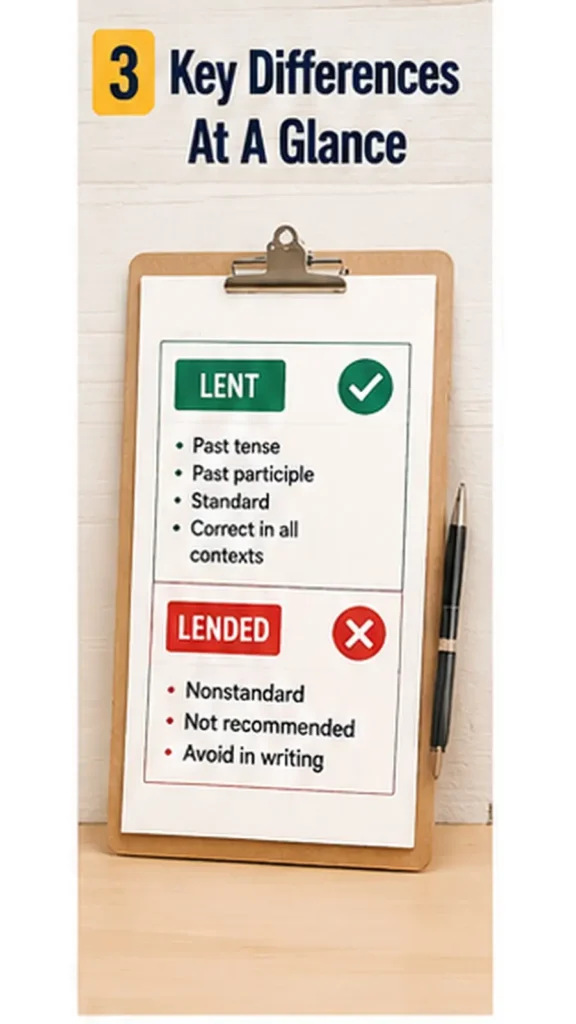
| Context | Correct Choice | Example |
|---|---|---|
| Simple past of lend | lent | She lent me her notes. |
| After has, have, or had | lent | He has lent me money before. |
| Temporary use of an object | lent | Dad lent me his truck. |
| Money given with repayment expected | lent | The bank lent them the money. |
| Giving support or assistance | lent | They lent us their support. |
| Adding a quality or effect | lent | The lighting lent the room warmth. |
| Past form written as lended | Avoid | Use lent instead. |
The rule is simple: when lend refers to the past, use lent, not lended.
Why Do People Say Lended?

The mistake makes sense because most English verbs form their past tense by adding -ed.
For example:
- walk → walked
- help → helped
- open → opened
- borrow → borrowed
A learner may follow the same pattern and assume:
lend → lended
However, lend is an irregular verb, so it does not use the normal -ed ending.
Its forms are:
- Present: lend
- Simple past: lent
- Past participle: lent
- Present participle: lending
Collins likewise lists the past participle as lent and forms such as have lent, confirming the irregular pattern.
Think of similar changes:
send → sent
bend → bent
lend → lent
Remembering this pattern can make the correct form easier to recognize.
What Does Lent Mean?
In this comparison, lent is the past tense or past participle of the verb lend.
The basic meaning of lend is to allow someone to use something temporarily, usually with the expectation that it or its equivalent will be returned.
“She lent me her umbrella.”
This means she temporarily gave me her umbrella to use.
Cambridge defines lend around this idea of giving something for a period of time with the expectation of getting it back, and identifies lent as its past form.
However, lent has several useful contexts beyond lending everyday objects.
Lending an Object
Use lent when someone allowed another person to use an item temporarily.
“My roommate lent me his headphones.”
“Maria lent her car to her brother for the weekend.”
“The library lent us several books for the project.”
Lending Money
Use lent when money was provided with an expectation of repayment.
“My parents lent me $500 for the repair.”
“The bank lent the business enough money to buy new equipment.”
“She lent her friend some cash until payday.”
Lending Help or Support
Lend can also mean to provide help, assistance, support, or influence.
Past examples use lent:
“Our neighbors lent us a hand during the move.”
“Several local businesses lent their support to the fundraiser.”
“His experience lent credibility to the proposal.”
Merriam-Webster records these broader uses of lend, including giving assistance or support and adding credibility or force.
Adding a Quality or Effect
Sometimes lent means that something added a particular feeling, appearance, or quality.
“The candles lent the room a warm glow.”
“Her calm voice lent confidence to the presentation.”
“The old brick walls lent the restaurant a historic feel.”
Nothing is literally borrowed in these sentences. Instead, something contributes a quality or effect.
Is Lended a Word?
For normal modern English usage, do not use lended as the past tense or past participle of lend.
Write:
“She lent me a book.”
Not:
“She lended me a book.”
Write:
“I have lent him money before.”
Not:
“I have lended him money before.”
There is one historical nuance. The Oxford English Dictionary records lended as an obsolete adjective found centuries ago. That historical entry does not make lended a standard modern past-tense form of lend.
Therefore, the most accurate practical rule is:
Lended is not the standard modern past tense or past participle of lend. Use lent instead.
Past Tense of Lend: Why Lent Is Correct
The simple past tense describes an action completed in the past.
Present:
“I lend my brother my tools when he needs them.”
Past:
“I lent my brother my drill yesterday.”
Because lend is irregular, the word changes internally rather than simply taking -ed.
Correct Simple Past Examples
“She lent me her phone during lunch.”
“Jake lent his neighbor a ladder.”
“The company lent us two laptops for the event.”
“Who lent you that jacket?”
“My aunt lent me her car last weekend.”
In every case, lent describes a completed past action.
Past Participle of Lend: Use Lent After Has, Have, and Had
Lent is also the past participle of lend.
Use it with helping verbs such as has, have, and had.
Correct:
“She has lent me books before.”
“We have lent them our equipment several times.”
“He had lent his car to a friend before the accident.”
Incorrect:
“She has lended me books before.”
“We have lended them our equipment.”
“He had lended his car to a friend.”
The form remains lent in perfect verb tenses. Cambridge’s American English entry explicitly lists lent as both the past tense and past participle.
Lend, Lent, and Lending: Correct Verb Forms
Here is the full pattern:
Base form: lend
“I often lend my sister books.”
Third-person singular: lends
“He lends his tools to neighbors.”
Simple past: lent
“He lent me a wrench yesterday.”
Past participle: lent
“He has lent me tools before.”
Present participle: lending
“He is lending me his truck today.”
A useful memory formula is:
Today I lend.
Yesterday I lent.
I have lent before.
Lent or Lended in Everyday Sentences
The easiest way to master the difference is to see the forms in realistic situations.
Money
Correct: “My friend lent me $40 until Friday.”
Incorrect: “My friend lended me $40 until Friday.”
A Car
Correct: “My sister lent me her car for the weekend.”
Incorrect: “My sister lended me her car for the weekend.”
School
Correct: “Ethan lent me his class notes.”
Incorrect: “Ethan lended me his class notes.”
Work
Correct: “The company lent us extra equipment for the project.”
Incorrect: “The company lended us extra equipment for the project.”
Help
Correct: “Our neighbors lent us a hand with the furniture.”
Incorrect: “Our neighbors lended us a hand with the furniture.”
Figurative Meaning
Correct: “The dark lighting lent the scene a mysterious mood.”
Incorrect: “The dark lighting lended the scene a mysterious mood.”
The type of thing being given does not change the verb form. The correct past form remains lent.
Common Mistakes and Quick Fixes
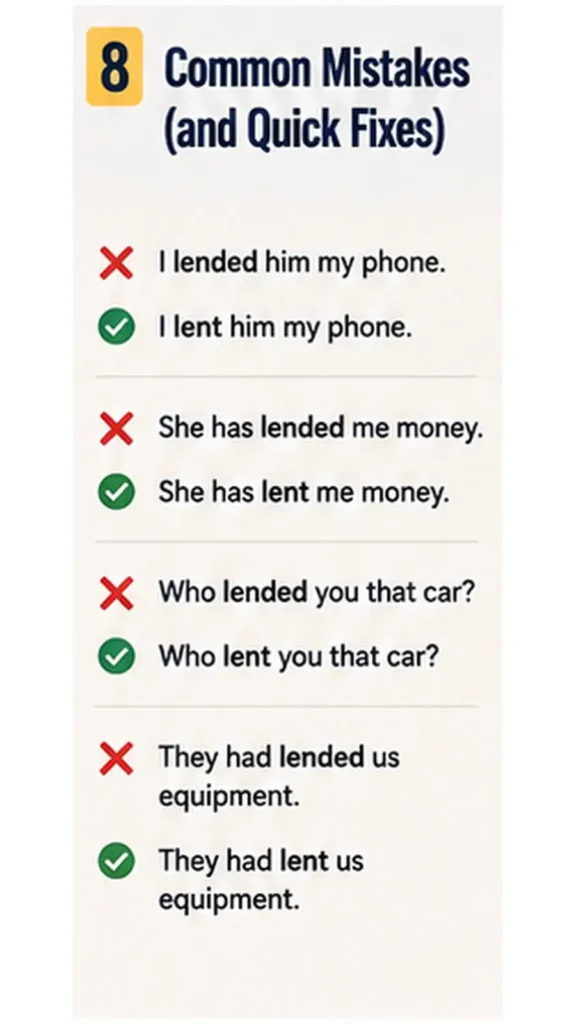
Mistake: I lended him my phone
Incorrect:
“I lended him my phone.”
Correct:
“I lent him my phone.”
Use lent for the simple past.
Mistake: She has lended me money
Incorrect:
“She has lended me money before.”
Correct:
“She has lent me money before.”
After has, use the past participle lent.
Mistake: Who lended you that car?
Incorrect:
“Who lended you that car?”
Correct:
“Who lent you that car?”
Questions do not change the irregular past form.
Mistake: They had lended us equipment
Incorrect:
“They had lended us the equipment.”
Correct:
“They had lent us the equipment.”
After had, use lent.
Mistake: The music lended the scene energy
Incorrect:
“The music lended the scene energy.”
Correct:
“The music lent the scene energy.”
The figurative meaning still uses lent.
Lent vs Loaned: Are Both Correct?
This is a related but separate distinction.
Lent is the past tense of lend.
Loaned is the past tense of loan when loan is used as a verb.
Both can be standard in sentences such as:
“The bank lent us the money.”
“The bank loaned us the money.”
In American English, loan is established as both a noun and a verb. Merriam-Webster defines the noun loan as money or something provided temporarily and also records verbal uses.
However, this does not make lended correct.
Remember:
lend → lent
loan → loaned
Lent vs Borrowed: What Is the Difference?
Lent and borrowed describe opposite sides of the same transaction.
The person who gives something temporarily lends it.
The person who receives it temporarily borrows it.
Compare:
“Sarah lent me her umbrella.”
“I borrowed Sarah’s umbrella.”
Both sentences can describe the same event from different perspectives.
Incorrect:
“Sarah borrowed me her umbrella.”
Correct:
“Sarah lent me her umbrella.”
Or:
“I borrowed Sarah’s umbrella.”
Cambridge specifically distinguishes lend as giving something temporarily and borrow as receiving or using something that belongs to someone else.
Lent and Lent: Same Spelling, Different Meanings
There is another word spelled Lent with a capital L.
lent , the past tense and past participle of lend
“She lent me her camera.”
Lent , a noun referring to a Christian religious season before Easter
“They observe Lent each year.”
These meanings are separate even though the spelling is the same apart from capitalization in normal use. Cambridge lists both senses separately.
For the lent vs lended question, the relevant word is lowercase lent, the verb form.
Can Lended Be Used Informally?
You may occasionally hear or see lended in casual, unedited English.
That does not make it the standard form.
Grammarist notes that lended appears from time to time but is not common, while established dictionaries consistently give lent as the accepted past and past-participle form.
Use lent in:
- everyday conversation
- text messages
- emails
- school assignments
- college writing
- business communication
- professional documents
- published writing
There is no need to switch to lended for a more casual tone.
Is Lent Formal or Informal?
Lent is neutral standard English.
It is appropriate in both casual and formal contexts.
Casual:
“Chris lent me his charger.”
Professional:
“The organization lent its support to the initiative.”
Financial:
“The lender lent the company additional funds.”
Academic or analytical:
“The new evidence lent credibility to the argument.”
The choice between lent and lended is not a choice between formal and informal styles. Lent is the standard grammatical form across contexts.
How to Remember Lent vs Lended
Use this three-part pattern:
lend → lent → lent
Or connect it with two familiar irregular verbs:
bend → bent
send → sent
lend → lent
You can also remember this sentence:
“I lend today, I lent yesterday, and I have lent before.”
Once you remember that line, there is no need to use lended.
Dictionary-Style Word Details

Verb
Lent: The standard simple past and past participle of lend.
Examples:
“She lent me a pen.”
“She has lent me several books.”
Lended: Not the standard modern past-tense or past-participle form of lend.
Correction:
“She lended me a pen.” → “She lent me a pen.”
Noun
lent: In the word-choice comparison discussed here, lowercase lent functions as a verb form, not a noun.
Lent: With a capital L, it is also the name of a Christian religious season. This is a separate word and meaning.
Lended: Not normally used as a noun in standard modern English.
Synonyms
The closest alternative to lent depends on the sentence.
For temporary use:
- loaned
- provided temporarily
- let someone use
- For money:
- loaned
- advanced
- For support:
- gave
- provided
- offered
- For adding a quality:
- gave
- added
- contributed
No single synonym replaces lent correctly in every context.
Lended does not need a separate synonym list when it is being used incorrectly as a past form; replace it with lent.
Example Sentences
Lent:
“My cousin lent me his camera for the trip.”
“The bank lent them money for the renovation.”
“I have lent that book to several friends.”
“She lent her support to the community project.”
“The wooden beams lent the room a rustic feel.”
Lended:
Nonstandard: “My cousin lended me his camera.”
Standard: “My cousin lent me his camera.”
Nonstandard: “I have lended him money.”
Standard: “I have lent him money.”
Word History
The history of lent is tied to the older verb lend.
Merriam-Webster traces lend through Middle English forms to Old English and notes historical developments that helped produce the modern form of the verb.
The form lent became the established past tense and past participle.
A historical adjective spelled lended is recorded by the Oxford English Dictionary as obsolete, with its last recorded use centuries ago. That historical form should not be confused with modern conjugation of the verb lend.
For present-day English, use:
lend → lent → lent
Phrases Containing
Common expressions with lend also take lent when used in the past.
Lend a hand
Present: “Can you lend me a hand?”
Past: “She lent me a hand with the boxes.”
Lend support
Present: “Several groups lend their support to the program.”
Past: “Several groups lent their support to the program.”
Lend an ear
Present: “He always lends an ear when I need to talk.”
Past: “He lent an ear when I needed advice.”
Lend itself to
Present: “The room lends itself to small meetings.”
Past: “The space lent itself well to private events.”
Merriam-Webster recognizes lend itself to as an established expression meaning to be suitable for a particular purpose.
Frequently Asked Questions
Is it lent or lended?
Use lent. It is the correct simple past and past participle of lend. Lended is nonstandard as the modern past form.
Correct: “She lent me her phone.”
Is lended a real word?
Do not use lended as the standard past tense of lend. An obsolete historical adjective with that spelling has been recorded, but it does not make lended correct in normal modern sentences such as “She lended me money.” Use lent instead.
What is the past tense of lend?
The past tense of lend is lent.
Present: “I lend him my car.”
Past: “I lent him my car.”
What is the past participle of lend?
The past participle is also lent.
Correct examples include has lent, have lent, and had lent.
“She has lent me her laptop before.”
Is it I lent or I lended?
Write I lent.
Correct: “I lent my friend $20.”
Incorrect: “I lended my friend $20.”
Is it has lent or has lended?
Use has lent.
Correct: “She has lent me books before.”
Because lent is the past participle, it follows has, have, and had.
Can I say lended in casual conversation?
You may hear it occasionally, but lent is the standard form in both casual and formal American English. Using lent is the safest and most natural choice.
What is the easiest way to remember lent vs lended?
Remember:
lend → lent → lent
Or use the sentence:
“I lend today, I lent yesterday, and I have lent before.”
Conclusion
The difference between lent vs lended comes down to one clear grammar rule.
Use lent as both the simple past and past participle of lend.
Correct:
“She lent me her laptop.”
“He has lent me money before.”
“They had lent us their equipment.”
Avoid lended as the modern past form:
“She lended me her laptop.”
The easiest pattern to remember is:
lend → lent → lent
Whether you are talking about a book, money, a car, help, support, or even a quality added to something, the correct past form is lent.