

When choosing between ditto vs diddo, use ditto when you mean “the same,” “likewise,” or “I feel the same way.”
Ditto is the established English word:
“I really need a vacation.” “Ditto.”
Here, the second speaker means, “I do too.”
Diddo may appear as a phonetic misspelling because ditto can sound somewhat like “did-oh” in fast American speech. However, major English dictionaries list ditto, not diddo, for the meanings of agreement, repetition, or sameness discussed here.
The practical rule is simple:
Correct standard spelling: ditto
Not the standard spelling for this meaning: diddo
Quick Answer
Use ditto when you want to express the same opinion, repeat something already stated, or indicate that the same information applies again.
Examples:
“I loved that movie.” “Ditto.”
The morning flight was delayed, and ditto for the evening flight.
Do not write diddo when you mean the established English word ditto.
A simple spelling trick is:
diTTo = two T’s
Compact comparison:
- Ditto → standard English word meaning “the same,” “likewise,” or “the same applies.”
- Diddo → not the standard spelling of ditto in this sense.
Why People Confuse Them
The confusion is largely caused by pronunciation.
In American English, ditto is pronounced approximately DIT-oh. Cambridge gives the US pronunciation as /ˈdɪt̬.oʊ/. The middle t can be pronounced with a quick flap that may sound similar to a soft d, especially in natural speech.
As a result, someone may hear:
DIT-oh
and assume the spelling is:
diddo
That spelling may also become familiar through casual texts, comments, or social posts. Familiarity, however, does not make it the standard spelling for the word meaning “the same.”
There is another reason for confusion: people often learn ditto by hearing it rather than seeing it written.
Once you remember that the standard form contains two t’s, the distinction becomes much easier.
Key Differences At A Glance
| Context | Best Choice | Why |
|---|---|---|
| Agreeing with what someone said | ditto | Means “same here” or “I agree” |
| Saying the same thing applies again | ditto | Refers back to previous information |
| Avoiding unnecessary repetition | ditto | Can stand for something already stated |
| Casual conversation or texting | ditto | Standard spelling, often informal in this use |
| Using the word as a verb | ditto | Standard forms include “dittoed” and “dittoing” |
| Writing “diddo” to mean “the same” | ditto | “Diddo” is not the standard spelling for this meaning |
The main difference is not a subtle difference in meaning.
For the meaning discussed here, ditto is the standard word. Diddo is generally a misspelling or intentional phonetic respelling.
Meaning And Usage Difference
What Does Ditto Mean?
The basic idea behind ditto is that something previously said, written, or established applies again.
Merriam-Webster defines the adverbial use as indicating that a previous statement also applies to another person or thing. Cambridge similarly describes ditto as a way to agree with what was just said or avoid repeating the same information.
In conversation:
“I’m exhausted after this week.” “Ditto.”
The reply means:
“I am too.”
or:
“Same here.”
You can also use ditto when the same fact or condition applies to something else:
The downtown store closes at 8:00, and ditto for the airport location.
This means the airport location also closes at 8:00.
Does Ditto Mean “Me Too”?
It can.
When someone makes a statement that also applies to you, ditto can function much like:
me too
same here
so do I
I agree
For example:
“I can’t wait for Friday.”
“Ditto.”
Here, ditto naturally means “same here.”
However, ditto does not literally mean only “me too.” Its broader function is to indicate that something previously stated applies again.
Compare:
“I love this restaurant.” “Ditto.”
Agreement.
The first proposal was too expensive; ditto the second.
The same description applies to the second proposal.
So the exact meaning depends on context.
What About Diddo?
When diddo is written to mean “the same,” “me too,” or “likewise,” the intended standard word is ditto.
Write:
“That was a long meeting.” “Ditto.”
Not:
“That was a long meeting.” “Diddo.”
This does not mean the letter sequence or name Diddo can never appear anywhere. It may occur as a proper name, brand, or other specialized label. But it is not the standard spelling of the ordinary English word ditto discussed in this comparison.
Tone, Context, And Formality
Ditto is especially natural in casual conversation.
Examples:
“I’m starving.” “Ditto.”
“I need some sleep.” “Ditto.”
“That deadline seems impossible.” “Ditto.”
As a brief response, it feels informal and concise.
Oxford and Collins both characterize common conversational uses of ditto as informal.
In more formal writing, ditto can sometimes sound too casual or leave the relationship between ideas unclear.
Less precise:
Sales declined in May, and ditto in June.
Clearer:
Sales also declined in June.
In a formal report, alternatives may include:
likewise
similarly
also
the same applies
the same was true of
The best choice depends on the sentence.
This does not make ditto incorrect in professional contexts. It simply means that a more explicit phrase may be better when accuracy and clarity matter.
Which One Should You Use?
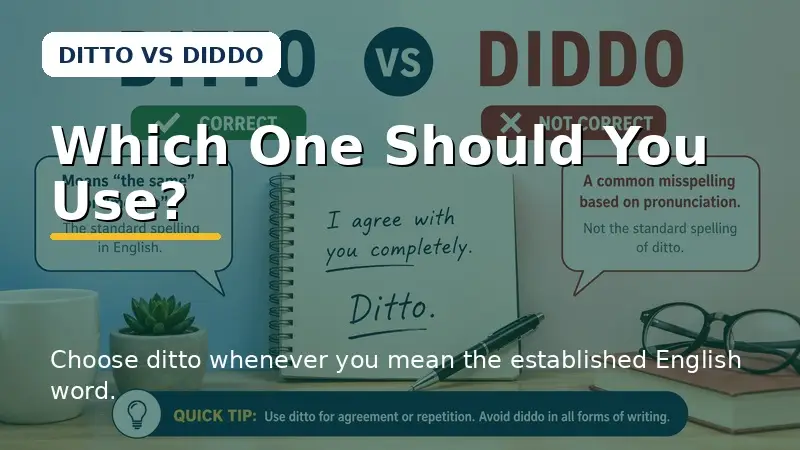
Use ditto whenever you mean the established word for agreement, sameness, or repetition.
For Agreement
“I think we should leave early.” “Ditto.”
For The Same Condition
The first apartment was overpriced, and ditto for the second.
For Something Already Stated
Her concerns focused on cost; ditto his.
As A Verb
Several committee members dittoed her concerns.
Use diddo only when it is intentionally part of a proper name or another context unrelated to the standard word ditto.
When you simply mean “same here” or “the same applies,” choose:
ditto
When One Choice Sounds Wrong
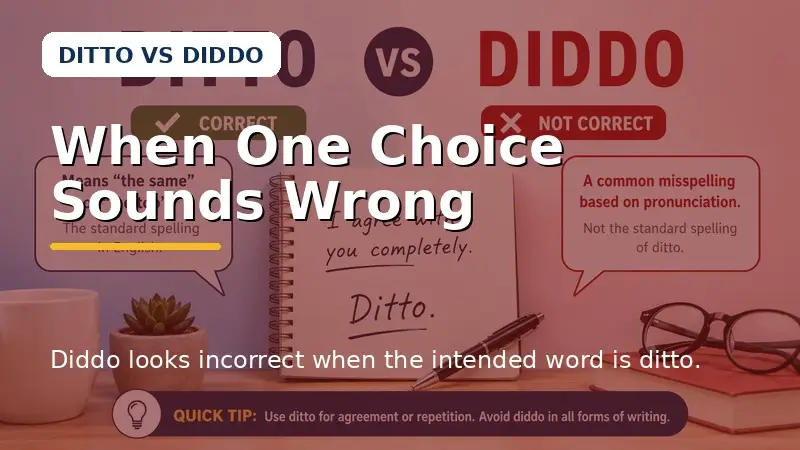
Using diddo in ordinary sentences can look like a spelling error.
Incorrect:
“I really enjoyed the concert.” “Diddo.”
Correct:
“I really enjoyed the concert.” “Ditto.”
Incorrect:
The policy applies to contractors, and diddo for temporary workers.
Correct:
The policy applies to contractors, and ditto for temporary workers.
However, even correctly spelled ditto can sound awkward when the reference is unclear.
Consider:
The schedule changed, and ditto the budget.
What does that mean?
Did the budget increase?
Was it delayed?
Was it completely revised?
The reader cannot tell.
A clearer version would be:
The schedule and budget were both revised.
Use ditto only when readers can easily identify exactly what is being repeated or applied again.
Common Mistakes And Quick Fixes
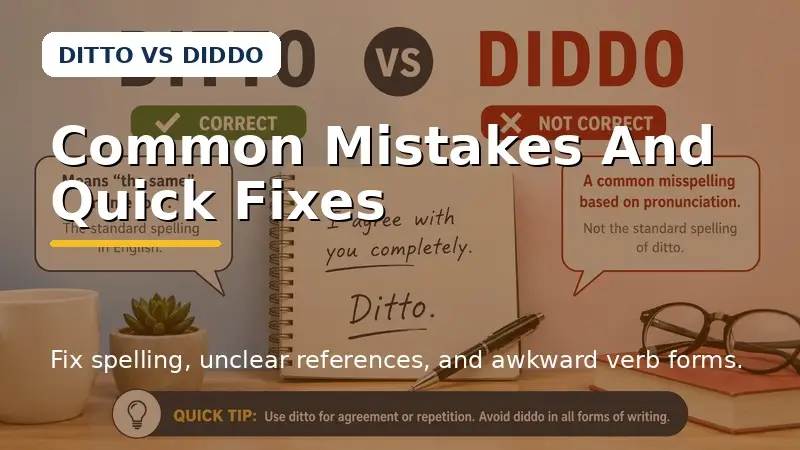
Mistake 1: Writing Diddo Instead Of Ditto
Incorrect:
Diddo. I feel the same way.
Correct:
Ditto. I feel the same way.
Remember the double t:
diTTo
Mistake 2: Assuming Ditto Means Only “Me Too”
Ditto can express personal agreement, but it has a broader use.
Example:
The first office needs repairs, and ditto for the second.
Here, it means that the same statement applies to the second office.
Mistake 3: Using Ditto Without A Clear Reference
Unclear:
The report changed, and ditto the staff.
Clearer:
The report changed, and the staffing plan changed as well.
A reader should immediately understand what ditto refers back to.
Mistake 4: Misspelling The Verb Forms
Standard forms include:
ditto
dittos
dittoed
dittoing
Example:
Several employees dittoed her complaint.
Merriam-Webster and Dictionary.com recognize verb uses of ditto, including forms such as dittoed and dittoing.
Mistake 5: Using Ditto When A Precise Phrase Is Better
Casual:
The first proposal failed, and ditto the second.
More explicit:
The second proposal failed as well.
The first version can work when the reference is obvious. The second may be better in formal or technical writing.
Everyday Examples
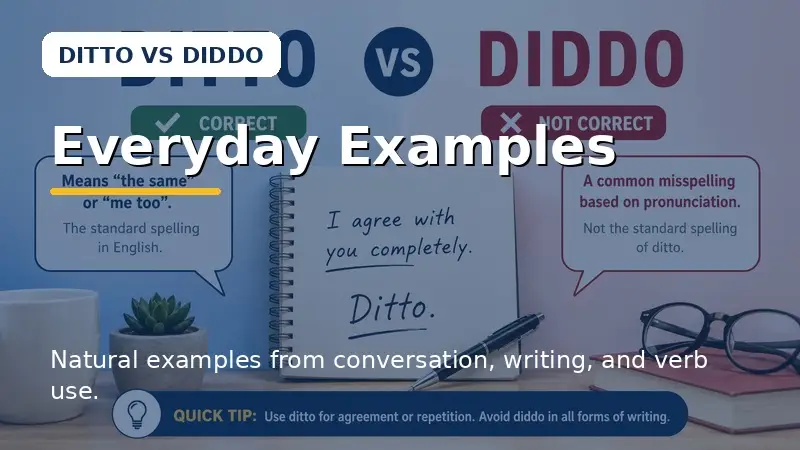
Ditto As A Quick Reply
“I’m ready for the weekend.” “Ditto.”
“That presentation was confusing.” “Ditto.”
“I loved the new restaurant.” “Ditto.”
In each case, ditto means that the second speaker shares the same feeling or opinion.
Ditto Meaning “The Same Applies”
The front office was closed, and ditto for the customer service desk.
The first option was too expensive; ditto the second.
Parents were frustrated by the delay, and ditto many teachers.
Here, ditto avoids repeating information that is already clear.
Ditto As A Verb
Several residents dittoed her concerns about traffic.
I would ditto what Marcus said about the deadline.
Here, the verb means roughly to repeat, echo, or endorse something already expressed.
Ditto In Casual Messages
You said you need coffee, ditto.
You’re exhausted after that trip? Ditto.
That meeting felt endless. Ditto.
These examples show why the word is especially useful when a short response communicates the full meaning.
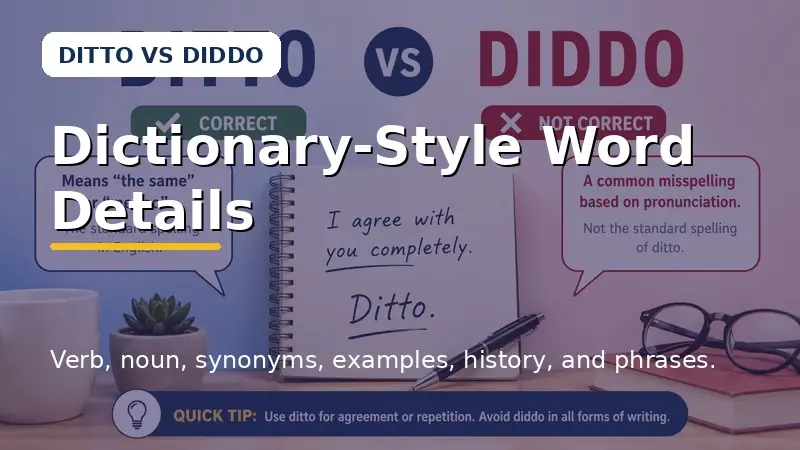
Dictionary-Style Word Details
Verb
Ditto: Can function as a verb meaning to repeat, copy, echo, or express agreement with something another person has said.
Examples:
I ditto your concerns about the schedule.
Several members dittoed her comments.
Common inflected forms include:
dittos
dittoed
dittoing
Major dictionaries document verb uses of ditto.
Diddo: Not the standard verb spelling for these meanings. When you mean repeat, echo, or agree in this way, use ditto.
Noun
Ditto: Can function as a noun referring to something previously mentioned, another of the same kind, a duplicate, or the indication that information above should be repeated.
Dictionary.com records both dittos and dittoes as plural forms of the noun.
Example:
The second design looked almost like a ditto of the first.
The word is also associated with the ditto mark, traditionally used to show that information from a line above should be repeated.
Diddo: Not the standard noun spelling for these meanings.
Synonyms
The closest alternatives to ditto depend on how it is being used.
For agreement:
same here
me too
so do I
I agree
For repeated application:
likewise
also
similarly
the same applies
For the verb:
repeat
echo
duplicate
No separate synonym list is needed for diddo in this comparison because it does not represent a separate standard meaning from ditto.
There is also no single antonym that works naturally for every use of ditto.
Example Sentences
Ditto:
“I could use another day off.” “Ditto.”
The first restaurant was crowded, and ditto the second.
Several board members dittoed her concerns.
His response was almost a ditto of mine.
Diddo:
Nonstandard for the intended meaning:
“That movie was amazing.” “Diddo.”
Standard correction:
“That movie was amazing.” “Ditto.”
Word History
Ditto was borrowed into English from Italian forms associated with the idea of something previously “said” or mentioned. It was especially useful in lists and records because writers could avoid repeating information that had already appeared.
Merriam-Webster traces the English word to Italian ditto/detto, ultimately connected with Latin dicere, “to say.” Its English uses later expanded beyond recordkeeping to include the familiar meanings of “the same,” agreement, repetition, and verbal copying or echoing.
Diddo does not represent a separate historical form of this standard English word. In the comparison discussed here, it is best understood as a spelling influenced by how ditto may sound in speech.
Phrases Containing
Common expressions and combinations with ditto include:
ditto for
ditto that
say ditto
ditto mark
dittoed the comment
Examples:
The same rule applies to managers, and ditto for supervisors.
I would say ditto to her concerns about the deadline.
Several employees dittoed the complaint.
Diddo is not the standard spelling in these expressions.
Use:
ditto for
Not:
diddo for
Frequently Asked Questions
Is it ditto or diddo?
Use ditto when you mean “the same,” “likewise,” “me too,” or that a previous statement applies again. Major English dictionaries recognize ditto for these meanings. Diddo is not the standard spelling in this context.
Is diddo a real word?
Diddo can appear as a proper name, brand, or other specialized label, so it is safer not to claim that the letter sequence can never be a word or name. However, when you mean “the same” or “me too,” the standard English spelling is ditto.
Does ditto mean “me too”?
Yes, it often does in conversation.
“I’m tired.” “Ditto.”
Here, ditto means “me too” or “same here.” More broadly, it indicates that something previously stated also applies.
How do you spell ditto correctly?
Spell it:
D-I-T-T-O
There are two t’s and one d:
ditto
A useful memory cue is diTTo.
Is ditto formal or informal?
A short reply such as “Ditto” is generally informal and works naturally in conversation, texting, and casual writing. In formal prose, a clearer phrase such as likewise, also, or the same applies may be more appropriate depending on context.
Why does ditto sometimes sound like diddo?
In American pronunciation, the middle t may be produced with a quick flap that can sound similar to a soft d. That can make ditto sound roughly like “did-oh,” but its standard spelling remains ditto. Cambridge gives the US pronunciation as /ˈdɪt̬.oʊ/.
Conclusion
Use ditto, not diddo, when you mean “the same,” “me too,” “likewise,” or that something previously stated applies again.
Correct:
“I loved the concert.” “Ditto.”
Not standard for this meaning:
“I loved the concert.” “Diddo.”
Remember the spelling with one simple cue:
diTTo = two T’s
In everyday American English, ditto works naturally as a brief expression of agreement. It can also indicate repeated information and function as a noun or verb. When the context is formal or the reference could be unclear, use a more explicit phrase such as likewise, also, or the same applies.