
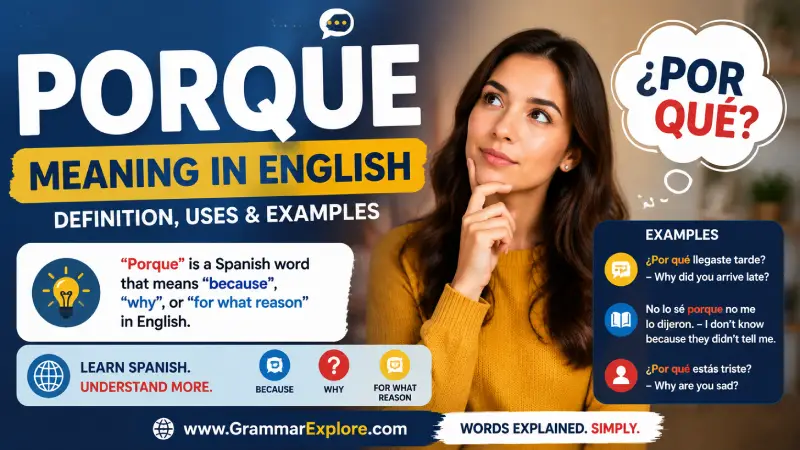
The Spanish word porque means “because” in English. It is one of the most common Spanish words used to give a reason, explain a situation, or answer a question.
Spanish learners often confuse porque with por qué, porqué, and por que because they look almost identical but have different meanings and uses.
Understanding porque meaning in English is simple: when you want to explain why something happens, you usually use porque.
Quick Answer
Porque means “because” in English. It is used to give a reason or explanation for something. For example, “No fui porque estaba enfermo” means “I did not go because I was sick.”
Porque Meaning Explained
The Spanish word porque is a conjunction. A conjunction connects words, phrases, or ideas.
It introduces a reason or cause.
Structure:
Statement + porque + reason
Examples:
Estoy feliz porque gané.
= I am happy because I won.
No salí porque llovía.
= I did not go out because it was raining.
In both sentences, porque explains the reason behind an action or feeling.
What Does Porque Translate To?
The most common English translation of porque is:
- because
Depending on the sentence, it may also be understood as:
- since
- as
- due to the fact that
However, because is the standard translation.
Examples:
Te llamé porque necesitaba ayuda.
= I called you because I needed help.
No fui porque estaba ocupado.
= I did not go because I was busy.
Porque vs Por Qué: What Is the Difference?
One of the biggest challenges for Spanish learners is understanding the difference between porque and por qué.
Porque = Because
Used to give an answer or explanation.
Example:
Por qué = Why
Used when asking a question.
Example:
¿Por qué estás aquí?
= Why are you here?
A simple way to remember:
- Por qué = why? (question)
- Porque = because (answer)
Porque vs Porqué
The words are similar but have different grammatical roles.
Porque
Meaning:
Because
Example:
Estoy aquí porque quiero aprender.
= I am here because I want to learn.
Porqué
Meaning:
The reason or cause
It is a noun and usually appears with an article.
Example:
No entiendo el porqué de su decisión.
= I do not understand the reason for his decision.
The accent changes the meaning.
Porque vs Por Que
The phrase por que (two separate words without an accent) is less common and has a different grammatical use.
It often appears when:
- the preposition por comes before the relative pronoun que
- certain expressions require it
Example:
La razón por que ocurrió.
This form is less common in everyday Spanish.
For most learners, the main distinction to remember is:
- porque = because
- por qué = why
How Is Porque Used in Spanish?
Porque is used whenever someone gives a reason.
Explaining Actions
Example:
Aprendo español porque quiero viajar.
English:
I learn Spanish because I want to travel.
Explaining Feelings
Example:
Estoy cansado porque trabajé mucho.
English:
I am tired because I worked a lot.
Answering Questions
Question:
¿Por qué no vienes?
Why are you not coming?
Answer:
Porque estoy ocupado.
Because I am busy.
Is Porque Formal or Informal?
Porque is a standard Spanish word used in both formal and informal situations.
It appears in:
- everyday conversations
- academic writing
- professional communication
- books
- news articles
Unlike slang expressions, porque is a normal part of Spanish grammar.
Examples:
Formal:
El proyecto fue cancelado porque faltaban recursos.
= The project was canceled because resources were missing.
Casual:
No fui porque estaba cansado.
= I did not go because I was tired.
Common Mistakes About Porque
Mistake 1: Using por qué when giving an answer
Incorrect:
No fui por qué estaba enfermo.
Correct:
No fui porque estaba enfermo.
Meaning:
I did not go because I was sick.
Mistake 2: Forgetting the accent in questions
Incorrect:
Porque estás triste?
Correct:
¿Por qué estás triste?
Meaning:
Why are you sad?
Mistake 3: Thinking porque and porqué are the same
They have different meanings:
- porque = because
- porqué = reason
Examples of Porque in Sentences
Example 1
Me gusta este libro porque es interesante.
English:
I like this book because it is interesting.
Example 2
Ella estudia mucho porque quiere mejorar.
English:
She studies a lot because she wants to improve.
Example 3
No compré comida porque no tenía dinero.
English:
I did not buy food because I did not have money.
Example 4
Llegamos tarde porque había tráfico.
English:
We arrived late because there was traffic.
Porque in Texting and Everyday Spanish
In casual messages, Spanish speakers often use porque normally.
Example:
No puedo salir porque estoy trabajando.
= I cannot go out because I am working.
Unlike some English texting shortcuts, porque usually remains unchanged.
However, some Spanish speakers may shorten it informally online as:
- xq
- pq
These are texting abbreviations and should not be used in formal writing.
Related Spanish Words
Por qué
Meaning:
Why
Used for questions.
Porqué
Meaning:
The reason
Used as a noun.
Pues
Meaning:
Well, because, or so
Depending on context.
Debido a
Meaning:
Due to
A more formal expression.
Frequently Asked Questions
What does porque mean in English?
Porque means “because” in English. It is used to explain a reason or cause.
What is the difference between porque and por qué?
Porque means “because” and gives an explanation. Por qué means “why” and is used when asking a question.
Is porque one word or two words?
Porque is written as one word when it means “because.”
Can porque start a sentence?
Yes. It can start a sentence when giving a reason.
Example:
Porque estaba cansado, me fui temprano.
= Because I was tired, I left early.
Is porque used in formal Spanish?
Yes. Porque is a standard grammatical word used in all types of Spanish.
How do you pronounce porque?
Porque is commonly pronounced:
POR-keh
The second syllable sounds like “keh.”
Mini Quiz: Test Your Knowledge
1. What does porque mean in English?
A) Why
B) Because
C) Where
D) When
Answer: B) Because
2. Which word means “why” in Spanish?
A) Porque
B) Porqué
C) Por qué
D) Pues
Answer: C) Por qué
3. Which sentence is correct?
A) No fui por qué estaba enfermo.
B) No fui porque estaba enfermo.
C) No fui porqué estaba enfermo.
D) No fui por que estaba enfermo.
Answer: B) No fui porque estaba enfermo.
4. Is porque a slang word?
A) Yes
B) No
C) Only online
D) Only in Mexico
Answer: B) No
Conclusion
Porque means “because” in English and is used to explain reasons in Spanish. It is one of the most important words for Spanish learners because it appears in everyday conversations, writing, and explanations.
The main thing to remember is simple: porque gives an answer or reason, while por qué asks a question. Learning this difference will help you understand and use Spanish more naturally.