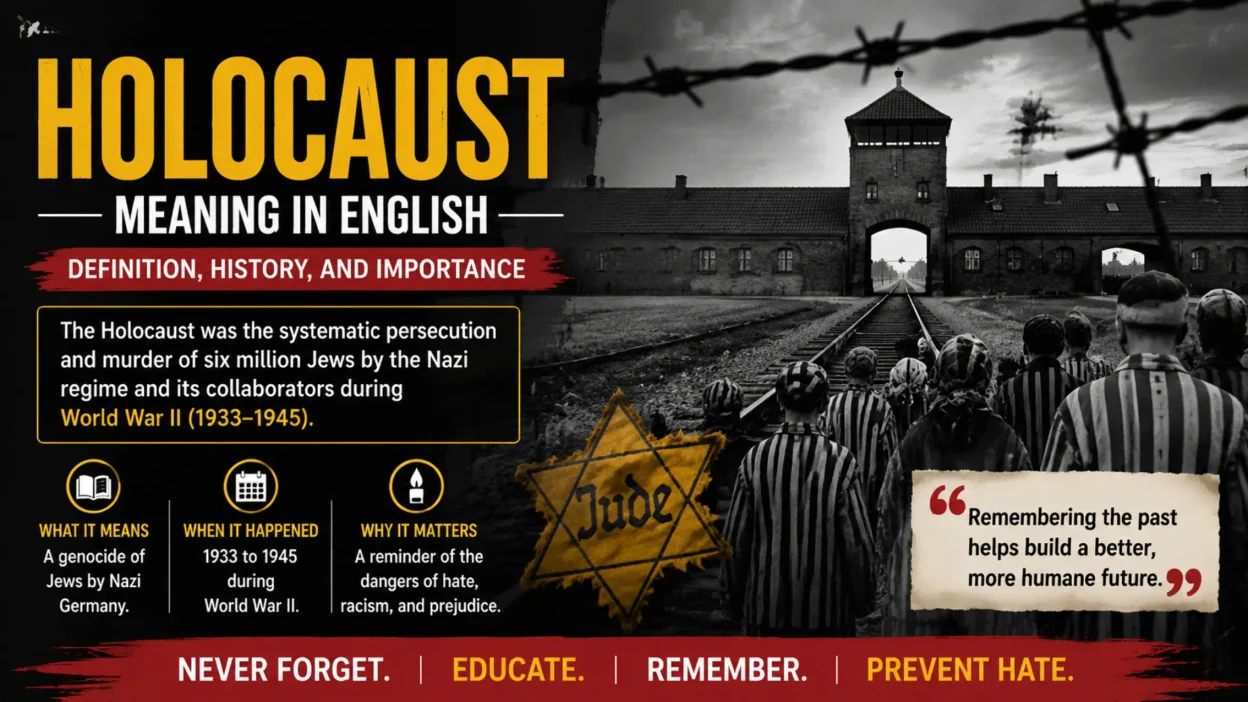
The word Holocaust refers to the systematic persecution and murder of approximately six million Jewish people by Nazi Germany and its collaborators during World War II. The term is also used more broadly to describe the persecution and mass murder of millions of other victims targeted by the Nazi regime.
In English, the word Holocaust is most commonly associated with the genocide of European Jews between 1941 and 1945. Understanding its meaning requires looking at both the literal definition of the word and its historical significance.
Quick Answer
Holocaust means a large-scale destruction or slaughter, but in modern English it most commonly refers to the Nazi genocide of Jewish people during World War II. The Holocaust was the systematic persecution and murder of millions of people by Nazi Germany and its collaborators.
Holocaust Meaning Explained
The word Holocaust comes from the Greek word holokauston, meaning something completely burned or sacrificed by fire.
Over time, the word developed broader meanings related to large-scale destruction. Today, when people use the Holocaust with a capital “H,” they usually mean the Nazi genocide during World War II.
The term describes a historical event involving:
- persecution
- imprisonment
- forced labor
- mass murder
- destruction of communities
What Was the Holocaust?
The Holocaust was a genocide carried out by Nazi Germany and its allies and collaborators during World War II.
The Nazi government, led by Adolf Hitler, developed policies that targeted Jewish people because of antisemitic beliefs. Millions of Jews across Europe were persecuted and murdered.
Other groups were also targeted by the Nazi regime, including:
- Roma people
- people with disabilities
- Polish civilians
- Soviet prisoners of war
- LGBTQ+ people
- political opponents
- others considered enemies by the Nazis
The Holocaust remains one of the most studied examples of genocide in modern history.
Why Is Holocaust Written With a Capital H?
When referring specifically to the Nazi genocide, Holocaust is usually capitalized.
Examples:
- The Holocaust occurred during World War II.
- Historians study the Holocaust to understand genocide.
A lowercase holocaust may refer more generally to widespread destruction or mass death.
Example:
“The disaster was described as a holocaust of destruction.”
However, modern readers usually associate the capitalized form with the Nazi genocide.
What Does Holocaust Mean Literally?
The original meaning of Holocaust comes from ancient Greek and refers to a sacrifice completely consumed by fire.
The word was later used in English to describe extreme destruction or devastation.
Today, the historical meaning has become the dominant use because of the Nazi genocide.
Holocaust vs Genocide: Difference
These terms are related but not identical.
| Term | Meaning |
|---|---|
| Holocaust | The Nazi persecution and mass murder of Jews and other targeted groups during World War II |
| Genocide | The intentional destruction of a national, ethnic, racial, or religious group |
The Holocaust is an example of genocide.
Historical Context of the Holocaust
The Holocaust took place during the period of Nazi rule in Germany from 1933 to 1945.
The persecution developed in stages:
Discrimination
The Nazi government introduced laws and policies that removed rights from Jewish people and other targeted groups.
Isolation
Victims were separated from society through restrictions, forced relocation, and imprisonment.
Deportation
Millions of people were transported to ghettos, concentration camps, and killing centers.
Mass Murder
The Nazi regime carried out systematic killings, including through extermination camps.
Understanding these stages helps explain how genocide developed over time.
Why Is Learning About the Holocaust Important?
Studying the Holocaust helps people understand:
- the dangers of hatred and discrimination
- how propaganda can influence society
- the importance of human rights
- the consequences of extremist ideologies
Education about the Holocaust is also used to preserve historical memory and honor the victims.
Common Misunderstandings About Holocaust
Mistake 1: Thinking Holocaust only means any tragedy
The word can have a general meaning, but the Holocaust usually refers specifically to the Nazi genocide.
Mistake 2: Believing only Jewish people were affected
Jewish people were the primary target of Nazi genocide, but many other groups were also persecuted and murdered.
Mistake 3: Treating Holocaust as a casual expression
Because of its connection to mass suffering and genocide, the term should be used carefully and respectfully.
How Is Holocaust Used in Sentences?
Historical Example
“The Holocaust changed world history and influenced international discussions about human rights.”
Meaning:
The sentence refers to the Nazi genocide.
Educational Example
“Students learn about the Holocaust in history classes.”
Meaning:
Students study the events and their impact.
General Meaning Example
“The novel describes a holocaust of destruction.”
Meaning:
A large-scale disaster or devastation.
Related Terms
Genocide
The deliberate destruction of a group of people based on identity.
Antisemitism
Prejudice or hostility toward Jewish people.
Nazi
A member or supporter of the National Socialist German Workers’ Party.
World War II
The global war that took place from 1939 to 1945.
Is Holocaust a Sensitive Word?
Yes. Holocaust is a historically sensitive term because it refers to the suffering and murder of millions of people.
When discussing the Holocaust, it is important to:
- use accurate historical information
- avoid minimizing the suffering involved
- understand the experiences of victims and survivors
The word is most appropriately used in educational, historical, and respectful discussions.
Frequently Asked Questions
What does Holocaust mean in English?
Holocaust means large-scale destruction or slaughter. In modern English, it most commonly refers to the Nazi genocide of Jewish people and other targeted groups during World War II.
Why is Holocaust an important historical term?
The Holocaust represents one of the most significant examples of genocide and is studied to understand discrimination, human rights, and the effects of extremist ideologies.
How many people died in the Holocaust?
Approximately six million Jewish people were murdered during the Holocaust. Millions of other victims were also persecuted and killed by the Nazi regime.
Is Holocaust the same as genocide?
The Holocaust is a specific example of genocide. Genocide is a broader term for the intentional destruction of a group of people.
Why is Holocaust capitalized?
The capitalized form “Holocaust” refers specifically to the Nazi genocide during World War II. Lowercase use can refer generally to destruction or devastation.
Who were the victims of the Holocaust?
Jewish people were the primary targets, but the Nazi regime also persecuted many other groups, including Roma people, people with disabilities, political opponents, and others.
Mini Quiz: Test Your Knowledge
1. What does the Holocaust commonly refer to?
A) A natural disaster
B) Nazi genocide during World War II
C) A political election
D) A scientific event
Answer: B) Nazi genocide during World War II
2. Which group was the primary target of the Holocaust?
A) Tourists
B) Jewish people
C) Athletes
D) Artists
Answer: B) Jewish people
3. What broader category does the Holocaust represent?
A) Genocide
B) Geography
C) Technology
D) Literature
Answer: A) Genocide
4. Why is the word Holocaust sensitive?
A) It is difficult to pronounce
B) It is connected to mass suffering and loss of life
C) It is a new word
D) It has no historical meaning
Answer: B) It is connected to mass suffering and loss of life
Conclusion
Holocaust means a large-scale destruction or slaughter, but in modern English it most commonly refers to the Nazi genocide during World War II. The term represents the systematic persecution and murder of millions of people, especially six million Jewish victims.
Understanding the meaning and history of the Holocaust helps people recognize the consequences of hatred, discrimination, and extremist ideologies. It remains an important subject in history, education, and discussions about human rights.