
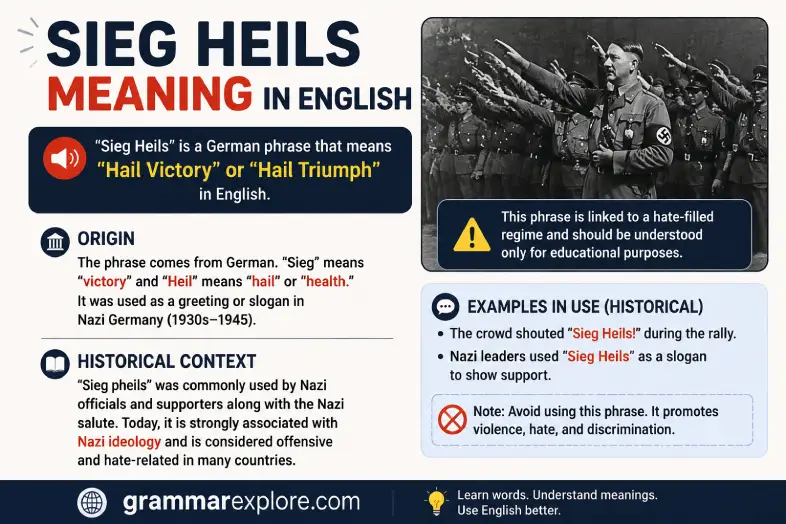
Although the literal translation sounds like a simple phrase about victory, its historical meaning strongly connects it to Nazi propaganda, dictatorship, and extremist ideology. Today, people generally recognize the phrase as a symbol of Nazi Germany, and many consider it offensive in many contexts.
The phrase Sieg Heil is a German expression that means “Hail victory” in English. Supporters of Nazi Germany widely used it as a political slogan and salute during Adolf Hitler’s rule.
Quick Answer
Sieg Heil means “Hail victory” in English. The Nazis used this phrase as a political slogan during the 1930s and 1940s to express loyalty to Adolf Hitler and the Nazi movement. Today, people strongly associate it with Nazism, and many consider it an extremist expression.
Sieg Heil Meaning Explained
The phrase comes from German:
- Sieg = victory
- Heil = hail, salute, or a greeting wishing well-being
A direct translation is:
“Hail victory.”
However, words can gain additional meaning through historical use. Because Nazi leaders used Sieg Heil as a public chant and political slogan, the phrase now carries a meaning connected to Nazi ideology rather than simply “victory.”
Historical Background of Sieg Heil
During Nazi Germany’s government from 1933 to 1945, political rallies often included slogans and chants designed to create unity among supporters and demonstrate loyalty to the Nazi Party.
Sieg Heil was common at Nazi gatherings, especially when supporters expressed loyalty to Adolf Hitler. Nazi leaders incorporated the phrase into propaganda and public ceremonies.
After World War II, the phrase became internationally recognized as a symbol of Nazi extremism.
Is Sieg Heil Still Used Today?
People rarely use the phrase in normal conversation because of its strong association with Nazism.
Today, people usually mention it in contexts such as:
- history discussions
- documentaries
- museums and education
- discussions about extremism
- criticism of Nazi ideology
In some cases, extremists may use the phrase to promote Nazi beliefs, which makes it highly sensitive.
Why Is Sieg Heil Considered Offensive?
The phrase is offensive because it represents a movement responsible for:
- dictatorship
- persecution
- aggression during World War II
- the Holocaust and the murder of millions of people
People cannot separate the phrase from this historical context. Using it casually may appear disrespectful or suggest support for extremist ideas.
Sieg Heil vs. Ordinary German Words
A common misunderstanding is that every German word in the phrase carries an offensive meaning.
That is not correct.
The individual words have ordinary meanings:
- Sieg can simply mean victory.
- Heil can refer to health or safety and had older uses as a greeting.
The combined phrase became offensive because of its historical use by the Nazi movement.
How Is Sieg Heil Translated in Different Ways?
Depending on the context, people may translate it as:
- “Hail victory”
- “Salute victory”
“Hail victory” provides the most common direct English rendering.
However, historians usually explain the phrase through its political meaning rather than its dictionary translation alone.
Common Mistakes About Sieg Heil
Mistake 1: Treating it as a normal victory phrase
Although the literal translation relates to victory, modern readers should understand its historical association with Nazism.
Mistake 2: Separating the phrase from history
Language reflects how people use it. Because Nazi Germany used this phrase as propaganda, it carries a specific historical meaning today.
Mistake 3: Using it as a joke without understanding the context
Because of its connection to Nazi ideology and hate movements, using the phrase casually can cause harm or offense.
How to Discuss Sieg Heil Appropriately
When discussing the phrase, it is best used in educational or historical contexts.
Appropriate examples:
- “The documentary explained how Nazi rallies used phrases like Sieg Heil.”
- “Historians study Sieg Heil as part of Nazi propaganda.”
The phrase should be discussed with historical awareness rather than used as a casual expression.
Frequently Asked Questions
What does Sieg Heil mean in English?
Sieg Heil means “Hail victory” in English. It was a Nazi slogan used to show support for Adolf Hitler and the Nazi movement.
Is Sieg Heil a German greeting?
No. While the individual words are German, the full phrase is mainly known as a Nazi political slogan rather than a normal greeting.
Why is Sieg Heil banned or restricted in some places?
Some countries restrict Nazi symbols and slogans because of their connection to extremist movements, hate, and historical crimes.
Is saying Sieg Heil illegal?
The legality depends on the country and the context. Some places restrict Nazi slogans, while others protect certain forms of historical or educational discussion.
What is the difference between Sieg Heil and Heil Hitler?
Both phrases were associated with Nazi Germany. “Sieg Heil” means “Hail victory,” while “Heil Hitler” was a salute expressing loyalty to Adolf Hitler.
Conclusion
Sieg Heil means “Hail victory” in English, but its modern meaning is deeply connected to Nazi Germany and extremist ideology. Understanding this phrase requires looking beyond the literal translation and recognizing the historical events and propaganda surrounding it.


