
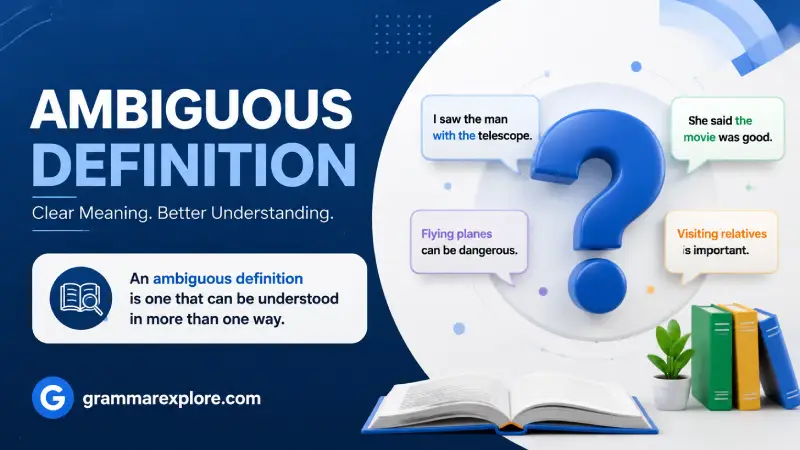
The word ambiguous describes something that can have more than one possible meaning or interpretation. It often applies to words, statements, instructions, questions, images, laws, or situations that leave people unsure about what exactly is meant. Merriam-Webster defines ambiguous as capable of being understood in two or more possible ways. It can also describe something that is difficult to identify or categorize clearly.
For example, if someone says, “I saw her duck,” the sentence can have more than one interpretation. It could mean that the speaker saw a woman lower her head, or that the speaker saw the woman’s duck. The wording creates ambiguity because the listener cannot determine the intended meaning from the sentence alone.
Understanding ambiguous is useful in everyday conversation, school, business, law, writing, and professional communication. It is especially important to know the difference between ambiguous, vague, unclear, and ambivalent, because these words describe different kinds of uncertainty.
Quick Answer
Ambiguous means open to two or more possible meanings or interpretations. For example, “The instructions were ambiguous” means the instructions could be understood in more than one way. The word is an adjective and commonly describes language, statements, answers, situations, or ideas. In some cases, ambiguity is intentional, such as in literature or humor; in other cases, it causes confusion.
What Does Ambiguous Mean?
In plain English, ambiguous means not having one clear meaning.
When something is ambiguous, two or more interpretations may seem reasonable. The problem is not always that the information is difficult. Instead, the wording or situation allows different readings.
Consider this sentence:
“The teacher told the student that she was late.”
Who was late, the teacher or the student?
The sentence does not clearly identify the person referred to by she. Therefore, the sentence can be considered ambiguous.
Another example is:
“Meet me by the bank.”
The word bank could refer to a financial institution or the side of a river. Without additional context, the meaning is uncertain.
Cambridge defines ambiguous as having or expressing more than one possible meaning and notes that the ambiguity can sometimes be intentional.
Simple Definition of Ambiguous
Ambiguous = having more than one possible meaning or interpretation.
Ambiguous in Plain English
If something is ambiguous, you cannot tell exactly what it means because there is more than one reasonable way to understand it.
Dictionary Definition
Merriam-Webster defines ambiguous as something capable of being understood in two or more possible senses or ways. It also lists a second sense involving something that is difficult to discern or categorize.
Ambiguous Meaning With Examples
The easiest way to understand the word is to see it in context.
The email was ambiguous.
This means the email could be interpreted in more than one way.
His answer was ambiguous.
His answer did not make his exact meaning clear and allowed multiple interpretations.
The contract contains ambiguous language.
Some wording in the contract could reasonably be interpreted in different ways.
The movie has an ambiguous ending.
The ending does not provide one definite interpretation, so viewers may understand it differently.
Her response was ambiguous.
Her response did not clearly communicate what she intended.
In each example, ambiguous points to multiple possible interpretations rather than simply saying something is difficult.
What Does Ambiguous Mean in Simple Terms?
Think of an ambiguous statement as a fork in the road.
One sentence can lead the reader toward two or more possible meanings.
For example:
“I’ll meet you later.”
This statement may be ambiguous because later does not specify a time. Does it mean in 10 minutes, an hour, or tonight?
However, this example can also be described as vague, depending on the context. That distinction matters.
Ambiguity usually involves multiple possible interpretations, while vagueness often involves a lack of precise information.
Is Ambiguous a Positive or Negative Word?
Ambiguous is usually neutral in meaning, but the situation determines whether it sounds positive or negative.
In business instructions, legal documents, or safety directions, ambiguity is often a problem because people need clear information.
For example:
“The safety instructions were ambiguous.”
This suggests the instructions could cause confusion.
However, ambiguity can be useful in creative writing.
“The novel ends with an ambiguous final scene.”
That may be a positive feature because the author wants readers to form their own interpretations.
Literature, art, film, and poetry sometimes use ambiguity deliberately. Cambridge also notes that something can have more than one possible meaning intentionally.
Is Ambiguous the Same as Unclear?
Not exactly.
Unclear is broader. Something can be unclear because it is poorly explained, incomplete, difficult to hear, confusing, or lacking enough information.
Ambiguous is more specific. It usually means that more than one interpretation is possible.
Compare:
The instructions were unclear.
The instructions were difficult to understand.
The instructions were ambiguous.
The instructions could reasonably be understood in two or more ways.
Merriam-Webster makes a similar distinction: ambiguous often describes something that is unclear specifically because it can be understood in more than one way.
Ambiguous vs. Vague
These words are related, but they are not identical.
| Word | Meaning | Example |
|---|---|---|
| Ambiguous | Has two or more possible interpretations | “The message was ambiguous.” |
| Vague | Lacks specific or precise information | “He gave a vague answer.” |
| Unclear | Difficult to understand or determine | “The instructions were unclear.” |
| Confusing | Causes difficulty in understanding | “The explanation was confusing.” |
Example
“I’ll see you sometime soon.”
This is vague because it does not give a precise time.
If a sentence can reasonably mean two different things, it is more clearly ambiguous.
The distinction is useful because replacing ambiguous with vague can sometimes change the intended meaning.
Ambiguous vs. Ambivalent
Ambiguous and ambivalent are commonly confused because they look and sound somewhat similar.
They describe different things.
Ambiguous concerns meaning or interpretation.
Ambivalent usually concerns mixed or contradictory feelings.
Compare:
“Her answer was ambiguous.”
Her answer had more than one possible interpretation.
“She felt ambivalent about the decision.”
She had conflicting feelings about the decision.
Merriam-Webster specifically warns readers not to confuse the two words. It explains that ambivalent typically concerns contradictory feelings, while ambiguous concerns multiple possible meanings or interpretations.
Easy Memory Trick
Think:
Ambiguous → meaning
Ambivalent → feelings
That simple distinction can prevent a common vocabulary mistake.
Pronunciation of Ambiguous
The American English pronunciation is:
am-BIG-yoo-us
The IPA pronunciation is:
/æmˈbɪɡ.ju.əs/
The main stress falls on BIG:
am-BIG-yoo-us
Common Pronunciation Mistake
Some learners place the stress incorrectly or try to pronounce every syllable too heavily.
A natural American pronunciation sounds closer to:
am-BIG-yuh-wus
The exact sound can vary slightly between speakers, but the main stress remains on the second syllable.
Part of Speech
Ambiguous is an adjective.
It describes a noun.
For example:
an ambiguous statement
an ambiguous answer
an ambiguous question
an ambiguous situation
an ambiguous ending
ambiguous language
The related forms include:
- ambiguity , noun
- ambiguously , adverb
- ambiguousness , noun, though less common
- unambiguous , adjective meaning clear and open to only one interpretation
Merriam-Webster lists ambiguously as the adverb and ambiguity as the common related noun.
The Noun Form: Ambiguity
The noun form is ambiguity.
Ambiguity means the condition of having more than one possible meaning or interpretation.
For example:
“The contract contains some ambiguity.”
This means some part of the contract can be interpreted in more than one way.
Another example:
“We need to remove the ambiguity from the instructions.”
Here, the speaker wants the instructions to have one clear meaning.
Merriam-Webster defines ambiguity as the quality or state of allowing more than one interpretation.
Ambiguous vs. Ambiguity
| Form | Part of Speech | Example |
|---|---|---|
| ambiguous | adjective | “The statement is ambiguous.” |
| ambiguity | noun | “The statement contains ambiguity.” |
| ambiguously | adverb | “The statement was written ambiguously.” |
| unambiguous | adjective | “She gave an unambiguous answer.” |
The Adverb Form: Ambiguously
Ambiguously means in a way that allows more than one interpretation.
Example:
“The question was worded ambiguously.”
This means the wording allowed multiple interpretations.
Another example:
“He answered ambiguously.”
His answer did not settle on one clear meaning.
The adverb is useful when you want to describe how someone says, writes, or presents something.
The Opposite of Ambiguous
The most direct opposite is unambiguous.
Unambiguous means clear and open to only one reasonable interpretation.
For example:
“She gave an unambiguous answer.”
This means there was little or no reasonable doubt about what she meant.
Other possible opposites include:
- clear
- definite
- precise
- explicit
- straightforward
- unmistakable
Merriam-Webster defines unambiguous as “not ambiguous” and gives related words such as clear, precise, and straightforward.
How Ambiguous Is Used in Everyday English
Americans use ambiguous in many situations, especially when discussing communication.
In Conversation
“His response was ambiguous.”
“That answer sounds ambiguous.”
“Your message is a little ambiguous.”
These sentences point out that someone may interpret the message in different ways.
In Text Messages
Texting can create ambiguity because short messages often lack tone and context.
For example:
“Fine.”
Depending on the conversation, fine might express agreement, annoyance, indifference, or genuine approval.
The message itself may not provide enough information to determine the intended tone.
You could say:
“Her text was ambiguous.”
In Social Media
Posts, captions, and comments can also be ambiguous.
For example:
“Some people should know when to leave.”
Without context, readers may not know who the writer means.
The statement is potentially ambiguous because several interpretations are possible.
Ambiguous in Business English
Ambiguous language can create problems at work.
Consider:
“Send the report to the manager after the meeting.”
Which manager? And which meeting?
If a company has several managers or meetings, the instruction may be ambiguous.
A clearer version would be:
“Send the sales report to Maria after the 2 p.m. budget meeting.”
The second sentence gives specific information and reduces the possibility of multiple interpretations.
Business communication often benefits from precise wording because employees need to know exactly what action to take.
Ambiguous in Legal English
Legal writing can become especially sensitive to ambiguity.
A contract may contain a phrase that two parties interpret differently. In that situation, the wording may become the focus of a dispute.
For example:
“The payment must be made after delivery.”
This could create questions if delivery itself has several possible meanings or if the parties disagree about when delivery officially occurs.
Cambridge gives legal examples involving ambiguous laws and contract wording.
Legal writers generally try to make important provisions precise because unclear or multiple interpretations can create serious consequences.
Ambiguous in Academic Writing
Students sometimes use ambiguous when describing:
- unclear research questions
- statements with multiple interpretations
- unclear instructions
- evidence that supports different readings
- terms with more than one possible meaning
For example:
“The question is ambiguous because it does not specify which population is being studied.”
That sentence uses the word correctly because the question permits more than one interpretation.
In academic writing, ambiguous can also describe a result or finding whose interpretation is not settled.
Ambiguous in Literature
Ambiguity can be intentional in literature.
A writer may avoid giving readers one definite answer.
For example, a novel might end with a character standing at a closed door while the author never reveals what happens next.
A reader could interpret the ending in several ways.
You might describe it as:
“The novel has an ambiguous ending.”
That does not necessarily mean the author made a mistake. Instead, the uncertainty may be part of the artistic design.
Cambridge notes that something can be ambiguous intentionally, which is particularly relevant to creative writing.
Ambiguous in Film and Television
Movies sometimes use ambiguous endings to encourage discussion.
For example, a film might end without revealing whether an important event really happened.
You could say:
“The ending is deliberately ambiguous.”
That means the filmmakers intentionally left more than one interpretation possible.
This use is common in discussions of storytelling because ambiguity can encourage viewers to think about the meaning of a scene rather than receive one definite answer.
Ambiguous in Questions
A question can be ambiguous when it allows multiple interpretations.
For example:
“Did you see the man with the telescope?”
This sentence can have different meanings.
Did you use a telescope to see the man?
Or did the man have a telescope?
The grammatical structure allows both interpretations.
A clearer version might be:
“Did you use the telescope to see the man?”
or:
“Did you see the man who was carrying a telescope?”
The revised sentences reduce ambiguity.
Ambiguous Instructions
Instructions should usually avoid ambiguity.
Consider:
“Put it over there.”
If the listener does not know what it refers to or where there is, the instruction is ambiguous or unclear.
A more precise instruction would be:
“Put the blue folder on the desk next to the printer.”
Now the reader knows what object to move and where to put it.
This illustrates an important practical point: specific details often remove ambiguity.
Intentional vs. Unintentional Ambiguity
Not all ambiguity is accidental.
Intentional Ambiguity
A writer may deliberately create multiple interpretations.
Examples include:
- poetry
- jokes
- advertising
- fiction
- song titles
- movie endings
- wordplay
The writer wants the audience to think about different meanings.
Unintentional Ambiguity
Sometimes the writer simply fails to communicate clearly.
Examples include:
- confusing instructions
- poorly written contracts
- unclear emails
- vague workplace requests
- badly worded questions
In these situations, ambiguity can cause mistakes or disagreements.
25 Examples of Ambiguous
Simple Examples
1. Sentence: “The question was ambiguous.”
Meaning: The question had more than one possible interpretation.
Why it is used: It describes a question that does not have one clear reading.
2. Sentence: “His answer was ambiguous.”
Meaning: His answer could be understood in different ways.
Why it is used: The answer did not clearly communicate one meaning.
3. Sentence: “The message was ambiguous.”
Meaning: The message could mean more than one thing.
Why it is used: The wording created uncertainty.
4. Sentence: “The instructions were ambiguous.”
Meaning: The instructions could be interpreted differently.
Why it is used: The directions did not clearly identify what the reader should do.
5. Sentence: “The ending was ambiguous.”
Meaning: The ending allowed several interpretations.
Why it is used: The story did not provide one definite conclusion.
Intermediate Examples
6. Sentence: “The manager gave an ambiguous response to the proposal.”
Meaning: The manager did not clearly indicate approval or rejection.
Why it is used: The response allowed different interpretations.
7. Sentence: “The contract contains ambiguous language.”
Meaning: Some wording in the contract can be understood in different ways.
Why it is used: The statement describes a possible problem with legal wording.
8. Sentence: “Her text was ambiguous, so I wasn’t sure whether she was joking.”
Meaning: The message did not clearly communicate her intention.
Why it is used: Text messages can lack enough context to establish tone.
9. Sentence: “The teacher said the student’s response was ambiguous.”
Meaning: The response could reasonably mean more than one thing.
Why it is used: The teacher is commenting on the answer’s interpretation.
10. Sentence: “The advertisement uses an ambiguous phrase.”
Meaning: The phrase can suggest more than one meaning.
Why it is used: Advertising sometimes uses wording that leaves room for interpretation.
Advanced Examples
11. Sentence: “The evidence remains ambiguous.”
Meaning: The evidence does not support one clear interpretation.
Why it is used: Different conclusions may still be reasonable.
12. Sentence: “The policy contains several ambiguous provisions.”
Meaning: Several parts of the policy can be interpreted differently.
Why it is used: The sentence discusses possible uncertainty in formal rules.
13. Sentence: “The author’s ambiguous wording encourages multiple readings.”
Meaning: The wording allows readers to interpret the text in different ways.
Why it is used: It describes deliberate or meaningful uncertainty in writing.
14. Sentence: “The report offers an ambiguous explanation of the results.”
Meaning: The explanation does not establish one definite interpretation.
Why it is used: It identifies uncertainty in an analytical explanation.
15. Sentence: “The statute contains language that is potentially ambiguous.”
Meaning: Some wording in the law may support different interpretations.
Why it is used: This is a formal way to discuss uncertain legal language.
Questions
16. Sentence: “Was the question intentionally ambiguous?”
Meaning: Did someone deliberately make the question open to multiple interpretations?
Why it is used: The speaker wants to know whether the uncertainty was intentional.
17. Sentence: “Why is this sentence ambiguous?”
Meaning: What makes the sentence open to more than one interpretation?
Why it is used: The speaker wants to identify the source of the uncertainty.
18. Sentence: “Can you rewrite this so it isn’t ambiguous?”
Meaning: Can you make the wording clearer and more specific?
Why it is used: The speaker wants to eliminate multiple interpretations.
Negative Examples
19. Sentence: “The instructions should not be ambiguous.”
Meaning: The instructions should have one clear interpretation.
Why it is used: Clear instructions reduce mistakes.
20. Sentence: “We cannot rely on an ambiguous statement.”
Meaning: The statement is too open to interpretation to serve as a clear basis for action.
Why it is used: It emphasizes the practical problem ambiguity can create.
Professional Examples
21. Sentence: “The agreement uses ambiguous terminology.”
Meaning: Some terms in the agreement may have more than one interpretation.
Why it is used: It identifies a potential issue in formal writing.
22. Sentence: “The report’s conclusion is somewhat ambiguous.”
Meaning: The conclusion does not clearly support one interpretation.
Why it is used: It describes uncertainty in professional analysis.
23. Sentence: “Please clarify the ambiguous section before we approve the document.”
Meaning: Make the unclear, multiply interpretable section more precise.
Why it is used: The speaker wants to prevent misunderstanding before approval.
Casual Examples
24. Sentence: “That text was pretty ambiguous.”
Meaning: The text could mean several things.
Why it is used: This is a natural casual comment about unclear messaging.
25. Sentence: “Your answer is kind of ambiguous.”
Meaning: Your answer does not clearly tell me what you mean.
Why it is used: The speaker wants clarification.
Common Mistakes With Ambiguous
Mistake 1: Using Ambiguous as a Direct Synonym for Difficult
Incorrect idea:
“The math problem was ambiguous because it was very hard.”
Difficulty alone does not necessarily make something ambiguous.
Better:
“The math problem was ambiguous because it had two possible interpretations.”
The key idea is multiple possible meanings, not simply difficulty.
Mistake 2: Confusing Ambiguous With Ambivalent
Incorrect:
“I am ambiguous about whether I want the job.”
If you mean that you have conflicting feelings, ambivalent is usually the better word.
Correct:
“I am ambivalent about whether I want the job.”
Use ambiguous when the problem concerns meaning or interpretation.
Mistake 3: Confusing Ambiguous With Vague
A vague statement lacks detail:
“I’ll call you sometime.”
An ambiguous statement allows multiple interpretations:
“I saw her duck.”
The two concepts can overlap, but they are not identical.
Mistake 4: Assuming Ambiguous Always Means Bad
Ambiguity can cause problems, but it can also be intentional and useful.
A poem may benefit from ambiguity because readers can interpret it in different ways.
A safety instruction, however, usually should not be ambiguous.
Synonyms for Ambiguous
Several words can be related to ambiguous, but they do not always work as exact replacements.
| Word | Meaning | Difference | Example |
|---|---|---|---|
| unclear | Difficult to understand | Broader than ambiguous | “The instructions are unclear.” |
| vague | Not specific or precise | Focuses on lack of detail | “He gave a vague answer.” |
| equivocal | Open to different interpretations | Often sounds more formal | “She gave an equivocal response.” |
| uncertain | Not definitely known or decided | Focuses on lack of certainty | “The outcome is uncertain.” |
| obscure | Difficult to understand or perceive | Often suggests something is hard to make out | “The meaning was obscure.” |
| confusing | Difficult to understand | Focuses on the effect on the reader or listener | “The directions were confusing.” |
Merriam-Webster lists words such as obscure, vague, mysterious, unclear, cryptic, equivocal, and uncertain among terms related to ambiguous.
Antonyms for Ambiguous
Natural opposites include:
- clear
- precise
- definite
- explicit
- specific
- straightforward
- unambiguous
- unmistakable
For example:
“The instructions were ambiguous.”
Opposite:
“The instructions were clear.”
Or:
“She gave an unambiguous answer.”
Ambiguous vs. Unambiguous
These are direct opposites.
Ambiguous:
“The instructions can be interpreted in two ways.”
Unambiguous:
“The instructions have one clear interpretation.”
Use unambiguous when you want to emphasize that there is no meaningful uncertainty about the intended meaning.
For example:
“The policy must provide unambiguous guidance.”
This means employees should not have to guess what the policy requires.
When Should You Use Ambiguous?
Use ambiguous when you want to explain that something has multiple possible interpretations.
It works naturally with:
- answer
- statement
- question
- wording
- language
- message
- instructions
- contract
- law
- policy
- evidence
- ending
- image
- situation
- meaning
- response
Examples:
“The wording is ambiguous.”
“His response was ambiguous.”
“The contract contains an ambiguous clause.”
“The movie has an ambiguous ending.”
When Should You Avoid Ambiguous?
Avoid it when you simply mean difficult, complicated, or long.
For example:
“The book was ambiguous because it was 500 pages.”
That does not make sense. Length does not automatically create multiple interpretations.
Instead, say:
“The book was difficult because it was 500 pages long.”
Likewise, if something lacks detail but has only one likely interpretation, vague may be more accurate.
Why Ambiguous Language Can Cause Problems
Ambiguous language can lead people to make different assumptions.
Imagine a workplace instruction:
“Finish the report before the meeting.”
If the company has several meetings that day, employees may not know which meeting the manager means.
One employee may finish the report before the morning meeting. Another may think the manager means the afternoon meeting.
A more precise instruction would be:
“Finish the report before the 3 p.m. budget meeting.”
The second version removes the uncertainty.
This is why precise language matters in professional, legal, academic, and safety-related communication.
Can Ambiguity Be Useful?
Yes.
Writers sometimes use ambiguity intentionally because it creates:
- suspense
- humor
- mystery
- multiple interpretations
- deeper discussion
- artistic freedom
For example, an ambiguous ending can encourage viewers to debate what happened.
A joke may also depend on an ambiguous phrase that initially suggests one meaning before revealing another.
Therefore, ambiguity is not automatically a writing error. Its value depends on the purpose and context.
Frequently Asked Questions
What is the simple definition of ambiguous?
Ambiguous means something can be understood in two or more possible ways. It commonly describes statements, questions, instructions, words, or situations that do not have one clear interpretation. For example, an ambiguous message may leave the reader unsure about what the writer intended.
What is an example of an ambiguous sentence?
A common example is “I saw her duck.” This can mean that you saw her lower her head, or that you saw the duck belonging to her. Because the sentence allows more than one reasonable interpretation, it is ambiguous.
What is the difference between ambiguous and vague?
Ambiguous usually means something has more than one possible interpretation. Vague usually means something lacks enough specific information. For example, “I’ll see you later” is vague because the time is not specific, while a sentence with two competing interpretations is ambiguous.
Is ambiguous a negative word?
Not necessarily. In contracts, instructions, and professional communication, ambiguity can create confusion and problems. However, writers may use ambiguity intentionally in literature, film, poetry, humor, and advertising to create multiple interpretations.
What is the opposite of ambiguous?
The most direct opposite is unambiguous, meaning clear and open to only one reasonable interpretation. Other opposites include clear, precise, definite, explicit, specific, and straightforward.
Is ambiguous the same as unclear?
They overlap, but they are not exactly the same. Unclear is a broad term for something that is difficult to understand. Ambiguous is more specific because it usually indicates that two or more interpretations are possible.
What is the noun form of ambiguous?
The most common noun form is ambiguity. It refers to the quality or condition of having more than one possible interpretation. For example, “The ambiguity of the statement caused confusion.” Another noun, ambiguousness, exists but is less common.
Conclusion
Ambiguous means open to more than one possible meaning or interpretation. It is an adjective commonly used for statements, questions, instructions, messages, contracts, laws, evidence, and creative works. When something is ambiguous, readers or listeners may reasonably understand it in different ways.
The word is not always negative. Ambiguous language can create confusion in business or legal writing, but writers may use it intentionally in literature, movies, poetry, and humor. It is also important to distinguish ambiguous from vague, unclear, and ambivalent. In particular, ambiguous concerns multiple possible meanings, while ambivalent usually describes conflicting feelings.
When you need to communicate one precise idea, aim for clear and unambiguous wording. When multiple interpretations are intentional, however, ambiguity can be an effective part of communication.

