
Use up and down arrow keys to resize the meta box pane.
Move upMove downShow or hide panel
Use up and down arrow keys to resize the meta box pane.
Move upMove downShow or hide panel
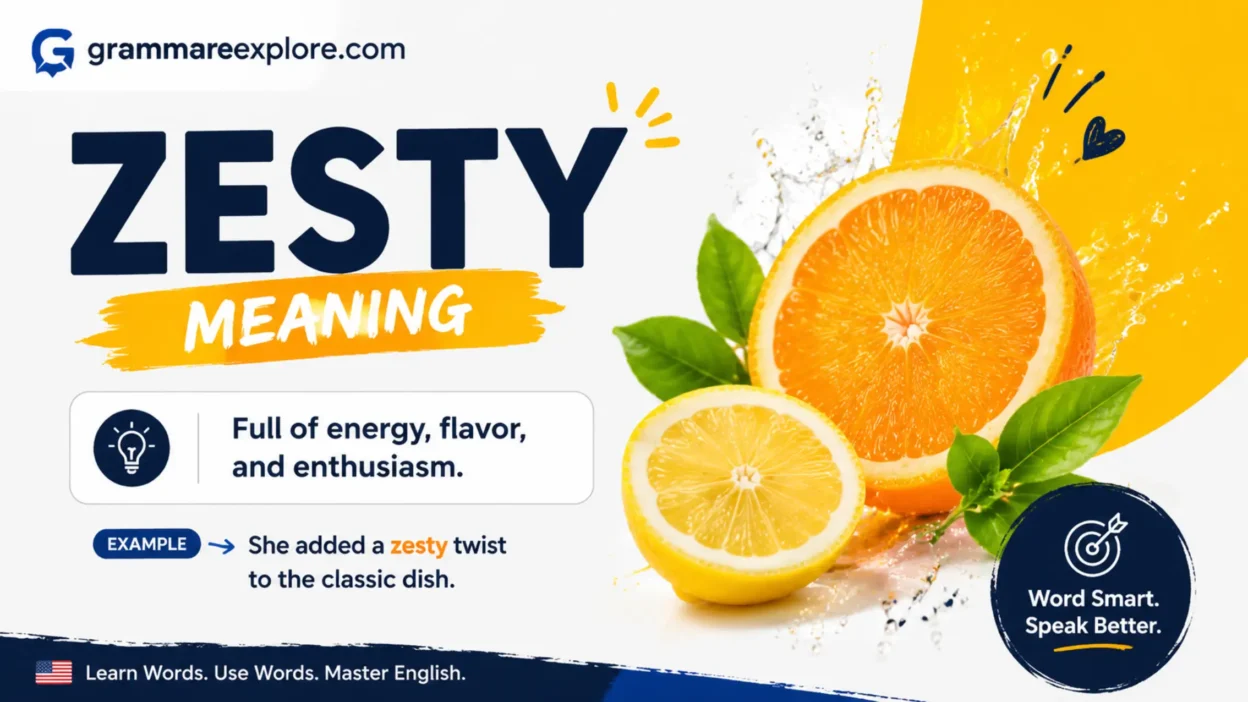
The word zesty describes something that has a strong, fresh, lively, or pleasantly sharp quality. It commonly describes food and drinks with a bright flavor, especially when citrus, herbs, spices, or other strong ingredients create a noticeable taste. It can also describe a person, performance, style, or idea that feels energetic, lively, exciting, or full of enthusiasm.
For example, “a zesty lemon sauce” describes a sauce with a bright, sharp flavor. In “a zesty performance,” the same adjective describes something lively and energetic rather than something related to taste. Cambridge Dictionary gives both of these major uses, while Merriam-Webster defines zesty as having or showing zest and describes it as appealingly piquant or lively.
Understanding these two uses makes the word much easier to recognize in everyday American English.
Quick Answer
Zesty is an adjective meaning full of flavor, especially a fresh or pleasantly sharp flavor, or full of energy and enthusiasm. You can use it for food, drinks, scents, writing, performances, personalities, and other things that feel lively or stimulating. For example, “The chicken has a zesty sauce” refers to flavor, while “She gave a zesty performance” refers to energy and enthusiasm.
What Does Zesty Mean?
Zesty has two closely related everyday meanings.
The first meaning relates to flavor. Something zesty has a strong, fresh, sharp, or lively taste. Citrus flavors often fit this description, but the word is not limited to lemons and limes.
The second meaning describes energy or enthusiasm. A person, performance, piece of writing, or activity can be zesty when it feels lively, exciting, spirited, or engaging.
Merriam-Webster defines the word as “having or characterized by zest” and gives examples such as a zesty sauce and zesty humor. Cambridge similarly explains that zesty can mean full of flavor or full of energy and enthusiasm.
Simple Definition
Zesty means pleasantly strong and lively in flavor, or energetic and enthusiastic in character.
The correct meaning depends on what noun the adjective describes.
Compare:
a zesty salsa
The salsa has a strong, lively flavor.
a zesty performance
The performance is energetic and exciting.
Zesty Meaning in Food
The most common use of zesty relates to food and drinks.
When people describe food as zesty, they usually mean that it has a bright, sharp, fresh, or stimulating flavor.
Citrus is especially common because lemon, lime, orange, and grapefruit can give food a fresh and noticeable taste. However, spicy, tangy, or strongly seasoned foods can also be called zesty.
Examples include:
- zesty lemon chicken
- zesty salsa
- zesty dressing
- zesty tomato sauce
- zesty shrimp
- zesty chicken wings
- zesty lime rice
- zesty marinade
For example:
The salad comes with a zesty lemon dressing.
This means the dressing has a bright, sharp, fresh flavor.
Merriam-Webster’s current examples include zesty sauces, marinades, dressings, citrus flavors, and other foods, showing how widely the adjective appears in descriptions of food.
Zesty Meaning for Taste
When zesty describes taste, it usually suggests more than simply “good.”
It draws attention to a flavor that stands out.
For example:
The soup needs a little more seasoning, but the sauce is already zesty.
Here, zesty suggests that the sauce has a lively and noticeable flavor.
It can also suggest freshness:
The lime gives the drink a zesty flavor.
The lime adds a bright, sharp quality.
Is Zesty the Same as Spicy?
Not exactly.
Spicy usually refers to heat from ingredients such as chili peppers.
Zesty is broader. It can describe a sharp, lively, tangy, or stimulating flavor without necessarily being hot.
For example:
The lemon dressing is zesty but not spicy.
This sentence is completely natural.
A zesty food can be spicy, but it does not have to be.
Zesty Meaning for People
Zesty can also describe a person who seems energetic, enthusiastic, lively, or full of personality.
For example:
She has a zesty personality.
This suggests that she is lively, energetic, or enthusiastic.
The meaning is positive in this context.
Another example:
He brought a zesty attitude to the project.
Here, the speaker means that he approached the project with energy and enthusiasm.
This use connects naturally to the noun zest, which can refer to an enjoyable or exciting quality and to keen enjoyment.
Zesty Meaning in Writing and Entertainment
The word can describe things that are lively, exciting, or engaging.
For example:
The article uses zesty language.
This means the language is lively, vivid, or energetic.
Oxford Learner’s Dictionaries gives zesty a meaning related to something being exciting, interesting, and fun, with an example involving lively language and wordplay.
You might also see:
a zesty comedy
a zesty performance
a zesty debate
a zesty personality
a zesty presentation
These examples use the word figuratively. No food is involved.
Zesty Meaning in Plain English
A simple way to understand zesty is to think about something that adds extra life or flavor.
- For food, it adds a noticeable flavor.
- For a person, it suggests energy.
- For writing, it can suggest vividness.
- For entertainment, it can suggest excitement.
For example:
| Context | Meaning of zesty |
|---|---|
| Food | Fresh, sharp, flavorful |
| Drink | Bright or lively in flavor |
| Person | Energetic and enthusiastic |
| Personality | Lively and spirited |
| Writing | Vivid and lively |
| Performance | Energetic and exciting |
| Style | Bold or lively |
The basic idea remains similar: something stands out because it has extra flavor, energy, or liveliness.
Zesty as a Part of Speech
Zesty is an adjective.
An adjective describes a noun or pronoun.
Examples:
zesty food
zesty sauce
zesty personality
zesty performance
zesty writing
zesty humor
Merriam-Webster lists zesty as an adjective and gives the comparative and superlative forms zestier and zestiest.
Comparative Form
Use zestier when comparing two things.
This dressing is zestier than the one we had yesterday.
Superlative Form
Use zestiest when comparing three or more things or identifying the strongest example.
That was the zestiest salsa on the menu.
These forms are grammatically normal because zesty follows the usual spelling pattern for adjectives ending in -y.
How to Pronounce Zesty
In American English, zesty is pronounced:
ZES-tee
IPA:
/ˈzes.ti/
The first syllable receives the main stress. Cambridge lists the U.S. pronunciation as /ˈzes.ti/.
Break it into two parts:
ZES + tee
Do not pronounce it as two equally stressed syllables.
Zesty vs. Zestful
The words zesty and zestful are related, but they are not always interchangeable.
Zesty often describes something with lively flavor or an energetic quality.
Zestful more commonly describes a person, attitude, or approach that shows enthusiasm and enjoyment.
Compare:
a zesty sauce
a zestful personality
The first focuses on flavor. The second focuses more directly on enthusiasm.
Zesty vs. Spicy
| Word | Meaning | Typical Use | Example |
|---|---|---|---|
| Zesty | Fresh, sharp, lively, or strongly flavored | Food and figurative descriptions | “The dressing is zesty.” |
| Spicy | Having a hot or pungent quality | Food, especially chili-based food | “The curry is spicy.” |
A dish can be both zesty and spicy, but the words describe different qualities.
The chicken has a zesty lime flavor and a spicy chili sauce.
Here, zesty refers to the bright lime flavor, while spicy refers to the heat.
Zesty vs. Tangy
These words are sometimes used for similar foods, but they are not exact synonyms.
Tangy usually emphasizes a sharp, sour, or acidic taste.
Zesty can suggest a similar brightness, but it can also emphasize freshness, liveliness, or a more complex flavor.
For example:
a tangy yogurt sauce
focuses on the acidic or sour quality.
a zesty herb and lemon sauce
suggests a lively combination of flavors.
The two words can overlap, especially when describing citrus-based foods.
Zesty vs. Lively
When describing people or activities, zesty and lively can overlap.
a lively performer
means the performer has lots of energy.
a zesty performer
also suggests energy, but it can sound more colorful, playful, or enthusiastic.
Lively is more common and neutral.
Zesty is more expressive.
Zesty vs. Flavorful
Flavorful simply means that something has a noticeable or appealing flavor.
Zesty adds the idea of a bright, sharp, lively, or stimulating quality.
Compare:
The soup is flavorful.
The soup has plenty of flavor.
The soup is zesty.
The soup has a lively or sharp flavor.
A food can be flavorful without being zesty.
Examples of Zesty in Sentences
Food Examples
1. Sentence: The restaurant serves a zesty tomato sauce.
Meaning: The sauce has a strong, lively flavor.
Why it is used: Zesty highlights the sauce’s noticeable taste.
2. Sentence: I added lemon to give the chicken a zesty flavor.
Meaning: The lemon made the chicken taste brighter and sharper.
Why it is used: The adjective describes the effect of the lemon.
3. Sentence: This salad needs a zesty dressing.
Meaning: The speaker wants a dressing with a bright, sharp flavor.
Why it is used: Zesty describes the desired taste.
4. Sentence: We ordered the zesty shrimp tacos.
Meaning: The tacos have a lively, strongly flavored taste.
Why it is used: The adjective describes the dish on a menu.
5. Sentence: The recipe calls for a zesty lime marinade.
Meaning: The marinade has a bright lime flavor.
Why it is used: Zesty makes the flavor sound fresh and noticeable.
People and Personality Examples
6. Sentence: Maria has a zesty personality.
Meaning: Maria is lively, energetic, and enthusiastic.
Why it is used: The word describes her character rather than food.
7. Sentence: His zesty attitude made the meeting more enjoyable.
Meaning: His energetic and positive attitude improved the atmosphere.
Why it is used: Zesty describes his lively approach.
8. Sentence: She brought a zesty sense of humor to the team.
Meaning: Her humor was lively, energetic, and entertaining.
Why it is used: The word emphasizes personality and energy.
Writing and Entertainment Examples
9. Sentence: The writer uses zesty language throughout the article.
Meaning: The language is lively and engaging.
Why it is used: It describes the style of writing.
10. Sentence: The comedian gave a zesty performance.
Meaning: The performance was energetic and lively.
Why it is used: The adjective describes the performer’s energy.
11. Sentence: The play has a zesty sense of humor.
Meaning: The humor is lively, playful, or energetic.
Why it is used: It describes the tone of the entertainment.
Everyday Examples
12. Sentence: We need something zesty to wake up the meal.
Meaning: The speaker wants a strong or lively flavor.
Why it is used: The adjective describes the desired quality of the food.
13. Sentence: Her zesty presentation kept everyone interested.
Meaning: Her presentation was energetic and engaging.
Why it is used: It describes her delivery.
14. Sentence: The new campaign has a zesty feel.
Meaning: The campaign feels lively, fresh, and energetic.
Why it is used: The adjective describes the overall impression.
15. Sentence: He gave the discussion a zesty start.
Meaning: He made the beginning energetic and engaging.
Why it is used: The word describes the lively quality of the discussion.
Common Phrases With Zesty
You may commonly see zesty in phrases such as:
- zesty sauce
- zesty dressing
- zesty flavor
- zesty chicken
- zesty salsa
- zesty lemon
- zesty lime
- zesty marinade
- zesty personality
- zesty attitude
- zesty performance
- zesty humor
- zesty writing
Food-related combinations are especially common in American English. Current dictionary examples include zesty sauces, dressings, chicken, citrus flavors, and other foods.
Is Zesty Positive or Negative?
Zesty is usually positive or neutral.
When describing food, it normally suggests that the flavor is appealing, lively, or interesting.
The pasta has a zesty lemon sauce.
This sounds positive.
When describing a person or performance, it can also be positive.
She gave a zesty performance.
This suggests energy and enthusiasm.
However, tone can change meaning in informal or slang contexts. The standard adjective itself is not inherently negative.
Is Zesty Formal or Informal?
Zesty is a standard English adjective, so it is not limited to casual speech.
You can use it in:
- everyday conversation
- restaurant descriptions
- recipes
- food writing
- product descriptions
- journalism
- creative writing
- professional writing
For example:
The restaurant introduced a zesty new dressing.
That sentence is perfectly acceptable in a professional food context.
The figurative use can also appear in polished writing:
The author gives the essay a zesty sense of humor.
Oxford lists the figurative meaning as exciting, interesting, and fun, showing that this use extends beyond casual conversation.
Is Zesty Slang?
Zesty is not primarily a slang word.
It is a standard English adjective with established dictionary meanings.
However, zesty has also developed informal slang uses online, especially when people describe someone’s behavior, appearance, or mannerisms. That newer use is separate from the standard meanings discussed on this page.
If someone says:
This salsa is zesty.
they are almost certainly talking about flavor.
If someone says:
He’s being zesty.
the meaning may depend on social context and could involve informal internet slang.
For a general definition page, the standard meanings should come first.
Where Did Zesty Come From?
The history of zesty is connected to the noun zest.
Merriam-Webster records the first known use of zesty in 1826.
The older noun zest originally referred to citrus peel used to add flavor. Over time, zest developed a figurative meaning connected with enjoyment, excitement, and liveliness. Merriam-Webster explains that English borrowed zest from French in the 17th century and later extended the word to qualities that add enjoyment or excitement.
That development explains why zesty can describe both flavor and energy.
The two meanings are connected by the basic idea of adding something lively or stimulating.
What Does Zesty Mean on a Menu?
On a menu, zesty almost always refers to flavor.
For example:
Zesty Chicken Wrap
- This suggests that the wrap has a strong, bright, tangy, spicy, or otherwise lively flavor.
Zesty Ranch Dressing
- This suggests a ranch dressing with an extra sharp or lively flavor.
Zesty Citrus Salad
- This suggests that citrus gives the salad a fresh and noticeable flavor.
Restaurant menus often use zesty because it makes food sound flavorful and appealing.
What Does Zesty Mean in a Description?
When used outside food, zesty usually describes something lively or energetic.
For example:
a zesty conversation
The conversation is lively and engaging.
a zesty personality
The person is energetic and enthusiastic.
a zesty performance
The performance is lively and exciting.
This figurative use is closely related to the idea of zest as enthusiasm or enjoyment.
Common Mistakes With Zesty
Mistake 1: Assuming Zesty Always Means Spicy
Incorrect assumption:
“Zesty means hot or spicy.”
Better understanding:
Zesty can describe a sharp, fresh, bright, or strongly flavored taste. It does not necessarily mean that food contains chili peppers.
The lemon sauce is zesty but not spicy.
Mistake 2: Using Zesty Only for Food
The word can describe people, writing, performances, humor, and other things that feel lively.
She has a zesty personality.
This is a standard figurative use.
Mistake 3: Thinking Zesty Means Sour
A zesty flavor can be sharp or citrusy, but zesty does not simply mean sour.
Sourness is one specific taste quality. Zesty describes a broader sense of liveliness or sharpness in flavor.
Mistake 4: Assuming Zesty Is Always Slang
The standard adjective has been used in English for a long time. Merriam-Webster records its first known use in 1826.
Therefore, a sentence such as:
This sauce has a zesty flavor.
uses completely standard English.
When Should You Use Zesty?
Use zesty when you want to describe something that has a bright, lively, noticeable quality.
It works especially well for:
- flavorful food
- citrus-based dishes
- sauces
- dressings
- drinks
- energetic personalities
- lively performances
- engaging writing
- playful humor
For example:
The lemon and herbs give the fish a zesty flavor.
Her zesty personality made the event more fun.
When Should You Use Another Word?
Sometimes another adjective is more precise.
- Use spicy when you mean hot from chili or similar ingredients.
- Use tangy when you specifically mean a sharp or sour taste.
- Use flavorful when you simply mean that something has plenty of flavor.
- Use energetic when you mean physical or mental energy.
- Use enthusiastic when you mean strong excitement or interest.
- Use lively when you want a broad, neutral description of energy.
- This helps prevent zesty from becoming too vague.
Frequently Asked Questions
What does zesty mean?
Zesty means full of flavor or characterized by a lively, sharp, or stimulating quality. It commonly describes food with a bright flavor, but it can also describe people, writing, performances, and other things that feel energetic or enthusiastic.
Does zesty mean spicy?
Not necessarily. Zesty can describe a sharp, fresh, tangy, or lively flavor, while spicy usually refers to heat from ingredients such as chili peppers. A food can be zesty without being hot, and it can also be both zesty and spicy.
What does zesty mean when describing a person?
When zesty describes a person, it usually means energetic, lively, enthusiastic, or full of personality. For example, “She has a zesty personality” suggests that she brings noticeable energy and enthusiasm to social situations.
Is zesty a positive word?
Usually, yes. Zesty generally has a positive or neutral tone when it describes food, energy, writing, or personality. For example, “a zesty sauce” suggests appealing flavor, while “a zesty performance” suggests lively energy.
What is the opposite of zesty?
The best opposite depends on the context. For food, possible opposites include bland, flavorless, or dull. For personality or performance, dull, lifeless, or uninspired may work. Merriam-Webster lists words such as bland, flavorless, and wearisome among contrasting terms.
Is zesty formal English?
Yes. Zesty is a standard English adjective, not merely a slang expression. It appears in dictionaries and can be used in everyday, professional, culinary, and creative writing. Its meaning changes according to context, but the word itself is fully established in English.
What is the difference between zesty and tangy?
Zesty suggests a lively, sharp, fresh, or stimulating flavor, while tangy more specifically emphasizes a sharp or acidic taste. They can overlap when describing citrus foods, but zesty has a broader meaning and can also describe energy or enthusiasm.
Conclusion
Zesty is an adjective that describes something with a lively, noticeable quality. When it refers to food or drinks, it usually means full of fresh, sharp, bright, or strongly appealing flavor. When it describes a person, performance, style, or piece of writing, it can mean energetic, enthusiastic, lively, or exciting.
The word is standard American English and works in both everyday and professional contexts. Its meaning becomes clear from the noun it modifies. A zesty sauce has a lively flavor, while a zesty personality has lively energy.
So, the easiest way to remember zesty meaning is to connect it with the idea of extra flavor or extra energy. Use it when something stands out because it feels fresh, lively, stimulating, or full of enthusiasm.


