

“Segue” and “Segway” sound exactly alike, so writers often choose the spelling that looks more logical. However, the two terms carry different meanings.
Use segue when you describe a smooth transition from one topic, activity, scene, song, or idea to another. Use Segway when you refer to the transportation brand, one of its vehicles, or another product sold under that name.
In emails, essays, presentations, and conversations about changing subjects, segue gives you the correct spelling. Its Italian-based spelling may look unusual, but its meaning remains simple: one thing flows directly into the next.
Quick Answer
Use segue for a smooth transition. Use Segway for the transportation brand and its products.
✔ Correct: The speaker used a story to segue into the main topic.
✔ Correct: We joined a guided Segway tour downtown.
✘ Incorrect: Let me segway into the next question.
✔ Correction: Let me segue into the next question.
Why People Confuse Them
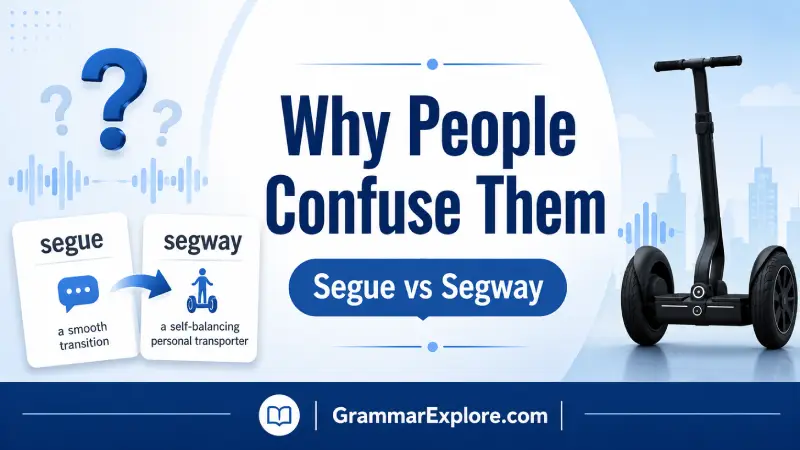
Both words usually sound like SEG-way. A listener cannot tell which spelling a speaker intends.
The spelling segway also appears more phonetic to many English readers because its final letters match the sound “way.” By contrast, segue came into English from Italian and kept its unexpected spelling.
The familiar Segway brand adds to the confusion. People see the name on vehicles, tours, advertisements, and product pages. They may then remember Segway more easily and mistakenly use it for a transition.
Key Differences at a Glance

| Context | Best Choice | Why |
|---|---|---|
| Moving to a new topic smoothly | segue | It describes a transition without an awkward stop. |
| Connecting songs or scenes | segue | It shows that one part flows into the next. |
| Linking sections of a speech | segue | It connects related ideas. |
| Naming the transportation brand | Segway | It identifies the company or product. |
| Describing a guided vehicle tour | Segway | The tour uses Segway vehicles. |
| Writing “___ into the next point” | segue | The sentence describes a transition. |
| Feature | Segue | Segway |
|---|---|---|
| Main meaning | A smooth transition; to move smoothly onward | A transportation brand or branded product |
| Part of speech | Verb and countable noun | Proper noun; sometimes a product noun |
| Capitalization | Usually lowercase | Usually capitalized |
| Pronunciation | SEG-way | SEG-way |
| Common context | Writing, speech, music, meetings, media | Vehicles, tours, products, transportation |
| Example | The joke created a natural segue. | The guide demonstrated the Segway. |
Meaning and Usage Difference
What Does Segue Mean?
As a verb, segue means to move smoothly and directly from one subject, section, activity, scene, or musical passage to another. Writers often pair it with into.
- The teacher segued from the warm-up into the lesson.
- The host segued into a discussion about college costs.
- The band segued from one song into the next.
- Her question helped the meeting segue into a useful debate.
As a noun, segue names the transition itself.
- That story provided a strong segue into the safety discussion.
- The film used a visual segue between the two periods.
Cambridge lists segue as both a verb and a noun and gives it the pronunciation /ˈseɡ.weɪ/. Merriam-Webster connects its modern meaning to an earlier musical direction. Does Segway Mean?
Segway names a transportation brand known for self-balancing personal transporters and other mobility products. Writers usually capitalize the word because it functions as a brand name.
- The security officer crossed the plaza on a Segway.
- Our family booked a Segway tour.
- The store displayed several Segway products.
The official company history traces the business to 1999 in Bedford, New Hampshire. This brand meaning remains separate from the ordinary word segue. unciation
Pronounce both terms SEG-way. Their matching sound creates the spelling problem, but their meanings remain separate.
Tone, Context, and Formality

Use segue in formal, casual, academic, and professional writing whenever you mean a transition. It works in essays, presentations, scripts, meetings, articles, and everyday conversations.
In academic writing, a sentence may create a segue between sections. In business writing, phrases such as “segue into the next topic” and “a natural segue into our proposal” sound professional.
Still, direct wording sometimes works better. “Next, we will discuss costs” sounds clearer than an elaborate transition when you simply need to announce a new section.
Use Segway only when you mean the brand, company, vehicle, tour, or product. The capital letter helps readers recognize the proper name.
Which One Should You Use?

Follow these simple rules:
- Choose segue when topics, ideas, songs, scenes, or activities flow into one another.
- Choose Segway when someone rides, rents, buys, demonstrates, or discusses the branded vehicle or product.
Try this memory trick: A Segway has wheels; a segue connects ideas.
You can also connect segue with sequence. Both words involve one thing following another, and both begin with seg-.
When One Choice Sounds Wrong
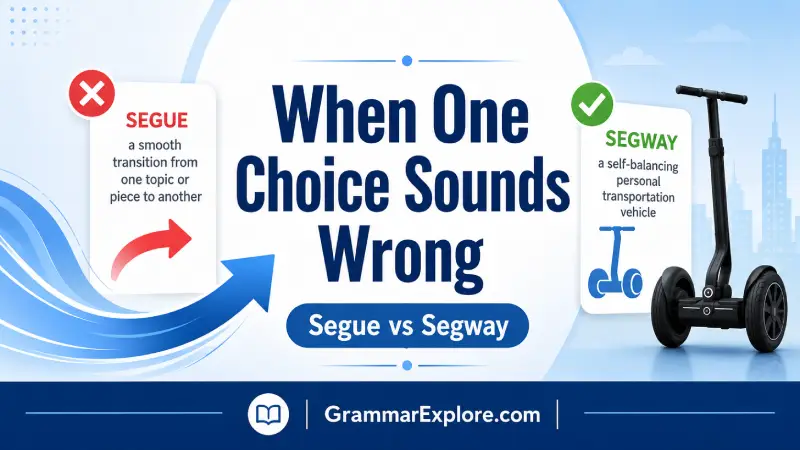
Incorrect: The presenter segwayed into the budget report.
Correct: The presenter segued into the budget report.
The sentence describes a change of topic, not a vehicle ride.
Incorrect: We rented two segues for the city tour.
Correct: We rented two Segways for the city tour.
The sentence refers to branded transportation devices.
Incorrect: The final paragraph offers a useful Segway to the conclusion.
Correct: The final paragraph offers a useful segue to the conclusion.
A paragraph creates a transition, so the common noun segue fits.
Common Mistakes and Quick Fixes
1. Using “segway” for a Topic Change
Incorrect: I will segway into the next issue.
Correct: I will segue into the next issue.
Explanation: The sentence describes a transition, so choose segue.
2. Capitalizing the Ordinary Word
Incorrect: The story creates a smooth Segue.
Correct: The story creates a smooth segue.
Explanation: Keep segue lowercase unless it begins a sentence or appears in a title.
3. Lowercasing the Brand Name
Incorrect: The officer rode a segway through the park.
Correct: The officer rode a Segway through the park.
Explanation: Capitalize the brand name in edited writing.
4. Writing the Wrong Past Tense
Incorrect: She segwayed into a new subject.
Correct: She segued into a new subject.
Explanation: Add -d to segue to form segued.
5. Dropping the Final “E” Before “-ing”
Incorrect: The host kept seguing from topic to topic.
Correct: The host kept segueing from topic to topic.
Explanation: The standard form keeps the full base spelling: segueing.
Everyday Examples
School
The final sentence gives the essay a smooth segue into its conclusion.
Work
The manager segued from sales results into staffing needs.
Home
Our conversation about groceries segued into weekend plans.
Business
The product demonstration provided a natural segue into pricing.
Emails
Before I segue into the schedule, I want to thank the support team.
Social Media
Her video segued from a tutorial into a product review.
Everyday Conversations
“That story gives me a perfect segue into my next question.”
“We took a Segway tour near the waterfront.”
Dictionary-Style Word Details
Verb
Segue commonly functions as an intransitive verb. It means to move smoothly from one part, subject, or activity to another.
Forms: segue, segues, segued, segueing
Segway does not commonly function as a standard verb meaning “transition.” Some speakers may use it informally to mean “ride a Segway,” but careful writers should write ride a Segway.
Noun
Segue functions as a countable noun that names a smooth transition.
Example: The anecdote created an effective segue.
Segway functions as a proper noun for the brand and may identify one of its vehicles or products.
Example: The tour company provided each rider with a Segway.
Synonyms
Closest alternatives for segue as a verb include transition, shift, move, flow, proceed, and lead into.
Closest alternatives for the noun include transition, link, bridge, and connection.
Segway has no exact synonym as a brand name. General alternatives include self-balancing transporter and personal transporter.
Example Sentences
Examples with segue:
- The introduction segues naturally into the first chapter.
- Ava used a statistic to segue into her main argument.
- The show segued from comedy into a serious interview.
- The two songs segue without a noticeable pause.
- His comment gave me an easy segue into the next question.
- The camera movement creates a visual segue between scenes.
- Our planning session segued into a discussion about costs.
- The author needs a clearer segue between these paragraphs.
Examples with Segway:
- The guide taught us how to balance on a Segway.
- A police officer patrolled the event on a Segway.
- The rental company offers Segway tours every morning.
- Jordan wore a helmet while riding the Segway.
- The store displayed a Segway product near the entrance.
Incorrect vs. correct:
- Incorrect: Let us segway into the final section.
- Correct: Let us segue into the final section.
- Incorrect: We booked a segue tour.
- Correct: We booked a Segway tour.
Word History
English borrowed segue from Italian, where it means “there follows.” Musicians used it as a direction to continue into the next passage without stopping. English speakers later applied the idea to conversations, writing, scenes, and activities. ** developed as a transportation brand name. Because it sounds like segue, writers often mix up the spellings. Merriam-Webster identifies segue as the correct word for a transition and treats Segway as the trademarked transportation term. ses Containing
Common phrases with segue:
- segue into
- smooth segue
- natural segue
- perfect segue
- seamless segue
- segue from one topic to another
- use something as a segue
Common phrases with Segway:
- Segway tour
- ride a Segway
- Segway rider
- Segway product
- Segway personal transporter
Practice MCQs
1. Which Sentence Uses “Segue” Correctly?
A. We rented a segue near the beach.
B. The host used a joke to segue into the interview.
C. The store sells a blue segue.
D. He wore a helmet on the segue.
Answer: B
2. Which Term Names a Transportation Brand?
A. Segue
B. Sequence
C. Segway
D. Segment
Answer: C
3. Complete the Sentence
“The example creates a smooth ___ into the conclusion.”
A. segway
B. segue
C. segwey
D. segoue
Answer: B
4. What Does “Segue” Usually Mean?
- A. To stop a discussion
- B. To ride a scooter
- C. To move smoothly to the next part
- D. To repeat an idea
Answer: C
5. Which Form Shows the Past Tense of “Segue”?
A. segwayed
B. segued
C. segged
D. segueing
Answer: B
Frequently Asked Questions
Is It “Segue Into” or “Segway Into”?
Use segue into when you describe a smooth transition. For example, “The host segued into the next topic” uses the standard spelling. Reserve Segway for the transportation brand, its vehicles, and related products. Their matching pronunciation causes the confusion, but their meanings remain separate.
How Do You Pronounce “Segue”?
Pronounce segue as SEG-way. It rhymes with Segway, which explains why writers often confuse the spellings. The letters -gue do not create the sound that many English readers expect, so learning the pronunciation and meaning together can prevent future mistakes.
Can “Segue” Function as a Noun?
Yes. As a noun, segue names a transition that connects two subjects, scenes, songs, or activities. You might write, “The story provided a natural segue into the presentation.” As a verb, it describes the movement: “The presentation segued into a question-and-answer session.”
What Is the Past Tense of “Segue”?
Use segued as the past tense of segue. For example, “The conversation segued into a debate.” Keep the complete base spelling and add -d. Avoid segwayed when you mean a transition because that spelling replaces the standard word with the brand name.
Can I Use “Transition” Instead of “Segue”?
Yes. Transition often gives you a simpler alternative. You can write “The speaker transitioned to the next topic” instead of “The speaker segued into the next topic.” Choose segue when you want to emphasize a smooth, direct connection between two parts.
Conclusion
Use segue when one topic, scene, song, paragraph, or activity moves smoothly into another. Use Segway when you mean the transportation brand, a related product, or a ride on one of its vehicles.
Remember the easiest distinction: A Segway has wheels; a segue connects ideas. Once you connect each spelling with its purpose, you can choose the correct term confidently in emails, essays, presentations, and everyday writing.