
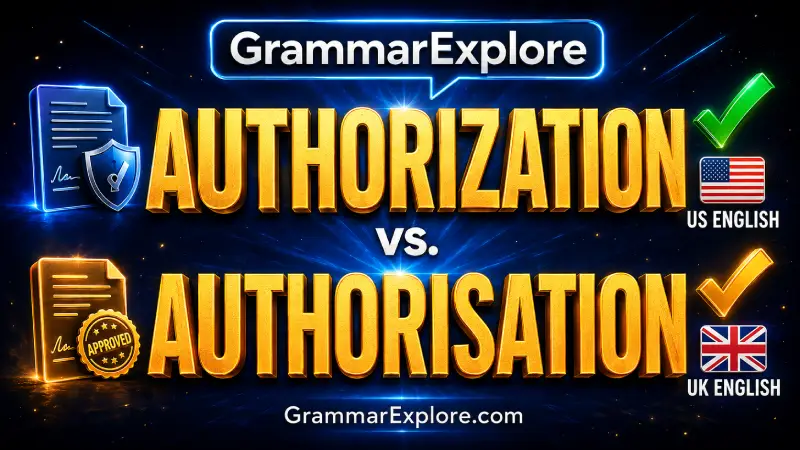
Authorization vs authorisation is a regional spelling choice rather than a difference in meaning. Both words refer to official permission, approval, or the act of giving someone authority to do something. Authorization, with a z, is the standard spelling in American English. Authorisation, with an s, is common in British English and several other varieties.
A US company might request payment authorization, while a British organization may ask for written authorisation. The documents serve the same purpose; only the spelling changes.
For content aimed at American readers, choose authorization. If you write for a British publication that follows the common -ise style, use authorisation. Some British publishers use -ize spellings, so authorization can also appear in carefully edited British text. The most important rule is to follow your audience or required style and remain consistent.
Quick Answer
Both spellings are correct and have the same meaning:
- Authorization is the standard American spelling.
- Authorisation is a common British spelling.
For a US audience, write:
- We need your written authorization.
For a British -ise style, write:
- We need your written authorisation.
Which Spelling Is Correct, Authorisation or Authorization?
Both authorisation and authorization are correct, but the preferred spelling depends on the variety of English. Authorization is the standard spelling in American English, while authorisation is preferred in British English. Both words have the same meaning.
Examples:
- The company requested authorization before processing the payment. (US)
- The company requested authorisation before processing the payment. (UK)
What Does Authorisation Mean?
Authorisation means official permission or approval to do something. It can refer to legal, financial, medical, or workplace approval.
Examples:
- You need authorisation to access the secure area.
- The manager gave authorisation for the purchase.
Is Authorisation with an S or Z?
Both spellings are correct. Use authorisation with S in British English and authorization with Z in American English.
Examples:
- Authorisation (UK)
- Authorization (US)
What’s the Difference Between Authentication and Authorisation?
Authentication and authorisation have different meanings. Authentication verifies who you are, while authorisation determines what you are allowed to do after your identity has been verified.
Examples:
- You enter your password to complete authentication.
- After
Why People Confuse Them
The words differ by only one letter:
- Authorization
- Authorisation
They also sound alike in normal speech. A reader cannot reliably identify the spelling from pronunciation alone.
The variation comes from broader differences involving words that end in -ize/-ise and -ization/-isation:
- Authorize / authorise
- Organize / organise
- Recognize / recognise
- Authorization / authorisation
- Organization / organisation
- Recognition / recognition
American English strongly favors -ize and -ization. British English commonly uses -ise and -isation, although some British styles retain z spellings.
Because both forms appear in reputable publications, writers may wonder whether they express different types of permission. They do not. The distinction concerns regional and editorial spelling preferences.
Key Differences At A Glance
| Feature | Authorization | Authorisation |
|---|---|---|
| Meaning | Official permission or approval | The same meaning |
| Main region | United States | Common in the United Kingdom |
| Spelling pattern | -ization | -isation |
| Related verb | Authorize | Authorise |
| Pronunciation | Essentially the same | Essentially the same |
| Part of speech | Noun | Noun |
| Best choice for US content | Yes | Usually no |
| Plural | Authorizations | Authorisations |
The spelling does not change the level, type, or legal force of the permission.
Meaning And Usage Difference
What Does Authorization Mean?
Authorization is a noun that means official permission, approval, or authority to perform an action. It can also refer to the document, code, or decision that grants permission.
American English uses this spelling in business, law, banking, medicine, government, and technology.
- The manager gave us authorization to proceed.
- The bank declined the payment authorization.
- We cannot release the records without your written authorization.
- The employee lacks authorization to access that folder.
- Congress passed an authorization for the program.
The word may function as a count or noncount noun.
As a noncount noun:
- You need authorization to enter the building.
As a count noun:
- The agency issued several authorizations.
What Does Authorisation Mean?
Authorisation carries the same meaning. It commonly appears in British writing that uses the -ise/-isation pattern.
- The council granted planning authorisation.
- The bank requires additional authorisation.
- Staff members need written authorisation to enter.
- The company withdrew its previous authorisation.
Changing z to s does not change the permission itself. It only adapts the word to a different spelling convention.
Do The Spellings Have Different Legal Meanings?
No general legal distinction separates authorization from authorisation. A US contract may use the z spelling, while a British contract may use the s spelling.
The document’s wording, governing law, and defined terms determine its legal effect, not the choice between s and z.
Always preserve the original spelling when quoting a law, contract, policy, form, or official title. Altering an official document’s wording can create inconsistency even when the replacement spelling remains valid.
American And British English Preferences
American English
- American English uses authorization almost universally.
Related forms include:
- Authorize
- Authorized
- Authorizes
- Authorizing
- Authorization
- Authorizations
Examples:
- The director authorized the purchase.
- Only authorized employees may enter.
- We received authorization yesterday.
For websites targeting the United States, authorization is the safest choice.
British English
Many British publishers use:
- Authorise
- Authorised
- Authorises
- Authorising
- Authorisation
- Authorisations
Examples:
- The director authorised the payment.
- Only authorised personnel may enter.
- The company received authorisation.
However, British English does not ban the z form. Some British dictionaries, academic publishers, and house styles use authorize and authorization. This convention is sometimes called Oxford spelling.
Therefore, the following claim would oversimplify the real pattern:
- “Authorization is always American, and authorisation is always British.”
A more accurate rule is:
- Authorization is standard in American English and also appears in some British styles.
- Authorisation is a common and widely accepted British spelling.
Other English Varieties
Canadian English often accepts or favors authorization, especially in government, business, and technical writing.
Australian and New Zealand English more commonly use authorisation, though individual organizations may follow a different style.
When writing for a specific country, client, school, or employer, follow its published style guide.
Pronunciation
Both words usually share the same pronunciation. The s in authorisation represents the same voiced z sound heard in authorization.
A practical pronunciation guide is:
aw-thuh-ruh-ZAY-shun
The spelling difference normally does not create a pronunciation contrast. Speakers use the same stress pattern, with the strongest emphasis on ZAY.
Because the words sound alike, pronunciation cannot help you select the regional spelling. Audience and style determine the choice.
Tone, Context, And Formality
Both forms sound formal and official. People often use them when permission involves rules, security, money, records, or legal responsibility.
Common contexts include:
- Banking and payments
- Medical records
- Insurance
- Employment
- Contracts
- Government programs
- Computer security
- Building access
- Travel documents
- Data privacy
In casual conversation, permission often sounds simpler:
- Formal: Do you have authorization to enter?
- Casual: Do you have permission to enter?
Choose authorization when the permission comes from an official authority, policy, system, or documented process. Use permission when the situation is ordinary or personal.
The regional spelling does not affect formality. Authorisation sounds just as formal in British English as authorization does in American English.
Authorization In Technology
In computing, authorization determines what an authenticated user or system may access or do.
For example:
- A customer may view only their own account.
- A manager may approve employee expenses.
- An administrator may change system settings.
Writers often confuse authorization with authentication, but the terms describe different processes:
- Authentication confirms identity: Who are you?
- Authorization controls access: What may you do?
A login may authenticate a user through a password, passkey, or security code. The system then checks the user’s authorization before allowing access to files or features.
British technical writing may use authorisation, but many international software platforms use the American z spelling in interfaces, documentation, and code.
Which One Should You Use?
| Context | Best Choice | Why |
|---|---|---|
| General American English | Authorization | It is the standard US spelling |
| US business document | Authorization | American organizations expect it |
| US legal or medical writing | Authorization | It follows American convention |
| British publication using -ise | Authorisation | It matches the publication’s style |
| British publication using -ize | Authorization | Some British styles prefer z |
| Quoting an official document | Preserve the original | Quotations should remain accurate |
| International software interface | Follow product terminology | Consistency prevents confusion |
| Content for mixed global readers | Choose one style | Both spellings are understandable |
For your US-focused grammar content, use authorization as the main spelling.
When One Choice Sounds Wrong
Authorisation is not grammatically wrong in American writing. However, it can look inconsistent if the rest of the document follows US spelling.
Inconsistent American style:
- The company requires written authorisation.
- Only authorized employees may approve the request.
Consistent American style:
- The company requires written authorization.
- Only authorized employees may approve the request.
The reverse applies to a British document that follows -ise spellings:
Inconsistent British -ise style:
- The company requires written authorization.
- Only authorised employees may approve the request.
Consistent British -ise style:
- The company requires written authorisation.
- Only authorised employees may approve the request.
A spelling may be valid but still feel wrong when it conflicts with the document’s established style.
Common Mistakes And Quick Fixes
Mixing Z And S Forms
Inconsistent:
- The manager authorised the request and sent an authorization letter.
US style:
- The manager authorized the request and sent an authorization letter.
British -ise style:
- The manager authorised the request and sent an authorisation letter.
Match the noun to the verb form.
Writing Authoriztion
Incorrect:
- We need your authoriztion.
Correct:
- We need your authorization.
Keep the full base authorize before adding the noun ending.
Writing Authorazation
Incorrect:
- The payment requires authorazation.
Correct:
- The payment requires authorization.
The middle syllable uses -ori-, and the ending uses -zation in American English.
Confusing Authorization With Authority
Authorization means permission:
- I received authorization to sign the form.
Authority means the power or right to make decisions:
- The director has the authority to approve the request.
A person with authority can give authorization.
Confusing Authorization With Authentication
Incorrect technical meaning:
- The password provides authorization by confirming your identity.
Correct:
- The password supports authentication by confirming your identity.
- The system checks authorization to determine your access.
Identity verification and access permission are related but separate concepts.
Changing Spelling Inside A Quotation
When quoting a British policy, do not silently replace authorisation with authorization. Preserve the source’s original language unless your editorial rules clearly allow changes with an explanation.
Everyday Examples
Examples With Authorization
- We need written authorization before releasing the records.
- The manager gave authorization for the purchase.
- My credit card authorization failed.
- Employees need security authorization to enter the lab.
- The hospital requested the patient’s authorization.
- The application cannot proceed without authorization.
- Only administrators have authorization to change these settings.
- The agency issued a temporary authorization.
- Please sign the authorization form.
- The payment is waiting for final authorization.
- She received authorization to use the photograph.
- The company withdrew its previous authorization.
Examples With Authorisation
These examples follow a common British spelling style:
- The council granted authorisation for the project.
- Written authorisation must accompany the application.
- The bank requested additional authorisation.
- Employees cannot enter without authorisation.
- The organisation received formal authorisation to operate.
- Please complete the authorisation form.
For American readers, change each example to authorization.
Examples With Related Verbs
American style:
- The board authorized the expenditure.
- An authorized technician completed the repair.
- Who authorized this transaction?
- The supervisor is authorizing the refund.
British -ise style:
- The board authorised the expenditure.
- An authorised technician completed the repair.
- Who authorised this transaction?
- The supervisor is authorising the refund.
Dictionary-Style Word Details
Verb
Neither authorization nor authorisation functions as a verb. Both are nouns.
The related verbs are:
- Authorize: Standard American spelling and an accepted form in some British styles.
- Authorise: Common British spelling.
Both verbs mean to give official permission.
Examples:
- US: The manager will authorize the payment.
- UK -ise style: The manager will authorise the payment.
Noun
- Authorization: Official permission, approval, or the act of granting authority; standard in American English.
- Authorisation: The same noun with a common British spelling.
Both can function as count or noncount nouns:
- We need authorization.
- The agency issued three authorizations.
British -ise style:
- We need authorisation.
- The agency issued three authorisations.
Synonyms
Meaning-matched alternatives include:
- Permission
- Approval
- Consent
- Clearance
- Sanction
- License
- Authority
- Go-ahead
These words do not always work interchangeably.
Consent often emphasizes voluntary agreement. Clearance commonly involves security or an official check. License may refer to a formal document or legal right. Authority describes decision-making power rather than the permission itself.
Possible opposites include:
- Refusal
- Denial
- Prohibition
- Rejection
- Revocation
- Withdrawal of permission
Example Sentences
Authorization:
- The employee requested authorization to work remotely.
- Your signed authorization allows us to process the request.
- The system denied access because the user lacked authorization.
Authorisation:
- The employee requested authorisation to work remotely.
- Your signed authorisation allows us to process the request.
- The system denied access because the user lacked authorisation.
The examples have identical meanings.
Word History
Both spellings belong to the same word family as author, authority, and authorize/authorise. The noun has long referred to the act of granting authority or official permission.
Over time, different English spelling traditions favored either z or s. American English settled strongly on authorization, while many British writers adopted authorisation. Some British styles retained the older z convention.
The regional spelling difference does not create a historical or modern difference in meaning.
Phrases Containing
Common American phrases include:
- Written authorization
- Prior authorization
- Payment authorization
- Medical authorization
- Security authorization
- Legal authorization
- Credit card authorization
- Authorization form
- Authorization code
- Authorization letter
- Without authorization
- Obtain authorization
Common British -ise forms include:
- Written authorisation
- Prior authorisation
- Payment authorisation
- Security authorisation
- Authorisation form
- Without authorisation
Use the spelling that matches your target variety throughout the document.
How To Remember Authorization vs Authorisation
Connect the z in authorization with the z in authorize, the standard American verb:
- Authorize → authorization
- Authorized → authorization
For a common British -ise style, connect the s forms:
- Authorise → authorisation
- Authorised → authorisation
A short memory rule is:
- American English favors authorization.
- British -ise style favors authorisation.
When unsure, check your audience rather than searching for a difference in meaning.
Frequently Asked Questions
Is authorization or authorisation correct?
Both spellings are correct. Authorization is standard in American English, while authorisation is common in British English.
Which spelling should I use in the United States?
Use authorization in American writing:
- We need your written authorization.
This spelling fits US business, legal, medical, government, and technical content.
Is authorization accepted in British English?
Yes. Although many British writers use authorisation, some British publishers and dictionaries prefer or accept authorization. Follow the relevant house style.
Do authorization and authorisation mean the same thing?
Yes. Both mean official permission, approval, or the act of granting someone authority. The spelling does not change the meaning.
Is it authorize or authorise?
Use authorize in American English. Authorise is common in British -ise style, while some British publishers also use authorize.
What is the plural of authorization?
The American plural is authorizations. The corresponding British -ise spelling is authorisations.
What is the difference between authorization and authentication?
Authentication confirms identity. Authorization determines what the confirmed user may access or do. A system usually authenticates a user before checking access permissions.
Should I Change Authorisation To Authorization In A Quotation?
No. Preserve the original spelling when directly quoting a document. Outside the quotation, follow the spelling style of your own article.
Conclusion
Authorization and authorisation have the same meaning. Both refer to official permission, approval, or the act of granting authority.
Use authorization for American English:
- We received authorization to proceed.
Choose authorisation when following a British style that favors -ise spellings:
- We received authorisation to proceed.
Some British styles also accept authorization, so the regional distinction is not absolute. For a US audience, however, authorization remains the safest and most natural choice. Whichever spelling you select, match it with authorize/authorise and use one style consistently.