
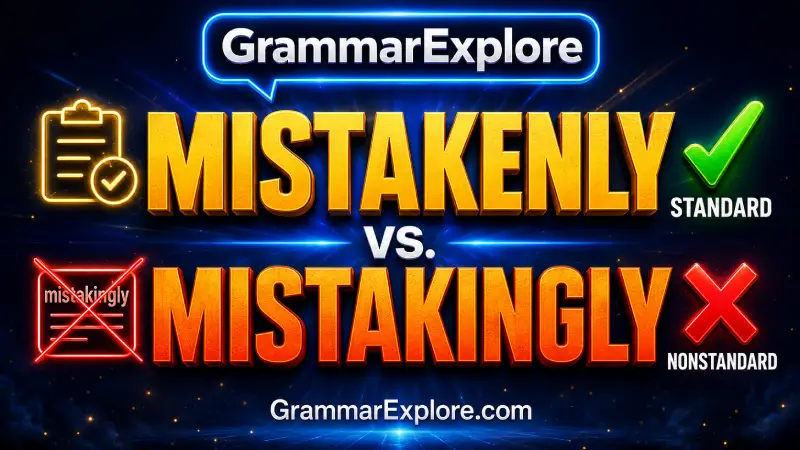
Mistakenly vs mistakingly may look like a choice between two spellings of the same word. However, modern English treats them differently. Mistakenly is the standard adverb for something done because of an error, incorrect belief, or misunderstanding. If you selected the wrong file or confused one person with another, you acted mistakenly.
Mistakingly does exist in some dictionaries, but it remains extremely rare. It technically means “in a mistaking manner.” Most readers will view it as an error when a writer simply means “by mistake” or “incorrectly.”
For clear American English, use mistakenly in almost every situation. You may encounter mistakingly in older, specialized, or highly unusual writing, but it rarely improves a sentence. Replacing it with mistakenly, mistook, or mistaking usually creates a more natural result.
Quick Answer
Use mistakenly when you mean “by mistake,” “incorrectly,” or “because of a wrong belief.”
- I mistakenly deleted the email.
Mistakingly is a rare recorded word, but standard modern writing seldom uses it. For school, business, academic, and everyday writing, choose mistakenly.
What Is the Meaning of Mistakingly?
Mistakingly means by mistake or incorrectly, but it is a rare and nonstandard form. Most dictionaries and style guides recommend using mistakenly instead.
Examples:
- She mistakenly sent the email to the wrong person.
- He was mistakenly identified as the suspect.
Is Mistakenly Grammatically Correct?
Yes. Mistakenly is the correct and standard adverb. It means by mistake or in error and is widely used in both formal and informal English.
Examples:
- I mistakenly deleted the file.
- They mistakenly believed the report was complete.
Is Mistaking a Real Word?
Yes. Mistaking is a real word. It is the present participle and gerund form of the verb mistake, meaning to wrongly identify or understand something.
Examples:
- She is mistaking kindness for weakness.
- Mistaking one twin for the other is common.
Do We Say “Mistaken” or “Mistaking”?
Both are correct, but they have different uses. Mistaken is usually an adjective or the past participle of mistake, while mistaking is the present participle or gerund.
Examples:
- I was mistaken about the meeting time.
- She is mistaking his silence for agreement.
Why People Confuse Them
The confusion comes from two real forms of the verb mistake:
- Mistaken is the past participle and an adjective.
- Mistaking is the present participle.
English often forms an adverb by adding -ly to an adjective. Applying that pattern to mistaken produces the standard word:
- mistaken + ly = mistakenly
Some writers start with mistaking and add -ly:
- mistaking + ly = mistakingly
Although dictionaries may record this second construction, it never became the usual adverb for “by mistake.” Its unusual spelling also looks logical enough to attract writers who have not seen mistakenly often.
The base forms clarify the difference:
- She held a mistaken belief.
- She mistakenly believed the rumor.
- She was mistaking a rumor for a fact.
The second sentence needs the standard adverb mistakenly.
Key Differences At A Glance
| Feature | Mistakenly | Mistakingly |
|---|---|---|
| Word status | Standard and widely accepted | Recorded but extremely rare |
| Main meaning | By mistake; incorrectly | In a mistaking manner |
| Base form | Mistaken | Mistaking |
| Part of speech | Adverb | Adverb |
| Natural in modern US English | Yes | Usually no |
| Suitable for formal writing | Yes | Best avoided |
| Example | I mistakenly called Sam. | Rarely sounds natural |
| Best everyday choice | Mistakenly | Avoid in most cases |
The safest rule is simple: if you mean by mistake, choose mistakenly.
Meaning And Usage Difference
What Does Mistakenly Mean?
Mistakenly means that someone did, said, understood, identified, or believed something incorrectly. The action often results from a false assumption, poor judgment, misunderstanding, or simple error.
- I mistakenly sent the message to the wrong person.
- She mistakenly believed the meeting began at noon.
- The cashier mistakenly charged us twice.
- We mistakenly entered through the employee entrance.
- Several viewers mistakenly identified the actor.
The word can describe several kinds of errors:
- An incorrect belief
- A wrong identification
- A misunderstanding
- An inaccurate statement
- An incorrect selection
- A decision based on false information
In each case, mistakenly explains how or why the error occurred.
What Does Mistakingly Mean?
Mistakingly means “in a mistaking manner.” It comes from mistaking, the present participle of the verb mistake.
Consider the normal use of mistaking:
- He was mistaking politeness for agreement.
A writer could theoretically create the adverb mistakingly, but the resulting sentence would sound unnatural:
- Unnatural: He mistakingly treated her politeness as agreement.
- Natural: He mistakenly treated her politeness as agreement.
- More direct: He mistook her politeness for agreement.
The rare form usually adds no useful meaning. Even when a dictionary recognizes it, most editors will replace it with mistakenly or rewrite the sentence.
Are They Two Spellings Of The Same Word?
Not exactly. The words come from different grammatical forms:
- Mistakenly comes from mistaken.
- Mistakingly comes from mistaking.
Their meanings can overlap, but their acceptance and frequency differ greatly. Mistakenly is the established adverb that readers expect. Mistakingly remains so rare that it often looks like a spelling mistake.
Do not treat them as equal alternatives in modern writing. Choose mistakenly when you want to express an error.
Mistakenly vs Mistaken
Mistaken and mistakenly belong to the same word family, but they perform different jobs.
Mistaken usually functions as an adjective:
- Your assumption is mistaken.
- I was mistaken about the date.
- She acted on a mistaken belief.
It can also appear as the past participle of mistake:
- We had mistaken the building for a hotel.
Mistakenly functions as an adverb. It modifies an action, belief, or statement:
- I mistakenly assumed the office was open.
- The report mistakenly listed an old address.
- She mistakenly identified the wrong person.
A simple test can help:
- If the word describes a person, belief, or assumption, use mistaken.
- If it explains how an action happened, use mistakenly.
Mistakenly vs Mistaking
Mistaking is a correct verb form. It describes the ongoing act of confusing, misunderstanding, or identifying something incorrectly.
- You are mistaking confidence for arrogance.
- I was mistaking one entrance for another.
- They kept mistaking the twins.
Mistakenly does not show an ongoing verb action. It explains that another action resulted from an error:
- You mistakenly described confidence as arrogance.
- I mistakenly entered through the wrong door.
- They mistakenly called one twin by the other’s name.
Both forms are correct, but they cannot always replace each other.
Mistakenly vs Accidentally
Mistakenly and accidentally can both describe unintended results. However, they emphasize different causes.
Mistakenly often points to incorrect judgment, belief, understanding, or identification:
- I mistakenly thought the store closed at 9 p.m.
- She mistakenly identified the blue bag as hers.
Accidentally focuses more broadly on an action that happened without intention:
- I accidentally knocked over the glass.
- She accidentally pressed the emergency button.
Sometimes either word can fit, but the meaning changes slightly:
- I mistakenly deleted the file because I thought it was a duplicate.
- I accidentally deleted the file when my finger slipped.
The first sentence highlights faulty judgment. The second highlights an unintended physical action.
Pronunciation
Both words follow predictable pronunciation patterns:
- Mistakenly: mis-TAY-kuhn-lee
- Mistakingly: mis-TAY-king-lee
Pronunciation does not usually cause the confusion. The problem comes from spelling and word formation.
Since mistakingly rarely appears in natural conversation or writing, most readers expect mistakenly whenever someone means “incorrectly” or “by mistake.”
Tone, Context, And Formality
Mistakenly works in casual, professional, academic, legal, and journalistic English. It has a neutral tone and does not necessarily blame someone for carelessness.
- I mistakenly attached an older version of the report.
- Researchers initially mistakenly identified the sample.
- The customer mistakenly entered an expired card number.
- Officials mistakenly reported the wrong total.
In some situations, by mistake sounds warmer and more conversational:
- Formal: I mistakenly sent you the wrong document.
- Conversational: I sent you the wrong document by mistake.
Mistakingly sounds unusual in both formal and informal English. Its rarity may distract readers from the sentence’s message. Publication-ready writing should normally avoid it.
Which One Should You Use?
| Context | Best Choice | Why |
|---|---|---|
| Doing something by mistake | Mistakenly | It is the standard adverb |
| Holding an incorrect belief | Mistakenly | It describes faulty judgment |
| Identifying someone incorrectly | Mistakenly | It clearly communicates the error |
| Writing a business email | Mistakenly | It sounds natural and professional |
| Completing a school assignment | Mistakenly | Standard English expects this form |
| Explaining a technical error | Mistakenly | It provides clear meaning |
| Describing ongoing confusion | Mistaking | This verb form fits the action |
| Confusing one person with another | Mistook | The simple past often sounds direct |
| Meaning “in a mistaking manner” | Mistakingly | Technically possible but extremely rare |
Try replacing the word with by mistake:
- I mistakenly closed the document.
- I closed the document by mistake.
Because the replacement works, mistakenly is correct.
When One Choice Sounds Wrong
Mistakingly usually sounds wrong when a writer simply means “incorrectly.”
Unnatural:
- I mistakingly sent the wrong attachment.
Natural:
- I mistakenly sent the wrong attachment.
Unnatural:
- She mistakingly believed Friday was a holiday.
Natural:
- She mistakenly believed Friday was a holiday.
Unnatural:
- The employee mistakingly entered the wrong price.
Natural:
- The employee mistakenly entered the wrong price.
Sometimes a verb construction makes the sentence even clearer:
- Awkward: He mistakingly identified Paul as Peter.
- Better: He mistakenly identified Paul as Peter.
- Most direct: He mistook Paul for Peter.
Common Mistakes And Quick Fixes
Using Mistakingly For By Mistake
Incorrect in normal usage:
- We mistakingly arrived one day early.
Correct:
- We mistakenly arrived one day early.
You could also write:
- We arrived one day early by mistake.
Removing Letters From Mistakenly
Incorrect:
- She mistakely selected the wrong option.
- He mistakonly entered the wrong address.
Correct:
- She mistakenly selected the wrong option.
- He mistakenly entered the wrong address.
Keep the complete word mistaken before adding -ly.
Using Mistakenly As An Adjective
Incorrect:
- That was a mistakenly assumption.
Correct:
- That was a mistaken assumption.
The noun assumption needs an adjective, so choose mistaken.
Using Mistaken As An Adverb
Incorrect:
- I mistaken sent the message twice.
Correct:
- I mistakenly sent the message twice.
The sentence needs an adverb to modify sent.
Confusing Mistaken And Mistaking
Use mistaken when someone or something is wrong:
- I was mistaken about the time.
- That idea is mistaken.
Use mistaking for an ongoing act of confusing one thing with another:
- You are mistaking kindness for weakness.
- She kept mistaking the two passwords.
Using Mistakenly When Accidentally Fits Better
Less precise:
- He mistakenly spilled coffee on the desk.
More natural:
- He accidentally spilled coffee on the desk.
Spilling coffee usually involves an unintended action rather than a false belief. Context can still make mistakenly appropriate if the person deliberately poured the coffee somewhere because of an incorrect instruction.
Everyday Examples
Examples With Mistakenly
- I mistakenly added salt instead of sugar.
- Ava mistakenly took my jacket.
- The driver mistakenly turned onto a one-way street.
- She mistakenly sent the invoice twice.
- We mistakenly assumed the event was free.
- The app mistakenly marked my account as inactive.
- A student mistakenly submitted an unfinished draft.
- The cashier mistakenly gave me too much change.
- They mistakenly believed the store opened at 8 a.m.
- My phone mistakenly identified the call as spam.
- The editor mistakenly removed the final paragraph.
- Several customers mistakenly ordered the older model.
- I mistakenly left your name off the invitation.
- Liam mistakenly believed the deadline had changed.
- The delivery driver mistakenly stopped at the next house.
Natural Replacements For Mistakingly
Instead of:
- She mistakingly called me Daniel.
Write:
- She mistakenly called me Daniel.
- She mistook me for Daniel.
Instead of:
- He mistakingly treated the joke as an insult.
Write:
- He mistakenly treated the joke as an insult.
- He mistook the joke for an insult.
Instead of:
- They mistakingly believed the rumor.
Write:
- They mistakenly believed the rumor.
- They believed the rumor by mistake.
Dictionary-Style Word Details
Verb
- Mistakenly: Not a verb. It functions as an adverb.
- Mistakingly: Not a verb. It also functions as an adverb, although writers rarely use it.
The related verb is mistake:
- Base form: mistake
- Past tense: mistook
- Past participle: mistaken
- Present participle: mistaking
Examples:
- Do not mistake silence for agreement.
- I mistook her brother for her coworker.
- We had mistaken the building for a hotel.
- He was mistaking criticism for hostility.
Noun
Neither mistakenly nor mistakingly functions as a noun.
The related noun is mistake:
- I made a mistake.
- The document contains a spelling mistake.
- Choosing that road was an honest mistake.
Synonyms
Closest alternatives for mistakenly include:
- Incorrectly
- Wrongly
- Erroneously
- By mistake
- In error
- Unintentionally
- Accidentally, in some contexts
These words do not always provide an exact match. Mistakenly often emphasizes faulty understanding or judgment, while accidentally emphasizes a lack of intention.
Possible opposites include:
- Correctly
- Accurately
- Rightly
- Knowingly
- Deliberately, when intention creates the contrast
Mistakingly has no useful independent synonym list because writers almost always replace it with mistakenly or a clearer verb form.
Example Sentences
Mistakenly:
- I mistakenly opened your package.
- The report mistakenly listed the wrong date.
- She mistakenly assumed that I had canceled.
- Customers mistakenly selected the annual plan.
- The website mistakenly displayed an outdated price.
Mistakingly:
Although dictionaries may record this word, it rarely sounds natural. Prefer:
- He mistakenly treated the imitation as genuine.
- He mistook the imitation for the genuine item.
Word History
Mistakenly developed from the adjective mistaken plus the adverb ending -ly. This formation matches its modern meaning: acting, speaking, or believing in a mistaken way.
Mistakingly comes from mistaking plus -ly. Historical dictionaries record the form, but it never became the standard adverb for “by mistake.”
Modern American usage strongly favors mistakenly.
Phrases Containing
Common patterns with mistakenly include:
- Mistakenly believe
- Mistakenly assume
- Mistakenly identify
- Mistakenly think
- Mistakenly report
- Mistakenly delete
- Mistakenly send
- Mistakenly enter
- Mistakenly claim
- Mistakenly conclude
- Mistakenly interpret
- Mistakenly select
Mistakingly does not appear in common modern phrases. Writers usually choose mistakenly, mistook, or mistaking instead.
How To Remember Mistakenly vs Mistakingly
Start with the adjective mistaken:
- A mistaken belief
- A mistaken identity
- A mistaken assumption
Now add -ly to describe an action:
- She mistakenly believed the rumor.
- He mistakenly identified me.
- We mistakenly assumed the date had changed.
Remember this short rule:
A mistaken action happens mistakenly.
If you can replace the word with by mistake, choose mistakenly.
Frequently Asked Questions
Is mistakingly a real word?
Some dictionaries record mistakingly with the meaning “in a mistaking manner.” However, the word remains extremely rare. Most readers may interpret it as a spelling error, so standard writing should normally use mistakenly.
Which is correct, mistakenly or mistakingly?
Use mistakenly when you mean “by mistake,” “wrongly,” or “incorrectly.” Although mistakingly has limited dictionary recognition, it does not work as the normal alternative.
Is mistakenly an adverb?
Yes. Mistakenly is an adverb:
- I mistakenly deleted the file.
It modifies the verb deleted and explains how the error happened.
What is the difference between mistakenly and accidentally?
Mistakenly often involves an incorrect belief, judgment, or identification. Accidentally focuses on an unintended action.
- I mistakenly selected the wrong answer.
- I accidentally dropped my pencil.
Can I say “I was mistaking you for someone else”?
Yes. Mistaking correctly functions as the present participle:
- I was mistaking you for someone else.
A shorter version often sounds more natural:
- I mistook you for someone else.
Is mistakingly acceptable in formal writing?
Avoid mistakingly in normal formal writing. Even though some dictionaries record it, mistakenly or a rewritten sentence will communicate your meaning more clearly.
How Do You Spell Mistakenly?
Spell it m-i-s-t-a-k-e-n-l-y. Keep mistaken intact and add -ly:
- mistaken + ly = mistakenly
What Can I Use Instead Of Mistakenly?
Depending on the sentence, use by mistake, incorrectly, wrongly, or in error:
- I mistakenly selected the wrong file.
- I selected the wrong file by mistake.
Conclusion
For standard American English, choose mistakenly when you mean “by mistake,” “incorrectly,” or “because of a wrong belief.”
- Correct: I mistakenly deleted the document.
- Avoid: I mistakingly deleted the document.
Mistakingly has limited dictionary recognition, but modern speakers rarely use it. Its unusual form can distract readers and make polished writing appear incorrect.
The easiest rule remains simple: If “by mistake” fits, use mistakenly.