
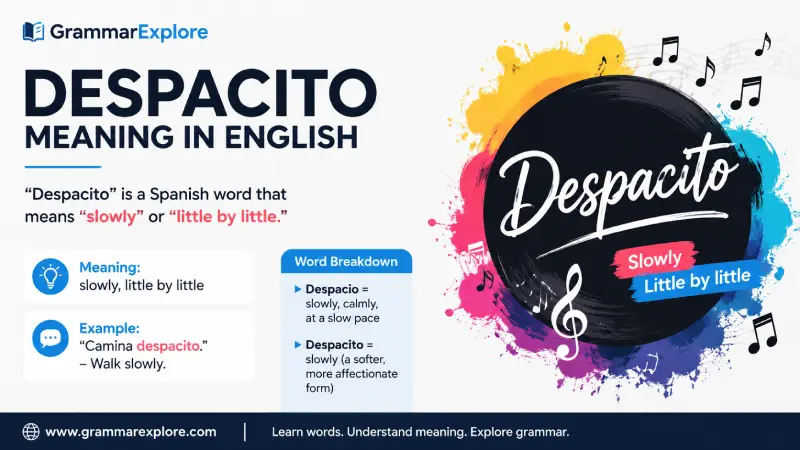
Despacito is a Spanish word that usually means “slowly” in English. Depending on the context, it can also mean “gently,” “softly,” or “quietly.” It is an adverb used to describe an action done in a slow, gentle, or quiet way.
The word became especially familiar to English-speaking audiences through the popular 2017 song “Despacito,” but its meaning in Spanish is broader than the song title alone.
Quick Answer
Despacito means “slowly” in English. It can also convey “gently,” “softly,” or “quietly,” depending on the sentence. The word comes from despacio, meaning “slowly,” with a diminutive form that can add a softer or gentler nuance.
What Does Despacito Mean?
The most common translation of despacito is “slowly.”
For example:
Vamos despacito.
Let’s go slowly.
Camina despacito.
Walk slowly.
SpanishDictionary also gives gently, softly, and quietly as possible translations when the context supports them.
So, although slowly is the simplest translation, the word can carry a sense of doing something carefully, gently, or without rushing.
Despacito vs. Despacio
Despacito and despacio both commonly translate as “slowly.” The main difference is the tone or nuance.
- despacio = slowly
- despacito = slowly, gently, softly
For example:
Habla despacio.
Speak slowly.
Habla despacito.
Speak slowly / Speak gently.
SpanishDictionary lists both words as adverbs meaning “slowly,” while despacito can also convey a softer or more delicate sense.
The diminutive ending -ito can add a sense of smallness, softness, or affection in Spanish, although its exact effect depends on context.
What Does Despacito Mean in the Song?
In the famous song “Despacito,” the title means “Slowly.” The word is used in a romantic and sensual context, where the singer describes moving slowly and taking his time.
The song’s title therefore does not mean “love,” “beautiful,” or “kiss.” Its direct meaning is “slowly.”
The song uses the word repeatedly to emphasize the idea of taking things slowly and deliberately.
Is Despacito a Spanish Word?
Yes. Despacito is a Spanish adverb.
It comes from despacio, which means “slowly.” The form despacito adds the diminutive -ito, giving the expression a softer or more delicate quality in suitable contexts. SpanishDictionary classifies despacito as an adverb.
How to Pronounce Despacito
Despacito is commonly pronounced:
dehs-pah-SEE-toh
SpanishDictionary gives the pronunciation approximately as /despaˈsito/.
The stress falls on the “si” syllable:
des-pa-CI-to
The c before i is pronounced like an s sound in most varieties of Spanish.
Does Despacito Mean Slowly or Gently?
Both translations can be correct, but “slowly” is the primary meaning.
The best translation depends on what action is being described.
For example:
La tortuga camina despacito.
The turtle walks slowly.
But:
Acaricia al bebé despacito.
Gently stroke the baby.
SpanishDictionary gives gently as a possible translation when despacito describes a delicate action.
Does Despacito Mean Quietly?
It can.
When despacito describes an action involving sound, “softly” or “quietly” may be more natural in English.
For example:
Háblame despacito.
Depending on context, this could mean:
Speak softly to me.
or:
Speak quietly to me.
SpanishDictionary provides both softly and quietly as possible contextual translations.
Examples of Despacito in Spanish
Here are natural examples:
- Vamos despacito.
Let’s go slowly. - Camina despacito.
Walk slowly. - Habla despacito.
Speak softly or slowly. - Hazlo despacito.
Do it slowly or gently. - La bebé duerme, así que entra despacito.
The baby is sleeping, so come in quietly. - La madre acarició despacito la cabeza del bebé.
The mother gently stroked the baby’s head.
These examples show why translating despacito as “slowly” every time can sometimes miss the intended nuance.
Is Despacito Formal or Informal?
Despacito is a normal Spanish word, not simply slang. It can appear in everyday speech and writing when the context calls for the meaning of slowly, gently, softly, or quietly.
Its tone can become more affectionate or expressive because of the diminutive -ito, but that does not make it slang.
Is Despacito a Romantic Word?
Not by itself.
Despacito simply means “slowly” in its basic use. It can appear in romantic or sensual contexts, as it does in the famous song, but the word itself is not inherently romantic.
For example:
Camina despacito porque el suelo está mojado.
This simply means:
Walk slowly because the floor is wet.
There is nothing romantic about this use.
Common Mistakes About Despacito
Mistake 1: Thinking Despacito Means “Love”
It does not. Despacito means “slowly,” not “love.”
Mistake 2: Assuming It Always Means “Slowly”
Slowly is the main translation, but gently, softly, and quietly can be more natural in certain contexts.
Mistake 3: Thinking It Is Only a Song Title
The word existed in Spanish before the famous song. It is a regular Spanish adverb that can be used independently in everyday language.
Frequently Asked Questions
What does despacito mean in English?
Despacito means “slowly” in English. Depending on context, it can also mean “gently,” “softly,” or “quietly.”
What does despacito mean in the song?
In the song “Despacito,” the word means “slowly.” The song uses it in a romantic and sensual context.
Is despacito a Spanish word?
Yes. Despacito is a Spanish adverb related to despacio, meaning “slowly.”
What is the difference between despacio and despacito?
Both can mean “slowly.” Despacito can add a softer, gentler, or more delicate nuance depending on context.
Does despacito mean gently?
It can. When describing a delicate action, despacito may be naturally translated as “gently.”
Is despacito a slang word?
No. Despacito is a standard Spanish word, although it became especially well known internationally because of the song with the same name.
Conclusion
Despacito means “slowly” in English. It can also mean “gently,” “softly,” or “quietly” when the context calls for those meanings.
The word is a normal Spanish adverb related to despacio, and its meaning is not limited to the famous song. In everyday Spanish, despacito can describe doing something slowly, carefully, gently, or quietly.