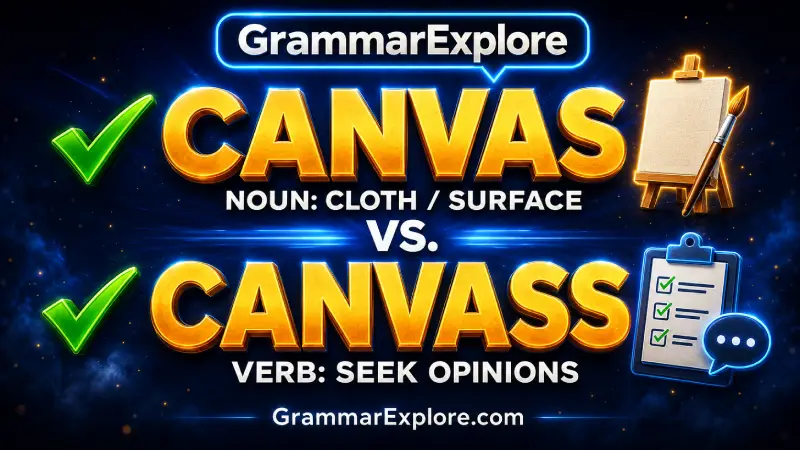
Canvas vs canvass becomes easier when you connect each spelling with its usual meaning. Canvas, with one final s, normally refers to a strong fabric or the surface on which an artist paints. Canvass, with two final s’s, usually means to visit people and seek their votes, opinions, support, or business.
An artist paints on a canvas, while campaign volunteers canvass a neighborhood. The words sound the same, but their spelling, meaning, and grammatical roles differ.
Canvas primarily functions as a noun, although it has a few less common verb uses. Canvass works as both a verb and a noun. As a verb, it describes gathering opinions, seeking support, or carefully examining something. As a noun, it names the organized effort or official review.
Quick Answer
Use canvas for strong fabric, an artist’s painting surface, or a setting for creative work:
- She painted the landscape on a large canvas.
Use canvass when someone seeks votes, support, orders, or opinions:
- Volunteers will canvass the neighborhood.
Remember: Artists use canvas; campaigners canvass.
What Does It Mean to Canvas the Area?
The phrase “canvas the area” is usually a misspelling of “canvass the area.” To canvass an area means to search, inspect, or gather information from people in a specific place.
Examples:
- Police canvassed the area to find witnesses.
- Volunteers canvassed the neighborhood to collect opinions.
What Are the Two Meanings of Canvas?
Canvas has two common meanings. As a noun, it means a strong fabric used for things like paintings, tents, and bags. It can also refer to a surface used for creating art.
Examples:
- The artist painted on a canvas.
- The tent was made from canvas material.
What Does the Word “Canvass” Mean?
Canvass is a verb that means to ask people for information, opinions, votes, or support. It is often used in politics, surveys, and investigations.
Examples:
- The campaign workers canvassed voters before the election.
- Investigators canvassed the neighborhood for clues.
What Does “Canvas” Mean in Slang?
In slang, canvas does not have a widely recognized special meaning. It usually keeps its standard meaning as a fabric, painting surface, or material. If someone uses canvas informally, the meaning depends on the context.
Tip:
- Canvas = fabric or painting surface.
- Canvass = ask, search, or gather information.
Why People Confuse Them
Canvas and canvass are homophones. American speakers generally pronounce both words as KAN-vuhs. Because pronunciation provides no reliable clue, writers must rely on meaning and spelling.
Only one letter separates them:
- Canvas ends in one s.
- Canvass ends in two s’s.
Their grammatical roles can also overlap. Canvas usually functions as a noun, while canvass commonly functions as a verb. However, canvass can also name an organized survey or an official examination of election results.
Rare dictionary variants create another complication. Some dictionaries recognize canvas as an alternate spelling of the verb canvass, and older or specialized writing may occasionally use canvass for the fabric. Modern writers should maintain the familiar distinction because it provides immediate clarity.
Key Differences At A Glance
| Feature | Canvas | Canvass |
|---|---|---|
| Usual meaning | Strong fabric or a painting surface | To seek votes, opinions, support, or orders |
| Main grammatical role | Noun | Verb and noun |
| Spelling | One final s | Two final s’s |
| Pronunciation | KAN-vuhs | KAN-vuhs |
| Common context | Art, tents, bags, shoes, sails | Elections, surveys, sales, public outreach |
| Example | The artist prepared a canvas. | Volunteers canvassed the district. |
The safest modern distinction is simple: choose canvas for material or art and canvass for questioning, campaigning, or seeking support.
Meaning And Usage Difference
What Does Canvas Mean?
Canvas commonly names a strong, closely woven fabric. Manufacturers often use it for tents, sails, bags, shoes, work clothes, and outdoor equipment.
- The tent uses waterproof canvas.
- He carried a heavy canvas backpack.
- These shoes have durable canvas uppers.
- The workers covered the equipment with canvas.
Artists also use canvas for the fabric surface on which they paint. The word can name the blank surface or the completed painting:
- She stretched the canvas over a wooden frame.
- The museum displayed three early canvases.
- He applied a thin layer of paint to the canvas.
The plural of canvas is canvases when the word refers to separate pieces of fabric, painting surfaces, or paintings:
- The studio contained several unfinished canvases.
Do not write canvasses for the normal plural of an artist’s canvas.
Figurative Meanings Of Canvas
Writers sometimes use canvas figuratively to mean a setting, background, or surface for creativity.
- The empty wall became her canvas.
- The city provides a colorful canvas for the story.
- The designer treated the small apartment as a blank canvas.
- The night sky formed a dark canvas for the fireworks.
The phrase blank canvas describes something that offers room for development, change, or creative expression.
- The unfinished basement gives us a blank canvas.
- For the new director, the project felt like a blank canvas.
Digital art and design programs may also call their main working area a canvas. Although no physical fabric exists, the digital space serves a similar purpose.
What Does Canvass Mean?
As a verb, canvass most commonly means to approach people and ask for votes, opinions, support, donations, subscriptions, or orders.
- Volunteers will canvass local neighborhoods this weekend.
- The organization canvassed residents about public transportation.
- Sales representatives canvassed the area for new customers.
- Researchers plan to canvass voters before the election.
Political campaigns frequently use the word for door-to-door or phone-based outreach:
- Campaign workers canvassed undecided voters.
- The candidate spent Saturday canvassing across the district.
- Volunteers went out to canvass for additional support.
The verb forms are:
- Base form: canvass
- Third-person singular: canvasses
- Past tense: canvassed
- Present participle: canvassing
Examples:
- She canvasses the neighborhood every Saturday.
- Volunteers canvassed more than 500 homes.
- The team is canvassing local business owners.
Because the base word already ends in two s’s, its inflected forms keep both letters.
Canvass Meaning Examine Or Discuss
Canvass can also mean to examine a subject carefully, gather views about it, or discuss its different aspects.
- The committee canvassed several possible solutions.
- Reporters canvassed public opinion on the proposal.
- The board will canvass the available options before voting.
This meaning does not always involve walking from door to door. The central idea involves collecting information or examining a matter thoroughly.
Canvass In Elections
Election officials may use canvass for the process of reviewing, verifying, and formally totaling election results. In this context, the word can function as either a verb or a noun.
As a verb:
- Election officials will canvass the returns.
As a noun:
- The county began its official canvass after Election Day.
A political campaign canvass and an official election canvass do not describe exactly the same activity. Campaign volunteers seek support before or during an election. Election officials examine and confirm results afterward.
Pronunciation
Canvas and canvass usually share the same pronunciation:
- Canvas: KAN-vuhs
- Canvass: KAN-vuhs
Both words place the stress on the first syllable. Since they sound alike, listeners use context to understand the intended meaning.
Compare:
- The artist bought a new canvas.
- The volunteers began to canvass.
The first sentence discusses art material. The second describes an outreach activity.
Tone, Context, And Formality
Both words belong to standard American English, but they appear in different settings.
Canvas sounds neutral and natural in discussions of:
- Painting and visual art
- Fabric and clothing
- Tents, bags, sails, and outdoor equipment
- Digital design
- Creative opportunities
- Backgrounds and settings
Canvass often appears in:
- Political campaigns
- Elections
- Surveys and public opinion research
- Sales and fundraising
- Community outreach
- Formal reviews and investigations
In casual political conversation, people may say knock on doors, talk to voters, or campaign door to door. Canvass expresses the same general idea more efficiently and professionally.
When discussing art or fabric, canvas remains the natural spelling. Adding the extra s may lead readers to think about elections, surveys, or outreach.
Which One Should You Use?
| Context | Best Choice | Why |
|---|---|---|
| A surface used for painting | Canvas | It names an art material |
| A completed painting | Canvas | It can name artwork on that material |
| Strong fabric for a tent or bag | Canvas | It names the fabric |
| A digital design workspace | Canvas | It acts like a creative surface |
| Asking residents for opinions | Canvass | It describes gathering views |
| Seeking votes door to door | Canvass | It describes political outreach |
| Looking for potential customers | Canvass | It describes solicitation |
| An official review of election returns | Canvass | Election authorities use this term |
| A broad creative opportunity | Canvas | The word works figuratively |
| An organized survey effort | Canvass | It names the outreach process |
Ask one quick question:
Does the sentence involve a material or creative surface, or does it involve seeking information or support?
- Material, painting, or creative surface → canvas
- Votes, opinions, support, orders, or examination → canvass
When One Choice Sounds Wrong
Using canvass for an artist’s surface creates unnecessary confusion:
- Incorrect: The artist painted on a large canvass.
- Correct: The artist painted on a large canvas.
The sentence refers to a painting surface, so canvas fits.
Using canvas for campaign activity also looks wrong in standard edited English:
- Incorrect: Volunteers will canvas the neighborhood for votes.
- Preferred: Volunteers will canvass the neighborhood for votes.
Some dictionaries record canvas as a variant of the verb canvass. Still, the double-s spelling provides greater clarity and remains the standard editorial choice for political outreach, surveys, and solicitation.
Another common error appears in the past tense:
- Incorrect: The campaign canvased the district.
- Correct: The campaign canvassed the district.
Keep both final s’s before adding -ed.
Common Mistakes And Quick Fixes
Using Canvass For Painting Material
Incorrect:
- She ordered a blank canvass online.
Correct:
- She ordered a blank canvas online.
A painting surface takes the one-s spelling.
Using Canvas For Political Outreach
Incorrect:
- The volunteers plan to canvas for the candidate.
Preferred:
- The volunteers plan to canvass for the candidate.
Use the double-s spelling for seeking political support.
Spelling The Plural Incorrectly
Incorrect:
- The gallery displayed six canvasses.
Correct:
- The gallery displayed six canvases.
Canvases is the standard plural of the art noun canvas.
Spelling The Verb Form Incorrectly
Incorrect:
- The organization is canvasing local residents.
Correct:
- The organization is canvassing local residents.
The verb canvass keeps both final s’s before -ing.
Confusing Canvases And Canvasses
Canvases usually serves as the plural of canvas:
- The painter bought three canvases.
It can also serve as a less common verb form when canvas means to cover something with canvas:
- The crew canvases the frame.
Canvasses is normally a verb form of canvass:
- She canvasses voters every weekend.
It may also serve as the plural of the noun canvass:
- The organization conducted two separate canvasses.
Everyday Examples
Examples With Canvas
The artist placed a fresh canvas on the easel.
We packed our supplies in a sturdy canvas bag.
The old canvas tent survived several storms.
She covered the floor with a heavy canvas sheet.
His largest canvas hangs in the main gallery.
White canvas shoes can stain easily.
The muralist treated the entire wall as her canvas.
The empty yard gave the landscaper a blank canvas.
I adjusted the size of the digital canvas.
The museum carefully stored the historic canvases.
Examples With Canvass
Volunteers will canvass the neighborhood on Saturday.
The campaign canvassed thousands of voters.
Researchers canvassed residents about the proposed park.
We need to canvass customer opinions before changing the product.
The charity began canvassing for monthly donations.
Sales representatives canvassed several nearby businesses.
The committee canvassed all available options.
Election officials met to canvass the results.
She spent the afternoon canvassing door to door.
The organization conducted a community canvass.
Examples With Both Words
The artist carried a canvas bag while volunteers canvassed the street.
Campaign workers asked a local artist to paint their sign on canvas before they began to canvass.
As Maya painted on her canvas, her neighbors canvassed voters nearby.
The community group displayed a painted canvas during its neighborhood canvass.
Volunteers used canvas tote bags while they canvassed local homes.
Dictionary-Style Word Details
Verb
- Canvas: Less commonly, to cover or provide something with canvas. Some dictionaries also recognize it as a variant spelling of canvass, but modern edited writing normally preserves the distinction.
- Canvass: To seek votes, opinions, support, donations, or orders; to survey people; or to examine something carefully.
Examples:
- Workers will canvas the canoe’s frame.
- Volunteers will canvass the district.
- The board canvassed several alternatives.
Noun
- Canvas: Strong woven fabric; a painting surface; a painting on that surface; or a figurative background for creativity.
- Canvass: An organized effort to gather opinions or support, or an official examination of election returns.
Examples:
- She painted the portrait on canvas.
- The campaign organized a weekend canvass.
- Officials completed the election canvass.
Synonyms
Closest plain alternatives for canvas include:
- Fabric
- Cloth
- Painting surface
- Backdrop
- Background
- Painting
These alternatives depend on context. Painting can replace canvas only when the word refers to finished artwork.
Closest alternatives for the verb canvass include:
- Survey
- Poll
- Interview
- Question
- Solicit
- Campaign
- Examine
- Discuss
No single antonym fits every meaning. Depending on context, contrasts for canvass might include ignore, avoid, or disregard, but these words do not act as exact opposites in every sentence.
Example Sentences
Canvas:
- A large canvas filled the studio wall.
- The sailor repaired the torn canvas.
- The new apartment gave us a blank canvas.
Canvass:
- Teams will canvass voters before the election.
- The researchers canvassed local business owners.
- Officials began the formal canvass of the results.
Word History
Canvas and canvass share a historical connection, although their modern meanings have separated.
Canvas developed as the word for a strong woven cloth. Canvass later gained meanings related to examining, discussing, questioning, and seeking support. Historical spellings sometimes overlapped, which helps explain why dictionaries may record occasional variants.
Modern writers benefit from keeping the spellings separate:
- Canvas for fabric and art
- Canvass for surveys, campaigning, solicitation, and examination
Phrases Containing
Common phrases with canvas include:
- Blank canvas
- Artist’s canvas
- Canvas painting
- Canvas bag
- Canvas shoes
- Canvas tent
- Canvas tarp
- Canvas print
- Digital canvas
- Oil on canvas
Common phrases with canvass include:
- Canvass voters
- Canvass a neighborhood
- Canvass for votes
- Canvass public opinion
- Canvass residents
- Door-to-door canvass
- Political canvass
- Election canvass
- Canvass the results
- Canvass the options
How To Remember Canvas vs Canvass
Use the extra s in canvass as a memory clue:
Canvass means to seek support or survey people.
The key words seek, support, and survey all begin with s, which matches the extra s in canvass.
For canvas, picture an artist standing at an easel. The artist uses a canvas with only one final s.
Another quick reminder is:
- An artist needs a canvas.
- A campaign needs to canvass.
Frequently Asked Questions
What is the main difference between canvas and canvass?
Canvas usually means a strong fabric or an artist’s painting surface. Canvass means to seek votes, opinions, support, donations, or orders. It can also mean to examine a subject or election results carefully.
Is it canvas or canvass for painting?
Use canvas for painting:
- She painted the portrait on canvas.
The standard plural is canvases.
Is it canvas or canvass a neighborhood?
Use canvass when people visit a neighborhood to seek votes, gather opinions, collect donations, or find customers:
- Volunteers will canvass the neighborhood.
What is the past tense of canvass?
The past tense is canvassed, with two s’s:
- The team canvassed the district last weekend.
What is the difference between canvases and canvasses?
Canvases is normally the plural of the art or fabric noun canvas. Canvasses usually means that someone seeks opinions or support:
- The studio stores several canvases.
- She canvasses voters each Saturday.
Canvasses can also name multiple organized survey efforts.
Can canvass function as a noun?
Yes. A canvass can mean an organized effort to gather support or opinions. It can also refer to an official review of election results.
- The campaign completed its neighborhood canvass.
- Officials began the election canvass.
What does a political canvass involve?
A political canvass usually involves contacting voters through door-to-door visits, phone calls, messages, or public events. Campaign workers may share information, ask about voter preferences, or encourage support.
What does canvass the votes mean?
To canvass the votes means to review and verify election returns as part of the official process for confirming results. This differs from asking people for their votes during a campaign.
Do canvas and canvass have different pronunciations?
No meaningful pronunciation difference exists in standard American English. Speakers generally pronounce both as KAN-vuhs. Context reveals which word they mean.
Conclusion
The difference between canvas and canvass depends on meaning and context.
Use canvas for strong fabric, an artist’s painting surface, finished artwork, or a figurative creative background:
- The painter prepared a blank canvas.
Choose canvass when someone gathers opinions, seeks votes or support, approaches potential customers, or examines election results:
- Volunteers will canvass local voters.
Remember the easiest rule: An artist uses a canvas, while a campaign sends people to canvass.