You may recognize hakuna matata from a movie, song, shirt, or travel slogan. However, the expression did not begin in popular entertainment. It comes from Swahili, also called Kiswahili, an important language in East Africa.
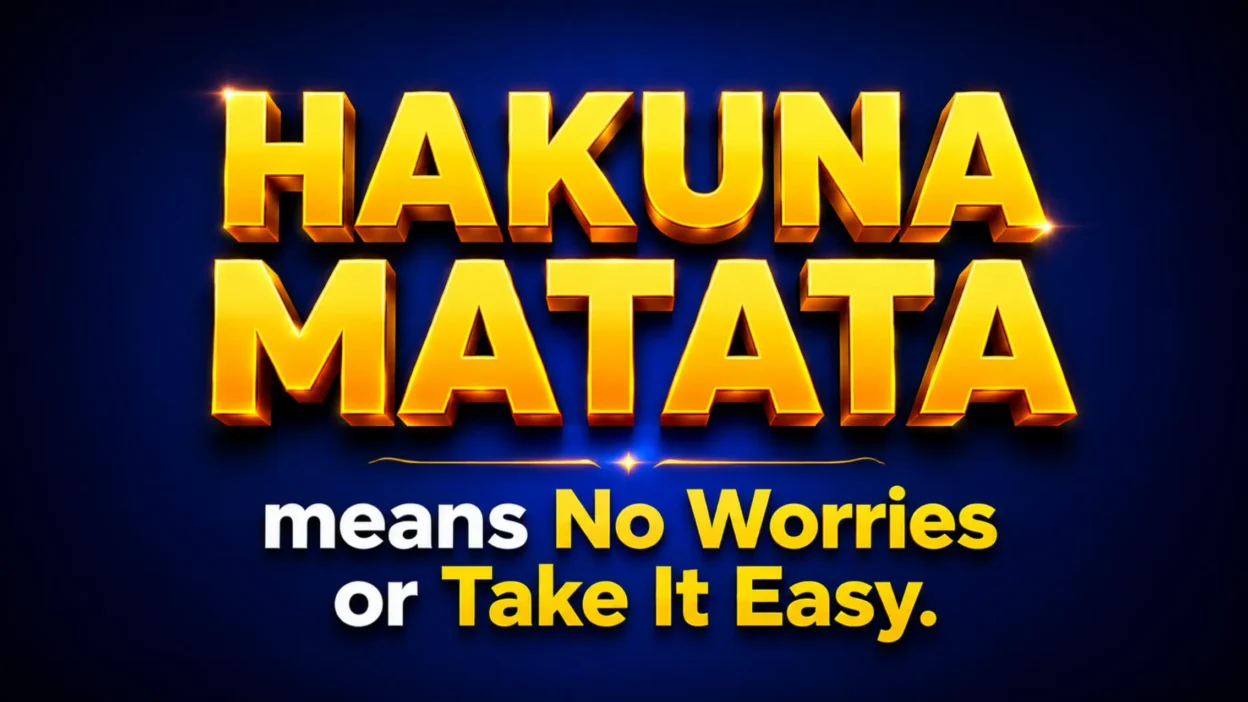
In natural English, the phrase means “no worries” or “no problem.” People use it to offer reassurance or express a relaxed attitude. Its literal translation is slightly different, though the main idea remains similar.
Knowing its background helps you use the phrase respectfully and accurately. It also prevents a common misunderstanding about who created it. This guide explains its English meaning, pronunciation, grammar, history, and cultural context. You will also learn when the expression sounds natural and when another phrase may work better.
Quick Answer
Hakuna matata meaning in English is “no worries,” “no problems,” or “don’t worry.” It is a real Swahili expression from East Africa.
The phrase reassures someone that everything is fine or manageable.
TL;DR
- • Hakuna matata is a Swahili expression.
- • It naturally means “no worries” in English.
- • Its literal meaning is “there are no troubles.”
- • It has a friendly, relaxed tone.
- • Popular entertainment made it famous worldwide.
- • Everyday Swahili usage varies by region.
What Does “Hakuna Matata” Mean in English?
The most natural English translation is “no worries.” Depending on the situation, it can also mean:
• No problem
- • Don’t worry
- • Everything is fine
- • It’s all good
- • Take it easy
The expression usually offers reassurance. Someone might say it after a small mistake, apology, or concern.
Example:
“Sorry I arrived a few minutes late.”
“Hakuna matata. We haven’t started yet.”
Here, the phrase means “No problem” or “Don’t worry about it.”
It can also express a calm attitude toward life. In that context, it suggests avoiding unnecessary worry rather than ignoring real responsibilities.
Literal Word-by-Word Meaning
The phrase contains two Swahili words:
| Word | Basic meaning | Role in the phrase |
|---|---|---|
| Hakuna | There is no or there are no | Shows absence |
| Matata | Troubles, problems, or complications | Names what is absent |
Together, the words literally mean “there are no troubles” or “there are no problems.”
English speakers usually translate the complete expression as “no worries.” A natural translation communicates the intended feeling, not only the individual words.
The word matata is plural. It refers to troubles, problems, disputes, or difficult complications.
Pronunciation and Part of Speech
A simple Swahili-style pronunciation is:
hah-KOO-nah mah-TAH-tah
Say each vowel clearly:
- • ha sounds like “hah.”
- • ku sounds like “koo.”
- • na sounds like “nah.”
- • ma-ta-ta has three clear syllables.
Many Americans pronounce the first word as huh-KOO-nuh. That version is widely recognized in American English.
In grammar, hakuna matata is a phrase or fixed expression. In English conversation, it can function like an interjection.
Example:
“Hakuna matata! We can fix it tomorrow.”
It is not normally treated as a single English noun, verb, adjective, or adverb.
How to Use “Hakuna Matata”
Use the phrase in friendly and informal situations. It works best when the issue is small or manageable.
To respond to an apology
“Sorry I spilled some water.”
“Hakuna matata. I’ll get a towel.”
To reassure someone
“I’m worried that we might miss the bus.”
“Hakuna matata. Another one arrives in ten minutes.”
To express a relaxed mood
“We have the whole afternoon. Hakuna matata!”
As a personal reminder
“Today, I’m taking things slowly. Hakuna matata.”
The phrase usually sounds cheerful and lighthearted. It may feel unsuitable during a serious emergency or painful situation.
Avoid using it to dismiss another person’s real concern.
Insensitive: “You lost your job? Hakuna matata!”
Better: “I’m sorry. Let’s think about how I can help.”
Origin and Cultural Context
Hakuna matata comes from Swahili, or Kiswahili. Swahili developed along the East African coast and is spoken across several countries.
The phrase existed before it became famous in American popular culture. Songs and tourism had already helped spread it beyond ordinary conversation.
The animated movie The Lion King, released in 1994, introduced the expression to a much larger international audience. Its characters use the phrase as a cheerful motto about living without unnecessary worry.
That portrayal captures its reassuring tone. However, the expression belongs to the Swahili language and East African culture. It was not invented for the movie.
Today, English speakers may use it humorously or positively. They often connect it with calmness, optimism, and letting go of minor stress.
Is “Hakuna Matata” Common in Everyday Swahili?
The phrase is real and understandable to Swahili speakers. However, its everyday frequency varies by country, region, and social setting.
In some tourist areas, visitors may hear hakuna matata often. Speakers may use it because international travelers recognize it easily.
Some Swahili speakers prefer expressions such as:
- • Hamna shida, There is no problem.
- • Hakuna shida, No problem.
- • Hakuna tatizo, There is no problem.
These alternatives may sound more ordinary in certain communities. No single statement describes every Swahili-speaking region.
Therefore, it is accurate to call hakuna matata a real Swahili phrase. It is less accurate to claim that every speaker uses it constantly.
Synonyms, Related Phrases, and Opposites
Several English expressions communicate a similar idea:
- • No worries , friendly reassurance
- • No problem , response to thanks or an apology
- • Don’t worry , direct reassurance
- • It’s okay , says that a situation is acceptable
- • Take it easy , encourages someone to relax
- • It’s all good , very informal reassurance
These phrases are close equivalents, not perfect word-for-word synonyms. Context determines the best choice.
- There is no fixed English antonym. Possible opposite ideas include:
- • There is a problem.
- • We should be concerned.
- • Things are not okay.
In Swahili, kuna matata expresses the opposite basic idea: “There are problems.”
Common Mistakes and Misunderstandings
Thinking the phrase came from a movie
The phrase is older than its famous movie use. It comes from Swahili and East African linguistic culture.
Translating it only as “be happy”
“Hakuna matata” does not directly mean “be happy.” Its closer meaning is “no worries” or “there are no problems.”
Treating it as formal English
The phrase is informal in English. Avoid placing it in formal reports, legal writing, or serious business correspondence.
Assuming everyone uses it frequently
Swahili speakers use different expressions across regions. Hamna shida or hakuna shida may be more common in some places.
Using it to dismiss serious problems
The phrase works well for minor concerns. It should not minimize grief, danger, illness, or other serious difficulties.
Misspelling the expression
Incorrect: Hakuna matada
Incorrect: Hakuna matatta
Correct: Hakuna matata
Mini Quiz
1. What is the most natural English meaning of “hakuna matata”?
A. Good morning
B. No worries
C. Thank you
2. What language does the phrase come from?
A. Swahili
B. Spanish
C. French
3. What does “matata” refer to?
A. Friends
B. Songs
C. Troubles or problems
4. Which pronunciation is closest to Swahili?
A. hah-KOO-nah mah-TAH-tah
B. HACK-nah MAY-tah
C. hah-KOON mat
5. Is the expression suitable for every serious situation?
A. Yes
B. No
Answer key: 1-B, 2-A, 3-C, 4-A, 5-B.
Frequently Asked Questions
What does “hakuna matata” mean in English?
It means “no worries,” “no problems,” or “don’t worry.” People use it to reassure someone or express a relaxed attitude.
Its literal translation is close to “there are no troubles.”
What language is “hakuna matata”?
It comes from Swahili, also known as Kiswahili. Swahili is spoken widely across East Africa.
The phrase entered international English through music, tourism, and popular entertainment.
Is “hakuna matata” a real Swahili phrase?
Yes, it is a real Swahili expression. It was not created for an American movie.
However, its frequency in daily conversation varies between regions and speakers.
How do you pronounce “hakuna matata”?
A simple guide is hah-KOO-nah mah-TAH-tah. Keep the vowels clear and pronounce every syllable.
American speakers may pronounce some vowels more softly.
Does it literally mean “no worries”?
The natural English meaning is “no worries.” A closer word-for-word translation is “there are no troubles” or “there are no problems.”
Both translations communicate the same general reassurance.
How should you respond to “hakuna matata”?
You can smile, say “thank you,” or repeat the phrase. The best response depends on why the person said it.
If it follows an apology, “Thanks for understanding” also works naturally.
Do people commonly say it in East Africa?
People recognize the phrase, especially in tourism settings. Everyday usage differs across Swahili-speaking communities.
Some speakers commonly use hamna shida or hakuna shida instead.
Conclusion
The hakuna matata meaning in English is “no worries,” “no problems,” or “everything is fine.” It is a genuine Swahili expression with roots in East Africa.
Use it casually to offer reassurance, while respecting its original language and context.