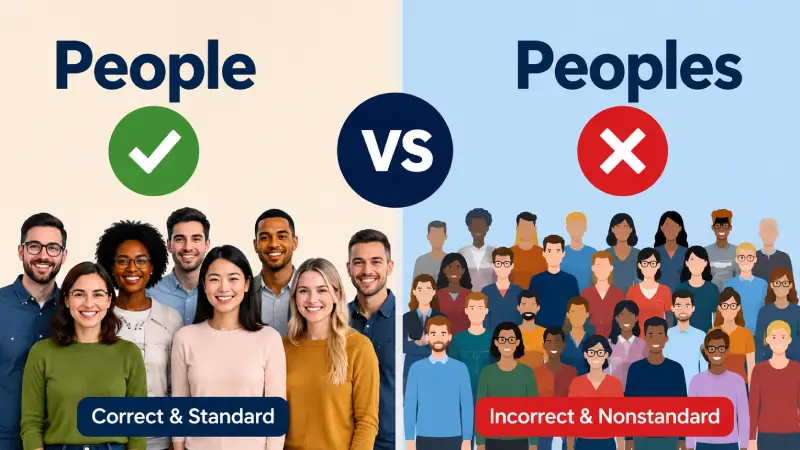
“People” and “peoples” are both correct words, but they are not used in the same way.
In everyday American English, people is the normal choice when talking about more than one person. However, peoples is used when referring to multiple distinct groups of people, especially groups with their own culture, history, or identity.
The difference is simple:
- People = individuals or a general group of persons
- Peoples = separate groups or nations of people
Choosing the right word depends on what you mean.
Quick Answer
Use people when you mean ordinary groups of individuals.
Example:
- Many people enjoy traveling.
Use peoples when you mean different cultural, ethnic, or national groups.
Example:
- The museum celebrates the traditions of Indigenous peoples.
In most everyday situations, people is the correct choice.
Is “peoples'” ever grammatically correct?
Yes, “peoples’” is grammatically correct, but it is rarely used. It refers to something belonging to multiple groups of people, such as different cultures or nations.
What is the difference between people and peoples?
People and peoples are not the same.
People is the common word for humans or a group of individuals. Peoples refers to different groups or communities with their own cultures, identities, or traditions.
Persons vs People vs Peoples
- Persons, people, and peoples are not the same.
- Persons means individual human beings and is often used in formal or legal language. People is the normal plural form of person. Peoples means multiple distinct groups of people.
Persons vs. People vs. Peoples, What’s the Difference?
The difference is in meaning and usage: persons focuses on individuals, people refers to a group of individuals, and peoples refers to separate cultural, ethnic, or national groups. In most everyday situations, people is the correct choice.
Why People Confuse Them
Many writers assume that peoples is simply the plural form of people. However, the meaning changes when the extra “s” is added.
The word people already works as a plural noun in common English.
Example:
- Three people are waiting outside.
Adding an “s” does not usually mean “more people.” Instead, peoples separates groups from one another.
Example:
- The peoples of the Pacific Islands have diverse traditions.
Here, “peoples” refers to different communities, not just a large number of individuals.
Key Differences At A Glance
| Context | Best Choice | Why |
|---|---|---|
| Talking about individuals | People | Refers to persons in general |
| Everyday conversation | People | Common modern usage |
| A crowd or group | People | Describes multiple individuals |
| Different cultural groups | Peoples | Highlights separate identities |
| Historical or academic discussions | Peoples | Refers to distinct communities |
Feature | People | Peoples
| Feature | People | Peoples |
|---|---|---|
| Main meaning | More than one person | Multiple distinct groups |
| Common usage | Everyday English | Specific cultural or social contexts |
| Refers to | Individuals | Separate communities |
| Frequency | Very common | Less common |
Meaning and Usage Difference
People
People is the standard plural form used when discussing two or more individuals.
Examples:
- The people at the concert enjoyed the show.
- Many people work from home.
- People often learn from experience.
It can also refer to a group in a general sense.
Example:
- Young people use technology in many ways.
Peoples
Peoples refers to different groups of people who are considered separately because of shared identity, culture, language, history, or traditions.
Examples:
- The Indigenous peoples of North America have diverse cultures.
- The book describes the ancient peoples of Europe.
In these examples, the word emphasizes separate groups rather than individual persons.
Tone, Context, and Formality
People works in almost every situation, including casual conversations, news writing, business communication, and everyday speech.
Examples:
- People need reliable information.
- Many people attended the meeting.
Peoples is more specialized. It often appears in academic, historical, legal, or cultural discussions.
Examples:
- The rights of Indigenous peoples are discussed in the report.
- Ancient peoples developed unique traditions.
Using peoples in normal daily conversation can sound unusual if you only mean “many people.”
Incorrect:
- Many peoples attended the football game.
Better:
- Many people attended the football game.
Which One Should You Use?
Ask yourself what you are describing.
Use people if you mean:
- individuals
- a crowd
- a general group
- humans in general
Use peoples if you mean:
- separate cultures
- different nations
- distinct communities
- groups with their own identities
A simple test:
If you can replace the word with “persons,” use people.
Example:
- Several people joined the event.
- Several persons joined the event.
If you are comparing different communities, peoples may be the better choice.
Example:
- The history of the world’s peoples is complex.
When One Choice Sounds Wrong
Peoples often sounds incorrect when used as a simple replacement for “people.”
Incorrect:
- Five peoples are waiting in line.
Correct:
- Five people are waiting in line.
The first sentence suggests five separate groups, not five individuals.
However, peoples is correct when different groups are being discussed.
Correct:
- The traditions of many peoples are represented at the festival.
Here, the sentence refers to different communities.
Common Mistakes (and Quick Fixes)
Mistake 1: Using “peoples” for a large number of people
Incorrect:
- Thousands of peoples visited the city.
Correct:
- Thousands of people visited the city.
Mistake 2: Thinking “peoples” is always wrong
Incorrect idea:
- Peoples is never correct.
Correct:
- Peoples is correct when discussing separate groups.
Example:
- The rights of native peoples are protected.
Mistake 3: Confusing groups with individuals
Incorrect:
- The peoples in the room were talking.
Correct:
- The people in the room were talking.
The sentence describes individuals in one group, so “people” fits.
Everyday Examples
People:
- Many people enjoy watching movies.
- The people in my neighborhood are friendly.
- People use different methods to solve problems.
Peoples:
- The festival celebrates the peoples of Latin America.
- Historians study ancient peoples and their traditions.
- Different peoples have developed unique languages and customs.
Dictionary-Style Word Details
Verb
People: Can function as a verb meaning “to fill or populate a place.”
Example:
- New residents began to people the growing town.
Peoples: Not commonly used as a verb in standard US English.
Noun
People: A plural noun meaning more than one person or a group of individuals.
Example:
- Many people attended the event.
Peoples: A plural noun referring to multiple distinct groups of people.
Example:
- The region is home to many peoples.
Synonyms
People: Closest plain alternatives:
- persons
- individuals
- humans
Peoples: Closest plain alternatives:
- communities
- groups
- nations
These alternatives depend on the exact meaning of the sentence.
Example Sentences
People:
- People often choose products based on reviews.
- Many people enjoy outdoor activities.
Peoples:
- The exhibit explains the traditions of different peoples.
- The story focuses on the lives of ancient peoples.
Word History
The word people has been used in English for centuries and developed meanings connected to both individuals and groups.
The form peoples developed as a way to refer to multiple separate groups of people rather than simply a larger number of individuals.
Phrases Containing
People:
- ordinary people
- young people
- people around the world
- people in general
Peoples:
- Indigenous peoples
- different peoples
- ancient peoples
- peoples of the world
Frequently Asked Questions
Is “peoples” a correct word?
Yes, “peoples” is a correct word. It is used when referring to different groups of people, especially groups with their own culture, history, or identity.
What is the difference between people and peoples?
People refers to individuals or a general group of persons, while peoples refers to multiple distinct groups or communities.
Is peoples just the plural of people?
No. In most everyday situations, people is already the plural form of person. Peoples has a special meaning and usually refers to separate groups of people.
When should I use peoples instead of people?
Use peoples when you are talking about different cultural, ethnic, or historical groups.
Example:
The traditions of Indigenous peoples are diverse.
Can I use people and peoples interchangeably?
No. They are not interchangeable. Using peoples when you only mean individuals can sound incorrect.
Which is more common: people or peoples?
People is much more common in everyday English. Peoples is used in more specific contexts, such as discussions about cultures, communities, or history.
Conclusion
Both people and peoples are correct, but they serve different purposes.
Use people for everyday situations involving individuals or general groups.
Use peoples when you are talking about separate communities, cultures, or groups with distinct identities.
For most writing and conversation, people will be the right choice. Use peoples only when the group distinction matters.