
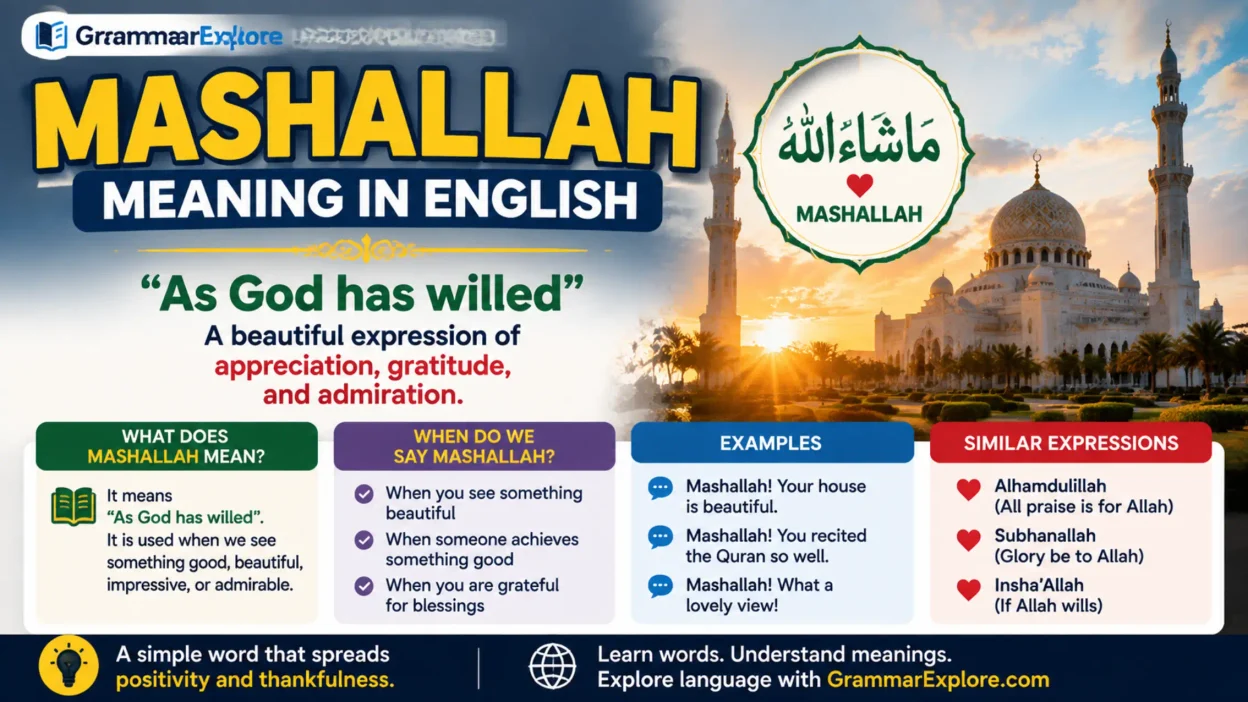
The Arabic expression Mashallah means “what God has willed,” “as God has willed,” or “God has blessed it” in English. It is commonly used by Muslims and Arabic speakers to express appreciation, gratitude, admiration, or recognition of something good.
People often say Mashallah when praising a person, achievement, appearance, success, or a positive event. The phrase carries a sense of acknowledging that blessings and good things come through God’s will.
Although the expression has religious roots, it is also used culturally in many Arabic-speaking communities as a respectful way to show admiration.
Mashallah means “what God has willed” in English. But what does Mashallah actually mean when someone says it after a compliment, achievement, or good news?
The Arabic expression is commonly used to show admiration, appreciation, and recognition of a blessing. In this guide, you’ll learn what Mashallah means, how to pronounce it, when to say it, and how it differs from Inshallah and Alhamdulillah.
Quick Answer
Mashallah means “what God has willed” in English. It is an Arabic expression used to show appreciation, praise, or gratitude for something good while recognizing God’s will. People often say it when admiring someone’s success, beauty, or blessings.
Mashallah means “what God has willed” in English. People commonly say it when admiring someone or something positive, such as a person’s appearance, success, child, home, or achievement. It expresses admiration while recognizing the blessing as connected to God’s will.
Mashallah Meaning Explained
The word Mashallah (ما شاء الله) comes from Arabic.
It is made from:
- Ma (ما) = what
- Sha’a (شاء) = willed or wanted
- Allah (الله) = God
Together, the phrase means:
“What God has willed.”
The expression is often used when someone sees something positive and wants to acknowledge it respectfully.
Examples:
Mashallah, your home is beautiful.
Meaning:
“Your home is beautiful, and this blessing is recognized as coming from God’s will.”
Mashallah, you did a great job.
Meaning:
“This achievement is admirable and blessed.”
“What Does Mashallah Mean When Someone Says It?”
Mashallah Meaning Explained ke baad add karo.
“How Do You Respond to Mashallah?”
Common Situations Where People Say Mashallah ke baad add karo.
Is H2 ke andar response examples do, phir FAQ wala “How do you respond to Mashallah?” remove kar do, kyunki same intent hai.
“What Does Mashallah Mean in Texting?”
Is Mashallah Only Used by Muslims? ke baad add karo.
What Does Mashallah Mean When Someone Says It?
When someone says “Mashallah,” they are usually expressing admiration, appreciation, or recognition of something positive. The exact meaning depends on the situation, but it often suggests that the person sees something as a blessing and acknowledges that it exists by God’s will.
For example, if someone says, “Mashallah, your new house is beautiful,” they are complimenting the house while recognizing it as a blessing.
People may say Mashallah when talking about:
- someone’s beauty or appearance
- a child or family
- academic or career success
- a new home or possession
- an achievement
- good fortune or a positive event
In everyday conversation, Mashallah can work alongside a compliment rather than replacing the compliment itself. It adds a respectful or appreciative tone to what the speaker is saying.
How Do You Respond to Mashallah?
There is no single required response when someone says “Mashallah.” The appropriate response depends on the context and the relationship between the speakers.
A simple “Thank you” is a natural response when Mashallah is used as part of a compliment.
For example:
“Mashallah, your daughter is doing very well in school.”
You could respond:
“Thank you.”
Some Muslims may also respond with “Alhamdulillah,” meaning “praise be to God” or “all praise is due to God,” especially when acknowledging a blessing or achievement.
The important point is that Mashallah does not require one fixed reply. A person can respond politely according to the situation.
What Does Mashallah Mean in Texting?
In texting and online conversations, Mashallah has essentially the same meaning as it does in spoken Arabic. People may use it when reacting positively to a photo, achievement, announcement, or other good news.
For example:
“I finally graduated!”
A friend might reply:
“Mashallah! Congratulations!”
Someone might also comment:
“Mashallah, beautiful family.”
or:
“Mashallah, your new car looks amazing.”
You may see several spellings online, including Mashallah, MashaAllah, Masha Allah, and Ma Sha Allah. These are different English transliterations of the Arabic expression ما شاء الله.
In texting, Mashallah is often used as a short expression of admiration, praise, or appreciation, especially when someone shares something positive on social media.
What Does Mashallah Mean When Someone Says It?
Is mein explain karo ke context ke according ye:
recognition of a blessingWhat Is the Purpose of Saying Mashallah?
admiration
appreciation
praise
People use Mashallah for several reasons:
Showing Appreciation
It can express admiration without jealousy or negativity.
Example:
“Your child is very talented, Mashallah.”
Meaning:
The speaker is praising the child while recognizing the blessing.
Expressing Gratitude
Some people say Mashallah when they experience or see something good.
Example:
“Mashallah, we finally completed the project.”
Meaning:
A positive achievement is being appreciated.
Acknowledging God’s Will
For many Muslims, the phrase reminds them that blessings ultimately come from God.
Is Mashallah a Religious Word?
Yes, Mashallah has religious origins, especially in Islam.
However, people do not limit its use to formal religious settings. Many Arabic-speaking people use it in daily conversations to express admiration or appreciation.
People may use it in:
- family conversations
- celebrations
- compliments
- social gatherings
- discussions about achievements
The meaning depends on the speaker’s culture and intention.
How Do You Pronounce Mashallah?
A common English pronunciation is:
muh-SHAH-lah
The stress is usually placed on the second syllable:
ma-SHA-llah
The pronunciation may vary slightly among different Arabic-speaking communities.
How Do You Respond to Mashallah?
“Thank you.”
“Alhamdulillah.”
“Thank you, I appreciate it.”
Mashallah vs Inshallah: Difference
Many people confuse Mashallah and Inshallah because both contain the word Allah.
| Expression | Meaning | When Used |
|---|---|---|
| Mashallah | What God has willed | When appreciating something that already happened or exists |
| Inshallah | If God wills | When talking about future plans |
Examples:
Mashallah, you passed your exam.
= Congratulations, this is a blessing.
Inshallah, I will pass my exam.
= I hope I will pass, if God wills.
Mashallah vs Alhamdulillah: Difference
Both expressions show gratitude but are used differently.
| Expression | Meaning |
|---|---|
| Mashallah | Recognition or admiration of a blessing |
| Alhamdulillah | Praise and thanks to God |
Example:
Someone sees a beautiful house:
“Your house is amazing, Mashallah.”
The homeowner responds:
“Alhamdulillah.”
Meaning:
“All praise and thanks belong to God.”
Is Mashallah Only Used by Muslims?
People strongly associate Mashallah with Muslim communities, but many Arabic speakers also use it as a cultural expression regardless of their religious background.
Its use depends on:
- language
- culture
- personal beliefs
- social context
Common Situations Where People Say Mashallah
About Children
Example:
“Mashallah, your baby is adorable.”
Meaning:
A respectful compliment expressing admiration.
About Success
Example:
“Mashallah, she graduated with excellent results.”
Meaning:
People are praising her achievement.
About Appearance
Example:
“Mashallah, you look great today.”
Meaning:
A compliment with a respectful tone.
About Possessions
Example:
“Mashallah, that is a beautiful car.”
Meaning:
The speaker admires the car.
Common Mistakes About Mashallah
Mistake 1: Translating Mashallah only as “thank you”
Mashallah does not mean thank you.
It expresses admiration, appreciation, or recognition of a blessing.
Mistake 2: Using Mashallah only for religious events
People commonly use the phrase in everyday situations, not only in religious contexts.
Mistake 3: Confusing Mashallah with Inshallah
Mashallah refers to something admired or already present.
Inshallah refers to something hoped for in the future.
Examples of Mashallah in Sentences
Example 1
“Your artwork is beautiful, Mashallah.”
Meaning:
The speaker admires the artwork.
Example 2
“Mashallah, he achieved his goal after years of hard work.”
Meaning:
His success is being appreciated.
Example 3
“Mashallah, the garden looks amazing.”
Meaning:
The garden is admired respectfully.
Example 4
“She said Mashallah after seeing her friend’s achievement.”
Meaning:
She expressed admiration and appreciation.
Mashallah, MashaAllah, or Ma Sha Allah?
Explain that English transliteration varies, while the Arabic phrase is:
ما شاء الله
This gives you another strong search-intent angle without making the article repetitive.
What Does Mashallah Mean in Texting?
Explain that people may write:
- Mashallah
- MashaAllah
- Ma Sha Allah
- Masha Allah
Then explain that these are different ways of writing/transliterating the same Arabic expression.
Related Arabic Expressions
Alhamdulillah
Meaning:
Praise be to God / Thanks to God.
Inshallah
Meaning:
If God wills.
Subhanallah
Meaning:
Glory be to God; often used when expressing amazement.
Allahu Akbar
Meaning:
God is the greatest.
Frequently Asked Questions
What does Mashallah mean in English?
Mashallah means “what God has willed” or “as God has willed.” People use it to express admiration, appreciation, and recognition of blessings.
When should you say Mashallah?
People commonly say Mashallah when praising someone’s success, appearance, achievements, or good fortune.
Is Mashallah Arabic or Islamic?
Mashallah is an Arabic phrase that people strongly associate with Islam. Many Arabic speakers also use it in cultural contexts.
What is the difference between Mashallah and Inshallah?
People use Mashallah to appreciate something that exists or has happened. They use Inshallah when discussing future hopes or plans.
Is Mashallah a compliment?
Mashallah is often used alongside compliments, but it is more accurately an expression of admiration and recognition of a blessing.
Mini Quiz: Test Your Knowledge
1. What does Mashallah mean in English?
A) Goodbye
B) What God has willed
C) Good morning
D) Thank you
Answer: B) What God has willed
2. What language does Mashallah come from?
A) Spanish
B) Arabic
C) French
D) German
Answer: B) Arabic
3. When is Mashallah commonly used?
A) When criticizing someone
B) When admiring something positive
C) When saying goodbye
D) When asking a question
Answer: B) When admiring something positive
4. Which phrase refers to future hopes?
A) Mashallah
B) Inshallah
C) Hello
D) Shukran
Answer: B) Inshallah
Conclusion
Mashallah means “what God has willed” in English and is used to express admiration, appreciation, and recognition of blessings. The Arabic phrase carries cultural and religious importance and is commonly used when praising someone or something positive.
Understanding Mashallah helps English speakers appreciate its deeper meaning. It is not simply a translation of “wow” or “beautiful”; it reflects respect, gratitude, and acknowledgment of God’s will.


