
If you have heard the phrase Kama Sutra and wondered what it means in English, the term has a broader meaning than simply “a book about sex.”
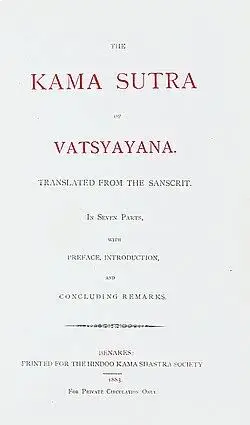
Kama Sutra is the name of an ancient Sanskrit text traditionally attributed to Vātsyāyana. The title is commonly translated as “Aphorisms on Love” or “Teachings on Love and Desire.” The work discusses love, desire, relationships, courtship, marriage, social life, and sexual relationships.
The text is part of the classical Indian tradition of writing about kama, a Sanskrit concept associated with desire, pleasure, and sensual enjoyment.
Quick Answer
Kama Sutra means roughly “Aphorisms on Love” or “Teachings on Desire and Pleasure” in English. It comes from Sanskrit and refers to an ancient Indian text traditionally attributed to Vātsyāyana. Although it contains material about sexual relationships, the Kama Sutra is a broader work covering love, courtship, marriage, relationships, and the pursuit of pleasure.
What Does Kama Sutra Mean in English?
The phrase Kama Sutra comes from Sanskrit.
It is commonly broken into two parts:
- Kama , desire, love, pleasure, or sensual enjoyment
- Sutra , a concise teaching, rule, aphorism, or thread of instruction
Together, Kama Sutra can be understood as:
“Aphorisms on Love and Desire”
or more broadly:
“Teachings on Love, Desire, and Pleasure.”
The exact English wording varies between translations because Sanskrit terms often carry meanings that do not fit perfectly into a single English word.
What Is the Kama Sutra?
The Kama Sutra is an ancient Sanskrit work associated with Vātsyāyana, an Indian philosopher traditionally believed to have lived during the early centuries of the Common Era.
It is best known today for its discussion of sexual relationships, but that represents only part of the work.
The text also addresses topics connected with:
- love
- courtship
- marriage
- relationships
- attraction
- social behavior
- pleasure
- household life
- personal conduct
Therefore, describing the Kama Sutra simply as “an ancient sex manual” is an incomplete explanation.
What Does “Kama” Mean?
The Sanskrit word kama has a broader meaning than the English word sex.
Depending on context, kama can refer to:
- desire
- pleasure
- love
- attraction
- sensual enjoyment
- longing
In Indian philosophical traditions, kama can refer to the pursuit of pleasure as one aspect of human life.
That is why translating kama simply as “sex” can miss much of its meaning.
What Does “Sutra” Mean?
Sutra is another Sanskrit term.
Literally, sutra is associated with the idea of a thread, but it also refers to a concise statement or teaching that presents knowledge in a compact form.
The term appears in the names of many classical Indian works.
So, in Kama Sutra, sutra refers to a collection of concise teachings or aphorisms concerning kama.
Is Kama Sutra the Same as a Sex Manual?
Not exactly.
The modern Western image of the Kama Sutra often focuses heavily on sexual positions. However, the original work covers a much wider range of subjects involving love, relationships, social conduct, marriage, and pleasure.
Sexual relationships are an important part of the text, but they are not the entirety of its subject.
This distinction is useful when explaining what Kama Sutra actually means.
Who Wrote the Kama Sutra?
The Kama Sutra is traditionally attributed to Vātsyāyana, whose full name is often given as Mallanaga Vātsyāyana.
He is generally regarded as the compiler or author of the work, although the text draws on earlier traditions and writings.
The exact details of Vātsyāyana’s life are not known with certainty.
When Was the Kama Sutra Written?
The Kama Sutra is generally dated to the early centuries CE, although scholars discuss the precise date.
It belongs to the classical Sanskrit literary tradition of India.
Because the text draws upon earlier material, its intellectual background is older than the surviving work itself.
Is Kama Sutra a Hindu Book?
The Kama Sutra developed within the classical Indian and Sanskrit intellectual tradition, which was closely connected with the broader religious and philosophical culture of ancient India.
However, calling it simply a “religious book” would be misleading.
It is primarily a work concerning kama, desire, pleasure, love, relationships, and social life rather than a scripture in the same sense as a sacred religious text.
What Does Kama Sutra Teach?
The work discusses different aspects of relationships and human pleasure.
Among its themes are:
Love and Attraction
The text considers how people develop attraction and form romantic relationships.
Courtship
It discusses social behavior and approaches to forming relationships.
Marriage
Marriage and household relationships receive significant attention.
Social Conduct
The work also explores manners, behavior, and social expectations.
Pleasure
Pleasure and sensual enjoyment are central to the concept of kama.
Sexual Relationships
The text also contains discussions of sexual relationships, which is the part that has become most famous in modern popular culture.
Kama Sutra Meaning in Modern English
Today, people often use Kama Sutra to refer specifically to the ancient Indian text or, more loosely, to ideas associated with romantic and sexual relationships.
For example:
I bought a translation of the Kama Sutra.
Here, the speaker means the ancient Sanskrit work.
Someone might also say:
The Kama Sutra is often misunderstood in popular culture.
Here, the phrase refers to the historical text and its broader subject matter.
Is Kama Sutra an English Word?
Kama Sutra is not originally an English expression.
It is a Sanskrit title that has been adopted into English and many other languages.
English speakers commonly use the phrase Kama Sutra when discussing the historical Indian text.
Because it is a borrowed term, English dictionaries may treat it as a proper noun or established cultural term rather than an ordinary English word.
How Do You Pronounce Kama Sutra?
In English, it is commonly pronounced approximately:
KAH-muh SOO-truh
The Sanskrit pronunciation can differ somewhat from common English pronunciation.
The phrase has two main parts:
Kama → KAH-muh
Sutra → SOO-truh
Is Kama Sutra a Phrase or a Book?
Kama Sutra is primarily the title of a classical Sanskrit text.
The phrase itself is also used in English when people discuss the work, its ideas, or its cultural influence.
So depending on context, you might see it described as:
- an ancient Sanskrit text
- a classical Indian work
- a book about love and pleasure
- a work concerning relationships and sexuality
Common Misunderstandings About the Kama Sutra
It Is Not Only About Sex
Sexual relationships are included, but the work covers broader themes involving love, relationships, social behavior, and pleasure.
“Kama” Does Not Simply Mean Sex
Kama has a broader semantic range involving desire, pleasure, love, and sensual enjoyment.
It Is Not Simply a List of Sexual Positions
Modern popular culture often reduces the Kama Sutra to this idea. The actual work is much broader.
Kama Sutra Is Not an English Phrase
The title comes from Sanskrit and has been adopted into English.
Kama Sutra vs. Kama
These terms are related but are not interchangeable.
Kama is a Sanskrit concept associated with desire, pleasure, love, and sensual enjoyment.
Kama Sutra is the title of a particular classical text concerning kama.
In simple terms:
Kama = desire/pleasure
Kama Sutra = teachings or aphorisms concerning kama
Frequently Asked Questions
What does Kama Sutra mean in English?
People commonly translate Kama Sutra as “Aphorisms on Love” or “Teachings on Desire and Pleasure.” Vātsyāyana traditionally receives credit for this ancient Sanskrit text.
Does Kama Sutra mean sex?
Not exactly. Kama has a broader meaning involving desire, pleasure, love, and sensual enjoyment. The Kama Sutra does discuss sexual relationships, but it is not exclusively about sex.
What language was the Kama Sutra written in?
Vātsyāyana wrote the Kama Sutra in Sanskrit, the classical language of ancient Indian literature and scholarship.
Who wrote the Kama Sutra?
The work is traditionally attributed to Vātsyāyana. It also incorporates ideas from earlier traditions and writings.
Is the Kama Sutra a religious book?
People better describe it as a classical Sanskrit work about love, pleasure, relationships, and social life rather than a religious scripture.
What does “sutra” mean?
Sutra can refer to a concise teaching, rule, or aphorism. In the title Kama Sutra, it refers to teachings concerning kama.
Why is the Kama Sutra famous?
It became especially famous in modern popular culture because of its discussions of sexuality. However, the original work covers a much wider range of topics involving relationships, love, marriage, pleasure, and social conduct.
Conclusion
Kama Sutra roughly means “Aphorisms on Love” or “Teachings on Desire and Pleasure.” Vātsyāyana traditionally authored this ancient Sanskrit work.
Although the text includes discussions of sexual relationships, its subject is broader than sex alone. The ideas of love, desire, pleasure, courtship, marriage, relationships, and social life are all important to understanding what Kama Sutra means.