
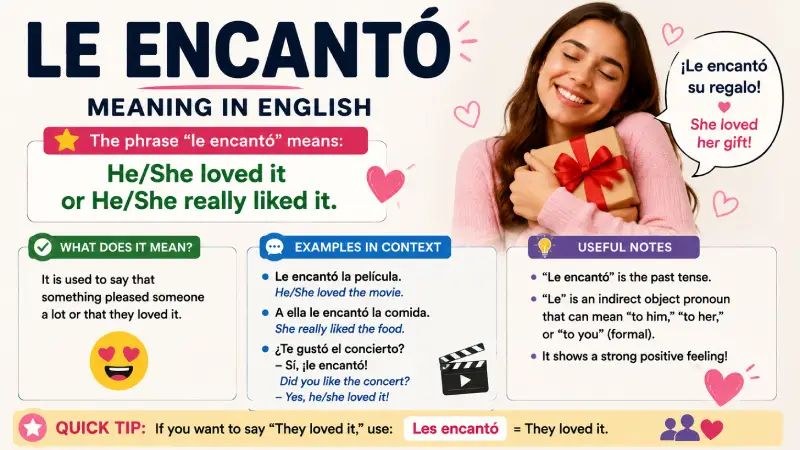
The Spanish phrase “le encantó” means “he/she loved it” or “he/she really liked it” in English.
It comes from the verb encantar, which means “to love,” “to delight,” or “to be very pleasing.” Unlike English, Spanish often structures this idea differently. Instead of saying someone “loved something,” Spanish literally expresses that something “enchanted” or “delighted” the person.
The exact translation depends on the context, but le encantó usually shows that someone had a very positive reaction to something.
Quick Answer
Le encantó means “he loved it,” “she loved it,” or “they loved it” in English. It is used when something greatly pleased or delighted someone.
Le Encantó: Word-by-Word Meaning
| Spanish Word | English Meaning | Explanation |
|---|---|---|
| Le | To him / to her / to them | Indirect object pronoun |
| Encantó | Loved, delighted, was wonderful | Past tense of encantar |
Literal idea:
Le encantó = It delighted him/her
Natural English:
He/she loved it
Understanding the Verb Encantar
The verb encantar is similar to gustar but usually expresses stronger feelings.
Examples:
Me gusta la película.
= I like the movie.
Me encanta la película.
= I love the movie.
When talking about the past:
Le encantó la película.
= He/she loved the movie.
How Is Le Encantó Used?
1. Talking About Something Someone Loved
The most common use is describing a strong positive reaction.
Example:
A María le encantó el regalo.
English:
María loved the gift.
Literally:
The gift delighted María.
2. Talking About Experiences
Le encantó can describe enjoying an experience.
Example:
A Juan le encantó viajar a España.
English:
Juan loved traveling to Spain.
3. Talking About Food, Movies, Places, or Objects
The phrase can be used with almost anything someone enjoys.
Examples:
Le encantó la comida.
= He/she loved the food.
Le encantó la ciudad.
= He/she loved the city.
Le encantó la canción.
= He/she loved the song.
Le Encantó vs Le Gustó: Difference
These phrases are similar but have different levels of feeling.
| Spanish Phrase | English Meaning | Strength |
|---|---|---|
| Le gustó | He/she liked it | Positive |
| Le encantó | He/she loved it | Stronger |
Example:
Le gustó el libro.
= He liked the book.
Le encantó el libro.
= He loved the book.
Le Encantó vs Me Encantó: Difference
The pronoun changes who loved something.
| Spanish | English Meaning |
|---|---|
| Me encantó | I loved it |
| Te encantó | You loved it |
| Le encantó | He/she loved it |
| Nos encantó | We loved it |
| Les encantó | They loved it |
The verb stays the same because the thing being loved is the focus.
Pronunciation of Le Encantó
A simple English pronunciation guide:
leh en-kahn-TOH
Breakdown:
- le = leh
- encantó = en-kahn-TOH
The stress is on the final syllable of encantó.
Is Le Encantó Formal or Informal?
Le encantó is a standard Spanish expression used in both formal and informal situations.
It can appear in:
- everyday conversations
- writing
- reviews
- professional discussions
The phrase itself is not slang.
Common Mistakes About Le Encantó
Mistake 1: Translating encantar as “to enchant” every time
The literal meaning relates to “enchanting,” but everyday Spanish usually means:
- love
- really like
- enjoy greatly
Mistake 2: Forgetting that le can mean different people
Le can refer to:
- him
- her
- a person you are speaking about
Context tells you who it refers to.
Mistake 3: Saying “le encantó” for a future action
Encantó is past tense.
Example:
Le encantó la película.
= He loved the movie.
Future:
Le encantará la película.
= He will love the movie.
Examples of Le Encantó in Sentences
| Spanish Sentence | English Meaning |
|---|---|
| A ella le encantó el vestido. | She loved the dress. |
| A Pedro le encantó la comida. | Pedro loved the food. |
| Le encantó conocer a su familia. | He/she loved meeting their family. |
| A los niños les encantó el juego. | The children loved the game. |
Related Spanish Words
Encantar
Meaning:
To love / to delight
Encanta
Meaning:
Loves / delights (present)
Encantó
Meaning:
Loved / delighted (past)
Gustar
Meaning:
To like
Amar
Meaning:
To love
Frequently Asked Questions
What does le encantó mean in English?
Le encantó means “he loved it,” “she loved it,” or “they loved it.”
Is le encantó the same as me encantó?
No. Me encantó means “I loved it,” while le encantó means someone else loved it.
What tense is encantó?
Encantó is the past tense (preterite) form of the verb encantar.
Does le always mean “he” or “she”?
Le can refer to him, her, or a formal “you.” The context determines the meaning.
Is encantar stronger than gustar?
Yes. Encantar usually expresses stronger enjoyment than gustar.
How do you pronounce le encantó?
It is pronounced approximately leh en-kahn-TOH.
Mini Quiz: Test Your Knowledge
1. What does le encantó mean?
A) He hated it
B) He loved it
C) He forgot it
D) He bought it
Answer: B) He loved it
2. What verb does encantó come from?
A) Comer
B) Encantar
C) Hablar
D) Vivir
Answer: B) Encantar
3. Which phrase means “I loved it”?
A) Le encantó
B) Me encantó
C) Te encantó
D) Les encantó
Answer: B) Me encantó
4. Is le encantó past or present?
A) Past
B) Present
C) Future
D) Conditional
Answer: A) Past
Conclusion
Le encantó means “he loved it,” “she loved it,” or “they loved it” in English. This Spanish phrase uses the verb encantar to express strong enjoyment or admiration for something.
Although the literal structure is different from English, the natural meaning is simple: someone liked something very much or absolutely loved it. Understanding phrases like le encantó helps Spanish learners communicate more naturally and understand everyday conversations.


