
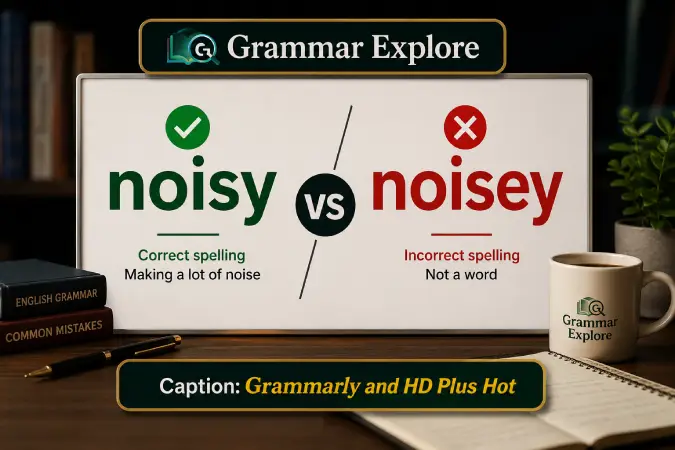
If you are wondering whether to write noisy or noisey, the correct spelling is noisy.
Noisy is the standard English spelling. It means making a lot of sound, being loud, or full of noise.
Noisey is a common misspelling and is not the standard form in modern American English.
The simple rule:
✅ Noisy = correct spelling
❌ Noisey = incorrect spelling
Examples:
- The restaurant was too noisy.
- The kids became noisy during the game.
- The street is noisy at night.
Quick Answer: Noisy or Noisey?
The correct spelling is noisy.
| Word | Correct Usage | Meaning |
|---|---|---|
| Noisy | Standard spelling | Full of noise or making a lot of sound |
| Noisey | Misspelling | Incorrect form |
Use noisy in:
- School writing
- Emails
- Professional documents
- Everyday conversations
Why People Confuse Noisy And Noisey
The confusion happens because many English adjectives ending in -y are formed from words that change spelling.
For example:
- easy → easier
- happy → happier
- noisy → noisier
Some writers assume:
noise + y = noisey
But the correct spelling changes the final e:
noise + y = noisy
The letter e is removed before adding -y.
What Does Noisy Mean?
Noisy is an adjective that describes something producing a lot of sound or causing disturbance.
It can describe:
- Places
- People
- Machines
- Activities
- Environments
Examples:
- The airport is very noisy.
- My neighbors are noisy at night.
- The old fan is getting noisy.
It can also describe something busy or full of activity.
Example:
- The classroom became noisy after lunch.
What Does Noisey Mean?
Noisey is not the standard spelling of the word.
It is usually a spelling mistake caused by adding -y to noise without removing the final e.
Incorrect:
- The room was noisey.
Correct:
- The room was noisy.
Meaning And Usage Difference
The difference between noisy and noisey is not meaning. It is a difference between a correct spelling and a misspelling.
| Context | Best Choice | Why |
|---|---|---|
| Loud place | Noisy | Correct adjective |
| Loud person | Noisy | Standard usage |
| Formal writing | Noisy | Accepted spelling |
| Noisey | Avoid | Misspelling |
Tone, Context, And Formality
Noisy is a normal adjective used in both casual and formal writing.
Examples:
Casual:
- The kids are being noisy.
Formal:
- The construction area is noisy during working hours.
Noisey should be avoided because readers may see it as a spelling error.
Which One Should You Use?
Use noisy every time.
Examples:
- A noisy classroom
- A noisy street
- A noisy machine
- A noisy neighbor
Do not write:
- noisey classroom
- noisey street
- noisey machine
A simple memory trick:
Noise + y = noisy
Drop the final e before adding y.
When One Choice Sounds Wrong
Using noisey can make writing look unpolished.
Incorrect:
The party was very noisey.
Correct:
The party was very noisy.
Incorrect:
The engine sounds noisey.
Correct:
The engine sounds noisy.
Common Mistakes And Quick Fixes
Mistake 1: Keeping The Final E
Incorrect:
The crowd was noisey.
Correct:
The crowd was noisy.
Mistake 2: Using Noisey In Professional Writing
Incorrect:
The office environment became noisey.
Correct:
The office environment became noisy.
Mistake 3: Confusing Noise And Noisy
Noise is a noun.
Example:
- The noise was too loud.
Noisy is an adjective.
Example:
- The room was noisy.
Everyday Examples
Home Examples
- The baby became noisy after waking up.
- The neighbors were noisy late at night.
- The washing machine is noisy.
Work Examples
- The office was noisy during construction.
- The equipment is noisy but effective.
- A noisy workplace can affect concentration.
Travel Examples
- The airport was noisy and crowded.
- The city streets are noisy at night.
- The train was noisy during the trip.
Dictionary-Style Word Details
Verb
Noisy: Not used as a verb in standard English.
Noisey: Not used as a verb in standard English.
Noun
Noisy: Not a noun. It is an adjective.
Noisey: Not a standard noun form.
Synonyms
Noisy
Closest plain alternatives:
- Loud
- Boisterous
- Rowdy
- Clamorous
- Sound-filled
The best alternative depends on context.
Examples:
- A noisy crowd = a loud crowd
- A noisy machine = a loud machine
Noisey
No synonyms apply because it is not a standard word.
Example Sentences
Noisy
- The classroom became noisy after the bell rang.
- The street is noisy during rush hour.
- The machine is too noisy to use indoors.
Noisey
The standard form is noisy.
Incorrect:
- The room was noisey.
Correct:
- The room was noisy.
Word History
Noisy comes from the noun noise combined with the adjective-forming ending -y. The spelling follows the common pattern of dropping the final e before adding -y.
Noisey is a common spelling error, not a standard alternative.
Phrases Containing
Noisy
Common phrases:
- noisy neighbor
- noisy environment
- noisy crowd
- noisy street
- noisy machine
Examples:
- We complained about the noisy neighbor.
- The noisy crowd filled the stadium.
Noisey
No standard phrases use this spelling.
Frequently Asked Questions
Is noisy or noisey correct?
Noisy is correct. Noisey is a common misspelling.
Why is noisy spelled without an e?
The final e in noise is removed before adding -y.
Is noisey a real word?
Noisey is not the standard English spelling.
What is the plural of noisy?
Noisy is an adjective, so it does not have a plural form.
What is another word for noisy?
Possible alternatives include loud, boisterous, rowdy, and clamorous.
Conclusion
The difference between noisy vs. noisey is simple.
Use:
Noisy for the correct spelling meaning loud or full of sound.
Avoid:
Noisey because it is a common spelling mistake.
When writing in American English, always choose noisy.