

Many English learners and even native speakers sometimes wonder whether they should write coaches or coachs. The confusion usually appears when people add -s to form the plural of coach. Since many English words simply take an -s, some writers assume that coachs follows the same pattern.
However, standard English follows a different spelling rule for nouns that end in -ch. Once you understand that rule, choosing the correct spelling becomes easy.
The short answer is simple: coaches is the correct plural form, while coachs is a misspelling. You should always write coaches in school assignments, business documents, emails, social media posts, and everyday conversations.
This guide explains the difference, shows you the correct grammar rule, and provides plenty of examples so you can use the word with confidence.
Quick Answer
✅ Coaches = Correct plural spelling of coach
❌ Coachs = Incorrect spelling
Correct:
- We hired three coaches for the soccer camp.
- Our basketball coaches planned today’s practice.
Incorrect:
- We hired three coachs for the soccer camp.
- Our basketball coachs planned today’s practice.
Always choose coaches in standard American English.
Why People Confuse Them
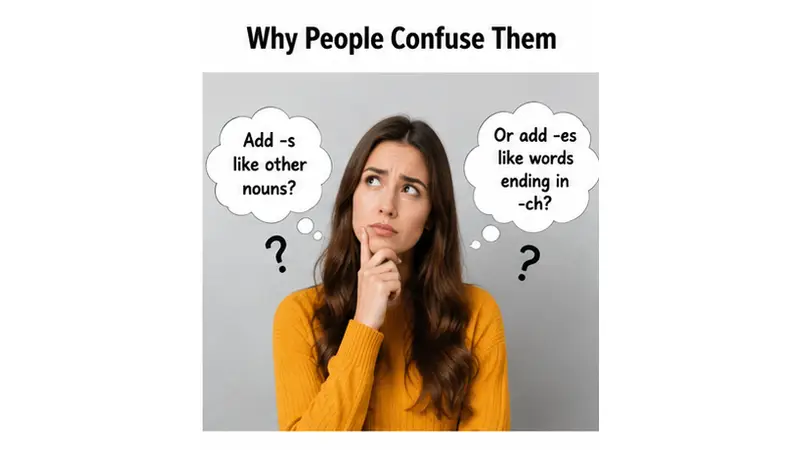
People often confuse coaches and coachs because English forms many plurals by adding -s to the end of a noun.
For example:
- book → books
- chair → chairs
- student → students
Many writers expect coach to follow the same pattern. However, nouns that end in -ch, -sh, -s, -x, or -z usually take -es instead of just -s.
That grammar rule changes:
- coach → coaches
- church → churches
- bus → buses
- box → boxes
- wish → wishes
Since coach ends with -ch, English requires -es to create the plural form.
Once you remember this spelling rule, the confusion disappears.
Key Differences at a Glance
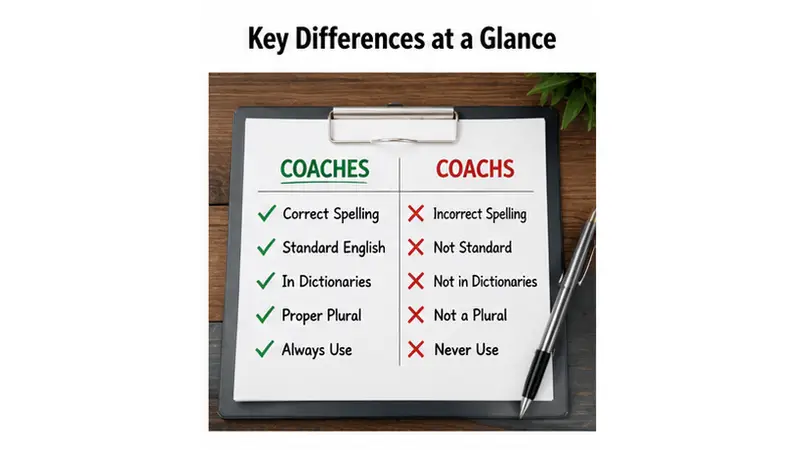
| Context | Best Choice | Why |
|---|---|---|
| Plural of coach | Coaches | Standard English plural form |
| School writing | Coaches | Grammatically correct |
| Business writing | Coaches | Professional spelling |
| Emails | Coaches | Correct English usage |
| Social media | Coaches | Readers expect the standard spelling |
| Formal documents | Coaches | Accepted by dictionaries |
| Everyday conversations | Coaches | Correct written form |
| Feature | Coaches | Coachs |
|---|---|---|
| Correct spelling | ✅ Yes | ❌ No |
| Standard English | ✅ Yes | ❌ No |
| Dictionary entry | ✅ Yes | ❌ No |
| Proper plural of coach | ✅ Yes | ❌ No |
| Recommended in writing | ✅ Always | ❌ Never |
| Used in education | ✅ Yes | ❌ No |
| Used in business | ✅ Yes | ❌ No |
Meaning and Usage Difference
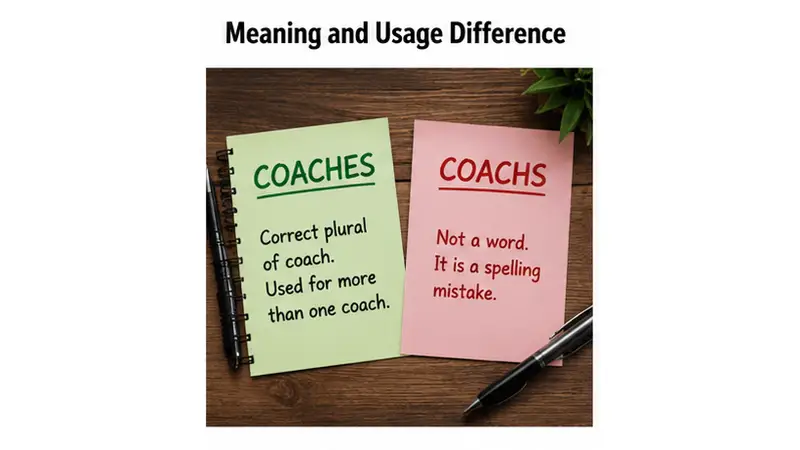
The difference between coaches and coachs is straightforward. Only one spelling belongs in standard English.
Coaches
Coaches is the correct plural form of the noun coach.
A coach usually teaches, trains, guides, or develops another person or a group. The word can describe a sports instructor, a personal coach, a business coach, or someone who helps people improve their skills.
Examples:
- The coaches organized the tournament.
- Our coaches encouraged every player.
- Several leadership coaches attended the conference.
- The swim coaches reviewed each athlete’s performance.
- Experienced coaches build confidence through practice.
As a verb, coaches also works correctly. It describes what one person does.
Examples:
- She coaches the middle school volleyball team.
- He coaches young entrepreneurs every weekend.
- Maria coaches new employees during training.
In these sentences, coaches functions as the third-person singular present-tense form of the verb coach.
Coachs
Coachs is not a standard English word.
No major American dictionary accepts coachs as the plural of coach.
Most people create this spelling by mistake when they forget the rule that adds -es after nouns ending in -ch.
Incorrect examples:
- We thanked all the coachs after the game.
- Several coachs attended the meeting.
- The school hired new coachs this year.
Correct versions:
- We thanked all the coaches after the game.
- Several coaches attended the meeting.
- The school hired new coaches this year.
Because coachs does not follow standard English spelling rules, you should avoid it in every type of writing.
Tone, Context, and Formality

The word coaches fits every level of communication. You can use it in formal reports, academic papers, business emails, sports articles, text messages, and casual conversations.
Teachers, editors, employers, and publishers expect the standard spelling. When you write coaches, your writing looks polished and professional.
The spelling coachs creates the opposite impression. Readers often notice the mistake immediately because the plural rule for words ending in -ch appears early in English education.
Formal Writing
Use coaches in research papers, reports, resumes, and official documents.
Example:
The district recognized its outstanding coaches during the annual awards ceremony.
Casual Writing
Friends also expect the correct spelling.
Example:
Our tennis coaches gave everyone extra practice before the tournament.
Academic Writing
Schools, colleges, and universities always use coaches.
Example:
The researchers interviewed twenty high school coaches for the study.
Business Writing
Many companies hire executive, career, and leadership coaches.
Example:
The company invited experienced coaches to lead the professional development workshop.
American English Usage
American English always uses coaches as the correct plural spelling. You will see this form in newspapers, books, websites, schools, sports organizations, and business publications.
Which One Should You Use?

You should always use coaches when you need the plural form of coach. Standard English follows a clear spelling rule for nouns that end in -ch. Instead of adding only -s, you add -es.
Use coaches when you refer to:
- More than one sports coach
- More than one business coach
- More than one life coach
- More than one driving instructor
- More than one mentor with the title coach
Examples:
- The coaches met before the championship.
- Our coaches created a new training schedule.
- Several career coaches spoke at the seminar.
- The soccer coaches selected the final team.
Never use coachs because English dictionaries do not recognize it as a correct spelling.
Easy Memory Trick
Think about the ending -ch.
If a noun ends in -ch, add -es to make it plural.
For example:
- church → churches
- beach → beaches
- bench → benches
- coach → coaches
If you remember those examples, you will naturally choose coaches every time.
When One Choice Sounds Wrong

The incorrect spelling coachs often distracts readers because it breaks a common English spelling rule. Even if readers understand your meaning, the mistake can make your writing look less polished.
Incorrect:
- Our football coachs planned the season.
Correct:
- Our football coaches planned the season.
Why: The noun coach ends in -ch, so the plural form requires -es.
Incorrect:
- The school hired five new coachs.
Correct:
- The school hired five new coaches.
Why: Standard English forms the plural as coaches.
Incorrect:
- All the coachs attended the meeting.
Correct:
- All the coaches attended the meeting.
Why: Every major dictionary accepts coaches and rejects coachs.
Incorrect:
- Experienced coachs helped the players.
Correct:
- Experienced coaches helped the players.
Why: You should never remove the -es ending after -ch.
Incorrect:
- Several leadership coachs joined the workshop.
Correct:
- Several leadership coaches joined the workshop.
Why: Professional writing always uses coaches.
Common Mistakes (and Quick Fixes)
Mistake 1
Incorrect:
We thanked all the coachs after the game.
Correct:
We thanked all the coaches after the game.
Explanation:
The noun coach ends in -ch, so you must add -es to form the plural.
Mistake 2
Incorrect:
The basketball coachs created a new practice plan.
Correct:
The basketball coaches created a new practice plan.
Explanation:
Standard American English uses coaches as the only correct plural spelling.
Mistake 3
Incorrect:
Our company hired several executive coachs.
Correct:
Our company hired several executive coaches.
Explanation:
Professional and business writing always uses coaches.
Mistake 4
Incorrect:
The coachs encouraged every player.
Correct:
The coaches encouraged every player.
Explanation:
English spelling rules require -es after nouns ending in -ch.
Mistake 5
Incorrect:
Many driving coachs attended the conference.
Correct:
Many driving coaches attended the conference.
Explanation:
The plural form of coach always ends with -es.
Everyday Examples
School
- Our math coaches helped students prepare for the competition.
- The debate coaches practiced with the team after school.
- Several academic coaches shared helpful study strategies.
- The science club invited experienced coaches to mentor students.
Work
- The company hired leadership coaches to improve management skills.
- Our performance coaches organized monthly workshops.
- The project managers thanked the business coaches for their advice.
- Experienced coaches guided new employees during training.
Home
- The neighborhood coaches volunteered at the youth sports camp.
- My parents thanked the soccer coaches after every game.
- Local coaches organized a free fitness event for families.
Business
- Executive coaches worked with senior managers.
- Professional coaches helped employees build communication skills.
- The consulting firm partnered with certified coaches.
- Successful coaches encouraged every participant to set clear goals.
Emails
- Our coaches will arrive at 9:00 a.m. tomorrow.
- Please contact the coaches if you have questions.
- The coaches approved the updated practice schedule.
- All coaches should attend Friday’s meeting.
Social Media
- Our amazing coaches inspired the entire team today!
- Thank you to our dedicated coaches for an unforgettable season.
- Our coaches celebrated every player’s progress.
- Great coaches help people grow every day.
Everyday Conversations
- Our coaches always support us.
- The coaches explained every drill clearly.
- We appreciate our coaches every season.
- Those coaches know how to motivate young athletes.
- Experienced coaches make every practice more productive.
Dictionary-Style Word Details
Verb
Coach
As a verb, coach means to teach, train, guide, or prepare someone to improve a skill or performance.
Examples:
- She coaches the volleyball team.
- He coaches young musicians every weekend.
- My neighbor coaches a youth baseball league.
Coachs
Not commonly used as a verb in standard English. Standard English does not recognize coachs as a correct verb form.
Noun
Coach
As a noun, coach refers to a person who teaches, trains, or guides others. It can also describe certain vehicles, although that meaning does not affect the plural spelling.
Plural:
coach → coaches
Examples:
- The coaches celebrated the team’s victory.
- Three coaches attended the tournament.
Coachs
Not a standard English noun. Writers treat coachs as a spelling mistake rather than a separate word.
Synonyms
Synonyms for Coach
Depending on the context, these words can work as synonyms:
- Trainer
- Instructor
- Mentor
- Teacher
- Guide
- Advisor
- Tutor
- Consultant
- Facilitator
Antonyms
Depending on the situation, possible opposites include:
- Student
- Learner
- Beginner
- Trainee
Synonyms for Coachs
There are no synonyms because coachs is not a recognized English word.
Example Sentences
Correct Examples with Coaches
- The coaches designed a new practice schedule for the team.
- Our coaches encouraged every player to stay focused.
- Several coaches attended the national sports conference.
- The school recognized its coaches during the annual awards ceremony.
- Experienced coaches helped new athletes improve their skills.
- The basketball coaches reviewed every game before the playoffs.
- Our leadership coaches taught effective communication strategies.
- The volunteer coaches organized free weekend training sessions.
Incorrect Examples with Coachs
The following sentences contain a spelling mistake. Replace coachs with coaches in every case.
- ❌ The coachs prepared the players for the tournament.
✅ The coaches prepared the players for the tournament. - ❌ Several coachs attended today’s meeting.
✅ Several coaches attended today’s meeting. - ❌ Our soccer coachs created a new training plan.
✅ Our soccer coaches created a new training plan. - ❌ The school hired experienced coachs this year.
✅ The school hired experienced coaches this year. - ❌ All the coachs supported the students throughout the season.
✅ All the coaches supported the students throughout the season.
Word History
The word coach entered English from the name of a Hungarian village, Kocs, which became famous for producing horse-drawn carriages. Over time, English speakers used coach for a carriage and later extended the word to describe a person who guides or trains others.
English has long formed the plural of coach as coaches by adding -es because the word ends in -ch.
The spelling coachs never became part of standard English. Writers usually create it by applying the wrong plural rule.
Phrases Containing Coaches
English includes many common phrases with coaches, including:
- football coaches
- basketball coaches
- baseball coaches
- soccer coaches
- tennis coaches
- swimming coaches
- life coaches
- career coaches
- executive coaches
- business coaches
- leadership coaches
- health coaches
- certified coaches
- assistant coaches
- head coaches
There are no established English phrases that contain coachs because standard English does not recognize it as a correct word.
Frequently Asked Questions
Which spelling is correct: coaches or coachs?
Coaches is the correct spelling. English forms the plural of coach by adding -es because the word ends in -ch. You should always write coaches in academic, professional, and everyday writing. Avoid coachs because dictionaries do not recognize it.
Why does coach become coaches instead of coachs?
English follows a spelling rule for nouns ending in -ch. These nouns usually take -es in the plural form. The same rule changes church to churches and bench to benches, so it also changes coach to coaches.
Does any dictionary accept coachs?
No. Standard English dictionaries do not list coachs as a correct spelling. If you write coachs, most spell-checkers and editors will recommend coaches instead.
Why do people write coachs?
Many people simply apply the wrong plural rule. They add -s instead of -es because many English nouns form plurals with -s. Once you remember the -ch rule, you can avoid this mistake.
How can I remember the correct spelling?
Remember that words ending in -ch usually form the plural with -es. Think about churches, beaches, and benches. Then apply the same pattern to coach and write coaches.
Will readers notice the difference?
Yes. Most readers recognize coaches as the standard spelling. If you write coachs, many readers will immediately spot the error. Using the correct spelling strengthens your writing and helps you communicate more clearly.
Conclusion
The comparison between coaches vs coachs has a simple answer. Coaches is the only correct spelling in standard English, while coachs is a misspelling that you should avoid.
Whenever you need the plural form of coach, write coaches. The word follows the standard English rule that adds -es to nouns ending in -ch. This rule also applies to words like churches, benches, and beaches.
A simple memory trick can help you remember the correct form: If a noun ends in -ch, add -es, not just -s. Keep that rule in mind, and you will choose coaches correctly every time.