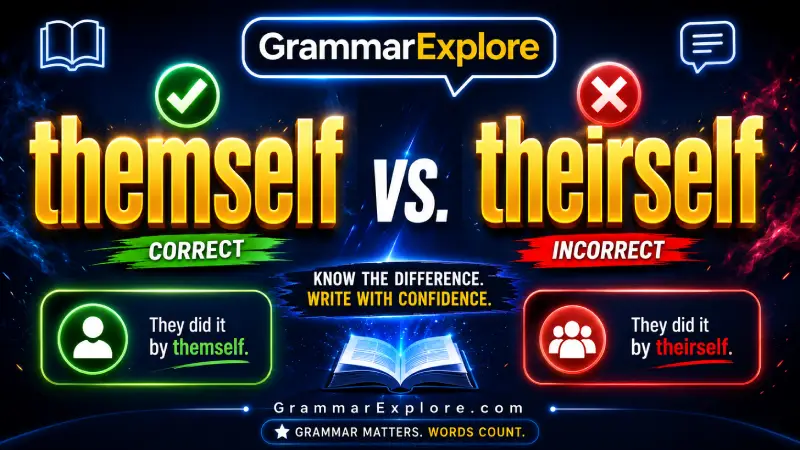
Themself vs theirself is a tricky comparison because both forms exist in English, but they do not have the same status in standard American usage.
Themself is a singular reflexive pronoun used with singular they. It can refer to one person whose gender is unknown, unspecified, or nonbinary. Merriam-Webster recognizes this use, although preferences still vary among dictionaries and editorial styles. Theirself, on the other hand, occurs mainly in dialectal or nonstandard speech and writing. Merriam-Webster labels it “chiefly dialectal.” Merriam-Webster
Therefore, for edited US English, themself is the better choice when you specifically need a singular reflexive form of they. However, themselves is also widely used with singular they and may sound more familiar to many readers.
Quick Answer
Use themself when referring reflexively to one person with singular they:
Every student should decide for themself.
Use theirself only when intentionally representing a dialect or a speaker who naturally uses that form. In standard edited American English, avoid it.
Also remember that themselves remains a widely accepted alternative with singular they:
Every student should decide for themselves.
Is “Theirselves” Grammatically Correct?
In standard English, theirselves is not grammatically correct. The correct reflexive pronoun is themselves. Although theirselves appears in some regional dialects and historical texts, it should be avoided in formal writing.
Is “Themself” a Valid Word?
Yes. Themself is a recognized singular reflexive pronoun used with singular they. It is commonly used when referring to a person whose gender is unknown or for someone who uses they/them pronouns. For example: Each student should introduce themself.
When Did “Theirself” Become a Word?
Theirself has existed in English for centuries and appears in historical writing and some regional dialects. However, it has never become the standard form in modern English. Today, themself or themselves is preferred, depending on the context.
What Does “Themself” Mean?
Themself is the singular reflexive form of they. It means that person himself or herself, but it is used with the singular pronoun they. For example: Someone should ask themself whether the decision is fair.
Is It Youall or You All?
You all is the correct spelling. It is a common phrase used to address more than one person, especially in the Southern United States. Youall (written as one word) is nonstandard, although the contraction y’all is widely accepted in informal writing.
Why People Confuse Them
The confusion begins with the pronoun they.
Traditionally, learners often meet they as a plural pronoun:
They prepared themselves.
However, English also uses they for one person:
Someone left their phone.
Taylor said they would arrive soon.
Once they becomes singular, writers may wonder which singular reflexive form should follow it.
Two possibilities can seem logical:
- they → them → themself
- they → their → theirself
However, modern standard usage does not treat those forms equally.
Themself has established use as a gender-neutral reflexive pronoun for one person. Merriam-Webster specifically defines it as a form used chiefly with singular they for an indefinite person or a person who is nonbinary. Merriam-Webster
Meanwhile, theirself exists, but dictionaries typically mark it as dialectal or nonstandard.
As a result, themself is the safer choice when a singular reflexive form is needed in standard US writing.
Key Differences At A Glance
| Context | Best Choice | Why |
|---|---|---|
| One person using they/them pronouns | Themself | Singular reflexive form |
| One person of unknown gender | Themself | Can agree with singular they |
| Multiple people | Themselves | Standard plural reflexive |
| Formal US writing | Themself or themselves | Choice may depend on house style |
| Dialect representation | Theirself may occur | Established dialectal form |
| General edited US English | Avoid theirself | Usually treated as nonstandard |
| Emphasis on one person | Themself | Singular form makes number explicit |
The simplest distinction is:
- Themself = recognized singular reflexive form connected with they/them
- Theirself = chiefly dialectal/nonstandard form
- Themselves = standard plural reflexive and also widely used with singular they
Meaning And Usage Difference
What Does Themself Mean?
Themself is a reflexive or intensive pronoun referring to a single person.
Consider this example:
Everyone should give themself enough time to prepare.
Here, themself refers back to everyone. Although everyone refers to individuals one at a time, the writer does not specify gender.
Another example is:
Alex said they would complete the project themself.
Here, they refers to one person, Alex. Therefore, themself makes the singular reference explicit.
Merriam-Webster recognizes this singular use, while Cambridge records the form but currently labels it “not standard.” This difference between major dictionaries shows why writers may encounter different editorial preferences. Merriam-Webster, Cambridge Dictionary
What Does Theirself Mean?
Theirself also appears as a singular reflexive form in some varieties of English.
For example, a speaker might say:
Everyone needs to look after theirself.
However, standard edited US English usually prefers:
Everyone needs to look after themself.
Or, more commonly for many writers:
Everyone needs to look after themselves.
Merriam-Webster describes theirself as chiefly dialectal. Therefore, you should not automatically call every spoken occurrence meaningless or accidental. Still, it is generally unsuitable for formal standard American writing.
Why Themself Makes Grammatical Sense
Reflexive pronouns often refer back to a person already mentioned in the clause:
- I taught myself.
- She taught herself.
- He taught himself.
- They taught themselves.
- They taught themself.
The final example works when they represents one person.
The form themself connects naturally with the object pronoun them, just as himself relates to him.
However, English reflexive pronouns are not perfectly uniform. We also have myself and yourself, so you should not try to derive every form from one simple formula.
Usage ultimately determines which forms standard English accepts.
Themself vs Themselves
This is an important distinction.
Themself emphasizes that they refers to one person:
Morgan completed the design themself.
Themselves can refer to multiple people:
Morgan and Casey completed the design themselves.
However, themselves is also widely used with singular they:
Someone left themselves a reminder.
Merriam-Webster notes that singular they and related forms, including themselves, have long-established use. Consequently, you do not always need to replace themselves with themself merely because they has a singular antecedent.
Pronunciation
The words also sound different:
- Themself: “them-SELF”
- Theirself: “thair-SELF”
The final word self receives the strongest stress in each form.
However, pronunciation does not determine which form fits standard writing. Context and usage do.
Tone, Context, And Formality
Themself increasingly appears when writers want a clearly singular reflexive form corresponding to singular they.
For example:
Each employee can introduce themself at the meeting.
The sentence clearly refers to each employee individually.
However, some readers and editorial systems still prefer:
Each employee can introduce themselves at the meeting.
Both patterns occur in contemporary English. Therefore, if you are writing for a school, university, newspaper, company, or other publication, follow its house style when one is available.
Theirself has a different status.
It may occur naturally in regional dialects. Consequently, it can be appropriate when accurately representing a speaker’s dialect in dialogue, linguistic discussion, or quotation.
For general academic, business, and professional American English, however, themself or themselves is usually the better choice.
Which One Should You Use?
For standard US writing, choose themself over theirself when you specifically want a singular reflexive pronoun for they.
For example:
Every applicant should ask themself whether the position is a good fit.
You can also use themselves, especially if that form matches your preferred editorial style:
Every applicant should ask themselves whether the position is a good fit.
However, avoid:
Every applicant should ask theirself whether the position is a good fit.
The final version may occur in dialectal English, but it is not the best choice for standard edited US prose.
When referring to several people, use themselves, not themself:
The students prepared themselves for the test.
A useful rule is:
One person + singular they → themself or, commonly, themselves
Several people + they → themselves
Theirself → mainly dialectal; generally avoid in edited US English
When One Choice Sounds Wrong
Consider this sentence:
A person should give theirself time to recover.
Readers can understand it. Nevertheless, standard edited English normally favors:
A person should give themself time to recover.
Another widely used option is:
A person should give themselves time to recover.
Now consider a plural subject:
The players prepared themself for the game.
Here, themself creates a number mismatch because players clearly refers to multiple people.
Write:
The players prepared themselves for the game.
Therefore, themself is not simply a replacement for themselves. Use it when the intended reference is singular.
When Theirself Can Be Appropriate
Calling theirself universally “fake” or “not a word” would oversimplify the evidence. Dictionaries document the form, and speakers use it in some dialects.
For example, a novelist might preserve the form in dialogue to represent a character’s natural speech.
However, that does not make theirself the standard choice for a school essay, business report, news article, or other edited American prose.
Context matters.
Common Mistakes (And Quick Fixes)
Mistake: Anyone can teach theirself this skill.
Standard edit: Anyone can teach themself this skill.
Mistake: Every student should prepare theirself.
Standard edit: Every student should prepare themself.
Also standard for many writers: Every student should prepare themselves.
Mistake: The players congratulated themself.
Fix: The players congratulated themselves.
Mistake: Assuming themself must always be an error.
Fix: Recognize its established use with singular they.
Mistake: Assuming theirself and themself have identical status.
Fix: Remember that theirself remains chiefly dialectal/nonstandard.
Mistake: Replacing every singular themselves with themself.
Fix: Remember that themselves also has established use with singular they.
Mistake: Using themself for an obviously plural group.
Fix: Use themselves when the antecedent clearly refers to multiple people.
Everyday Examples
Examples With Themself
- Everyone should give themself enough time.
- Each student can decide for themself.
- A good leader should know themself well.
- Someone left themself a reminder.
- Every applicant should ask themself that question.
- A person should allow themself time to rest.
- The winner may choose the prize themself.
- Taylor said they fixed the computer themself.
- Jordan prepared themself for the interview.
- Each participant introduced themself to the group.
Examples With Themselves
When several people are involved, themselves is clearly required:
- The students introduced themselves.
- My neighbors painted the house themselves.
- The players prepared themselves for the game.
- The children made lunch themselves.
However, singular they can also take themselves in established usage:
- Everyone should ask themselves what they really want.
- Someone might find themselves in that situation.
Examples Showing Why Theirself Is Usually Avoided
In standard edited US English:
Someone should ask theirself that question.
Better: Someone should ask themself that question.
Each employee introduced theirself.
Better: Each employee introduced themself.
Alternatively, themselves can work in these sentences when that form matches the writer’s style.
Dictionary-Style Word Details
Verb
Themself: Not a verb. It is a reflexive or intensive pronoun.
Theirself: Not a verb. It is also a pronoun, chiefly found in dialectal or nonstandard usage.
Therefore, neither word takes verb forms or verb endings.
Noun
Themself: Not a noun in its relevant grammatical use. It functions as a pronoun.
Casey completed the assignment themself.
Theirself: Also a pronoun rather than a regular noun.
Theirself occurs in some regional varieties of English.
Neither form should be classified as an ordinary noun merely because it refers to a person.
Synonyms
Reflexive pronouns generally do not have true synonyms because their grammatical function depends on the antecedent.
Depending on the person and context, related reflexive forms include:
- himself
- herself
- itself
- themselves
However, these are not interchangeable synonyms.
For example, use herself for a person who uses she/her pronouns and himself for someone who uses he/him. If a person uses they/them pronouns, themself or themselves may fit according to their usage and the relevant style.
No meaningful antonyms apply.
Example Sentences
Themself:
- Every person should decide for themself.
- Riley introduced themself to the new team.
- Anyone can find themself in a difficult situation.
- The employee completed the task themself.
- A person should learn to trust themself.
Theirself:
The form occurs in dialectal English, but standard editing generally substitutes themself or themselves.
Dialectal:
Someone might find theirself in trouble.
Standard edited version:
Someone might find themself in trouble.
Or:
Someone might find themselves in trouble.
Word History
Neither themself nor theirself is simply a recent invention.
Merriam-Webster documents themself historically and notes that it appeared centuries ago. The form later lost ground to themselves but continued to occur. Today, it has gained renewed attention as singular they has become widely accepted.
Theirself also has a long documented history. However, modern dictionaries generally treat it as dialectal or nonstandard rather than as the usual form for edited prose.
Therefore, age alone does not determine whether a word belongs in standard modern writing. Current usage and editorial convention matter more.
Phrases Containing
Because themself and theirself are pronouns rather than words used in many fixed expressions, they do not form numerous standard phrases.
Natural constructions with themself include:
- be themself
- find themself
- ask themself
- introduce themself
- prepare themself
- express themself
- teach themself
- see themself
- remind themself
- take care of themself
For example:
Every person deserves the freedom to be themself.
Comparable expressions with theirself may occur in dialectal speech, but standard US writing normally uses themself or themselves instead.
Frequently Asked Questions
Is themself a correct word?
Yes. Themself has established use as a singular reflexive pronoun corresponding to singular they. However, editorial preferences vary, and themselves also remains widely used with singular they.
Is theirself grammatically correct?
Theirself exists and has a documented history, but dictionaries generally label it dialectal or nonstandard. Therefore, avoid it in standard edited American English unless you intentionally represent a dialect.
Should I use themself or themselves for one person?
Both occur with singular they. Themself makes the singular reference explicit, while themselves remains widely established. Follow the person’s preference or your publication’s style when relevant.
Can themself refer to a nonbinary person?
Yes. Themself can refer to one person who uses they/them pronouns.
Avery completed the project themself.
Is themselves only plural?
No. Although themselves commonly refers to several people, it can also occur with singular they.
Why do people say theirself?
Theirself occurs in some regional and dialectal varieties of English. Speakers may also form it by analogy with reflexive forms such as yourself. Nevertheless, edited standard English normally favors themself or themselves.
Which form is best for formal US writing?
For one person with singular they, themself can be appropriate, while themselves is also well established. Generally avoid theirself unless the context specifically calls for dialectal language.
Conclusion
The themself vs theirself distinction is not simply a choice between two equally standard spellings.
Themself is an established singular reflexive form used with singular they, especially when referring to one person of unspecified gender or someone who uses they/them pronouns. Theirself, meanwhile, is a documented but chiefly dialectal or nonstandard form.
For standard American writing, remember:
Singular they → themself or themselves
Plural they → themselves
Theirself → generally avoid in edited US English
Therefore, if you must choose specifically between themself and theirself, themself is the better choice for standard modern US English.