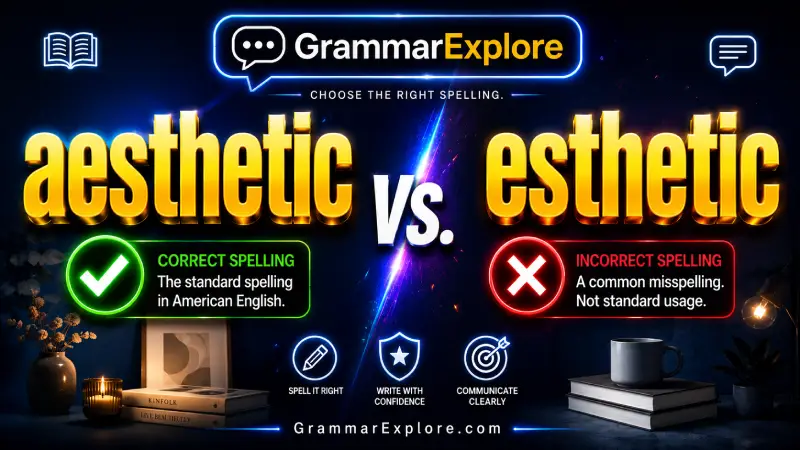
Aesthetic vs esthetic is mostly a spelling-choice question. Both words can relate to beauty, artistic taste, visual appearance, or cosmetic enhancement. However, aesthetic is the more common and widely recognized spelling in modern American English.
For example:
The designer created a clean, modern aesthetic.
Esthetic is also a legitimate US variant, not simply a misspelling. You may encounter it in discussions of beauty, cosmetic care, dentistry, or appearance. Still, it appears less often in general writing.
Both forms can work as adjectives and nouns, and they usually share the same pronunciation. Therefore, if you need one reliable spelling for a US audience, choose aesthetic. Use esthetic when a profession, business, organization, publication, or established term specifically prefers that form.
Quick Answer
Both aesthetic and esthetic are correct in American English, and they generally mean the same thing.
- Aesthetic is the standard and more common spelling.
- Esthetic is an accepted US variant.
- Both can relate to beauty, art, visual style, or appearance.
- Both are generally pronounced “es-THET-ik.”
- For most US writing, choose aesthetic.
For example:
The room’s minimalist aesthetic makes it feel calm and spacious.
Is It Spelled Esthetic or Aesthetic?
Both esthetic and aesthetic are correct. Aesthetic is the standard and far more common spelling in both American and British English. Esthetic is an accepted American variant but is used much less often.
Why Does Gen Z Say “Aesthetic”?
Gen Z often uses aesthetic to describe a specific visual style, vibe, or overall look. On social media, the word refers to a carefully chosen appearance or theme, such as a cottagecore aesthetic or minimalist aesthetic, rather than only its traditional meaning related to beauty or art.
What Is the Difference Between Aesthetic and Beautiful?
Beautiful describes something that is pleasing to look at, while aesthetic refers to the overall style, design, or artistic quality of something. A person might call a room beautiful, but they might describe its aesthetic as modern, vintage, or minimalist.
Is Botox Aesthetics or Esthetics?
Both terms may be used, but aesthetics is the more common choice in the cosmetic and medical industries. Treatments such as Botox are often described as aesthetic procedures or aesthetic medicine. Esthetics is more commonly used for skincare, facials, and beauty therapy, especially in North America.
Why People Confuse Them
The initial a causes most of the confusion.
Writers may wonder whether the letter is necessary because they do not clearly hear it in ordinary pronunciation. Both spellings usually begin with an es or is sound rather than a separately pronounced long a.
As a result, esthetic may look more phonetic.
Another reason involves American spelling patterns. American English often simplifies certain spellings, such as color instead of colour. Because dictionaries recognize esthetic as a US variant, some writers assume Americans should always drop the initial a.
However, that conclusion goes too far. Aesthetic remains the dominant general spelling in American English, even though esthetic is valid.
Beauty-care terminology creates additional uncertainty. People often encounter the professional title esthetician, while still seeing aesthetic in phrases such as aesthetic treatment, aesthetic medicine, and aesthetic appeal.
Therefore, the most important rule is consistency rather than trying to assign entirely different meanings to the two forms.
Key Differences At A Glance
| Context | Best Choice | Why |
|---|---|---|
| General American English | Aesthetic | More common and widely recognized |
| Art and design | Aesthetic | Conventional spelling in general writing |
| Philosophy of beauty | Aesthetic | Standard in phrases such as aesthetic theory |
| Social media visual style | Aesthetic | Familiar modern spelling |
| Cosmetic or appearance-related context | Usually aesthetic | Widely used and understood |
| US variant spelling | Esthetic | Correct but less common |
| Official job title or business name | Follow the official spelling | Preserve the organization’s chosen form |
| Writing for a broad audience | Aesthetic | Least likely to distract readers |
A compact comparison makes the answer clear:
- Meaning: Usually identical
- Pronunciation: Usually identical
- Aesthetic: More common general spelling
- Esthetic: Accepted US variant
- Parts of speech: Both can be adjectives and nouns
- Best default: Aesthetic
Meaning And Usage Difference
Major dictionaries treat esthetic as a variant of aesthetic, so the spelling normally does not create a difference in meaning. Merriam-Webster lists esthetic as a US variant, while Cambridge describes it as another US spelling of aesthetic. Merriam-Webster, Cambridge Dictionary
Relating To Beauty
As an adjective, aesthetic can describe something connected with beauty or the appreciation of beauty.
For example:
- The renovation made several aesthetic improvements.
- Color plays an important aesthetic role in the design.
- The architect considered both practical and aesthetic concerns.
- The sculpture has strong aesthetic appeal.
You could substitute esthetic in these sentences without changing the basic meaning. However, aesthetic will look more familiar to most readers.
Relating To Art And Taste
The word can also describe artistic judgment, taste, or principles.
For example:
- The movement developed a distinctive aesthetic philosophy.
- Her aesthetic preferences influence her photography.
- The course explores aesthetic theory.
- Critics discussed the film’s aesthetic qualities.
Here, the word goes beyond “pretty.” It concerns how people experience, evaluate, and understand beauty and art.
A Particular Visual Style
As a noun, aesthetic can mean a recognizable visual or artistic style.
For example:
- The café has a warm, rustic aesthetic.
- Her website uses a minimalist aesthetic.
- The movie combines a futuristic setting with a vintage aesthetic.
- The brand’s aesthetic appeals to younger shoppers.
This meaning appears frequently in modern conversations about clothing, interior design, photography, social media, and branding.
Someone might say:
That outfit fits your aesthetic.
Here, aesthetic means the person’s preferred visual style or overall look.
Cosmetic And Appearance-Related Uses
Aesthetic can also describe procedures, treatments, or services intended to improve or change a person’s appearance.
Common phrases include:
- aesthetic medicine
- aesthetic dentistry
- aesthetic treatment
- aesthetic surgery
- aesthetic procedure
- aesthetic clinic
For example:
The clinic offers several nonsurgical aesthetic treatments.
Esthetic may also appear in these contexts:
The practice provides restorative and esthetic dentistry.
Both spellings can be correct. Therefore, follow the terminology used by the relevant organization or professional field while maintaining consistency.
Aesthetics And Esthetics
The plural-looking noun aesthetics can refer to:
- The study or philosophy of beauty and art
- The artistic or visual qualities of something
- Considerations related to appearance
For example:
She studied aesthetics and art history.
The team considered cost, function, and aesthetics.
The spelling esthetics also exists as a US variant. However, aesthetics remains the more widely recognized form.
Pronunciation
Aesthetic and esthetic usually share the same pronunciation:
es-THET-ik or is-THET-ik
The first letter in aesthetic does not usually create an extra syllable.
Similarly:
- aesthetically: es-THET-ik-lee
- esthetically: es-THET-ik-lee
- aesthetics: es-THET-iks
- esthetics: es-THET-iks
Because the pronunciations match, listeners cannot determine the spelling from speech alone.
Tone, Context, And Formality
Both spellings can appear in formal and informal American English. Therefore, esthetic is not automatically informal, and aesthetic is not inherently more sophisticated.
The main difference involves familiarity and frequency.
Aesthetic works naturally in:
- Academic writing
- Art criticism
- Interior design
- Fashion
- Architecture
- Marketing
- Cosmetic medicine
- Everyday conversation
- Social media
For example:
The redesign improved the website’s aesthetic without reducing usability.
Esthetic can also appear in professional writing, especially when an organization or field has adopted that spelling:
The clinic focuses on esthetic dental treatments.
However, readers may notice the shorter spelling because it is less common. Consequently, use aesthetic when you want the most neutral and recognizable form.
Which One Should You Use?
For most American writing, choose aesthetic.
Use it when discussing:
- Beauty
- Art
- Design
- Visual style
- Taste
- Appearance
- Cosmetic procedures
- Philosophy
- Architecture
- Fashion
For example:
Natural light adds to the room’s aesthetic appeal.
The artist developed a distinctive aesthetic.
The physician specializes in aesthetic medicine.
Use esthetic when:
- An official title contains that spelling
- A company uses it in its name
- An industry term or publication consistently prefers it
- You are preserving an original quotation
- Your established house style requires it
For example, if a business officially calls itself the “Center for Esthetic Dentistry,” preserve that spelling.
Most importantly, do not switch between the forms without a reason.
Inconsistent:
The clinic provides aesthetic treatments and esthetic consultations.
Consistent:
The clinic provides aesthetic treatments and aesthetic consultations.
When One Choice Sounds Wrong
Because both spellings are accepted, using esthetic does not usually create a grammatical error. However, it may look unusual in general writing.
For example:
The photographer developed a distinctive esthetic.
This sentence is valid, but most US readers will expect:
The photographer developed a distinctive aesthetic.
Likewise:
The room needs several esthetic improvements.
The spelling works, but aesthetic improvements appears more familiar.
The choice can also sound wrong when a writer invents a distinction between the forms.
For instance, it would be inaccurate to claim:
- Aesthetic always refers to art.
- Esthetic always refers to skin care.
Real usage does not support such an absolute rule. Both forms can relate to beauty and appearance. However, specific professions and organizations may develop their own spelling preferences.
Aesthetic vs Esthetician
Do not assume that choosing aesthetic requires you to write only aesthetician.
Both aesthetician and esthetician occur. Merriam-Webster lists aesthetician as its main form and esthetician as a variant. The term can describe a specialist in aesthetics or a professional who provides cosmetic skin-care services. Merriam-Webster
However, actual job titles, licensing language, and business terminology may vary. Therefore, use the spelling that appears in the person’s official title or the relevant jurisdiction’s wording.
Common Mistakes (And Quick Fixes)
Mistake: Assuming that esthetic is always incorrect.
Fix: Recognize it as an accepted American variant of aesthetic.
Mistake: Assuming that aesthetic and esthetic have completely different meanings.
Fix: Remember that they generally express the same meanings.
Mistake: Switching between both spellings in one article.
Fix: Choose one form and use it consistently.
Mistake: Writing the word as asthetic.
Fix: Use aesthetic or esthetic.
Mistake: Writing aestethic.
Fix: The correct order is aesthetic.
Mistake: Pronouncing the initial a as a separate syllable.
Fix: Pronounce aesthetic approximately as “es-THET-ik.”
Mistake: Claiming that esthetic always belongs to skin care.
Fix: Treat it as a spelling variant unless a specific professional context creates a preference.
Mistake: Changing the spelling in an official business name.
Fix: Preserve the organization’s chosen spelling.
Everyday Examples
Examples With Aesthetic As An Adjective
The new windows provide both practical and aesthetic benefits.
She made a few aesthetic changes to the living room.
The designer balanced function with aesthetic appeal.
Color has an important aesthetic purpose.
The building has several striking aesthetic features.
They chose the material for aesthetic reasons.
The garden adds aesthetic value to the property.
The treatment addressed an aesthetic concern.
Examples With Aesthetic As A Noun
The apartment has a clean, modern aesthetic.
Her photography has a dreamy aesthetic.
The brand changed its entire aesthetic.
I like the website’s simple aesthetic.
The director created a dark, futuristic aesthetic.
Vintage furniture fits the restaurant’s aesthetic.
The color palette defines the room’s aesthetic.
His clothing reflects a casual outdoor aesthetic.
Examples With Esthetic
- The dentist discussed several esthetic options.
- The clinic offers esthetic treatments.
- The designer considered the project’s esthetic qualities.
- The renovation improved the building’s esthetic appeal.
- Cost and esthetics influenced the final decision.
These sentences are correct. Nevertheless, replacing esthetic with aesthetic would make them look more conventional to many American readers.
Dictionary-Style Word Details
Verb
Aesthetic: Not commonly used as a verb in standard English.
Esthetic: Not commonly used as a verb either.
Use a more precise verb such as:
- beautify
- design
- decorate
- style
- improve
- enhance
For example:
The designer enhanced the room’s appearance.
Do not write:
The designer aestheticized the room.
Although specialized related formations may exist, they are usually unnecessary in everyday writing.
Noun
Aesthetic: A particular visual style, artistic approach, or concept of beauty.
The studio has a minimalist aesthetic.
Esthetic: A less common variant with the same basic noun meanings.
The artist developed a modern esthetic.
In general US writing, aesthetic is the safer noun form.
Synonyms
For aesthetic or esthetic as an adjective, the closest alternatives may include:
- artistic
- visual
- decorative
- beautiful
- attractive
- tasteful
- appearance-related
For the noun meaning, possible alternatives include:
- style
- look
- visual identity
- artistic approach
- design
- taste
However, these words are not exact replacements in every sentence.
For example:
The room has a modern aesthetic.
Here, style could work:
The room has a modern style.
Possible contextual opposites include:
- unattractive
- unappealing
- visually unpleasant
However, these are not universal antonyms because aesthetic does not always mean “beautiful.”
Example Sentences
Aesthetic:
- The renovation improved the office’s aesthetic.
- She prefers a simple aesthetic.
- The sculpture has considerable aesthetic value.
- The clinic provides aesthetic services.
- Practical and aesthetic concerns shaped the design.
Esthetic:
- The procedure produced an esthetic improvement.
- The dentist explained the esthetic benefits.
- The building’s esthetic qualities attracted visitors.
- The company offers several esthetic products.
- The team considered function and esthetics.
Word History
The word aesthetic ultimately connects with ideas of perception, sensation, beauty, art, and taste. English adopted the form through earlier European philosophical and scholarly usage.
The spelling esthetic developed as a simplified variant and gained acceptance in American English. However, it never completely replaced the longer form.
As a result, modern American dictionaries recognize both spellings. Still, aesthetic remains the more familiar choice across general writing.
Because both forms share the same linguistic history, writers should not invent a historical difference in meaning between them.
Phrases Containing
Common phrases with aesthetic include:
- aesthetic appeal
- aesthetic value
- aesthetic quality
- aesthetic choice
- aesthetic preference
- aesthetic sense
- aesthetic style
- aesthetic design
- aesthetic medicine
- aesthetic treatment
- aesthetic procedure
- aesthetic dentistry
- modern aesthetic
- minimalist aesthetic
- visual aesthetic
- overall aesthetic
- aesthetically pleasing
Less common variant forms include:
- esthetic appeal
- esthetic value
- esthetic treatment
- esthetic dentistry
- esthetic improvement
- esthetically pleasing
For broad US audiences, the versions beginning with aesthetic will usually feel more familiar.
Frequently Asked Questions
Is aesthetic or esthetic correct?
Both spellings are correct in American English. However, aesthetic is more common and generally works better for a broad audience.
Is esthetic an American spelling?
Yes. Dictionaries recognize esthetic as an American variant of aesthetic. Still, Americans also use, and more commonly encounter, aesthetic.
Do aesthetic and esthetic mean the same thing?
Yes, they generally share the same meanings. Both can relate to beauty, art, visual style, taste, or appearance-related treatments.
Which spelling should I use in the US?
Use aesthetic as your default. Choose esthetic when an official title, organization, professional term, quotation, or house style prefers it.
Is it aesthetic appeal or esthetic appeal?
Both are possible, but aesthetic appeal is the more familiar and widely recognized phrase.
Is it aesthetics or esthetics?
Both spellings exist. However, aesthetics is the more common form for the study of beauty and art or the visual qualities of something.
Are aesthetic and esthetic pronounced differently?
No. They usually share the same pronunciation: approximately es-THET-ik.
Conclusion
The aesthetic vs esthetic choice does not involve two different meanings. Both spellings can describe beauty, artistic taste, visual style, or appearance-related treatments.
However, aesthetic is the more common and recognizable spelling in American English. Therefore, it is the best default for articles, academic work, design discussions, social media content, and professional communication.
Esthetic remains a valid US variant. Use it when a particular profession, business, title, quotation, or publication specifically prefers that spelling.
The easiest rule to remember is:
Use aesthetic for most writing. Use esthetic when an established context specifically calls for it.