
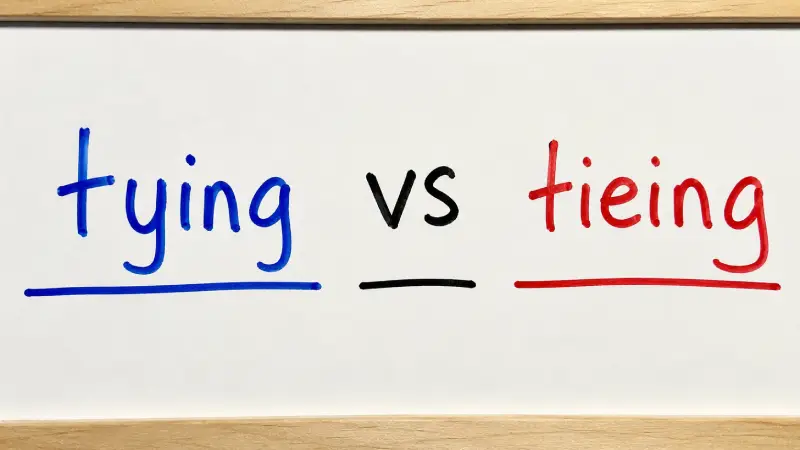
If you’ve searched for tying vs tieing, you’re probably wondering which spelling is actually correct. It’s an easy mistake to make because English spelling doesn’t always follow one simple rule.
The good news is that the answer is straightforward.
Tying is the correct spelling in modern American English. Tieing is generally considered incorrect in everyday writing and should be avoided.
Whether you’re writing an email, completing homework, creating business documents, or posting online, tying is the spelling you should use.
Once you understand the spelling rule behind this word, you’ll never have to guess again.
Quick Answer
Here’s the simple rule:
- ✅ Tying = Correct
- ❌ Tieing = Incorrect in standard American English
Examples:
- ✅ She is tying her shoes.
- ✅ They’re tying the boat to the dock.
- ✅ I’m tying a ribbon around the gift.
Incorrect:
❌ She is tieing her shoes.
❌ We are tieing the package.
Although tieing occasionally appears in older texts or highly specialized writing, it is not the spelling used in modern American English.
Why People Confuse Them
Many people assume the word should be tieing because the base verb is tie.
After all, English often forms -ing words by keeping most of the original spelling.
For example:
- bake → baking
- smile → smiling
- hope → hoping
So it’s easy to expect:
- tie → tieing
However, tie follows a different spelling pattern.
When -ing is added, the ie changes to y.
That gives us:
- tie → tying
The same pattern appears in:
- die → dying
- lie → lying
Because this rule isn’t obvious, many writers accidentally use tieing even though dictionaries recognize tying as the standard spelling.
Key Differences At A Glance
| Context | Best Choice | Why |
|---|---|---|
| Everyday writing | Tying | Standard American English spelling |
| School assignments | Tying | Accepted by dictionaries and teachers |
| Business writing | Tying | Professional and correct |
| Emails and messages | Tying | Preferred modern spelling |
| Websites and blogs | Tying | Matches current grammar standards |
| General English | Tieing | Usually considered incorrect |
Quick Comparison
| Feature | Tying | Tieing |
|---|---|---|
| Correct spelling | ✅ Yes | ❌ No |
| Found in modern dictionaries | ✅ Yes | Rare or historical mentions |
| Recommended in American English | ✅ Yes | ❌ No |
| Appropriate for professional writing | ✅ Yes | ❌ No |
| Used in schools | ✅ Yes | ❌ No |
Meaning And Usage Difference
One reason this topic causes confusion is that tying and tieing are intended to represent the same action.
Both refer to fastening, securing, or making a knot.
The difference isn’t meaning.
It’s spelling.
Tying
Tying is the accepted present participle and gerund form of the verb tie.
Examples:
- She’s tying her running shoes.
- They’re tying balloons for the party.
- Dad is tying the boat to the dock.
- We’re tying the gift with a ribbon.
- He spent the afternoon tying fishing knots.
Every one of these examples follows standard American English.
Tieing
Tieing is generally viewed as a misspelling in modern writing.
You might occasionally see it in:
- historical publications
- archived documents
- specialized technical references
However, those situations are uncommon.
For almost every purpose, including school, work, publishing, and online writing, you should use tying.
Tone, Context, And Formality
Tying is appropriate in every level of writing.
It works naturally in:
- Casual conversations
- Academic essays
- Professional emails
- Business reports
- Books
- Newspapers
- Websites
- Marketing content
- Social media posts
Examples:
- She is tying the ribbon carefully.
- We’re tying the package before shipping it.
- The coach is tying the team’s equipment securely.
Using tieing instead can distract readers because it looks like a spelling mistake.
If you’re writing for an American audience, tying is always the safer and more professional choice.
Which One Should You Use?
The answer is simple:
Choose tying every time.
Use tying whenever you’re describing someone:
- tying shoes
- tying a knot
- tying a tie
- tying a rope
- tying balloons
- tying ribbons
- tying fishing line
- tying a boat
- tying packages
- tying decorations
A simple memory trick can help.
Remember these three words together:
- die → dying
- lie → lying
- tie → tying
Notice that each word changes ie to y before adding -ing.
This pattern makes it much easier to remember the correct spelling.
Another helpful tip is to trust your spell checker.
Modern dictionaries, grammar references, and writing software consistently recognize tying as the standard spelling used in American English.
If your goal is clear, professional writing, tying is always the right choice.
When One Choice Sounds Wrong
Although tying and tieing may sound identical when spoken, they do not look equally correct in writing.
In modern American English, tying is the accepted spelling you’ll find in dictionaries, textbooks, newspapers, and professional writing. By contrast, tieing usually appears as a spelling mistake.
Compare these examples:
✅ She is tying her shoes before school.
❌ She is tieing her shoes before school.
✅ They are tying the boat to the dock.
❌ They are tieing the boat to the dock.
If you’re writing for school, work, or online, tying is the spelling readers expect.
Common Mistakes (And Quick Fixes)
Mistake 1: Writing “Tieing” Instead of “Tying”
Incorrect
- I’m tieing my shoes.
Correct
- I’m tying my shoes.
Quick Fix: Remember that ie changes to y before adding -ing.
Mistake 2: Applying the Wrong Spelling Rule
Some writers assume tie follows the same pattern as:
- hope → hoping
- bake → baking
- smile → smiling
However, tie belongs to a different group:
- tie → tying
- die → dying
- lie → lying
Learning this pattern helps you avoid the mistake.
Mistake 3: Ignoring Spell Checker Suggestions
Modern writing software usually flags tieing because tying is the accepted spelling.
Unless you’re quoting an older source, use tying.
Everyday Examples
Here are examples you’ll commonly see in American English.
Correct Examples
- She’s tying her shoes before the game.
- Dad is tying the boat to the dock.
- They’re tying balloons for the party.
- I’m tying a ribbon around the gift.
- The campers are tying secure knots.
- We’re tying the trash bags before taking them outside.
- He’s tying his tie before the interview.
- The workers are tying steel bars together.
- She’s tying her hair into a ponytail.
- They spent the afternoon tying fishing flies.
Incorrect Examples
- ❌ She is tieing her shoes.
- ❌ We are tieing the rope.
- ❌ They were tieing decorations.
Replace tieing with tying in each sentence.
Dictionary-Style Word Details
Verb
Tying
The present participle and gerund of the verb tie, meaning to fasten, secure, connect, or make a knot.
Examples
- She is tying the package.
- They’re tying the ropes together.
Tieing
Generally considered a nonstandard spelling in modern American English and not recommended for everyday writing.
Noun
Tying
Can function as a gerund, meaning a verb acting as a noun.
Examples:
- Tying knots takes patience.
- Tying fishing flies requires practice.
Tieing
Not commonly used as a noun in standard English.
Synonyms
Tying (closest plain alternatives)
- fastening
- securing
- binding
- attaching
- connecting
- knotting
The best synonym depends on the sentence.
Tieing
No separate synonyms apply because it is simply a nonstandard spelling of tying.
Example Sentences
Tying
- She is tying the ribbon around the gift.
- The crew is tying the boat to the dock.
- We’re tying the decorations before guests arrive.
- He’s tying a knot in the rope.
- They’re tying everything together neatly.
Tieing
- ❌ She is tieing her shoes.
- ❌ We are tieing the package.
These examples are incorrect in standard American English.
Word History
The verb tie has existed in English for centuries. As English spelling developed, the accepted -ing form became tying, following the same spelling pattern seen in die → dying and lie → lying.
Although tieing has appeared occasionally in older publications and a few specialized contexts, modern dictionaries and style guides recognize tying as the standard spelling for everyday American English.
Phrases Containing
Common expressions include:
- tying the knot
- tying your shoes
- tying a bow
- tying a ribbon
- tying a boat to the dock
- tying loose ends
- tying everything together
- tying a secure knot
- tying fishing flies
- tying a package
Each expression uses tying, not tieing.
Frequently Asked Questions
Is “tying” or “tieing” correct?
Tying is the correct spelling in modern American English. Tieing is generally considered incorrect in everyday writing.
Why is it “tying” instead of “tieing”?
The verb tie changes ie to y before adding -ing, creating tying. The same rule applies to die → dying and lie → lying.
Is “tieing” ever correct?
In rare historical documents or specialized technical contexts, you may see tieing. However, tying is the correct choice for standard American English.
How do you spell “tying your shoes”?
The correct phrase is tying your shoes.
Example:
She is tying her shoes before going outside.
Why does spell check mark “tieing” as incorrect?
Most spell checkers follow modern dictionary standards, which recognize tying as the accepted spelling.
Is “tying” a verb or a noun?
It can be both. Tying is the present participle of tie, and it can also function as a gerund.
Example:
Tying knots takes patience.
What is the easiest way to remember the correct spelling?
Remember this simple pattern:
tie → tying
die → dying
lie → lying
Changing ie to y before adding -ing makes the correct spelling easy to remember.
Which spelling should I use in American English?
Always use tying in standard American English. It is the spelling recommended by modern dictionaries, grammar references, and professional style guides.
Conclusion
When comparing tying vs tieing, the correct spelling is clear.
Tying is the standard spelling in modern American English. It is the present participle and gerund form of the verb tie and is accepted in schools, workplaces, books, websites, and professional writing.
Tieing, on the other hand, is generally considered a nonstandard or incorrect spelling for everyday use. While it may appear in rare historical or specialized contexts, it should not be used in normal writing.
If you’re ever unsure, remember this simple pattern:
- tie → tying
- die → dying
- lie → lying
Using this rule will help you choose the correct spelling every time and make your writing look polished and professional.