
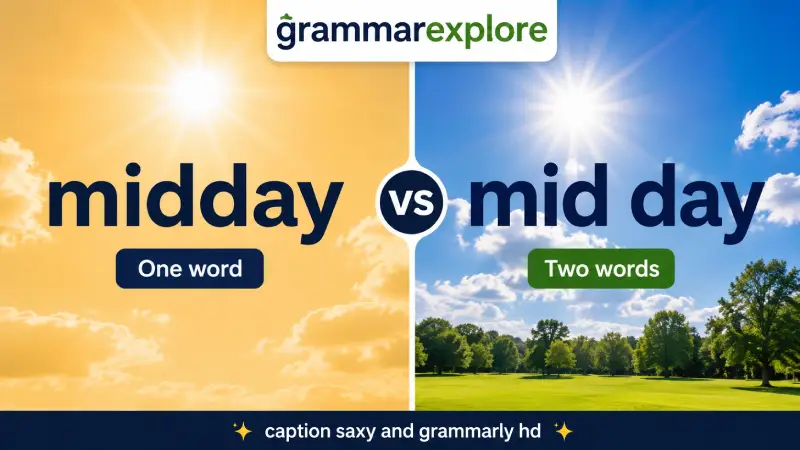
Midday is the standard spelling in modern American English. It means the middle of the day, usually around noon, and it is widely used in professional writing, articles, emails, school assignments, and everyday conversations.
The spelling mid day is generally not considered the standard form. Although most readers can understand it, the two-word version can look like a spelling mistake or an unnecessary separation of a compound word.
The simple rule is:
✅ Correct: midday
❌ Avoid: mid day
Examples:
- The meeting starts at midday.
- Please complete the report before midday.
- The midday sun was extremely bright.
When you mean the middle of the day, use midday as one word.
Quick Answer: Midday or Mid Day?
The correct spelling is midday.
| Word | Correct Usage | Meaning |
|---|---|---|
| Midday | ✅ Standard | The middle of the day, usually around noon |
| Mid Day | ❌ Not standard | A separated form that is generally avoided |
Use midday in:
- Business emails
- Articles
- Reports
- Academic writing
- Website content
- Personal messages
Examples:
- The delivery should arrive by midday.
- We will meet around midday.
- The store closes at midday.
The word midday works naturally in both formal and casual situations.
Why People Confuse Midday And Mid Day
Many people confuse these forms because English has many compound words made from smaller words.
Examples:
- today
- tomorrow
- afternoon
- daytime
- sometimes
Because mid and day are both valid words, it may seem logical to write them separately. However, English compound words often develop their own accepted spelling over time.
Midday has become an established single word. Modern readers expect this spelling when referring to the middle of the day.
Compare:
Natural:
The package will arrive by midday.
Less natural:
The package will arrive by mid day.
Both versions communicate the idea, but the first follows standard written English.
What Does Midday Mean?
Midday means the middle part of the day, usually around 12:00 p.m.
It can refer to:
- The exact time of noon
- The period around noon
- Something connected with the middle of the day
Examples:
- We arrived at the hotel at midday.
- The office becomes busy around midday.
- Temperatures usually rise by midday.
- She takes her lunch break at midday.
The exact meaning depends on context. Sometimes it refers to a specific time, while sometimes it describes a general period near noon.
How To Use Midday Correctly
Midday As A Noun
As a noun, midday refers to a time of day.
Examples:
- The meeting begins at midday.
- The package should arrive before midday.
- By midday, everyone had arrived.
- We reached the destination at midday.
Midday As A Describing Word
Midday can also describe another noun.
Common examples:
- midday sun
- midday heat
- midday meal
- midday break
- midday traffic
Examples:
- The midday sun was too strong.
- The midday heat made outdoor work difficult.
- Employees usually take a midday break.
This use is common in professional and everyday English.
Is Mid Day Ever Correct?
In modern American English, mid day is generally not the preferred spelling.
You may see it occasionally because of:
- Informal writing
- Typing mistakes
- Lack of editing
- Confusion about compound words
However, the standard form remains midday.
Correct:
The event starts at midday.
Less standard:
The event starts at mid day.
Correct:
We expect the results before midday.
Less standard:
We expect the results before mid day.
For polished writing, always choose midday.
Meaning And Usage Difference
The difference between midday and mid day is not meaning. Both are understood as referring to the middle of the day.
The real difference is usage:
- Midday is the accepted standard word.
- Mid day is a nonstandard separated form.
Use midday when writing:
- Emails
- Reports
- Articles
- School assignments
- Business documents
- Website content
Examples:
✅ The conference begins at midday.
✅ The weather was hottest around midday.
✅ We should finish the work by midday.
Avoid:
❌ The conference begins at mid day.
❌ The weather was hottest around mid day.
❌ We should finish the work by mid day.
Midday vs. Noon: What Is The Difference?
Midday and noon are closely related, but they are not always used in exactly the same way.
| Feature | Midday | Noon |
|---|---|---|
| Refers to 12:00 p.m. | Yes | Yes |
| Refers to the period around noon | Yes | Less often |
| Used before another noun | Common | Less common |
Examples:
- The meeting starts at noon.
- The meeting starts around midday.
- The midday sun was intense.
Noon usually sounds more exact, while midday can describe a wider period around the middle of the day.
Which One Should You Use?
When choosing between midday and mid day, use midday almost every time.
Choose midday for:
- Professional communication
- Articles
- Reports
- School writing
- Everyday messages
Examples:
- Please arrive before midday.
- The restaurant gets busy at midday.
- The midday schedule changed.
A useful proofreading tip is to search your writing for “mid day.” If you mean the middle of the day, replace it with “midday.”
Common Mistakes And Quick Fixes
Writing Mid Day As Two Words
Incorrect:
We should finish the project by mid day.
Correct:
We should finish the project by midday.
Using Mid Day In Compound Phrases
Incorrect:
We took a mid day break.
Correct:
We took a midday break.
Other examples:
Incorrect:
- mid day meal
- mid day traffic
- mid day meeting
Correct:
- midday meal
- midday traffic
- midday meeting
Confusing Midday With Afternoon
Midday refers to the middle of the day.
Afternoon refers to the time after noon.
Examples:
- We met at midday.
- We continued working in the afternoon.
Everyday Examples Of Midday
Workplace Examples
- The manager requested the update before midday.
- Our team meeting starts at midday.
- The office becomes quieter after midday.
- Employees usually take a midday break.
Travel Examples
- We reached the airport before midday.
- The tour begins at midday.
- Traffic became heavier by midday.
- We stopped for lunch around midday.
Weather Examples
- The midday sun can be intense in summer.
- Temperatures often peak around midday.
- The midday heat made walking difficult.
Daily Life Examples
- I usually finish errands before midday.
- We planned a midday picnic.
- The store is busiest around midday.
- She prefers exercising before midday.
Dictionary-Style Word Details
Verb
Midday: Not commonly used as a verb in standard American English.
Mid Day: Not commonly used as a verb in standard American English.
Noun
Midday: A noun meaning the middle of the day, usually around noon.
Examples:
- The shipment arrived at midday.
- We met at midday.
Mid Day: Not the standard noun form. It is generally treated as an incorrect spacing of midday.
Synonyms
Midday:
Closest plain alternatives:
- Noon
- Middle of the day
- Noon hour
Depending on context:
- Lunchtime
Mid Day:
No separate synonyms apply because it is not a standard separate word.
Example Sentences
Midday:
- The event begins at midday.
- The office was crowded by midday.
- The midday sun was very bright.
- We completed the task before midday.
Mid Day:
The standard form is midday.
Instead of:
❌ The event starts at mid day.
Write:
✅ The event starts at midday.
Word History
Midday developed as a compound word from mid and day. Over time, the single-word form became the standard spelling in English.
The separated form mid day does not function as a separate modern standard word.
Phrases Containing
Common phrases include:
- by midday
- around midday
- midday sun
- midday heat
- midday meal
- midday break
- midday traffic
- midday meeting
Examples:
- We should complete the work by midday.
- The midday sun was very strong.
- She took a short midday break.
Frequently Asked Questions
Is mid day wrong?
Midday is one word. It is the standard spelling in modern American English.
Is mid day wrong?
For most modern writing, yes. The preferred form is midday.
Is midday the same as noon?
They are closely related. Noon usually means exactly 12:00 p.m., while midday can include the period around noon.
Should midday be capitalized?
Usually no. Midday is a common word and stays lowercase unless it begins a sentence or appears in a title.
Can midday be used before another noun?
Yes. Examples include:
midday sun
midday meal
midday traffic
Why do people write mid day?
People often separate the words because mid and day are familiar words on their own. However, the standard compound spelling is midday.
Conclusion
The difference between midday vs. mid day is simple.
Use:
✅ Midday is the correct standard spelling for the middle of the day.
Avoid:
❌ Mid day is a nonstandard separated form.
Whether you are writing a professional email, school assignment, article, or everyday message, midday is the spelling readers expect.
When you mean the time around noon, keep it simple: write it as one word , midday.