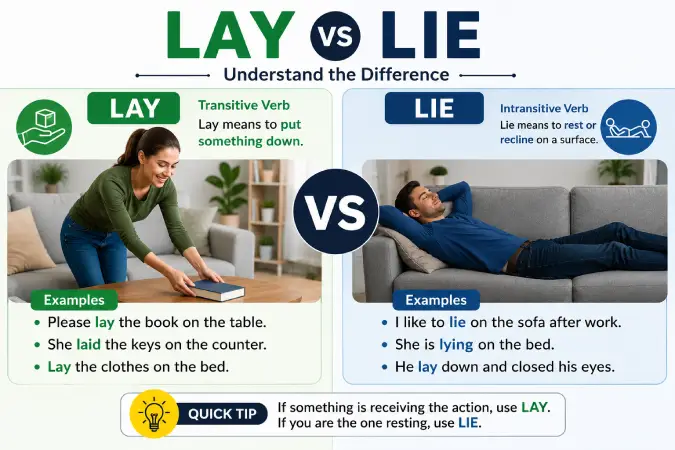
Lay and lie are two of the most confusing verbs in American English. Many people mix them up because their meanings are related and some of their forms look the same.
The easiest way to remember the difference:
- Lay = put or place something somewhere
- Lie = rest or recline
Examples:
✅ Please lay the phone on the table.
✅ I need to lie down after work.
The main question is:
Are you placing something, or are you resting yourself?
That answer tells you which word to use.
Quick Answer
Use lay when an object is being placed somewhere.
Example:
- She laid the keys on the kitchen counter.
Use lie when a person or animal is resting.
Example:
- She lay on the couch for an hour.
Quick memory trick:
Lay = Lay something down.
Lie = Lie down yourself.
Why People Confuse Them
The confusion happens because these verbs have similar meanings and overlapping forms.
The verb lay always needs something after it.
Example:
- Lay the book on the desk.
The book is receiving the action.
The verb lie does not need an object.
Example:
- I want to lie down.
The person is doing the resting.
The biggest confusion comes from the past tense:
| Verb | Present | Past |
|---|---|---|
| Lay (place something) | lay | laid |
| Lie (rest) | lie | lay |
Notice that the past tense of lie is lay, which looks exactly like the present tense of the other verb.
Key Differences At A Glance
| Context | Best Choice | Why |
|---|---|---|
| Putting a book somewhere | Lay | The book is receiving the action |
| Resting on a bed | Lie | No object is being placed |
| Giving instructions to place something | Lay | Requires an object |
| Taking a break | Lie | Means to rest |
Feature Comparison
| Feature | Lay | Lie |
|---|---|---|
| Meaning | Put or place | Rest or recline |
| Requires an object | Yes | No |
| Example | Lay the bag here | Lie down here |
| Common mistake | “I lay down” for resting | “Lie the book down” |
Meaning and Usage Difference
Lay
Lay means to place something in a specific position.
Because it is a transitive verb, it needs an object.
Examples:
- Lay the documents on my desk.
- She laid her jacket on the chair.
- He is laying the baby’s blanket on the bed.
You always lay something.
Lie
Lie means to rest, recline, or remain in a position.
It does not take an object.
Examples:
- I need to lie down.
- The dog is lying near the fireplace.
- She likes to lie on the beach.
You do not lie something. You simply lie yourself down.
Tone, Context, and Formality
Both words are common in American English. The difference is not about being formal or informal.
The difference is grammar and meaning.
Use lay in situations involving placement:
- Lay the papers on the table.
- Lay the blanket over the chair.
Use lie when talking about rest:
- I’m going to lie down.
- The baby is lying in the crib.
Which One Should You Use?
Use this simple test:
Is there something being placed?
Yes → Use lay
Example:
- Lay your phone beside the laptop.
No → Use lie
Example:
- Lie on the sofa.
Another way to remember:
Someone lays something.
Someone lies down.
When One Choice Sounds Wrong
Some sentences sound common but are grammatically incorrect.
Incorrect:
- I need to lay down.
Correct:
- I need to lie down.
Why? Because you are resting, not placing something.
Incorrect:
- Lie the book on the table.
Correct:
- Lay the book on the table.
Why? The book is being placed.
Incorrect:
- Yesterday, I laid on the bed.
Correct:
- Yesterday, I lay on the bed.
Why? The past tense of “lie” is “lay.”
Common Mistakes (and Quick Fixes)
Mistake 1: Using “lay” for yourself
Wrong:
- I’m going to lay down.
Right:
- I’m going to lie down.
Remember: You lie down. You lay something down.
Mistake 2: Forgetting the object after “lay”
Wrong:
- Please lay here.
Right:
- Please lie here.
“Lay” needs something to receive the action.
Mistake 3: Confusing “laid” and “lay”
Wrong:
- She lay the book on the desk.
Right:
- She laid the book on the desk.
The book was placed, so use “laid.”
Everyday Examples
Lay Examples
- Lay the remote on the table.
- She laid the baby’s clothes on the bed.
- Please lay the papers beside the computer.
Lie Examples
- I want to lie down after dinner.
- The dog is lying in the backyard.
- He lay on the couch all afternoon.
Dictionary-Style Word Details
Verb
Lay:
A verb meaning to put or place something somewhere.
Example:
- Lay the keys on the counter.
Lie:
A verb meaning to rest or be in a flat or horizontal position.
Example:
- Lie down and relax.
Noun
Lay:
Not commonly used as a noun in this comparison.
Lie:
Can also be a noun meaning a false statement.
Example:
- That was a lie.
This is a different meaning from the resting verb.
Synonyms
Lay: Closest plain alternatives:
- put
- place
- set
Lie: Closest plain alternatives:
- rest
- recline
- relax
Example Sentences
Lay:
- Lay your coat on the chair.
- She laid the package near the door.
Lie:
- I need to lie down for a few minutes.
- The cat is lying in the sun.
Word History
Both verbs have existed in English for a long time. Their similar forms and meanings are the main reason they continue to confuse many speakers.
Phrases Containing
Lay:
- lay the foundation
- lay out a plan
- lay something down
Lie:
- lie down
- lie still
- lie ahead
Conclusion
The difference between lay and lie becomes easier when you remember one question:
Are you putting something somewhere, or are you resting?
- Lay = place something
- Lie = rest yourself
Most mistakes happen because people forget that lay needs an object, while lie does not.
Once you understand that basic difference, choosing the correct word becomes much easier.
Frequently Asked Questions
Is it correct to say “lay down”?
It depends on the meaning. If you mean “rest yourself,” the correct phrase is lie down.
Example:
I need to lie down.
If you mean “put something down,” use lay.
Example:
Lay the book down.
What is the difference between lay and lie?
Lay means to place something. Lie means to rest or recline.
Is “I laid down” correct?
Usually no, if you mean resting. The correct sentence is:
I lay down yesterday.
“Lay” is the past tense of “lie.”
Why is lay the past tense of lie?
English has two different verbs with similar forms. The past tense of lie happens to be lay, which creates confusion.
How do I remember lay vs lie?
Remember:
Lay = Lay something down.
Lie = Lie down yourself.
Which word is more common in everyday English?
Both are common, but lie and lay are used in different situations. Use the one that matches the action you mean.