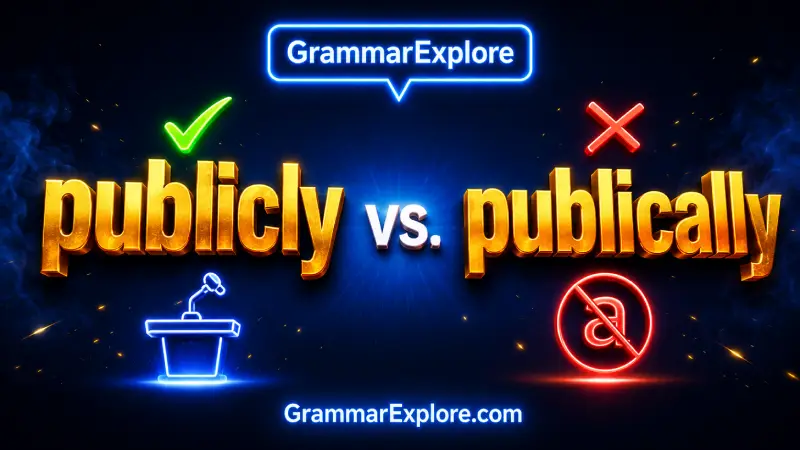
When choosing between publicly and publically, use publicly. It is the established and widely preferred spelling in standard US English.
Some dictionaries recognize publically as a less common variant, so it is not entirely unknown. However, many readers, editors, teachers, and spell-checkers treat it as a mistake. Using publicly keeps your writing clear and professional.
- Correct and preferred: The mayor publicly supported the proposal.
- Best avoided: The mayor publically supported the proposal.
Both forms carry the same basic meaning. The difference concerns acceptance and usage, not meaning.
Quick Answer
Publicly is the correct choice for almost every situation. It means openly, in public, or in a way that people can observe or know about.
Publically is a rare variant of the same word. Although some dictionaries record it, it may look misspelled and is unsuitable for most edited US writing.
Use:
- publicly available
- publicly announced
- publicly traded
- publicly funded
- publicly criticized
For reliable writing, remember this rule: add -ly directly to public to form publicly.
Is “Publically” Grammatically Correct?
Yes. Publically is a grammatically correct but less common spelling. In American English, publicly is the preferred and more widely accepted form. Both words have the same meaning.
Examples:
- She publicly apologized for the mistake.
- The company announced the decision publicly.
What Does “Publically” Mean?
Publically means in a public manner or openly. It has the same meaning as publicly, but publicly is the standard spelling in modern English.
Examples:
- He spoke publicly about the issue.
- The results were released publicly.
Is There a Word Called Publicly?
Yes. Publicly is a standard English word that means openly, in public, or so that everyone can know or see. It is the preferred spelling in both American and British English.
Examples:
- The mayor publicly thanked the volunteers.
- She publicly supported the project.
What Does the Word “Publically” Mean?
Publically means openly or in a public way. Although it has the same meaning as publicly, most dictionaries and style guides recommend using publicly because it is the standard spelling.
Examples:
- The report was publicly available.
- He publicly admitted his mistake.
Why People Confuse Them
The spelling publically looks reasonable because many adjectives ending in -ic form adverbs with -ically:
- automatic becomes automatically
- dramatic becomes dramatically
- specific becomes specifically
- strategic becomes strategically
That pattern may lead writers to assume that public should become publically. Standard usage follows a different pattern: public becomes publicly.
Both spellings also sound nearly identical in everyday speech. A person who has heard the word but rarely seen it in writing may naturally add the extra al.
The safest memory aid is simple:
Public + ly = publicly
Key Differences At A Glance
- Publicly: The standard, preferred spelling in US English.
- Publically: A rare variant that many readers consider an error.
- Meaning: Both refer to something done openly, before the public, or with public knowledge.
- Grammar: Both function as adverbs, although publicly is the form to use.
- Professional writing: Choose publicly.
- Pronunciation: The spellings usually sound alike, so pronunciation does not help much with the choice.
Meaning And Usage Difference
Publicly means in an open or public manner. It can describe something that people can see, hear, access, or know about.
- The governor publicly addressed the allegations.
- The records are publicly available.
- The organization publicly disclosed its expenses.
- She had never discussed the incident publicly.
The word can also describe something associated with the public or government:
- a publicly funded program
- a publicly owned utility
- a publicly traded company
Publically has the same intended meaning. It does not describe a different type of public action. The issue is that it remains far less accepted.
Consider these two sentences:
- The company publicly apologized.
- The company publically apologized.
They communicate the same idea, but the first sentence uses the spelling readers expect. The second may distract readers or appear careless.
| Feature | Publicly | Publically |
|---|---|---|
| Meaning | Openly or in a public manner | Same intended meaning |
| Word Class | Adverb | Adverb |
| Status In US English | Standard and preferred | Rare variant |
| Suitable For Edited Writing | Yes | Usually no |
| Likely To Be Flagged | No | Often |
Tone, Context, And Formality
Publicly works in formal, neutral, and conversational English. You can use it in academic papers, news reports, business emails, government documents, and social posts.
Formal:
- The agency publicly released its findings.
- The corporation is publicly traded.
Neutral:
- He publicly thanked the volunteers.
- The schedule is publicly available.
Conversational:
- She has never talked publicly about the breakup.
- Why did he criticize her publicly?
The word itself does not create a formal tone. The surrounding sentence determines the tone.
Publically does not sound more formal or carry a special meaning. Its extra letters may make it look formal, but they do not improve the sentence. In fact, the unusual spelling can weaken the credibility of professional writing.
Which One Should You Use?
Choose publicly whenever you mean openly, before other people, or in a way the public can access.
| Context | Best Choice | Why |
|---|---|---|
| A public announcement | Publicly | It is the standard spelling |
| Information anyone can access | Publicly | “Publicly available” is the expected form |
| A company listed on a stock exchange | Publicly | “Publicly traded” is the standard phrase |
| Government financial support | Publicly | “Publicly funded” is the accepted form |
| An open apology | Publicly | It describes an apology made before others |
| Academic or business writing | Publicly | It avoids an unusual and disputed variant |
| A direct quotation containing “publically” | Publically | Preserve the original wording when quoting exactly |
You may encounter publically in older material, informal posts, or unedited writing. Its appearance does not create a new definition. Unless you are reproducing someone’s exact words, change it to publicly.
When One Choice Sounds Wrong
Publically may sound normal when spoken, but it often looks wrong on the page:
- Weak: The decision was publically announced Monday.
- Better: The decision was publicly announced Monday.
- Weak: The database is publically accessible.
- Better: The database is publicly accessible.
- Weak: He publically denied the accusation.
- Better: He publicly denied the accusation.
Writers sometimes use publically because they follow the spelling pattern of words such as logically or politically. That logic is understandable, but it does not reflect the established spelling of publicly.
Do not use publicly when you need the adjective public:
- Incorrect: The meeting is publicly.
- Correct: The meeting is public.
In the correct sentence, public describes the meeting. An adverb cannot complete that sentence in the same way.
Common Mistakes (And Quick Fixes)
Mistake: The report is publically available.
Fix: The report is publicly available.
Mistake: She publically accepted responsibility.
Fix: She publicly accepted responsibility.
Mistake: The organization is publically funded.
Fix: The organization is publicly funded.
Mistake: The business became publically traded last year.
Fix: The business became publicly traded last year.
Mistake: They made a publicly statement.
Fix: They made a public statement.
The last example involves a different error. Publicly is an adverb, so it does not normally describe a noun such as statement. Use the adjective public before a noun:
- public statement
- public meeting
- public announcement
- public record
Use publicly when modifying a verb, adjective, or participle:
- spoke publicly
- publicly available
- publicly supported
- publicly funded
Everyday Examples
These examples show how publicly appears in modern US English:
- The school publicly posted its updated calendar.
- Both candidates publicly supported the measure.
- The actor apologized publicly after the interview.
- The documents are publicly accessible online.
- She does not discuss her family publicly.
- The startup plans to become publicly traded.
- City officials publicly announced the road closure.
- The museum receives both private donations and publicly funded grants.
- He publicly thanked the nurses who cared for him.
- The research team made its findings publicly available.
- No one has publicly claimed responsibility.
- The coach publicly defended the player.
Placement can vary without changing the basic meaning:
- The director publicly apologized for the delay.
- The director apologized publicly for the delay.
Both sentences are correct. The first puts slightly more emphasis on the public nature of the apology.
Dictionary-Style Word Details
Verb
- Publicly: Not a verb. It is an adverb that can modify a verb: “The senator publicly objected.”
- Publically: Not a verb. It is a rare adverbial variant, but publicly is the preferred spelling.
The related verb depends on the intended action. Possible verbs include announce, disclose, publish, and reveal, but none is an exact replacement in every sentence.
Noun
- Publicly: Not a noun in standard US English.
- Publically: Not a noun in standard US English.
The related noun public can refer to people as a group:
- The park is open to the public.
- The announcement surprised the public.
Do not confuse that noun with the adverb publicly.
Synonyms
- Publicly: The closest plain alternatives include openly, in public, and for everyone to see. The best choice depends on context.
- Publically: It has the same intended alternatives, but use publicly as the standard spelling.
Possible opposites include:
- privately
- secretly
- confidentially
- discreetly
These opposites do not fit every context. For example, a record that is not publicly available may be private or restricted, but it is not necessarily secret.
Example Sentences
Publicly:
- The board publicly approved the new policy.
- Her contact information is not publicly available.
- The company has publicly committed to lowering its emissions.
- He declined to comment publicly on the dispute.
- The facility receives publicly funded support.
Publically:
- Some writers use “publically,” but editors usually change it to “publicly.”
- If a quotation contains “publically,” preserve the spelling when exact wording matters.
Using the rare form in a sentence does not add a new meaning.
Word History
Publicly developed as the adverbial form of public. Its spelling follows the direct combination of public and -ly.
Publically appeared as an alternative formation, likely influenced by the spelling of other adverbs ending in -ically. Dictionaries do not treat it uniformly: some list it as a less common variant, while others label it nonstandard or omit it.
That disagreement does not create much practical uncertainty. Publicly remains the safe, established choice for present-day US writing.
Phrases Containing
Common phrases with publicly include:
- publicly available
- publicly accessible
- publicly announced
- publicly disclosed
- publicly funded
- publicly known
- publicly owned
- publicly released
- publicly supported
- publicly traded
- speak publicly
- apologize publicly
Writers sometimes place the adverb after the verb:
- announced publicly
- traded publicly
- spoke publicly
Publically may appear in the same positions, but replacing it with publicly will usually improve the text.
Conclusion
Use publicly, not publically, in standard US English.
Publicly means openly, before other people, or in a way the public can access or know about. Publically carries the same intended meaning, and a few dictionaries recognize it as a rare variant. Still, many readers and editors view it as a spelling error.
The easiest rule is:
Add -ly directly to public: public + ly = publicly.
Choose publicly for school assignments, business communication, news writing, formal documents, and everyday use.