
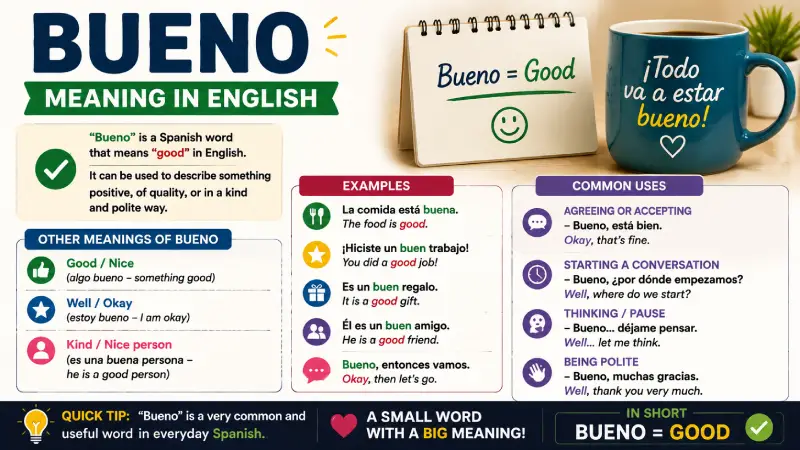
The Spanish word bueno means “good” in English. It is one of the most common Spanish words and is used to describe something positive, acceptable, or of good quality.
Depending on the context, bueno can also mean “well,” “okay,” “alright,” or “good” as a conversation expression. Spanish speakers use it in everyday conversations to describe people, things, actions, and situations.
Because bueno changes according to gender and number, learners may see different forms such as buena, buenos, and buenas.
Quick Answer
Bueno means “good” in English. It can describe quality, behavior, or a positive situation. In conversations, it can also mean “well,” “okay,” or “alright,” depending on the context.
Bueno Meaning Explained
The basic translation of bueno is:
- good
- nice
- kind
- correct
- acceptable
Examples:
Un buen libro
= A good book
Un hombre bueno
= A good man
La comida está buena
= The food is good
The exact meaning changes depending on what is being described.
Bueno as “Good”
The most common use of bueno is describing something positive.
Examples:
El restaurante es bueno.
English:
The restaurant is good.
Este es un buen ejemplo.
English:
This is a good example.
Here, bueno describes quality.
Bueno as “Kind” or “Good-Hearted”
When describing a person, bueno can refer to someone’s character.
Example:
Ella es una persona buena.
English:
She is a good person.
Meaning:
She is kind, caring, or morally good.
Bueno as “Okay” or “Well” in Conversation
Spanish speakers often use bueno as a conversational word.
Examples:
Bueno, vamos.
English:
Well, let’s go.
Bueno, está bien.
English:
Okay, that’s fine.
In these situations, bueno does not describe quality. It works more like a transition word.
Bueno Gender and Number Forms
Spanish adjectives change depending on the noun they describe.
| Spanish Form | English Meaning | Example |
|---|---|---|
| Bueno | Good (masculine singular) | Un libro bueno |
| Buena | Good (feminine singular) | Una idea buena |
| Buenos | Good (masculine plural) | Buenos amigos |
| Buenas | Good (feminine plural) | Buenas noticias |
Bueno vs Bien: Difference
Many Spanish learners confuse bueno and bien.
| Word | Meaning | Use |
|---|---|---|
| Bueno | Good | Describes nouns |
| Bien | Well | Describes actions or conditions |
Examples:
El libro es bueno.
= The book is good.
Ella canta bien.
= She sings well.
A simple rule:
- Bueno = good thing/person
- Bien = well action
Bueno vs Buen: Difference
Both words come from the same adjective, but the position changes.
Bueno
Used after a noun.
Example:
Un hombre bueno.
= A good man.
Buen
Used before a masculine singular noun.
Example:
Un buen hombre.
= A good man.
Both can be correct, but the placement changes.
How Do You Pronounce Bueno?
A simple English pronunciation guide:
BWEH-noh
Breakdown:
- bue = bweh
- no = noh
The “b” sound in Spanish may be softer than the English “b.”
Is Bueno Formal or Informal?
Bueno is a standard Spanish word used in both formal and informal situations.
It appears in:
- everyday conversations
- books
- professional communication
- education
- media
The conversational use of bueno (“well” or “okay”) is more common in casual speech.
Common Expressions With Bueno
Buenos días
Meaning:
Good morning
Example:
Buenos días, señor.
= Good morning, sir.
Buen trabajo
Meaning:
Good job
Example:
¡Buen trabajo!
= Good job!
Está bueno
Meaning:
It is good / tasty / attractive
The meaning depends on the country and context.
Example:
La comida está buena.
= The food tastes good.
Bueno, entonces…
Meaning:
Well, then…
Example:
Bueno, entonces empezamos.
= Well, then we start.
Common Mistakes About Bueno
Mistake 1: Using bueno for every “good” situation
Sometimes Spanish uses bien instead.
Incorrect:
Ella canta bueno.
Correct:
Ella canta bien.
Meaning:
She sings well.
Mistake 2: Forgetting gender agreement
Incorrect:
Una libro bueno
Correct:
Un libro bueno
The adjective must match the noun.
Mistake 3: Translating conversational bueno literally
Example:
Bueno, no sé.
Natural meaning:
Well, I don’t know.
Not:
Good, I don’t know.
Examples of Bueno in Sentences
| Spanish Sentence | English Meaning |
|---|---|
| Tengo un buen amigo. | I have a good friend. |
| La película fue buena. | The movie was good. |
| Buenos días a todos. | Good morning everyone. |
| Bueno, podemos empezar. | Well, we can start. |
| Él es un hombre bueno. | He is a good man. |
Related Spanish Words
Malo
Meaning:
Bad
Bien
Meaning:
Well
Mejor
Meaning:
Better
Excelente
Meaning:
Excellent
Correcto
Meaning:
Correct
Frequently Asked Questions
What does bueno mean in English?
Bueno means “good” in English. It can also mean “well” or “okay” in certain conversations.
Is bueno a Spanish adjective?
Yes. Bueno is a Spanish adjective that describes nouns.
What is the difference between bueno and bien?
Bueno means “good” and describes things or people. Bien means “well” and usually describes actions.
What does Buenos días mean?
Buenos días means “good morning” in English.
How do you pronounce bueno?
Bueno is pronounced approximately as BWEH-noh.
Can bueno mean okay?
Yes. In conversations, bueno can mean “okay,” “alright,” or “well.”
Mini Quiz: Test Your Knowledge
1. What does bueno mean in English?
A) Bad
B) Good
C) Fast
D) Small
Answer: B) Good
2. Which word means “well”?
A) Bueno
B) Bien
C) Malo
D) Mejor
Answer: B) Bien
3. What does “Buenos días” mean?
A) Good night
B) Good morning
C) Good luck
D) Good food
Answer: B) Good morning
4. Does bueno change form?
A) Yes
B) No
C) Never
D) Only in English
Answer: A) Yes
Conclusion
Bueno means “good” in English and is one of the most useful Spanish words for everyday communication. It can describe quality, character, and situations, while also working as a conversational expression meaning “well” or “okay.”
Learning the different uses of bueno, including its forms buena, buenos, and buenas, helps Spanish learners speak more naturally and understand real conversations.