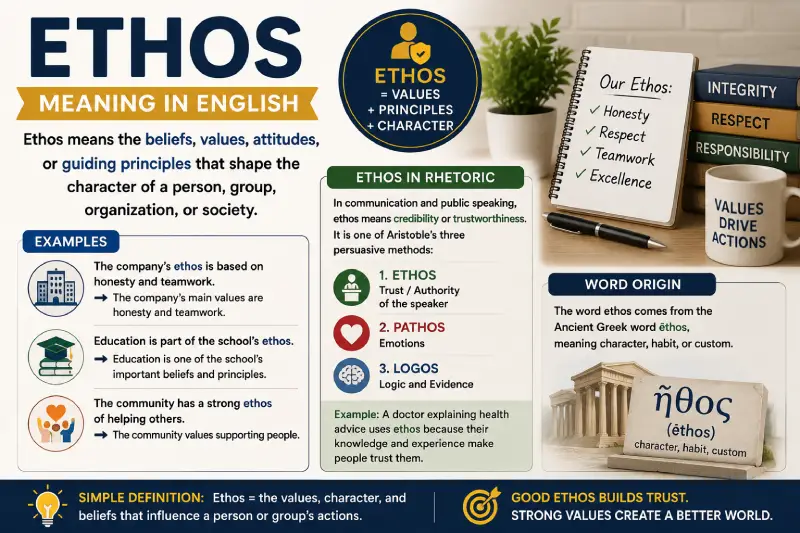
The word ethos means the character, values, beliefs, or guiding principles that influence a person, group, organization, or society. In English, it is often used to describe the qualities that shape how someone thinks, behaves, or communicates.
The term is especially common in writing, speeches, literature, leadership, and communication. In rhetoric, ethos refers to the way a speaker builds trust and credibility with an audience.
Understanding ethos meaning in English helps explain why people trust certain speakers, brands, organizations, or ideas.
Quick Answer
Ethos means the beliefs, values, and character that define a person, group, or organization. In communication, ethos means building credibility and trust with an audience.
Ethos Meaning Explained
The word ethos describes the qualities that represent the identity or character of something.
It can refer to:
- values
- beliefs
- principles
- moral character
- culture
- credibility
Examples:
The company’s ethos focuses on honesty and customer care.
Meaning:
The company’s guiding values emphasize honesty and caring for customers.
The teacher’s ethos inspired students to work harder.
Meaning:
The teacher’s character and values influenced students.
Ethos in Simple Words
In simple terms, ethos is “the character behind the message.”
When people ask:
“Why should I trust this person?”
The answer often relates to ethos.
For example:
- A doctor explaining health advice has professional expertise.
- A scientist discussing research has educational credibility.
- A leader showing honesty builds public trust.
These qualities create ethos.
Ethos in Communication and Rhetoric
In rhetoric, ethos is one of Aristotle’s three methods of persuasion.
The three persuasive appeals are:
| Appeal | Meaning | Focus |
|---|---|---|
| Ethos | Credibility and trust | Who is speaking |
| Pathos | Emotion | How people feel |
| Logos | Logic and evidence | Facts and reasoning |
Ethos helps convince people by showing that the speaker is reliable and knowledgeable.
Example:
A doctor saying:
“I have studied heart health for 20 years.”
uses ethos because the statement builds trust through experience.
Ethos Examples in Everyday Life
Example 1: Business
A company promotes an ethos of sustainability.
Meaning:
The company’s values focus on protecting the environment.
Example 2: Education
The school’s ethos encourages respect and responsibility.
Meaning:
The school culture is based on those values.
Example 3: Public Speaking
The speaker built ethos by sharing professional experience.
Meaning:
The speaker gained trust by showing knowledge and authority.
Ethos Meaning in Writing
In writing, ethos helps an author appear trustworthy and knowledgeable.
Writers create ethos by using:
- accurate information
- expert opinions
- professional experience
- reliable sources
- respectful language
Example:
A medical article written by a qualified doctor has stronger ethos because readers may trust the author’s expertise.
Ethos vs Ethics: Difference
Although ethos and ethics look similar, they are different.
| Word | Meaning | Example |
|---|---|---|
| Ethos | Character, values, beliefs, or guiding principles | A company’s ethos is based on innovation |
| Ethics | Rules about right and wrong behavior | Professional ethics require honesty |
A simple way to remember:
- Ethos = what a person or group represents
- Ethics = what is considered right or wrong
Ethos vs Pathos vs Logos
These three terms are often confused because they all relate to persuasion.
| Term | Meaning | Example |
|---|---|---|
| Ethos | Trust and credibility | Expert experience |
| Pathos | Emotional connection | Inspiring stories |
| Logos | Logic and evidence | Facts and statistics |
A strong argument often uses all three.
Is Ethos Formal or Informal?
Ethos is a formal word.
It is commonly used in:
- academic writing
- business discussions
- leadership studies
- literature analysis
- communication studies
It is less common in casual conversations.
Instead of saying:
“My personal ethos is kindness.”
People may say:
“My values are based on kindness.”
Pronunciation of Ethos
Ethos is pronounced:
EE-thos
or
EE-thahs
The pronunciation may vary slightly depending on the speaker’s accent.
Origin of the Word Ethos
The word ethos comes from the ancient Greek word ēthos, meaning:
- character
- custom
- habit
- way of life
The term became important in philosophy and rhetoric, especially through Aristotle’s ideas about persuasion.
Common Mistakes About Ethos
Mistake 1: Thinking ethos only means ethics
Ethos and ethics are related but not the same.
Ethos refers to character and values, while ethics refers to moral rules.
Mistake 2: Using ethos to mean emotion
Emotion is connected to pathos, not ethos.
Ethos focuses on trust and credibility.
Mistake 3: Thinking ethos only applies to people
Ethos can describe:
- companies
- schools
- organizations
- communities
- movements
Examples of Ethos in Sentences
Example 1
The organization has an ethos of equality and fairness.
Meaning:
The organization is guided by those values.
Example 2
The author established ethos through years of research.
Meaning:
The author built credibility.
Example 3
The brand’s ethos attracts customers who value quality.
Meaning:
The brand’s values appeal to customers.
Example 4
The politician tried to strengthen his ethos among voters.
Meaning:
The politician tried to appear trustworthy.
Related Terms
Values
Beliefs about what is important.
Principles
Rules or ideas that guide behavior.
Credibility
The quality of being trusted.
Character
The qualities that define a person.
Reputation
The opinion people have about someone or something.
Frequently Asked Questions
What does ethos mean in English?
Ethos means the character, values, beliefs, or guiding principles of a person, group, or organization.
What does ethos mean in rhetoric?
In rhetoric, ethos means building trust and credibility with an audience.
What is an example of ethos?
A doctor explaining medical advice using professional experience is an example of ethos because expertise creates trust.
Is ethos the same as ethics?
No. Ethos refers to values and character, while ethics refers to moral rules and principles.
What are ethos, pathos, and logos?
They are three persuasive techniques: ethos builds credibility, pathos uses emotion, and logos uses logic.
How do you pronounce ethos?
Ethos is commonly pronounced as EE-thos.
Mini Quiz: Test Your Knowledge
1. What does ethos mean?
A) Anger
B) Character and values
C) A physical object
D) A grammar rule
Answer: B) Character and values
2. Which persuasive appeal focuses on credibility?
A) Pathos
B) Logos
C) Ethos
D) Tone
Answer: C) Ethos
3. What is the difference between ethos and ethics?
A) They are exactly the same
B) Ethos is values; ethics are moral rules
C) Ethics means emotion
D) Ethos means logic
Answer: B) Ethos is values; ethics are moral rules
4. Ethos is commonly used in which field?
A) Communication
B) Cooking
C) Mathematics only
D) Weather reports
Answer: A) Communication
Conclusion
Ethos means the character, values, and beliefs that define a person, group, or organization. In communication, it refers to the ability to build trust and credibility with an audience.
Whether used in business, writing, speeches, or everyday discussions, ethos helps explain why people believe and trust certain messages. Understanding this term makes it easier to analyze how ideas influence others.