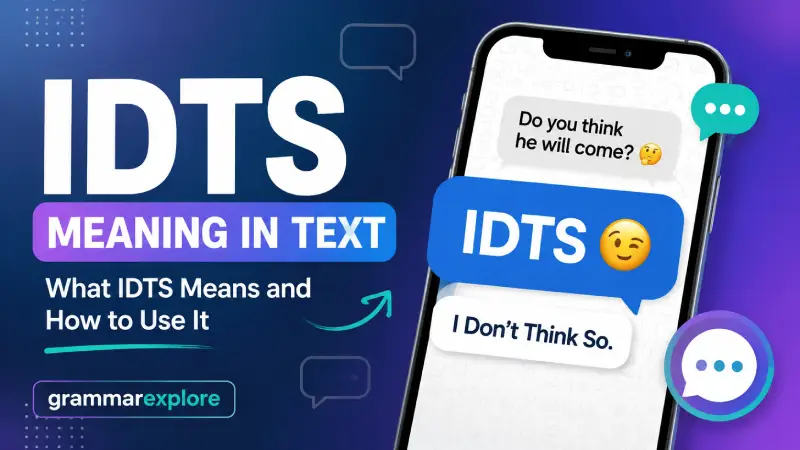
If you see IDTS in a text message, chat, or social media comment, it usually means “I don’t think so.” People use it as a quick way to express doubt, disagreement, uncertainty, or a negative response without typing the full phrase.
For example, someone might ask, “Do you think Sam is coming tonight?” and receive “IDTS” as a reply. In that context, the sender probably thinks Sam is not coming, although they are not necessarily completely certain.
The abbreviation is informal and works best in casual digital conversations. Its tone can range from neutral and uncertain to skeptical or slightly dismissive, depending on the conversation and punctuation.
Quick Answer
IDTS means “I don’t think so” in text. It is an informal texting initialism used to express doubt, disagreement, skepticism, or a soft negative answer. For example, “Are they still coming?” , “IDTS” means “I don’t think so.” The exact tone depends on context.
What Does IDTS Stand For?
IDTS stands for:
I = I
D = Don’t
T = Think
S = So
So:
IDTS = I don’t think so.
Technically, IDTS is an initialism because the letters represent the first letters of the words in the phrase. It is mainly used in written digital communication rather than spoken conversation.
You may see it written as IDTS, idts, or sometimes Idts. Capitalization usually does not change the meaning in casual texting.
What Does IDTS Mean in Texting?
In texting, IDTS usually communicates one of four closely related ideas:
- Doubt: “I don’t believe that’s likely.”
- Disagreement: “I don’t agree.”
- Uncertainty: “Probably not.”
- Skepticism: “I’m not convinced.”
The phrase is often softer than simply saying “No.” However, it does not always sound especially polite. A one-word reply such as “IDTS.” can feel blunt when the surrounding conversation is serious.
For example:
Person A: “Do you think the store will still be open?”
Person B: “IDTS.”
Here, the sender probably means, “I don’t think so.”
How People Use IDTS in Real Conversations
IDTS can respond to a question, prediction, suggestion, or statement.
1. Answering a question
Person A: “Is Alex coming to dinner?”
Person B: “IDTS.”
Meaning: “I don’t think Alex is coming.”
The response expresses an expectation rather than absolute certainty.
2. Showing disagreement
Person A: “This is the best restaurant in town.”
Person B: “IDTS.”
Meaning: “I don’t think so.”
Here, IDTS functions as a casual disagreement.
3. Questioning a prediction
Person A: “I think we’ll finish everything tonight.”
Person B: “IDTS.”
Meaning: “I don’t think that will happen.”
4. Responding to an unlikely idea
Person A: “Do you think they’ll give us a refund?”
Person B: “IDTS.”
Meaning: “I don’t think they will.”
IDTS Tone: What Does It Sound Like?
The meaning stays basically the same, but the tone can change.
| Context | Likely tone | Possible meaning |
|---|---|---|
| “Will Jake come?” , “IDTS.” | Neutral | I don’t think he will. |
| “You think she’ll say yes?” , “idts lol” | Playful | Probably not. |
| “This plan is perfect.” , “IDTS.” | Skeptical | I disagree. |
| “You really believe that?” , “IDTS…” | Uncertain | I don’t think that’s true. |
Punctuation can influence how the message feels. For example, “IDTS lol” may sound lighter, while “IDTS.” can sound more final or dismissive.
That does not mean punctuation gives IDTS a completely different definition. Instead, it provides clues about the sender’s attitude.
Is IDTS Slang?
IDTS is informal internet and texting language. More precisely, it is an initialism used in text messaging and online communication. Wiktionary classifies it as internet slang and text-messaging language, while other references describe it as an abbreviation or acronym.
You can comfortably use IDTS in casual conversations with friends, family members, or other people who understand texting abbreviations.
For formal communication, write the complete phrase:
Casual: “IDTS.”
Formal: “I don’t think so.”
A work email, academic paper, professional report, or formal request usually benefits from the full wording.
Is IDTS Rude?
Not necessarily. IDTS itself is not inherently rude or offensive.
However, a short response can sometimes feel dismissive. Consider these examples:
Friendly:
“IDTS 😂 We should probably leave earlier.”
More blunt:
“IDTS.”
The first message provides extra context that makes the response feel lighter. The second may sound more final, especially if someone has made a serious statement.
When tone matters, writing “I don’t think so” or adding a short explanation can prevent misunderstanding.
IDTS vs. “No”
IDTS and “no” can both communicate a negative answer, but they are not always identical.
No can sound direct and definite.
IDTS usually suggests that the speaker does not believe something is true or likely, rather than claiming absolute certainty.
For example:
“Is Maria coming?”
“No.”
This sounds definite.
“Is Maria coming?”
“IDTS.”
This suggests “I don’t think Maria is coming,” while leaving some room for uncertainty.
Can IDTS Mean Something Else?
For the specific query “IDTS meaning in text,” the established and dominant meaning is “I don’t think so.” Multiple current references agree on this interpretation.
The same four letters can appear as an abbreviation in specialized contexts, but those meanings are not the normal interpretation when someone sends IDTS in an everyday text conversation.
Therefore, if you receive “IDTS” from a friend in a casual chat, “I don’t think so” is the interpretation to consider first.
Common Mistakes When Using IDTS
Mistake 1: Treating IDTS as a formal expression
Less appropriate:
“Dear Professor, IDTS this conclusion is correct.”
Better:
“Dear Professor, I don’t think this conclusion is correct.”
IDTS belongs primarily to casual digital communication.
Mistake 2: Assuming it always means a definite “no”
IDTS expresses a belief or judgment. It often means “probably not” rather than an absolute rejection.
For example:
“Will it rain tomorrow?”
“IDTS.”
The sender is saying they do not expect rain, not necessarily that they know with certainty that it will not rain.
Mistake 3: Assuming IDTS always sounds friendly
Context matters. A bare “IDTS.” can sound dismissive when someone expects a detailed response.
If you want to sound warmer, add an explanation:
“IDTS. I think they’re closed on Mondays.”
That gives the other person useful information instead of leaving them to interpret the short reply.
When Should You Use IDTS?
IDTS works well when:
- You’re texting friends.
- You’re chatting casually online.
- You want a quick response.
- You’re expressing mild disagreement.
- You’re unsure whether something will happen.
- The other person already understands texting abbreviations.
Avoid it when:
- You’re writing a formal email.
- You’re submitting academic work.
- You’re communicating with someone unfamiliar with texting slang.
- A situation requires precise or professional wording.
When clarity matters more than brevity, simply write “I don’t think so.”
Frequently Asked Questions
What does IDTS mean in text?
IDTS means “I don’t think so.” People use it in casual messages to express doubt, disagreement, skepticism, or a likely negative answer.
Is IDTS slang?
Yes. IDTS is informal internet and texting language. It is more accurately described as an initialism used in digital communication.
Is IDTS the same as “I don’t think so”?
Yes. “I don’t think so” is the standard meaning of IDTS in ordinary texting and online chat.
What does IDTS mean from a girl or guy?
The abbreviation has the same basic meaning regardless of who sends it: “I don’t think so.” The personal or emotional meaning depends on the surrounding conversation, not the sender’s gender.
Can IDTS sound rude?
It can, depending on context. A short “IDTS.” may sound blunt or dismissive, while “idts lol” or a longer explanation can feel more casual and friendly.
Should I use IDTS in a professional email?
Generally, no. IDTS is informal, so “I don’t think so” or a more precise professional sentence is better for workplace and formal communication.
Conclusion
IDTS means “I don’t think so” in text messages and online conversations. It is an informal initialism that people use to express doubt, disagreement, skepticism, or a soft negative response.
The most important point is that IDTS does not always mean an absolute “no.” In many situations, it communicates “probably not” or “I don’t believe so.” Pay attention to the surrounding conversation, punctuation, and relationship between the people chatting to understand its tone correctly.