
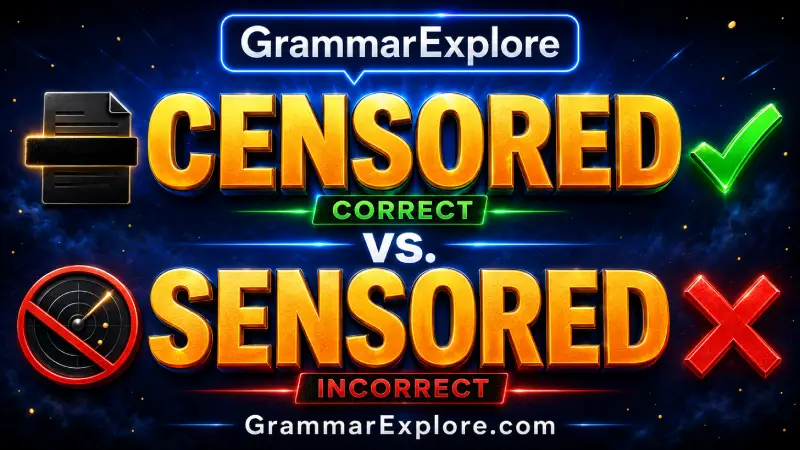
Censored vs sensored can confuse writers because the words sound alike and differ by only one letter. However, they describe completely different actions and situations.
Use censored when a person, publisher, broadcaster, platform, or authority removes, hides, mutes, blurs, or restricts content. For example, a television network may censor offensive language before airing a program.
Sensored appears mainly in specialized technical writing. It may describe a machine, vehicle, room, or system that uses sensors. Even so, clearer phrases such as sensor-equipped, sensor-controlled, or fitted with sensors usually work better.
Do not use sensored when a device detects something. In that situation, choose sensed or detected.
Remember the basic difference: a censor controls content, while a sensor detects physical conditions.
Quick Answer
Use censored when someone restricts or removes content:
- The broadcaster censored the offensive language.
- Editors released a censored version of the interview.
Sensored is an uncommon technical term for equipment that uses sensors:
- Engineers tested a sensored vehicle.
Clearer:
- Engineers tested a sensor-equipped vehicle.
If a device detected movement, write sensed, not sensored.
Is It Sensored or Censored?
The correct word depends on the meaning. Censored means that someone removed, blocked, hidden, or restricted content because it was considered inappropriate, sensitive, or unsuitable. Sensored is a rare technical term that refers to something equipped with sensors, but it is not commonly used.
Examples:
- The movie was censored because it contained explicit scenes.
- The machine was equipped with sensors to detect movement.
What Does It Mean to Be Censured and Why Was the Last Senator Censured?
To be censured means to receive an official expression of strong disapproval, usually from an organization, group, or governing body. It is a formal criticism of someone’s actions but usually does not remove them from their position.
A senator may be censured when other members believe the senator’s actions or behavior violated expected standards.
Example:
What Happens If a Person Is Censured?
When a person is censured, they receive an official public warning or statement of disapproval. They may face damage to their reputation, but a censure usually does not include legal punishment or automatic removal from a position.
Example:
- The official was censured by the committee but kept their position.
Why People Confuse Them
The confusion begins with the words censor and sensor. Most American speakers pronounce them alike or almost alike, but their meanings have no practical connection.
A censor examines content and decides whether to restrict, remove, or suppress it. A sensor detects a physical condition and sends information to another part of a system.
Writers may also confuse three related forms:
- censor → censored
- sensor → sensored
- sense → sensed
The spelling offers a useful clue:
- Censored relates to content control.
- Sensored relates to a sensor.
- Sensed means detected, noticed, or perceived.
Key Differences At A Glance
| Context | Best Choice | Why |
|---|---|---|
| A network removes profanity | Censored | Someone restricts the content |
| An editor hides a name | Censored | Someone conceals information |
| A platform blocks a post | Censored | The platform limits access |
| A publisher removes passages | Censored | The publisher suppresses material |
| A machine contains several sensors | Sensor-equipped | This wording is clearer than sensored |
| Sensors control a door | Sensor-controlled | It states the exact function |
| A camera detects motion | Sensed or detected | Sensored does not describe the detection |
| A person notices tension | Sensed | Sense is the correct base verb |
| Specialized engineering context | Sensored may fit | Some technical fields use the term |
| General US writing | Avoid sensored | A clearer expression usually works better |
The shortest distinction is:
- Censored: Someone restricted content.
- Sensored: Equipment contains or uses sensors.
- Sensed: A person or device detected something.
Meaning And Usage Difference
The words differ in both meaning and context.
Censored comes from censor. It describes an action involving speech, images, books, films, documents, messages, or other information.
- The station censored several comments.
- Editors censored the graphic photograph.
- The platform censored content that violated its rules.
Sensored comes from sensor and appears mainly in technical descriptions.
- The laboratory created a sensored testing environment.
- Engineers collected data from several sensored vehicles.
Although these examples can work in technical writing, clearer versions often sound better:
- The laboratory created a testing environment equipped with sensors.
- Engineers collected data from several sensor-equipped vehicles.
Meanwhile, sensed describes detection:
- The camera sensed movement.
- The thermostat sensed a rise in temperature.
- She sensed tension in the room.
What Does Censored Mean?
Censored is the simple past and past participle of the verb censor. It can also function as an adjective.
Its main verb forms include:
- Base form: censor
- Third-person singular: censors
- Simple past: censored
- Past participle: censored
- Present participle: censoring
To censor something means to examine it and remove, block, hide, or restrict material that someone considers offensive, dangerous, private, sensitive, or unacceptable.
Removing Offensive Language
Broadcasters, publishers, and platforms may censor profanity or offensive remarks.
- The network censored three swear words.
- Producers censored the guest’s offensive comment.
- The radio station censored explicit lyrics.
- Editors removed language that violated the publication’s standards.
- The streaming service offered a censored version for younger viewers.
Specific verbs can often explain the method more clearly:
- Editors muted the profanity.
- Producers replaced the word with a beep.
- The station removed the offensive remark.
Hiding Private Information
Editors may conceal names, faces, addresses, phone numbers, or other personal details.
- The news team blurred the child’s face.
- Editors hid the victim’s address.
- The publisher removed private medical details.
- Journalists covered the license plate in the photograph.
- The company released a censored screenshot.
When someone removes confidential information from a document, redacted may provide greater precision.
- Officials redacted the names before releasing the report.
- Attorneys submitted a document with several redacted sections.
Removing Scenes Or Images
Film studios, broadcasters, and online platforms may censor visual material.
- The channel removed a graphic scene.
- Producers blurred part of the image.
- The publisher covered sensitive details in the photograph.
- The theater showed a censored cut of the film.
- Editors shortened the sequence before publication.
The word censored identifies the general action. Words such as blurred, cut, pixelated, or removed explain how someone changed the content.
Suppressing Ideas Or Information
Censorship can also involve controlling political speech, books, news, art, or public communication.
- Authorities censored several passages in the report.
- The publisher refused to print material that officials had restricted.
- The writer claimed that the organization censored her article.
- Officials limited access to the disputed information.
- The platform removed posts that violated local laws.
This use often appears in journalism, history, politics, education, and discussions about free expression.
What Does Sensored Mean?
Sensored is an uncommon technical formation based on sensor. Some engineers and researchers use it to describe objects or environments that contain sensors.
Examples may include:
- a sensored vehicle
- a sensored platform
- a sensored environment
- a sensored production line
- sensored equipment
The word can communicate the intended meaning in a specialized document. However, it may confuse a general reader.
Clearer alternatives include:
- sensor-equipped
- sensor-based
- sensor-controlled
- sensor-operated
- sensor-activated
- fitted with sensors
- monitored by sensors
- instrumented
Instead of writing:
- The warehouse uses sensored lights.
Write:
- The warehouse uses sensor-activated lights.
- Motion sensors control the warehouse lights.
Instead of:
- Researchers tested a sensored car.
Write:
- Researchers tested a sensor-equipped car.
- Researchers fitted the car with several sensors before testing it.
Is Sensored A Real Word?
Some technical writers use sensored, especially when discussing engineering, robotics, manufacturing, research, or monitoring systems. Therefore, it is more accurate to call it a rare technical formation than a universal spelling mistake.
However, most general dictionaries and everyday readers strongly favor clearer descriptions. Outside a specialized context, sensored may look like:
- a misspelling of censored
- an incorrect past tense of sense
- unnecessary technical jargon
- an unclear adjective
Use it only when your industry or source regularly uses that term. Otherwise, choose a precise compound:
- sensor-equipped vehicle
- sensor-controlled system
- sensor-activated door
- sensor-based technology
- room monitored by sensors
Sensored vs Sensed
Writers often choose sensored when they actually need sensed.
Sensed is the simple past and past participle of sense. It means detected, perceived, felt, or noticed.
Use sensed for machines:
- The camera sensed movement.
- The thermostat sensed a temperature change.
- The alarm sensed smoke.
- The phone sensed a change in orientation.
- The system sensed unusual pressure.
Use sensed for people or animals:
- She sensed that something was wrong.
- He sensed tension in the room.
- The dog sensed danger.
- We sensed their disappointment.
Do not write:
- The camera sensored movement.
- She sensored a problem.
Instead, write:
- The camera sensed movement.
- She sensed a problem.
Censor vs Sensor
Understanding the root nouns makes the comparison much easier.
Censor
A censor is a person, organization, or authority that reviews and restricts content.
- The censor removed several scenes.
- Government censors reviewed the newspaper.
- The network’s censor flagged the offensive language.
As a verb, censor means to restrict or suppress content.
- The station may censor explicit language.
- Authorities censored parts of the report.
Sensor
A sensor is a device that detects a physical condition and sends information or activates a response.
Sensors can detect:
- movement
- light
- heat
- sound
- pressure
- smoke
- moisture
- speed
- distance
Examples:
- A motion sensor turned on the light.
- The temperature sensor monitored the engine.
- A smoke sensor activated the alarm.
- The phone uses a light sensor to adjust screen brightness.
The rule is simple:
A censor controls content; a sensor detects conditions.
Pronunciation Of Censored And Sensored
In everyday American English, censored and sensored usually sound the same:
SEN-serd
Their pronunciation cannot reliably help you select the correct spelling. Instead, check the meaning.
Ask:
- Did someone restrict content? Choose censored.
- Does equipment contain sensors? Consider sensor-equipped or sensored.
- Did someone or something detect a condition? Choose sensed.
Context normally makes the spoken meaning clear, but writing requires the correct spelling.
Tone, Context, And Formality
Censored In General Writing
Censored is a standard word. It appears naturally in discussions of:
- television
- radio
- books
- films
- journalism
- music
- social media
- privacy
- government
- public communication
Examples:
- The broadcaster censored the profanity.
- The newspaper published a censored photograph.
- The platform removed the disputed material.
- Viewers watched the censored version.
Sensored In Technical Writing
Sensored has a narrow technical use. Engineers or researchers may understand it, but general readers may not.
Technical:
- Researchers studied movement inside a sensored environment.
Clearer:
- Researchers studied movement inside an environment monitored by sensors.
A strong technical sentence should identify the sensor type whenever that detail matters:
- Researchers installed pressure sensors throughout the floor.
- Infrared sensors monitored movement inside the room.
- Engineers fitted the vehicle with light, speed, and proximity sensors.
Which One Should You Use?
Choose censored when someone:
- removes a word
- mutes profanity
- blurs an image
- covers a face
- hides private information
- cuts a film scene
- blocks a post
- restricts a book
- suppresses an opinion
- limits access to information
Choose sensored only when:
- your technical field accepts the term
- the object contains sensors
- the surrounding context clearly explains the meaning
For general writing, choose a clearer alternative such as sensor-equipped.
Choose sensed when someone or something:
- detects movement
- notices a change
- perceives danger
- feels tension
- registers heat
- recognizes pressure
When One Choice Sounds Wrong
Restricted Content
Incorrect:
- The platform sensored the offensive post.
Correct:
- The platform censored the offensive post.
The platform restricted content; it did not install a sensor.
Motion Detection
Incorrect:
- The camera censored movement.
- The camera sensored movement.
Correct:
- The camera sensed movement.
- The camera’s motion sensor detected movement.
A Sensor-Controlled Door
Incorrect:
- The building uses censored doors.
Better:
- The building uses sensor-controlled doors.
- Motion sensors operate the doors.
An Edited Film
Incorrect:
- We watched the sensored version of the film.
Correct:
- We watched the censored version of the film.
Human Perception
Incorrect:
- Maria sensored tension during the meeting.
Correct:
- Maria sensed tension during the meeting.
Common Mistakes And Quick Fixes
Mistake: Sensored Language
Incorrect:
- The network aired sensored language.
Correct:
- The network aired censored language.
- The network muted the profanity before airing the program.
Mistake: Censored Equipment
Incorrect:
- Engineers tested a censored robot.
Correct:
- Engineers tested a sensor-equipped robot.
Mistake: Sensored A Sound
Incorrect:
- The alarm sensored a loud sound.
Correct:
- The alarm sensed a loud sound.
- The sensor detected a loud sound.
Mistake: Using Censored For Every Edit
Not every change counts as censorship.
- An editor may shorten an article for length.
- A writer may revise a paragraph for clarity.
- A producer may cut a scene to improve pacing.
Use censored when the change involves restriction or suppression. Use edited, revised, shortened, or removed when those terms explain the action more accurately.
Mistake: Using Sensored When A Clear Compound Fits
Unclear:
- The hotel installed sensored lights.
Clear:
- The hotel installed sensor-activated lights.
Censored vs Redacted
Censored and redacted overlap, but they often fit different contexts.
Use censored broadly when someone restricts speech, images, video, music, or other content:
- The network censored the profanity.
- Authorities censored parts of the publication.
Use redacted when someone removes or obscures specific information in a document:
- Officials redacted the names.
- Attorneys redacted private medical information.
- The agency released a heavily redacted report.
A broadcaster usually censors offensive language. An agency usually redacts confidential details.
Censored vs Edited
Edited has a broader and more neutral meaning. Writers and producers edit material for many reasons, including:
- clarity
- accuracy
- organization
- length
- grammar
- pacing
- style
Censored specifically suggests restriction or suppression.
Compare:
- The editor revised the article for clarity.
- The authority censored the article before publication.
Editing does not automatically equal censorship.
Censored vs Bleeped
Bleeped identifies one method of censoring audio.
- The producer bleeped the swear word.
- The producer censored the swear word.
The first sentence provides more detail. Other specific actions include:
- muting audio
- blurring an image
- pixelating a face
- covering text
- removing a scene
- blocking a post
Whenever possible, use the verb that explains exactly what happened.
Everyday Examples
Examples With Censored
- The television network censored several offensive words.
- Editors released a censored version of the photograph.
- The platform censored content that violated its policies.
- Producers censored the guest’s explicit language.
- The station aired a heavily censored interview.
- The publisher censored several disputed passages.
- Editors blurred the person’s face for privacy.
- The streaming service offered both censored and uncensored versions.
- Authorities censored parts of the report.
- The radio station muted the profanity.
- The theater showed a censored cut of the film.
- Moderators removed the offensive post.
- The article contained a censored image.
- Editors hid the private phone number.
- The broadcaster replaced the offensive word with a beep.
Technical Examples With Sensored
- Engineers tested a fully sensored vehicle.
- Researchers created a sensored environment.
- The laboratory compared sensored and nonsensored platforms.
- Technicians collected data from a sensored production line.
- The team studied movement through a sensored space.
Clearer versions for general readers:
- Engineers tested a vehicle equipped with sensors.
- Researchers created an environment monitored by sensors.
- The laboratory compared platforms with and without sensors.
- Technicians collected data from a sensor-equipped production line.
- The team used motion sensors to study movement through the space.
Examples With Sensed
- The camera sensed movement near the door.
- The thermostat sensed a temperature increase.
- The alarm sensed smoke in the hallway.
- She sensed that something had changed.
- The dog sensed danger.
- The phone sensed its new orientation.
- The system detected an unusual vibration.
- The automatic door sensed someone approaching.
Dictionary-Style Word Details
Verb
- Censored: The simple past and past participle of censor. It means that someone examined and restricted, removed, or suppressed content.
- Sensored: A rare technical formation related to sensor. It does not serve as the standard past tense of sense.
Examples:
- The broadcaster censored the offensive language.
- The camera sensed movement.
Noun
Neither censored nor sensored normally functions as a noun.
Related nouns include:
- censor
- censorship
- sensor
- sensing
- detection
Examples:
- The censor removed the scene.
- A motion sensor activated the light.
Adjective
- Censored: Describes content that someone has restricted, hidden, removed, blurred, muted, or suppressed.
- Sensored: Rare technical adjective describing equipment or an environment that contains sensors.
Examples:
- a censored broadcast
- a censored photograph
- a sensored platform
- a sensor-equipped vehicle
Synonyms
Depending on context, close alternatives for censored include:
- suppressed
- restricted
- removed
- blocked
- redacted
- blurred
- muted
- bleeped
- pixelated
- obscured
Clear alternatives for sensored include:
- sensor-equipped
- sensor-based
- sensor-controlled
- sensor-operated
- sensor-activated
- instrumented
- monitored by sensors
Possible opposites of censored include:
- uncensored
- unrestricted
- unedited
- uncut
Example Sentences
- Censored: The broadcaster censored the offensive comment.
- Censored: Editors released a censored photograph.
- Censored: Authorities censored several passages.
- Sensored: Engineers tested a sensored platform.
- Sensored: General readers may prefer the phrase sensor-equipped.
- Sensed: The platform sensed movement nearby.
Word History
Censored comes from censor, a word associated with examining conduct, communication, or published material and restricting unacceptable content.
Sensored developed as a technical formation from sensor, a device that detects physical input. Technical writers sometimes use it to describe systems that contain sensors.
The words sound alike, but their modern meanings remain unrelated.
Phrases Containing
Common phrases with censored include:
- censored version
- censored content
- censored language
- censored scene
- censored image
- censored photograph
- censored broadcast
- heavily censored
- partially censored
- censored for privacy
- government-censored content
Technical combinations may include:
- sensored environment
- sensored vehicle
- sensored system
- sensored platform
- sensored equipment
Clearer alternatives include:
- sensor-equipped vehicle
- sensor-controlled system
- sensor-activated door
- sensor-based technology
- environment monitored by sensors
How To Remember The Difference
Use the first letters:
Censored means someone controlled the content.
Sensored relates to a sensor.
Also remember this sentence:
A sensor senses, while a censor censors.
Examples:
- The sensor sensed movement.
- The censor censored the image.
Frequently Asked Questions
What is the difference between censored and sensored?
Censored describes content that someone restricted, removed, muted, blurred, or suppressed. Sensored is a rare technical term for equipment or environments that use sensors.
Is sensored a correct word?
Some engineers and researchers use sensored in specialized contexts. However, sensor-equipped, sensor-controlled, or fitted with sensors usually communicates the meaning more clearly.
Is it censored or sensored content?
Use censored content. The phrase means that someone restricted or altered the material. Sensored content does not express that meaning.
Is it sensored or sensed movement?
Use sensed movement when a device detects movement. You can also write detected movement.
What is the past tense of censor?
The past tense is censored:
- The network censored the profanity.
What is the past tense of sense?
The past tense is sensed:
- The device sensed movement.
Should I Write Sensored Doors?
Most readers will understand the phrase, but sensor-controlled doors, sensor-activated doors, or doors equipped with sensors sounds clearer.
Are Censor And Sensor Pronounced The Same?
Most American speakers pronounce them alike or nearly alike. Their spellings and meanings distinguish them in writing.
Does Censored Mean Deleted?
Not always. Someone may censor content by deleting, blurring, muting, covering, restricting, blocking, or replacing it.
What Is The Difference Between Censored And Redacted?
Censored broadly describes restricted or suppressed content. Redacted usually refers to specific confidential information that someone removes or hides in a document.
Conclusion
The difference between censored vs sensored involves content restriction and sensor technology.
Use censored when a broadcaster, publisher, platform, editor, or authority removes, hides, mutes, blurs, blocks, or restricts material.
Choose sensored only in specialized technical contexts. For most readers, sensor-equipped, sensor-controlled, or fitted with sensors provides a clearer description.
If a device detected something, use sensed:
- The broadcaster censored the video.
- Engineers equipped the machine with sensors.
- The machine sensed movement.