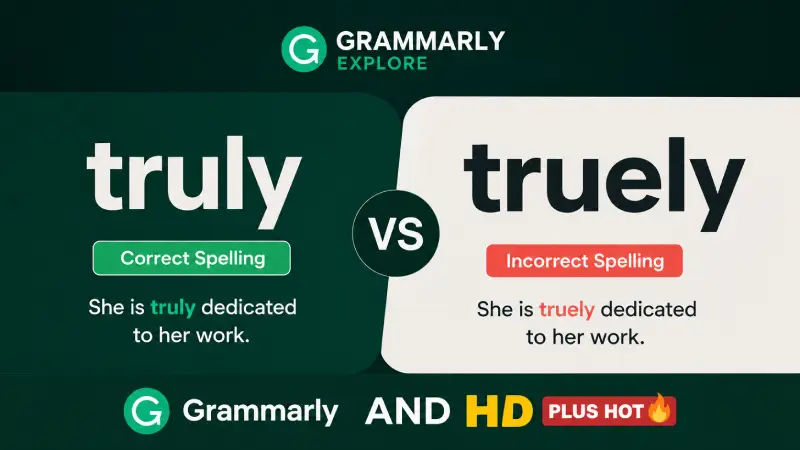
If you are wondering whether to write truly or truely, the correct spelling is truly.
Truly is the standard English spelling. It is an adverb that means genuinely, really, sincerely, or in a way that is true.
Truely is not the standard spelling. It is a common misspelling caused by adding -ly to true without following English spelling rules.
The simple rule:
✅ Correct: truly
❌ Incorrect: truely
Examples:
- I truly appreciate your help.
- She is truly talented.
- He truly believes in the idea.
When you mean “really” or “genuinely,” use truly.
Quick Answer: Truly or Truely?
The correct spelling is truly.
| Word | Correct Usage | Meaning |
|---|---|---|
| Truly | Standard | Genuinely, really, sincerely |
| Truely | Nonstandard | Common misspelling of truly |
Use truly in:
- Emails
- Essays
- Articles
- Professional writing
- Everyday conversations
Examples:
- I am truly grateful.
- This was a truly amazing experience.
- She truly understands the situation.
Why People Confuse Truly And Truely
People often confuse these spellings because the word true ends with the letter e.
When adding -ly to many adjectives, writers keep the original spelling.
Examples:
- quick → quickly
- slow → slowly
- careful → carefully
This can make people think:
true + ly = truely
However, true follows a different spelling pattern. The final e is removed before adding -ly.
Correct:
true + ly = truly
Incorrect:
true + ly = truely
What Does Truly Mean?
Truly means genuinely, honestly, really, or in a sincere way.
It is used to emphasize that something is real or deeply felt.
Examples:
- I truly enjoyed the concert.
- She is truly one of the best players on the team.
- We are truly thankful for your support.
It can describe:
- Feelings
- Opinions
- Beliefs
- Statements
- Experiences
How To Use Truly Correctly
Truly As An Adverb
Truly modifies verbs, adjectives, or other descriptions.
Examples:
- I truly value your advice.
- The movie was truly inspiring.
- She truly cares about her work.
Truly For Emphasis
Writers often use truly to show strong belief or sincerity.
Examples:
- This is truly important.
- He is truly committed to the project.
- They were truly happy with the result.
Meaning And Usage Difference
The difference between truly and truely is not meaning. The difference is correct spelling.
| Context | Best Choice | Why |
|---|---|---|
| Sincere feelings | Truly | Standard spelling |
| Strong emphasis | Truly | Correct adverb form |
| Formal writing | Truly | Accepted usage |
| Truely | Avoid | Misspelling |
There is no situation in standard English where truely is preferred.
Tone, Context, And Formality
Truly is a neutral word that works in both casual and formal writing.
Examples:
Formal:
- We are truly grateful for your support.
Casual:
- I truly love this song.
Professional:
- This achievement is truly remarkable.
Because it expresses sincerity, it is often used in thank-you messages, speeches, and personal writing.
Which One Should You Use?
Use truly every time.
Correct:
- I truly appreciate your help.
- She truly understands.
- This is truly special.
Avoid:
- I truely appreciate your help.
- She truely understands.
- This is truely special.
A simple memory trick:
Remove the final e from true before adding -ly.
True + ly = truly
When One Choice Sounds Wrong
Using truely can make writing look like it contains a spelling mistake.
Incorrect:
I truely believe this is the best option.
Correct:
I truly believe this is the best option.
Incorrect:
She is truely grateful.
Correct:
She is truly grateful.
Common Mistakes And Quick Fixes
Mistake 1: Keeping The Final E
Incorrect:
The experience was truely amazing.
Correct:
The experience was truly amazing.
Mistake 2: Using Truely In Professional Writing
Incorrect:
We are truely thankful for your partnership.
Correct:
We are truly thankful for your partnership.
Mistake 3: Confusing True And Truly
True is an adjective.
Example:
- The statement is true.
Truly is an adverb.
Example:
- She truly believes the statement.
Everyday Examples
Workplace Examples
- We are truly thankful for your effort.
- This result is truly impressive.
- The team truly appreciated the feedback.
Personal Examples
- I truly miss my old friends.
- She was truly happy with the gift.
- They truly enjoyed the trip.
Writing Examples
- This is truly one of the most useful lessons.
- The author truly explains the topic clearly.
- The message was truly meaningful.
Dictionary-Style Word Details
Verb
Truly: Not used as a verb in standard English.
Truely: Not used as a verb in standard English.
Noun
Truly: Not commonly used as a noun in standard English.
Truely: Not a standard noun form.
Synonyms
Truly
Closest plain alternatives:
- Really
- Genuinely
- Sincerely
- Honestly
- Actually
The best alternative depends on the sentence.
Examples:
- I truly appreciate it.
- I genuinely appreciate it.
Truely
No synonyms apply because it is not a standard word.
Example Sentences
Truly
- I truly appreciate your kindness.
- She is truly talented.
- This was truly an unforgettable experience.
- He truly cares about his work.
Truely
The standard form is truly.
Incorrect:
- She truely understands.
Correct:
- She truly understands.
Word History
Truly developed from the adjective true combined with the suffix -ly. English spelling conventions remove the final e in this form.
The spelling truely is a common error but is not the accepted modern form.
Phrases Containing
Truly
Common phrases include:
- truly appreciate
- truly believe
- truly amazing
- truly grateful
- truly unique
- yours truly
Examples:
- I truly appreciate your support.
- Yours truly appears at the end of some letters.
Truely
No standard phrases use this spelling.
Frequently Asked Questions
Is truly or truely correct?
Truly is correct. Truely is a common misspelling.
Why is truly spelled without an e?
The final e in true is dropped before adding -ly.
Is truly a real word?
Yes. Truly is a standard adverb meaning genuinely or really.
Can I use truly in formal writing?
Yes. Truly is appropriate in both formal and casual writing.
Is truly the same as really?
They can be similar, but truly often adds a sense of sincerity or strong emphasis.
Conclusion
The difference between truly vs. truely is simple.
Use:
Truly for the correct spelling meaning genuinely, really, or sincerely.
Avoid:
Truely because it is not the standard English spelling.
When writing emails, essays, articles, or everyday messages, always choose truly.