
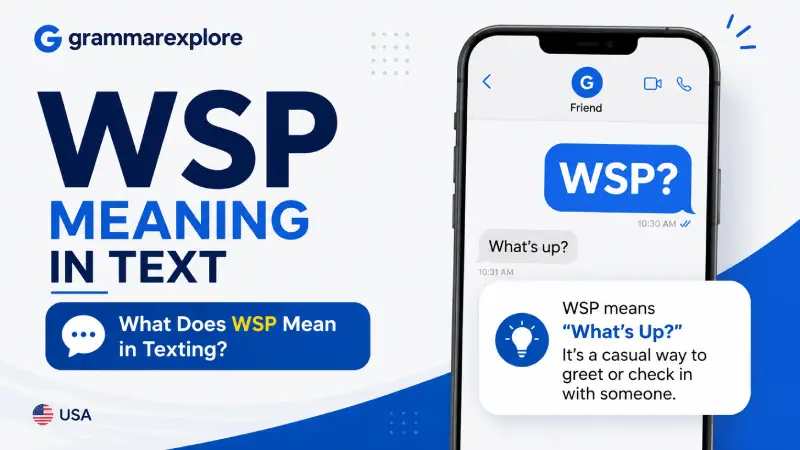
If someone sends you “WSP?” in a text, they are usually asking a simple question: “What’s up?” It is a casual way to ask how you are doing, what you are doing, or what is happening.
You may see WSP in text messages, group chats, social-media DMs, and other informal conversations. It is especially useful when someone wants to start a conversation without writing a longer greeting.
For example, a friend might text:
“WSP?”
A natural response could be:
“Not much. Just watching a movie. You?”
WSP is short, friendly, and informal. However, understanding the context still matters because abbreviations can sometimes have other meanings.
Quick Answer
WSP meaning in text is usually “What’s up?” It is an informal abbreviation people use to ask how someone is doing, what they are doing, or what is happening. For example, “WSP?” can mean “What’s up?” or “What are you up to?” It is common in casual texting, DMs, and group chats.
What Does WSP Mean in Text?
In texting, WSP usually means “What’s up?”
“What’s up?” is a common American English greeting. It can mean:
- How are you?
- What are you doing?
- What is happening?
- What’s going on?
The exact meaning depends on the conversation.
For example:
“Hey, WSP?”
This is usually just a casual greeting.
A friend might answer:
“Not much. How about you?”
The sender may not be asking about a specific problem. They may simply want to start talking.
What Does WSP Stand For?
When WSP means “What’s up?”, the abbreviation comes from the letters of the phrase.
W = What
S = ’s
P = up
So:
WSP = What’s up?
In actual texting, the abbreviation is usually written as WSP, although people may also write wsp in lowercase.
For example:
“wsp bro?”
has the same basic meaning as:
“What’s up?”
WSP Meaning in Slang
WSP is an informal texting abbreviation for “What’s up?”
It can have a relaxed, friendly tone. People may use it when they want to begin a conversation quickly.
For example:
“wsp?”
could simply mean:
“What’s up?”
Another example is:
“wsp with you?”
This may mean:
“What’s up with you?”
or:
“How are things with you?”
WSP is not usually considered formal English.
WSP as a Greeting
One of the most common uses of WSP is as a greeting.
Instead of writing:
“Hey, what’s up?”
someone may simply send:
“WSP?”
The recipient can respond with information about what they are doing.
For example:
Alex: WSP?
Jordan: Just getting ready for work. You?
Here, WSP functions almost like “Hey, how are you?”
WSP Meaning in a Text From a Friend
When a friend sends “WSP?”, they may simply want to start a conversation.
For example:
Friend: WSP?
You could reply:
“Not much. Just relaxing.”
Or:
“I’m at the gym. What’s up?”
Or:
“Doing homework. You?”
The response does not need to be complicated.
WSP Meaning on Snapchat
WSP can appear in Snapchat messages when someone wants to start a casual conversation.
For example:
“wsp tonight?”
Depending on the context, the person may be asking what you are doing that evening.
You could respond:
“Nothing planned yet. You?”
Snapchat conversations often use short forms like WSP because the communication is informal and fast.
WSP Meaning on Instagram
In Instagram DMs, WSP can serve as a quick conversation starter.
For example:
“Hey wsp?”
The sender is most likely saying:
“Hey, what’s up?”
A simple response might be:
“Hey! Not much. How are you?”
The abbreviation works especially well between friends or people who already communicate casually.
WSP Meaning on TikTok
WSP may also appear in TikTok comments or direct messages.
For example:
“wsp y’all?”
This can mean:
“What’s up, everyone?”
However, not every use of WSP on social media has the same meaning. The surrounding text should always guide your interpretation.
Is WSP the Same as “What’s Up?”
Yes. In casual texting, WSP is commonly used as a shortened form of “What’s up?”
For example:
WSP?
and
What’s up?
can communicate essentially the same message.
The main difference is tone and format. The complete phrase works in ordinary speech, while WSP is mainly useful in informal digital communication.
What Does “What’s Up?” Mean?
“What’s up?” has several closely related meanings in American English.
As a Greeting
“Hey, what’s up?”
This can simply mean:
“How are you?”
Asking What Someone Is Doing
“What’s up tonight?”
This may mean:
“What are you doing tonight?”
Asking About a Situation
“What’s up with the computer?”
This means:
“What is wrong with the computer?” or “What is happening with the computer?”
WSP normally carries the casual greeting sense when it appears by itself.
How Do You Reply to WSP?
There is no single correct response.
Your answer depends on what you are doing and what you want to communicate.
Casual Reply
“Not much. You?”
This is one of the easiest responses.
Friendly Reply
“Hey! I’m good. What’s up with you?”
This keeps the conversation going.
Tell Them What You Are Doing
“Just watching Netflix. You?”
This directly answers the implied question.
If You Are Busy
“I’m working right now. What’s up?”
This lets the sender know that you are occupied.
If Something Is Wrong
“I’m stressed about my exam.”
This can turn the greeting into a deeper conversation.
Is WSP Formal or Informal?
WSP is informal.
It is appropriate for casual digital communication, including:
- Text messages
- Group chats
- Social-media DMs
- Casual online conversations
- Messages between friends
It is generally not appropriate in formal writing.
Instead of:
“WSP?”
in a professional email, write:
“How are you?”
or:
“I hope you’re doing well.”
Can You Use WSP at Work?
Usually, you should avoid WSP in professional communication unless your workplace culture clearly supports casual texting abbreviations.
For example, this is not ideal for a client:
“WSP? Did you review the proposal?”
A better version is:
“Hi, I wanted to check whether you had a chance to review the proposal.”
However, a very informal workplace chat between close coworkers may be different.
For example:
“WSP? Are you joining the meeting?”
could be understood easily, but a clearer professional option is:
“Hi, are you joining the meeting?”
Is WSP Slang?
WSP is best described as informal texting shorthand.
It is closely associated with casual online communication. However, it is not a slang word in the same way that a highly specialized slang expression might be.
The underlying phrase “What’s up?” is ordinary informal American English. WSP simply shortens it for digital communication.
Is WSP Rude?
No, WSP is not normally rude.
Its tone is usually casual and friendly.
For example:
“Hey wsp?”
sounds relaxed.
Still, tone can change based on the conversation. A message containing only:
“WSP?”
may feel very brief if the sender normally writes longer messages.
That does not automatically make it rude.
Is WSP Flirty?
WSP does not have a standard flirty meaning.
Someone may use WSP when talking to a romantic interest, but the abbreviation itself does not indicate romantic interest.
For example:
“Hey wsp?”
could come from:
- A friend
- A coworker
- A classmate
- A romantic interest
- Someone you recently met
You need to consider the entire conversation to understand the tone.
WSP vs. WYD
WSP and WYD are similar because both can start a conversation, but they ask slightly different questions.
| Abbreviation | Meaning | Typical purpose |
|---|---|---|
| WSP | What’s up? | Greeting or asking what is happening |
| WYD | What are you doing? | Asking about someone’s current activity |
For example:
“WSP?”
may simply mean:
“How are you?”
But:
“WYD?”
usually asks:
“What are you doing?”
Example
Person A: WSP?
Person B: Not much. Just relaxing.
Person A: WYD tonight?
Here, the first question starts the conversation, while the second asks about plans or activities.
WSP vs. WYA
WYA commonly means “Where you at?”
It asks about someone’s location.
For example:
“WYA?”
means:
“Where are you?”
By contrast:
“WSP?”
usually means:
“What’s up?”
So these abbreviations ask different questions.
WSP vs. WTW
WTW can mean “What’s the word?” in casual texting.
Depending on context, it may ask what is happening or what the plan is.
For example:
“WTW tonight?”
may ask about plans.
WSP is broader:
“WSP?”
usually works as a casual greeting.
WSP vs. Sup
“Sup?” is another shortened form of “What’s up?”
So:
“WSP?”
and:
“Sup?”
can have almost the same meaning.
“Sup?” is even more shortened and casual. Both are informal.
Is WSP a Word?
No. WSP is an abbreviation rather than a standard English word.
When people use it in texting, they usually understand it as a shortened form of “What’s up?”
It should not normally be used as a replacement for “What’s up?” in formal writing.
Is WSP Used in Spoken English?
People generally do not pronounce WSP as a separate spoken word.
In conversation, Americans are more likely to say:
“What’s up?”
rather than:
“W-S-P?”
WSP mainly belongs to written digital communication.
Who Uses WSP?
WSP can appear among people who communicate through casual digital messages.
You may encounter it in:
- Personal texts
- Group chats
- Instagram DMs
- Snapchat
- TikTok messages
- Gaming chats
- Online communities
There is no strict age group that must use WSP. Its main feature is informality, not a specific age.
25 Examples of WSP in Text
Example 1
Sentence: “WSP?”
Meaning: What’s up?
Why it is used: It is a quick, casual greeting.
Example 2
Sentence: “Hey wsp?”
Meaning: Hey, what’s up?
Why it is used: The sender wants to start a conversation.
Example 3
Sentence: “WSP bro?”
Meaning: What’s up, bro?
Why it is used: It creates a relaxed, friendly tone.
Example 4
Sentence: “WSP with you?”
Meaning: What’s up with you?
Why it is used: The sender wants to know how you are doing.
Example 5
Sentence: “WSP tonight?”
Meaning: What’s happening tonight?
Why it is used: The sender may be asking about evening plans.
Example 6
Sentence: “WSP everyone?”
Meaning: What’s up, everyone?
Why it is used: The sender is greeting a group.
Example 7
Sentence: “Hey, wsp?”
Meaning: What’s up?
Why it is used: It is a simple conversation opener.
Example 8
Sentence: “Wsp? You good?”
Meaning: What’s up? Are you okay?
Why it is used: The sender may be checking on someone’s well-being.
Example 9
Sentence: “WSP man?”
Meaning: What’s up, man?
Why it is used: It is a casual greeting between friends.
Example 10
Sentence: “WSP, are you free?”
Meaning: What’s up? Are you available?
Why it is used: The sender wants to start a conversation before asking something.
Example 11
Sentence: “WSP today?”
Meaning: What’s happening today?
Why it is used: The sender may be asking about plans.
Example 12
Sentence: “WSP at your place?”
Meaning: What’s happening at your place?
Why it is used: The sender wants information about the situation.
Example 13
Sentence: “WSP? Haven’t heard from you.”
Meaning: What’s going on? I haven’t heard from you.
Why it is used: The sender wants to reconnect.
Example 14
Sentence: “WSP with the party?”
Meaning: What’s happening with the party?
Why it is used: The sender wants an update.
Example 15
Sentence: “WSP later?”
Meaning: What are you doing later?
Why it is used: The sender may be checking availability.
Example 16
Sentence: “WSP, you coming?”
Meaning: What’s up? Are you coming?
Why it is used: The sender wants to confirm plans.
Example 17
Sentence: “WSP? I’m outside.”
Meaning: What’s up? I’m outside.
Why it is used: The sender starts a conversation while providing an update.
Example 18
Sentence: “WSP guys?”
Meaning: What’s up, guys?
Why it is used: It is a casual group greeting.
Example 19
Sentence: “WSP with the new job?”
Meaning: What’s happening with the new job?
Why it is used: The sender wants an update.
Example 20
Sentence: “WSP? Long time no talk.”
Meaning: What’s up? We haven’t talked in a while.
Why it is used: The sender wants to reconnect casually.
Example 21
Sentence: “WSP tonight? You doing anything?”
Meaning: What are you doing tonight?
Why it is used: The sender wants to discuss plans.
Example 22
Sentence: “WSP, want to grab food?”
Meaning: What’s up? Do you want to get food?
Why it is used: The sender is starting a casual invitation.
Example 23
Sentence: “WSP with your project?”
Meaning: What’s happening with your project?
Why it is used: The sender wants an update.
Example 24
Sentence: “WSP? Everything okay?”
Meaning: What’s going on? Is everything okay?
Why it is used: The sender is checking whether there is a problem.
Example 25
Sentence: “WSP! Haven’t seen you in forever.”
Meaning: What’s up? I haven’t seen you in a long time.
Why it is used: The sender uses WSP as a friendly greeting.
Common Mistakes With WSP
Mistake 1: Thinking WSP Always Means Something Technical
WSP can represent other abbreviations in specialized contexts.
However, when someone sends “WSP?” in an ordinary personal text, “What’s up?” is a common interpretation.
Always consider the context.
Mistake 2: Confusing WSP With WYD
WSP and WYD are not identical.
WSP: What’s up?
WYD: What are you doing?
They may produce similar conversations, but their direct meanings differ.
Mistake 3: Using WSP in Formal Writing
Less appropriate:
“WSP regarding the meeting?”
Better:
“What is happening with the meeting?”
Formal communication usually benefits from complete wording.
Mistake 4: Assuming WSP Is Flirty
WSP itself is not a romantic abbreviation.
The sender’s relationship with you and the rest of the conversation determine whether a message is friendly, romantic, or simply casual.
Mistake 5: Assuming WSP Always Means “How Are You?”
“What’s up?” can be a greeting, but it can also ask about an activity or situation.
For example:
“WSP with the project?”
asks about the project rather than someone’s general health.
When Should You Use WSP?
WSP works well when:
- You are texting a friend.
- You are chatting casually.
- The recipient knows common texting shorthand.
- You want a short conversation starter.
- The situation does not require formal language.
For example:
“Hey, wsp?”
is natural in a casual message.
When Should You Avoid WSP?
Avoid WSP when:
- Writing a school assignment
- Sending a formal business email
- Contacting a customer
- Writing to an unfamiliar professional contact
- Communicating in an official setting
Use the complete phrase instead.
For example:
“Hi, how are you?”
is safer and clearer than:
“WSP?”
WSP Meaning in American English
In American English, “What’s up?” is a familiar informal greeting.
It can be similar to:
- How are you?
- How’s it going?
- What are you up to?
- What’s going on?
WSP simply compresses that phrase into a short digital form.
In spoken American English, people normally say “What’s up?” rather than WSP.
WSP Meaning: Quick Reference Table
| Expression | Meaning | Tone | Common setting |
|---|---|---|---|
| WSP | What’s up? | Casual | Texting |
| What’s up? | Casual greeting/question | Informal | Speech and texting |
| Sup? | What’s up? | Very casual | Texting |
| WYD | What are you doing? | Casual | Texting |
| WYA | Where you at? | Casual | Texting |
| WTW | What’s the word? | Casual | Texting |
| How are you? | Asking about well-being | Neutral | Speech and writing |
| How’s it going? | Asking how things are | Informal | Everyday English |
Frequently Asked Questions
What does WSP mean in text?
WSP usually means “What’s up?” in casual text messages. It works as a quick greeting or a way to ask what someone is doing or what is happening. For example, “WSP?” can receive a response such as “Not much, you?”
What does WSP stand for?
In casual texting, WSP stands for “What’s up?” The abbreviation shortens a common informal greeting. People may write it as WSP or wsp, with capitalization usually making no difference in casual messages.
Is WSP slang?
WSP is best described as informal texting shorthand. It represents the casual phrase “What’s up?” rather than functioning as a formal English word. You may see it in texts, DMs, group chats, and other relaxed online conversations.
How do you reply to WSP?
You can reply naturally with something such as “Not much, you?”, “I’m good. How about you?”, or a description of what you are doing. If the sender appears to be asking about a specific situation, answer that question directly.
Is WSP formal?
No. WSP is informal and works best in casual digital communication. Avoid it in formal emails, academic assignments, professional documents, and other situations where clear standard English is expected.
Is WSP the same as WYD?
No. WSP usually means “What’s up?”, while WYD usually means “What are you doing?” They can lead to similar conversations, but WSP is often more general and can function simply as a greeting.
Does WSP mean “What’s up with you?”
Sometimes the intended idea can be “What’s up with you?”, especially when WSP appears with additional words or in a conversation about someone’s situation. However, when used alone, “What’s up?” is the most straightforward interpretation.
Conclusion
WSP meaning in text is usually “What’s up?” It is a short, informal way to greet someone or ask what they are doing, how things are going, or what is happening. You may see WSP in text messages, Snapchat, Instagram DMs, group chats, and other casual online conversations.
The abbreviation is especially useful when you want to start a conversation quickly. A simple “WSP?” can receive a response such as “Not much, you?” or “I’m just heading home.”
WSP should not be treated as formal English. For professional emails, academic writing, or official communication, use a complete phrase such as “What’s up?”, “How are you?”, or “What is happening?”
Also remember that context matters. WSP can have other meanings outside ordinary texting, but in a casual message, “What’s up?” is a common interpretation.