
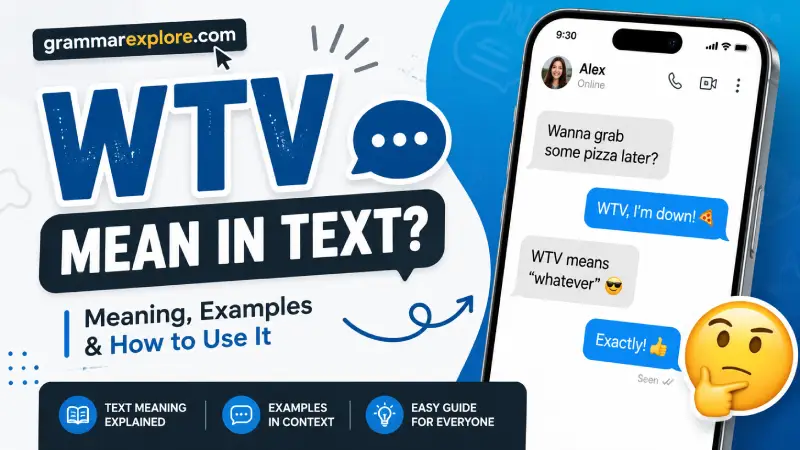
WTV usually means “whatever” in text messages and online conversations. People use it as a quick abbreviation when they mean “whatever,” “it doesn’t matter,” or “I don’t really care.” Depending on the context and tone, WTV can sound casual, neutral, dismissive, annoyed, or playful.
You may see WTV in text messages, group chats, social media, gaming conversations, and private messages. For example, someone might text “WTV, you decide” to mean “Whatever, you decide.”
Because tone can be difficult to read in short messages, WTV does not always express the same emotion. The surrounding words and the relationship between the people help determine what the sender means.
Quick Answer
WTV means “whatever” in text and texting slang. People use it as a shortened form of “whatever” when they want to say that something does not matter to them, they have no preference, or they do not want to argue about it. Depending on context, WTV can sound relaxed, indifferent, dismissive, or slightly annoyed.
What Does WTV Mean in Text?
In texting, WTV is a common abbreviation for “whatever.”
For example:
“WTV, I’m fine with either.”
This means:
“Whatever, I’m fine with either.”
The sender may be saying that they have no strong preference.
Another example is:
“WTV you want is fine.”
Here, WTV means:
“Whatever you want is fine.”
The abbreviation saves typing time and gives the message a casual tone.
However, WTV does not always mean “I don’t care.” Sometimes it simply means that the speaker is flexible.
For instance:
“WTV works for you works for me.”
could communicate:
“Whatever works for you works for me.”
That sounds cooperative rather than rude.
WTV Meaning in Slang
WTV is informal internet and texting slang for “whatever.”
In casual communication, people often shorten common expressions to make messages faster and more relaxed. WTV is one of those shortcuts.
Its meaning can range from:
- Whatever
- It doesn’t matter
- Either option is fine
- I don’t have a preference
- I don’t care
- Forget it
The exact tone depends on context.
Compare these messages:
“WTV 😂”
This may sound playful.
“WTV.”
This can sound dismissive or annoyed.
“WTV you want is okay.”
This usually sounds neutral and flexible.
Therefore, the abbreviation itself does not completely determine the speaker’s attitude.
Is WTV Short for Whatever?
Yes. WTV is commonly used as a shortened form of “whatever.”
The letters come from the beginning and key consonants of whatever:
W → wha-
T → t
V → ver
Texting abbreviations do not always follow strict spelling rules. Users create and understand them through repeated informal use.
You may also see the full word whatever written normally. WTV is simply a shorter digital form.
What Does WTV Mean in a Text Message?
A text containing WTV can have slightly different meanings.
“Whatever”
“WTV, let’s go.”
The basic meaning is “Whatever, let’s go.”
“I don’t mind”
“WTV restaurant you choose is fine.”
This means the sender has no preference.
“It doesn’t matter”
“WTV happens, we’ll figure it out.”
Here, the sender means that the exact outcome is not important.
“I don’t care”
“WTV. Do what you want.”
This version can sound much more dismissive.
Context determines which interpretation makes the most sense.
WTV Meaning in a Conversation
Suppose two friends are deciding where to eat.
Friend A: “Pizza or burgers?”
Friend B: “WTV.”
Friend B probably means:
“Whatever. I don’t have a preference.”
Now consider a different conversation:
Friend A: “Why did you do that?”
Friend B: “WTV.”
Here, WTV may communicate:
“Whatever. I don’t want to discuss it.”
The abbreviation stays the same, but the emotional meaning changes.
WTV Meaning on Snapchat
On Snapchat, WTV usually means “whatever.”
A person might send:
“WTV 😂”
to show that they are joking or do not want to make a big deal out of something.
However:
“WTV.”
with a period can sometimes feel colder or more dismissive.
Snapchat does not give WTV a completely different standard definition. The usual texting meaning still applies.
WTV Meaning on Instagram
On Instagram, people may use WTV in:
- Direct messages
- Group chats
- Comments
- Story replies
- Casual conversations
For example:
“WTV you want 😂”
means:
“Whatever you want.”
The abbreviation is especially natural in casual conversations between people who already understand texting shorthand.
WTV Meaning on TikTok
WTV can also appear in TikTok comments and messages.
For example:
“WTV bro 😭”
might communicate playful frustration or dismissal.
A comment such as:
“WTV, this is still funny.”
means something like:
“Whatever, this is still funny.”
The surrounding language and emojis can strongly affect the tone.
Is WTV Rude?
WTV is not automatically rude, but it can sound rude depending on context.
For example:
“WTV, you choose.”
could simply mean:
“I don’t have a preference. You choose.”
But:
“WTV. I don’t care.”
sounds much more dismissive.
If you want to avoid sounding rude, write the idea more clearly:
“Either one works for me.”
That sounds more positive than simply saying:
“WTV.”
Is WTV Dismissive?
It can be.
When someone sends only:
“WTV.”
they may be showing that they do not want to continue an argument or discussion.
For example:
Person A: “You should have listened to me.”
Person B: “WTV.”
The second person may mean:
“Whatever. I’m not going to argue about it.”
However, you should not assume that every use of WTV is dismissive. The surrounding conversation matters.
Is WTV the Same as Whatever?
Yes, in most texting situations.
WTV is simply an abbreviated way to write whatever.
The difference is mainly in style:
| Form | Style | Example |
|---|---|---|
| Whatever | Standard | “Whatever you choose is fine.” |
| WTV | Informal texting | “WTV you choose is fine.” |
The full word works in both casual and formal situations. WTV belongs mainly to casual digital communication.
WTV vs. IDC
WTV and IDC can sometimes communicate similar feelings, but they are not identical.
WTV = Whatever
IDC = I don’t care
For example:
“WTV, you choose.”
means:
“Whatever, you choose.”
It can suggest that the person has no preference.
By contrast:
“IDC.”
directly says:
“I don’t care.”
Therefore, IDC can sound stronger or more blunt.
WTV vs. IDK
These abbreviations also have different meanings.
WTV = Whatever
IDK = I don’t know
Compare:
“WTV you want.”
= Whatever you want.
“IDK what you want.”
= I don’t know what you want.
WTV expresses indifference or flexibility, while IDK expresses uncertainty or lack of knowledge.
WTV vs. NVM
NVM usually means “never mind.”
For example:
“NVM, I figured it out.”
means:
“Never mind, I figured it out.”
WTV means “whatever.”
Although both can appear when someone wants to end a topic, they communicate different ideas.
NVM often means the speaker no longer needs an answer.
WTV often means the speaker does not care about the issue or does not want to argue about it.
WTV vs. WYD
These abbreviations are completely different.
WTV = Whatever
WYD = What are you doing?
For example:
“WTV, I’m staying home.”
means:
“Whatever, I’m staying home.”
But:
“WYD?”
means:
“What are you doing?”
Do not confuse the two simply because both appear frequently in texting.
How to Respond to WTV
Your response should depend on the tone.
If WTV means “I don’t mind”
You can continue the conversation normally:
“Okay, let’s get pizza.”
If WTV sounds dismissive
You might give the person space:
“No worries. We can talk about it later.”
If you’re unsure
Ask for clarification:
“Are you saying either option is fine?”
This avoids misunderstanding the sender’s tone.
Examples of WTV in Text
Example 1
Sentence: “WTV, you choose.”
Meaning: Whatever; you can choose.
Why it is used: The sender has no strong preference.
Example 2
Sentence: “WTV works for me.”
Meaning: Whatever works for you is acceptable.
Why it is used: The sender is being flexible.
Example 3
Sentence: “WTV 😂”
Meaning: Whatever.
Why it is used: The emoji can make the message sound playful rather than serious.
Example 4
Sentence: “WTV, let’s just go.”
Meaning: Whatever; let’s go anyway.
Why it is used: The sender wants to move forward.
Example 5
Sentence: “WTV you want is fine.”
Meaning: Whatever you want is fine.
Why it is used: The sender has no preference.
Example 6
Sentence: “WTV happens, we’ll deal with it.”
Meaning: Whatever happens, we’ll handle it.
Why it is used: The sender is saying that the exact outcome does not matter.
Example 7
Sentence: “WTV, I’m not arguing.”
Meaning: Whatever; I don’t want to argue.
Why it is used: The sender wants to end a disagreement.
Example 8
Sentence: “WTV you decide is okay.”
Meaning: Whatever you decide is okay.
Why it is used: The sender gives the other person freedom to choose.
Example 9
Sentence: “WTV, I’m tired.”
Meaning: Whatever; I’m tired.
Why it is used: The sender may not want to continue the discussion.
Example 10
Sentence: “WTV restaurant you pick is good.”
Meaning: Any restaurant you choose is fine.
Why it is used: The sender has no preference.
Example 11
Sentence: “WTV bro.”
Meaning: Whatever, bro.
Why it is used: The casual wording suggests an informal relationship.
Example 12
Sentence: “WTV 😭.”
Meaning: Whatever.
Why it is used: The emoji may signal humor, embarrassment, or exaggerated frustration.
Example 13
Sentence: “WTV, I’ll go with you.”
Meaning: Whatever; I’ll go with you.
Why it is used: The sender agrees without having a strong preference.
Example 14
Sentence: “WTV you think.”
Meaning: Whatever you think.
Why it is used: Depending on context, it can express either openness or disagreement.
Example 15
Sentence: “WTV. Do what you want.”
Meaning: Whatever; do what you want.
Why it is used: The sender likely wants to end the discussion and may sound annoyed.
Example 16
Sentence: “WTV, just send me the address.”
Meaning: Whatever; just send me the address.
Why it is used: The sender wants to move past an issue and focus on the next step.
Example 17
Sentence: “WTV is easier for you.”
Meaning: Whatever is easier for you.
Why it is used: The sender is being flexible.
Example 18
Sentence: “WTV, I’m down.”
Meaning: Whatever; I’m willing to go along with it.
Why it is used: The sender accepts the plan.
Example 19
Sentence: “WTV happens next, don’t worry.”
Meaning: Whatever happens next, don’t worry.
Why it is used: The speaker is trying to reassure someone.
Example 20
Sentence: “WTV, forget it.”
Meaning: Whatever; forget it.
Why it is used: The message may signal frustration or a desire to end the conversation.
Example 21
Sentence: “WTV color you want.”
Meaning: Whatever color you want.
Why it is used: The sender does not care which color gets chosen.
Example 22
Sentence: “WTV works.”
Meaning: Whatever option works.
Why it is used: The sender is showing flexibility.
Example 23
Sentence: “WTV 😂 I’m still coming.”
Meaning: Whatever; I’m still coming.
Why it is used: The sender dismisses the issue but confirms the plan.
Example 24
Sentence: “WTV, it’s your call.”
Meaning: Whatever; you decide.
Why it is used: The sender gives the final decision to someone else.
Example 25
Sentence: “WTV. I’m done talking about it.”
Meaning: Whatever; I don’t want to discuss it anymore.
Why it is used: The sender is clearly ending the discussion.
Common Mistakes With WTV
Mistake 1: Thinking WTV Has Only One Tone
Incorrect assumption: WTV always means the sender is angry.
Better understanding: WTV can express flexibility, indifference, humor, or frustration.
Reason: Text messages do not always show voice or facial expression, so context determines the tone.
Mistake 2: Treating WTV as Formal English
Incorrect: “WTV option you prefer is acceptable.”
Better: “Whatever option you prefer is acceptable.”
Reason: WTV is informal texting shorthand.
Mistake 3: Confusing WTV With IDK
Incorrect assumption: WTV and IDK mean “I don’t know.”
Correct: WTV means “whatever,” while IDK means “I don’t know.”
Reason: The abbreviations communicate different ideas.
Mistake 4: Assuming WTV Is Always Rude
Incorrect assumption: Anyone who says WTV is being disrespectful.
Better understanding: The abbreviation can be neutral or friendly when someone simply has no preference.
Reason: A message such as “WTV works for me” sounds much softer than “WTV. Do what you want.”
Mistake 5: Using WTV With Everyone
Incorrect approach: Using WTV with a professor or client.
Better approach: Use “whatever,” “either option is fine,” or another complete expression.
Reason: WTV belongs mainly to casual digital communication.
Is WTV Appropriate for Work?
Generally, WTV is too informal for professional writing.
In a casual workplace chat with close coworkers, someone might understand it. However, professional emails and formal messages should use standard wording.
Instead of:
“WTV works.”
write:
“Either option works for me.”
Instead of:
“WTV you prefer.”
write:
“Whichever option you prefer is fine.”
These alternatives communicate the same basic idea with a more professional tone.
Can WTV Be Used in School Writing?
It is better to avoid WTV in academic writing.
For example, do not write:
“WTV happens, the experiment was useful.”
Instead, write:
“Whatever happens, the experiment remains useful.”
Texting abbreviations are appropriate for informal messages, not standard essays, reports, or assignments.
Is WTV an Acronym?
Strictly speaking, WTV is better described as an abbreviation or initialism used for “whatever.”
People generally say the individual letters rather than pronounce WTV as a normal English word.
In everyday language, however, people may casually call it a texting acronym. The important point for users is that it is an informal shortened form of whatever.
How Do You Pronounce WTV?
WTV is normally written rather than spoken.
If someone reads the abbreviation aloud, they would generally say:
“W-T-V.”
In ordinary speech, people usually say the full word:
“Whatever.”
You would not normally pronounce WTV as a single word.
Who Uses WTV?
WTV appears mainly in informal digital communication.
You may encounter it among:
- Teenagers
- Young adults
- Friends
- Social-media users
- Gamers
- People in group chats
- Online communities
- People who frequently use texting shorthand
Adults can use it as well. There is no fixed age group that exclusively owns the abbreviation.
The main requirement is an informal communication setting where both people understand texting shorthand.
What Does a Period After WTV Mean?
Punctuation can affect how WTV feels.
Compare:
“WTV”
with:
“WTV.”
The first can feel casual or unfinished.
The second may feel more final or dismissive, especially during an argument.
Still, punctuation does not create a fixed meaning. Some people naturally use periods in their texts, while others rarely use them.
Therefore, consider the person’s usual texting style before interpreting the tone.
WTV in American English
WTV is most useful in casual American English texting and online communication.
A person might write:
“WTV you want.”
instead of:
“Whatever you want.”
Or:
“WTV works for me.”
instead of:
“Whatever works for me.”
The abbreviation makes the message shorter and more conversational.
However, the full word whatever remains the standard choice in ordinary spoken and written English.
Quick Comparison Table
| Expression | Meaning | Tone | Typical Use |
|---|---|---|---|
| WTV | Whatever | Informal | Texting |
| Whatever | Whatever | Neutral to informal | Speech and writing |
| IDC | I don’t care | Often blunt | Texting |
| IDK | I don’t know | Neutral | Texting |
| NVM | Never mind | Casual | Texting |
| WYD | What are you doing? | Casual | Texting |
Frequently Asked Questions
What does WTV mean in text?
WTV usually means “whatever.” People use it as a short, informal way to say that something does not matter, they have no preference, or they do not want to continue discussing an issue. The tone can be friendly, neutral, playful, or dismissive depending on the conversation.
Is WTV slang?
Yes. WTV is commonly used as informal texting shorthand or internet slang. It appears in text messages, social-media posts, DMs, and casual chats. It is not normally appropriate for formal writing, academic assignments, or professional correspondence.
Does WTV mean “whatever”?
Yes. “Whatever” is the main meaning of WTV in texting. For example, “WTV you want” means “Whatever you want.” The abbreviation simply makes the message shorter and more casual.
Is WTV rude?
Not necessarily. WTV can sound neutral when someone means that they have no preference, but it can sound dismissive when someone uses it to end an argument. The surrounding words, punctuation, emojis, and conversation all help determine the tone.
What does WTV mean on Snapchat?
On Snapchat, WTV generally means “whatever.” A person might use it to say they have no preference or to dismiss a minor issue. Snapchat does not normally give WTV a separate standard definition.
What does WTV mean on Instagram?
WTV usually means “whatever” on Instagram. People may use it in DMs, group chats, comments, or story replies. The meaning can range from “I don’t mind” to “I don’t care,” depending on the context.
What is the difference between WTV and IDC?
WTV means “whatever,” while IDC means “I don’t care.” They can overlap, but WTV can sound less direct. For example, “WTV you choose” can mean that either choice is fine, while “IDC” directly expresses a lack of concern.
What is the difference between WTV and IDK?
WTV means “whatever,” while IDK means “I don’t know.” WTV often expresses indifference or flexibility. IDK expresses uncertainty or a lack of knowledge.
Conclusion
WTV means “whatever” in text messages and casual online communication. People use it when they have no preference, want to say something does not matter, or want to move past a disagreement. For example, “WTV you want” means “Whatever you want.”
The tone can change significantly with context. “WTV works for me” can sound flexible and cooperative, while “WTV. Do what you want” may sound annoyed or dismissive. Therefore, do not judge the tone from the abbreviation alone.
WTV works best in texts, DMs, group chats, and other informal settings. For school, business, or professional communication, write “whatever” or use a clearer phrase such as “Either option works for me.”
In short, when you see WTV in text, the most likely meaning is simple: “whatever.”