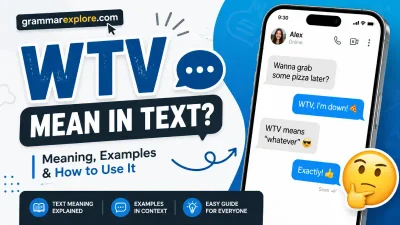
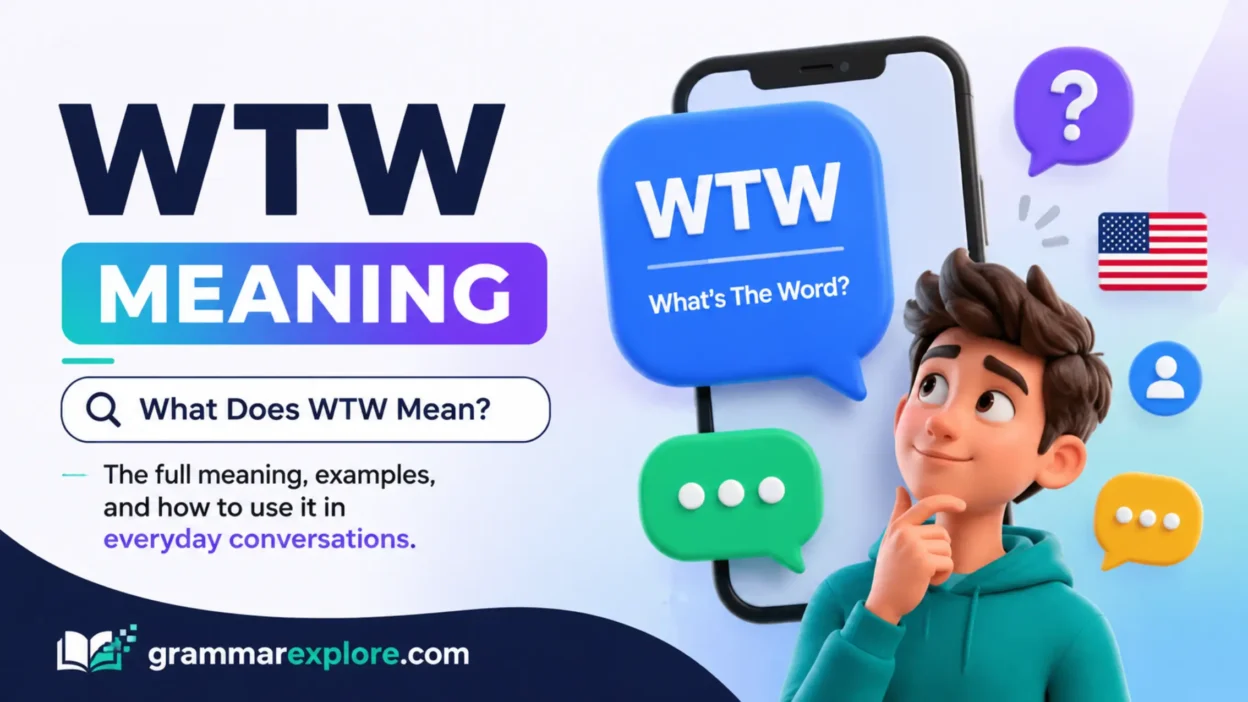
WTW is an informal texting abbreviation that most commonly means “What’s the word?” In casual American English, “What’s the word?” does not usually ask for a literal word. Instead, it works as a relaxed way to ask “What’s up?”, “What’s going on?”, or “What are the plans?”
You may see WTW in text messages, group chats, social-media DMs, Snapchat conversations, and other informal online settings. For example, a friend might text “WTW tonight?” to ask what the plans are for the evening.
Context can change the interpretation. A less common use of WTW is “What the what?”, which expresses surprise or confusion rather than asking for an update.
Quick Answer
WTW most commonly means “What’s the word?” in texting and online slang. It is a casual way to ask what is happening, what someone is doing, what the plans are, or what is new. For example, “WTW tonight?” can mean “What are the plans tonight?” WTW is informal and works best in casual conversations, not professional or academic writing.
What Does WTW Mean?
WTW usually stands for:
What’s the word?
In everyday texting, however, the phrase has a broader meaning.
Someone who sends:
“WTW?”
may simply be asking:
- What’s up?
- What’s going on?
- What are you doing?
- What are the plans?
- What’s happening?
- What’s new?
The exact interpretation depends on the conversation.
For example:
“Yo, WTW?”
is probably a casual way of saying:
“What’s up?”
But:
“WTW tonight?”
is more likely asking:
“What are the plans tonight?”
So, WTW is flexible. It often works as a quick conversation opener or a way to find out what is happening.
What Does WTW Stand For?
The most common expansion is:
W = What’s
T = The
W = Word
Therefore:
WTW = What’s The Word
The phrase itself existed as casual language before people began shortening it in text messages. In this expression, “the word” means news, information, an update, or what is happening.
So when someone asks:
“What’s the word?”
they are not normally asking you to give them one vocabulary word.
They are asking something closer to:
“What’s going on?”
That meaning carried naturally into texting, where WTW became a short digital version of the phrase. The exact date when the abbreviation first became common online is not clearly documented, so it is better not to assign it a specific invention date.
WTW Meaning in Texting
WTW is especially common in casual text conversations.
A friend might send:
“WTW?”
You could respond:
“Not much. Just relaxing. You?”
Here, WTW means something like “What’s up?”
Another example is:
“WTW this weekend?”
This probably means:
“What are the plans this weekend?”
The abbreviation allows the sender to ask a broad question without typing a complete sentence.
It can also be a way to start a conversation:
“Hey, WTW?”
In this case, the sender may simply want to reconnect and see what you are doing.
WTW Meaning in Slang
WTW is informal texting slang.
Its most common slang sense is closely related to “What’s the word?”, which functions as a casual greeting or request for an update.
The tone is usually:
- Casual
- Friendly
- Relaxed
- Conversational
- Sometimes playful
It can also be used when someone wants to make plans.
For example:
“WTW after work?”
could mean:
“What are we doing after work?”
or:
“What are the plans after work?”
The exact meaning comes from the words around WTW.
WTW Meaning in Chat
In a chat, WTW can work as a quick check-in.
For example:
Person A: “WTW?”
Person B: “Nothing much. Just watching a movie.”
Person A is essentially asking what is going on or what Person B is doing.
WTW can also lead directly to plans:
Person A: “WTW tonight?”
Person B: “I’m free. Want to get food?”
Here, WTW acts as an indirect way to ask about plans.
This is one reason the abbreviation is useful in casual conversations. It can be open-ended rather than asking one very specific question.
WTW Meaning on Snapchat
WTW can appear naturally in Snapchat chats and snaps.
For example:
“WTW?”
A friend may be checking whether you have plans or simply starting a conversation.
You could answer:
“Not much, you?”
Or:
“Going out later. Wbu?”
The abbreviation fits Snapchat because the platform encourages short, informal exchanges.
However, WTW does not have a completely different Snapchat-specific definition. The usual texting meaning still applies unless the surrounding conversation suggests otherwise.
WTW Meaning on Instagram
On Instagram, WTW may appear in:
- Direct messages
- Group chats
- Comments
- Stories
- Casual conversations
For example:
“WTW this weekend?”
usually asks about plans.
A friend might also send:
“WTW 👀”
The eye emoji can add curiosity or a playful tone.
Again, the abbreviation itself does not automatically make a message flirty. The surrounding conversation determines the tone.
WTW Meaning on TikTok
WTW can also appear in TikTok comments, captions, and direct messages.
For example:
“WTW?”
could be used as a casual way to ask:
“What’s going on?”
or:
“What’s happening?”
If the comment is responding to surprising content, though, another interpretation may be possible.
For this reason, context matters more than the three letters alone.
WTW Meaning in Dating and Flirty Conversations
WTW can appear in dating conversations because it is an easy way to start a casual chat.
For example:
“Hey, WTW tonight?”
could mean:
“What are you doing tonight?”
It may also be a way of testing whether someone is available to hang out.
A message such as:
“WTW 👀”
could feel playful or suggestive depending on the relationship.
However, WTW does not inherently mean flirting.
If someone sends it to you, do not assume they are romantically interested just because they used the abbreviation.
Look at the rest of the conversation.
WTW and Making Plans
One of the most useful ways to understand WTW is to see how it works with plans.
Consider:
“WTW Friday?”
The sender probably wants to know what is happening Friday or whether there are plans.
Similarly:
“WTW after the game?”
could mean:
“What are we doing after the game?”
And:
“WTW tonight?”
could mean:
“What are the plans tonight?”
This makes WTW useful when a conversation is moving toward an activity or meetup.
Is WTW Formal or Informal?
WTW is informal.
It belongs mainly in casual communication.
Good situations for WTW
You can naturally see WTW in:
- Text messages
- Friend-to-friend chats
- Group chats
- Social-media DMs
- Casual online communities
- Gaming chats
- Informal conversations
Situations where WTW should be avoided
Do not normally use WTW in:
- Academic essays
- Job applications
- Business letters
- Formal reports
- Professional emails
- Official documents
Instead of:
“WTW on the project?”
write:
“What is the latest update on the project?”
That version is clearer and appropriate for professional communication.
Is WTW Grammatically Correct?
WTW itself is not a standard grammatical sentence.
It is an abbreviation used in informal digital communication.
The complete expression is:
“What’s the word?”
That phrase is grammatically normal, although its meaning is idiomatic in casual conversation.
If you want to communicate in standard English, write the complete expression or choose a clearer question such as:
“What’s going on?”
“What are the plans?”
“What are you doing?”
For texting, however, WTW is perfectly understandable when the audience knows the abbreviation.
WTW vs. WYD
- WTW and WYD can sometimes appear in similar conversations, but they are not identical.
- WTW = What’s the word?
WYD = What are you doing?
For example:
“WTW tonight?”
focuses more broadly on plans or what is happening.
“WYD tonight?”
more directly asks what the person is doing.
They can sometimes produce similar answers, but their wording and focus differ.
Example
WTW tonight?
“Probably going to a party.”
WYD tonight?
“I’m watching a movie.”
WTW can be broader, while WYD is more directly about someone’s activity.
WTW vs. WYA
WYA commonly means:
Where You At?
It usually asks about someone’s current location.
WTW usually asks:
What’s the word?
or, more naturally:
What’s up?
Compare:
“WTW tonight?”
This asks about plans.
“WYA tonight?”
This asks where someone is.
The two abbreviations can appear in the same conversation, but they serve different purposes.
WTW vs. WBU
WBU usually means:
What About You?
For example:
“I’m staying home tonight. WBU?”
means:
“I’m staying home tonight. What about you?”
WTW is different because it starts a broader question:
“WTW tonight?”
The sender wants to know what is happening or what the plan is.
Other Meanings of WTW
The dominant meaning in texting is “What’s the word?”, but WTW can have other interpretations.
The most useful alternative to know in casual messaging is:
WTW = “What the What?”
In some contexts, WTW is used as a playful expression of surprise or confusion. Dictionary.com and other slang references document this interpretation.
For example:
“WTW? You actually bought it?”
Here, the abbreviation is not asking what is happening in general.
Instead, it expresses something like:
“What the what?”
The tone is surprised or confused.
How to Tell the Difference
Look at the sentence.
“WTW tonight?”
Likely meaning:
“What’s the word?” / “What are the plans?”
“WTW? You did WHAT?”
Possible meaning:
“What the what?”
The second use depends heavily on the surrounding message.
Can WTW Mean “What to Wear”?
In some contexts, WTW may be interpreted as “What to Wear.” This is much less likely in an ordinary message that simply says “WTW?”, but context can make the intended meaning clear.
For example:
“WTW for the wedding?”
could mean:
“What to wear for the wedding?”
This is why abbreviations should always be interpreted within the full conversation.
If someone simply sends:
“WTW?”
the safest everyday interpretation is usually “What’s the word?”
How to Reply to WTW
Your reply depends on what the sender is asking.
If WTW means “What’s up?”
You could say:
“Not much. You?”
Or:
“I’m good. What’s up with you?”
If WTW means “What are the plans?”
You could say:
“I’m free tonight.”
Or:
“Thinking about getting dinner.”
If WTW is asking what you are doing
You could answer:
“Just watching TV.”
Or:
“I’m heading home.”
If you are unsure
Ask:
“What do you mean by WTW?”
That is better than guessing when the context is unclear.
25 Examples of WTW in Text
Example 1
Sentence: “WTW?”
Meaning: What’s up? / What’s going on?
Why it is used: It is a casual way to start a conversation.
Example 2
Sentence: “WTW tonight?”
Meaning: What are the plans tonight?
Why it is used: The sender wants to know what is happening that evening.
Example 3
Sentence: “Yo, WTW?”
Meaning: What’s up?
Why it is used: The sender is casually checking in.
Example 4
Sentence: “WTW this weekend?”
Meaning: What are the plans this weekend?
Why it is used: The sender wants to discuss weekend activities.
Example 5
Sentence: “Hey, WTW?”
Meaning: What’s going on?
Why it is used: It opens a casual conversation.
Example 6
Sentence: “WTW after work?”
Meaning: What are we doing after work?
Why it is used: The sender is asking about plans.
Example 7
Sentence: “WTW with you?”
Meaning: What’s going on with you?
Why it is used: The sender wants an update.
Example 8
Sentence: “WTW Friday?”
Meaning: What are the plans for Friday?
Why it is used: The sender wants to know whether anything is planned.
Example 9
Sentence: “WTW? I’m bored.”
Meaning: What’s going on? / What can we do?
Why it is used: The sender may be looking for something to do.
Example 10
Sentence: “WTW later?”
Meaning: What are the plans later?
Why it is used: The sender wants to know about upcoming activities.
Example 11
Sentence: “WTW bro?”
Meaning: What’s up?
Why it is used: The casual wording makes the message friendly and relaxed.
Example 12
Sentence: “WTW 👀”
Meaning: What’s going on? / What are the plans?
Why it is used: The emoji adds curiosity or playful interest.
Example 13
Sentence: “WTW for Saturday?”
Meaning: What are the plans for Saturday?
Why it is used: The sender is asking about a specific day.
Example 14
Sentence: “WTW? Haven’t heard from you in a while.”
Meaning: What’s going on?
Why it is used: The sender is reconnecting after some time.
Example 15
Sentence: “WTW after the game?”
Meaning: What are we doing after the game?
Why it is used: The sender wants to know what happens next.
Example 16
Sentence: “WTW at the party?”
Meaning: What’s happening at the party?
Why it is used: The sender wants an update about an event.
Example 17
Sentence: “WTW? You good?”
Meaning: What’s going on?
Why it is used: The sender is checking on someone.
Example 18
Sentence: “WTW tonight? I’m free.”
Meaning: What are the plans tonight?
Why it is used: The sender signals that they are available.
Example 19
Sentence: “WTW tomorrow?”
Meaning: What are the plans tomorrow?
Why it is used: The sender wants to discuss the next day’s activities.
Example 20
Sentence: “WTW with the group?”
Meaning: What is happening with the group?
Why it is used: The sender wants an update about other people.
Example 21
Sentence: “WTW? You disappeared.”
Meaning: What’s going on?
Why it is used: The sender is checking why someone has been absent.
Example 22
Sentence: “WTW for dinner?”
Meaning: What are the plans for dinner?
Why it is used: The sender wants to discuss dinner arrangements.
Example 23
Sentence: “WTW, are we still meeting?”
Meaning: What’s the word? / Are we still meeting?
Why it is used: The sender wants confirmation about a plan.
Example 24
Sentence: “WTW? You actually did that?”
Meaning: What the what?
Why it is used: Here, WTW expresses surprise rather than asking about plans.
Example 25
Sentence: “WTW for the wedding?”
Meaning: What to wear for the wedding?
Why it is used: The context makes a less common interpretation possible.
Common Mistakes With WTW
Mistake 1: Thinking “What’s the Word?” Is Literal
Incorrect assumption: The sender wants you to provide a single word.
Better interpretation: In casual texting, WTW usually means something like “What’s up?” or “What’s going on?”
Reason: “What’s the word?” functions as an informal expression rather than a literal vocabulary question.
Mistake 2: Assuming WTW Always Means One Thing
Incorrect assumption: WTW can only mean “What’s the word?”
Better approach: Check the context.
Reason: WTW can also be used for other expressions, including “What the what?” in some conversations.
Mistake 3: Using WTW in Formal Writing
Incorrect: “WTW on the project?”
Better: “What is the latest update on the project?”
Reason: WTW is casual texting shorthand.
Mistake 4: Confusing WTW With WYD
Incorrect assumption: WTW and WYD always mean the same thing.
Better: WTW is usually “What’s the word?” while WYD is “What are you doing?”
Reason: They can lead to similar conversations, but they ask slightly different questions.
Mistake 5: Assuming WTW Is Flirty
Incorrect assumption: WTW automatically signals romantic interest.
Better approach: Consider the entire conversation.
Reason: Friends, coworkers in casual chats, and other people can use WTW without any romantic meaning.
When Should You Use WTW?
Use WTW when the conversation is casual and the other person is familiar with texting shorthand.
For example:
“WTW tonight?”
works naturally when talking with a friend about plans.
It can also work as a simple greeting:
“Yo, WTW?”
However, use the full phrase or a clearer question when communicating with people who may not understand the abbreviation.
When Should You Avoid WTW?
Avoid WTW in situations where standard English is expected.
For example, instead of:
“WTW about the meeting?”
write:
“What is the update about the meeting?”
In professional communication, clarity is usually more important than saving a few characters.
The same applies to academic writing. A professor, employer, or client may understand WTW, but that does not make it appropriate for formal writing.
Is WTW Rude?
WTW is usually not rude.
Its tone is generally casual and friendly.
For example:
“Hey, WTW?”
sounds like a relaxed check-in.
Still, tone depends on context. A very short message can sometimes seem abrupt if the relationship is formal or unfamiliar.
If you want to sound more polite or professional, use a complete question:
“How are you doing?”
or:
“What is the latest update?”
Is WTW Flirty?
WTW can appear in flirting or dating conversations, but WTW itself is not a flirty term.
For example:
“WTW tonight? 👀”
could sound playful when sent by someone interested in meeting you.
But:
“WTW, everyone?”
in a group chat is simply a casual question.
The surrounding words, timing, emojis, and relationship provide the tone.
Is WTW a Word?
No. WTW is an abbreviation or initialism used in informal digital communication.
The underlying phrase, “What’s the word?”, is normal English.
The shortened form is mainly a feature of texting and online conversation.
That means an English learner should understand both forms:
Informal:
“WTW?”
Standard:
“What’s the word?”
Natural alternatives:
“What’s up?”
“What’s going on?”
“What are the plans?”
How Do You Pronounce WTW?
WTW is mainly written rather than spoken.
If someone reads the abbreviation aloud, they may say the letters individually:
“W-T-W.”
However, in normal spoken conversation, people are more likely to say the full phrase:
“What’s the word?”
or simply:
“What’s up?”
There is no need to pronounce WTW as a single word.
Who Uses WTW?
WTW is used by people who communicate casually online.
You may encounter it among:
- Friends
- Teenagers
- Young adults
- Social-media users
- Gamers
- People in group chats
- Dating-app users
- Online communities
However, there is no strict age requirement. Adults can use it too.
The main factor is the communication style, not the person’s age.
WTW in American English
WTW fits informal American digital communication, especially when someone wants a quick, relaxed exchange.
An American texter might write:
“WTW?”
instead of:
“What’s going on?”
Or:
“WTW tonight?”
instead of:
“What are the plans tonight?”
These shortcuts are common because texting favors speed and conversational tone.
Still, WTW should not be treated as a replacement for standard English in every setting.
Related Texting Abbreviations
| Abbreviation | Common Meaning | Typical Use |
|---|---|---|
| WTW | What’s the word? | Asking what is happening |
| WYD | What are you doing? | Asking about an activity |
| WYA | Where you at? | Asking someone’s current location |
| WBU | What about you? | Returning a question |
| WSP | What’s up? | Casual greeting |
| BTW | By the way | Adding information |
| IDK | I don’t know | Showing uncertainty |
| TBH | To be honest | Giving an honest opinion |
These abbreviations can overlap in casual conversations, but each has its own usual meaning.
Frequently Asked Questions
What does WTW mean in text?
WTW most commonly means “What’s the word?” In texting, that usually means “What’s up?”, “What’s going on?”, or “What are the plans?” It is an informal abbreviation used mainly in casual digital conversations.
What does WTW stand for?
WTW usually stands for “What’s The Word?” In casual American slang, “What’s the word?” is an expression used to ask for news, an update, or information about what is happening.
Is WTW slang?
Yes. WTW is commonly used as informal texting slang or shorthand. It appears in texts, group chats, DMs, and social-media conversations. It is not normally appropriate for formal writing or professional communication.
What does WTW mean on Snapchat?
On Snapchat, WTW usually means “What’s the word?” It can function like “What’s up?” or “What are you doing?” A friend may use it to start a conversation or ask about plans.
What does WTW mean on Instagram?
WTW on Instagram usually has the same casual meaning: “What’s the word?” Depending on the conversation, it can ask what is happening, what someone is doing, or what the plans are.
Is WTW the same as WYD?
No. WTW usually means “What’s the word?”, while WYD means “What are you doing?” The two can sometimes lead to similar answers, but WTW is generally broader.
How do you respond to WTW?
Your response depends on the context. If someone means “What’s up?”, you could say “Not much, you?” If they mean “What are the plans?”, you could answer with your plans, such as “I’m free tonight.”
Conclusion
WTW most commonly means “What’s the word?” in texting and online slang. In everyday use, that phrase usually means “What’s up?”, “What’s going on?”, or “What are the plans?” It is a flexible expression that can start a conversation, check on a friend, or open a discussion about upcoming plans.
The abbreviation is informal, so it works best in texts, DMs, group chats, and casual social-media conversations. For professional emails, school assignments, and other formal writing, use a complete question instead.
Context is important because WTW can sometimes have another meaning, such as “What the what?” when someone expresses surprise. Therefore, do not interpret the three letters in isolation.
The simplest rule is: if someone casually texts “WTW?”, they are most likely asking what is going on or what the plans are.