

Many English learners confuse disorganized and unorganized because both words describe something that lacks good organization. Their meanings overlap, but they often emphasize different problems.
Disorganized usually describes something messy, scattered, confusing, or poorly arranged. Unorganized usually describes something that lacks a clear plan, system, structure, or formal arrangement.
For example, a desk covered with loose papers may look disorganized. A meeting without an agenda, assigned roles, or a clear schedule may feel unorganized.
Both words are correct in American English. However, disorganized sounds more natural in many everyday situations. Understanding the difference will help you choose the clearest word for each context.
Quick Answer
Use disorganized when something looks messy, chaotic, scattered, or difficult to manage.
Use unorganized when something has not received proper planning, structure, coordination, or formal organization.
Examples:
- Her desk is disorganized because papers cover every surface.
- The meeting felt unorganized because nobody prepared an agenda.
A simple way to remember the difference is:
Disorganized = disorder
Unorganized = unplanned or unstructured
Why People Confuse Disorganized and Unorganized
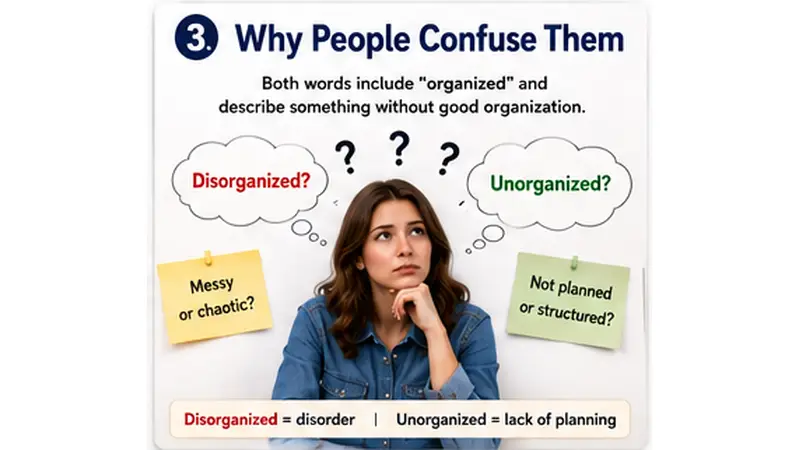
People confuse these words because both contain the word organized, and both use a negative prefix.
The prefix dis- can suggest disorder, disruption, or the loss of an expected condition. In disorganized, it points to confusion, poor arrangement, or a lack of order.
The prefix un- usually means “not.” Therefore, unorganized literally means “not organized.”
Consider these examples:
- A classroom with books, papers, and supplies scattered everywhere looks disorganized.
- A classroom without a seating plan, lesson schedule, or clear routine may feel unorganized.
The meanings sometimes overlap because poor planning can lead to disorder. As a result, both words may seem possible in the same sentence. However, one word usually sounds more natural depending on whether you want to emphasize messiness or missing structure.
Key Differences at a Glance
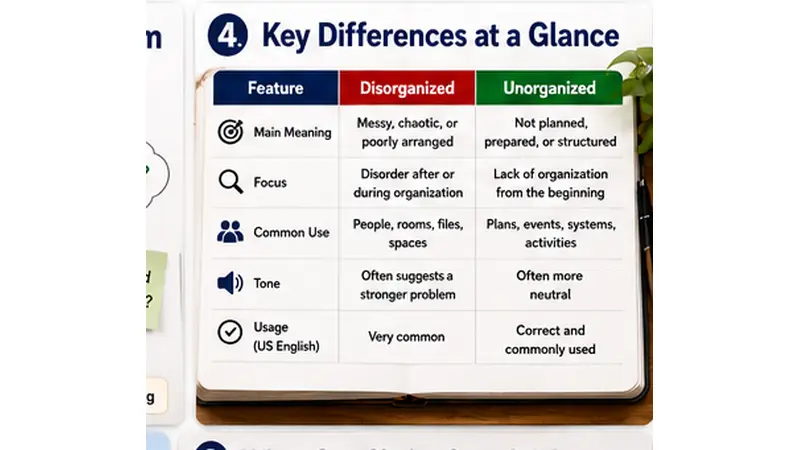
| Feature | Disorganized | Unorganized |
|---|---|---|
| Main meaning | Messy, scattered, confused, or poorly arranged | Not planned, structured, coordinated, or formally arranged |
| Main focus | Disorder or confusion | Absence of organization |
| Commonly describes | People, rooms, desks, thoughts, files, writing | Meetings, projects, teams, groups, systems, activities |
| Tone | Often suggests a noticeable problem | Often sounds more neutral or literal |
| Frequency | Very common in everyday English | Correct but less common in many contexts |
| Memory clue | Disorder | Unplanned |
Common Situations
| Situation | More Natural Choice | Reason |
|---|---|---|
| A desk covered with papers | Disorganized | The desk looks messy and poorly arranged |
| A project without a timeline | Unorganized | The project lacks planning and structure |
| A person who frequently loses things | Disorganized | The person struggles to maintain order |
| A meeting without an agenda | Unorganized | The meeting lacks preparation |
| An essay with ideas in the wrong order | Disorganized | The information feels scattered |
| A group without formal leadership | Unorganized | The group lacks formal organization |
Meaning and Usage Difference
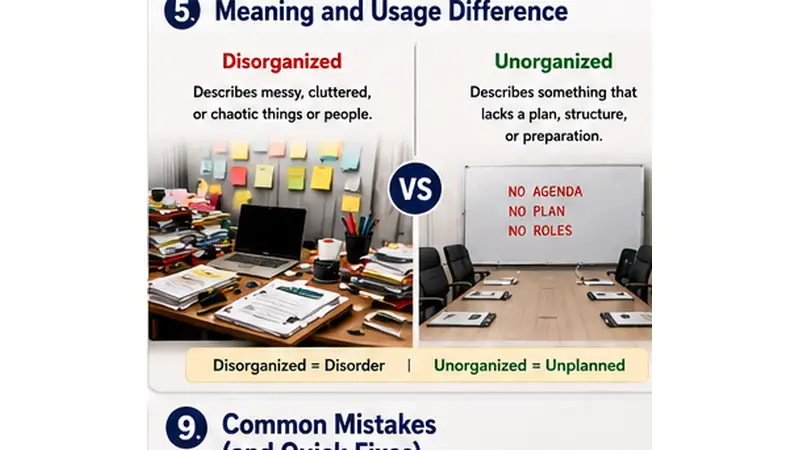
Disorganized: Meaning and Usage
Disorganized means lacking order, clear arrangement, or effective control. It often describes something that appears messy, scattered, confusing, or difficult to manage.
The word does not always mean that something was once perfectly organized. It simply emphasizes that the current condition lacks order.
Examples
- His office looks disorganized because he leaves documents everywhere.
- The disorganized files made the contract difficult to find.
- Her presentation felt disorganized because the ideas appeared in an unclear order.
- I felt disorganized after handling several deadlines at once.
- The kitchen became disorganized during the dinner rush.
What Can You Describe as Disorganized?
People commonly use disorganized for:
- people
- rooms
- desks
- offices
- thoughts
- notes
- files
- schedules
- essays
- presentations
- workspaces
- routines
When you describe a person as disorganized, you usually mean that the person struggles to manage belongings, tasks, time, or responsibilities effectively.
Example:
Tom is disorganized and often forgets where he leaves his keys.
This sentence does not necessarily mean that Tom never makes plans. It means that he has difficulty maintaining order.
Unorganized: Meaning and Usage
Unorganized means not organized, planned, coordinated, structured, or formally arranged. It often focuses on the absence of a system rather than visible messiness.
Examples
- The team remained unorganized because nobody assigned responsibilities.
- The event felt unorganized because the organizers had not created a schedule.
- Their travel plans were still unorganized a week before the trip.
- The new department seemed unorganized during its first month.
- The volunteers formed an unorganized group without official leadership.
What Can You Describe as Unorganized?
People may use unorganized for:
- meetings
- projects
- events
- plans
- teams
- groups
- campaigns
- activities
- systems
- processes
- movements
For example:
The company’s training program was unorganized.
This sentence suggests that the program lacked a clear schedule, sequence, method, or division of responsibilities. It does not necessarily suggest physical messiness.
A Special Use of Unorganized
Unorganized can also describe a group or activity that has no formal organization.
For example:
- The workers remained unorganized and did not belong to a union.
- The protest began as an unorganized local movement.
- Several unorganized community groups joined the campaign.
In these examples, unorganized means “not formally organized,” not “messy.”
Pronunciation
The two words share the same base word but use different prefixes.
Disorganized: dis-OR-guh-nized
Unorganized: un-OR-guh-nized
The stress usually falls on the first syllable of organized.
Tone, Context, and Formality

Both words work in casual, academic, and professional English. However, the most natural choice depends on the context.
Formal Writing
Use disorganized when you want to describe confusion, disorder, or poor arrangement.
- The report appeared disorganized because the sections followed no logical order.
- The evidence looked disorganized and difficult to evaluate.
Use unorganized when you want to describe missing planning, coordination, or formal structure.
- The committee remained unorganized during the first stage of the project.
- The event seemed unorganized because the team had not assigned responsibilities.
Casual Writing and Conversation
In everyday speech, people often use disorganized for both physical messiness and poor planning.
- My backpack is completely disorganized.
- Our vacation plans are still disorganized.
- I feel so disorganized today.
People may also use unorganized, but it can sound less natural when visible clutter or confusion is the main issue.
Academic Writing
Academic writing requires precise word choice.
Use disorganized for:
- scattered ideas
- unclear arguments
- poorly arranged evidence
- confusing paragraphs
- weak essay structure
Example:
The student’s essay felt disorganized because each paragraph introduced an unrelated idea.
Use unorganized for:
- research without a plan
- informal groups
- systems without structure
- projects without assigned roles
Example:
The research team remained unorganized during the early planning stage.
Business Writing
Business writers commonly use disorganized to describe confusing materials, workflows, records, or communication.
- The filing system became disorganized after the office move.
- The report looked disorganized and required extensive revision.
- A disorganized workflow can reduce productivity.
Use unorganized when a process, team, or project lacks planning.
- The onboarding process felt unorganized because no one assigned a trainer.
- The campaign remained unorganized until the manager created a timeline.
Which One Should You Use?
Choose disorganized when something:
- looks messy
- feels chaotic
- contains scattered information
- follows an unclear order
- becomes difficult to manage
- shows confusion or disorder
Choose unorganized when something:
- lacks a plan
- has no formal structure
- has no assigned roles
- has not received proper preparation
- operates without a clear system
- has not formed into an organized group
Simple Rules
- A messy room → disorganized
- A cluttered desk → disorganized
- Scattered thoughts → disorganized
- A confusing essay → disorganized
- A meeting without an agenda → unorganized
- A project without a timeline → unorganized
- A team without assigned roles → unorganized
- A group without formal leadership → unorganized
Easy Memory Trick
Use this quick memory trick:
Disorganized = disorder
Unorganized = unplanned
Think about what you can see or experience.
If you notice clutter, confusion, or chaos, choose disorganized.
If you notice missing planning, coordination, or structure, choose unorganized.
When One Choice Sounds Less Natural
The two words sometimes overlap, so the alternative may not always be grammatically wrong. However, one choice often sounds more natural.
Less Natural
My bedroom is unorganized.
More Natural
My bedroom is disorganized.
A bedroom with clothes, books, and other belongings scattered around shows visible disorder. Therefore, disorganized sounds more natural.
Less Precise
The conference was disorganized because nobody created an agenda.
More Precise
The conference was unorganized because nobody created an agenda.
The sentence focuses on missing preparation. Therefore, unorganized expresses the intended meaning more precisely.
However, disorganized could also work if the conference itself felt chaotic while it was happening.
Less Natural
His thoughts were unorganized during the interview.
More Natural
His thoughts were disorganized during the interview.
Thoughts can become scattered, confused, or difficult to express. Therefore, disorganized fits naturally.
Less Precise
The volunteer group remained disorganized because nobody had chosen a leader.
More Precise
The volunteer group remained unorganized because nobody had chosen a leader.
The group lacks formal structure, so unorganized emphasizes the problem more clearly.
Less Natural
My paperwork is unorganized all over the desk.
More Natural
My paperwork is disorganized and scattered across the desk.
The papers appear physically messy, so disorganized works better.
Common Mistakes and Quick Fixes
Mistake 1: Treating the Words as Exact Synonyms
Less precise:
The two words always mean the same thing.
Better:
The two words overlap, but disorganized emphasizes disorder while unorganized emphasizes missing organization.
Mistake 2: Calling Every Use of Unorganized Incorrect
Incorrect claim:
You can never describe a room as unorganized.
Better explanation:
You can describe a room as unorganized, but disorganized usually sounds more natural when the room looks messy or cluttered.
Mistake 3: Using Unorganized for Scattered Thoughts
Less natural:
My thoughts became unorganized.
Better:
My thoughts became disorganized.
The second sentence sounds more natural because it describes mental confusion.
Mistake 4: Using Disorganized When the Main Problem Is Missing Planning
Less precise:
The project was disorganized because we never created a timeline.
More precise:
The project was unorganized because we never created a timeline.
The second sentence focuses directly on the lack of planning.
Mistake 5: Assuming Disorganized Always Means “Previously Organized”
Some learners believe that disorganized must describe something that was once organized and later became messy. English speakers do not follow that rule strictly.
For example:
- He has always been disorganized.
- Her desk looks disorganized.
- The essay feels disorganized.
In each sentence, the word simply describes a lack of order.
Everyday Examples
School
- The classroom looked disorganized after the science experiment.
- Her notes became disorganized during the fast lecture.
- Our study group remained unorganized until we assigned topics.
- The essay felt disorganized because the ideas appeared in the wrong order.
Work
- His desk became disorganized during the busy season.
- The project remained unorganized without a project manager.
- The manager reorganized the disorganized files.
- The team looked unorganized because nobody understood their role.
Home
- My kitchen feels disorganized after I cook a large dinner.
- The garage has become disorganized over the years.
- Our moving plans remained unorganized until we created a checklist.
- A few storage boxes helped us fix the disorganized closet.
Business
- The company’s records became disorganized after the software failure.
- The marketing campaign remained unorganized because the team had no timeline.
- Customers complained about the disorganized checkout process.
- The new department seemed unorganized during its first week.
Emails and Writing
- Your email feels disorganized because it jumps between unrelated topics.
- The report looked disorganized, so the editor rearranged the sections.
- Our communication process remained unorganized until we selected one platform.
- The writer turned several disorganized notes into a clear article.
Social Media and Online Events
- The comment section became disorganized after hundreds of users replied.
- The online event felt unorganized because the schedule kept changing.
- The creator arranged the disorganized content into separate categories.
- An unorganized volunteer team managed the first livestream.
Everyday Conversation
- My backpack is always disorganized.
- I feel disorganized when I have too many tasks.
- We started the trip with completely unorganized plans.
- Their kitchen looks clean, but the cabinets remain disorganized.
Dictionary-Style Word Details
Disorganized
Part of speech: Adjective
Meaning: Lacking order, clear arrangement, or effective control.
Verb form: Disorganize
Noun form: Disorganization
Example:
The unexpected changes disorganized the team’s workflow.
Unorganized
Part of speech: Adjective
Meaning: Not organized, planned, structured, or formally arranged.
English speakers rarely use unorganize as a standard everyday verb. They normally say:
- fail to organize
- leave unorganized
- remain unorganized
- not organize
Example:
The group remained unorganized until the members elected a leader.
Synonyms and Antonyms
Synonyms for Disorganized
- messy
- disorderly
- chaotic
- cluttered
- untidy
- scattered
- confused
- unsystematic
- poorly arranged
Antonyms for Disorganized
- organized
- orderly
- neat
- systematic
- structured
- well arranged
Synonyms for Unorganized
- unplanned
- unstructured
- uncoordinated
- informal
- unsystematic
- unmanaged
- not arranged
- not formally organized
Antonyms for Unorganized
- organized
- planned
- structured
- coordinated
- formalized
- systematic
Example Sentences with Disorganized
- The office became disorganized during the renovation.
- Her notebook looked disorganized, so she rewrote her notes.
- A disorganized schedule caused several missed appointments.
- His disorganized desk made important documents difficult to find.
- The kitchen remained disorganized after the family gathering.
- The student’s disorganized essay confused the reader.
- My garage has become disorganized over the years.
- She felt disorganized after juggling several deadlines.
- The speaker gave a disorganized presentation.
- We created folders for the disorganized digital files.
Example Sentences with Unorganized
- The volunteer group remained unorganized until someone accepted a leadership role.
- The meeting felt unorganized because no one had prepared an agenda.
- Their travel plans remained unorganized until the final week.
- The new department looked unorganized during its first month.
- An unorganized process often causes delays.
- The campaign started as an unorganized community effort.
- The team remained unorganized because the manager had not assigned responsibilities.
- Several unorganized groups joined the larger movement.
Word History
Both disorganized and unorganized come from the verb organize.
English formed disorganized by adding the prefix dis-, which can suggest disruption, separation, or disorder. The resulting word came to describe people, places, thoughts, and systems that lack clear order.
English formed unorganized by adding the prefix un-, meaning “not.” The word describes something that has not received organization or does not have a formal structure.
Modern English uses both words, but disorganized appears more often in ordinary descriptions of messiness, confusion, and poor arrangement.
Common Phrases with Disorganized
- disorganized desk
- disorganized office
- disorganized thoughts
- disorganized schedule
- disorganized classroom
- disorganized files
- disorganized workspace
- disorganized approach
- disorganized lifestyle
- disorganized notes
- disorganized essay
- disorganized presentation
Example:
Her disorganized workspace made every task take longer.
Common Phrases with Unorganized
- unorganized event
- unorganized meeting
- unorganized project
- unorganized team
- unorganized group
- unorganized process
- unorganized campaign
- unorganized movement
- unorganized system
- unorganized activity
- unorganized workers
Example:
The unorganized meeting ended without any clear decisions.
Frequently Asked Questions
Can I use disorganized and unorganized interchangeably?
You can use these words interchangeably in some situations because their meanings overlap. However, use disorganized when you want to emphasize messiness, confusion, or poor arrangement. Use unorganized when you want to emphasize a lack of planning, coordination, or formal structure. Always choose the word that best fits your context.
Which word sounds more natural in American English?
American English speakers use disorganized more often. They commonly use it to describe messy rooms, cluttered desks, scattered thoughts, confusing writing, and people who struggle to manage tasks. They usually reserve unorganized for plans, meetings, projects, teams, and groups that lack structure.
Should I call a messy room disorganized or unorganized?
Call a messy room disorganized. This word clearly describes visible clutter and poor arrangement. Although some people use unorganized, disorganized sounds more natural in everyday American English.
Can I describe a project as unorganized?
Yes. Use unorganized when a project lacks a timeline, clear responsibilities, leadership, or an effective system. Use disorganized when the project contains confusing files, scattered information, conflicting instructions, or poorly arranged tasks.
Which word works better for a person?
Disorganized usually works better for a person. It describes someone who struggles to manage time, belongings, tasks, or responsibilities. Use unorganized when someone has not prepared a plan for a specific situation, although it sounds less natural as a general personality description.
Do disorganized and unorganized have exactly the same meaning?
No. Both words relate to poor organization, but they highlight different ideas. Disorganized emphasizes disorder, confusion, or poor arrangement. Unorganized emphasizes the absence of planning, structure, coordination, or formal organization.
Can I use disorganized in professional writing?
Yes. Professional, academic, and business writers regularly use disorganized to describe confusing reports, scattered evidence, poorly arranged files, unclear presentations, and inefficient workflows. Use this word whenever you want to emphasize disorder or a lack of clarity.
Why do people confuse these words?
People often confuse these words because both include the word organized and describe a lack of effective organization. Poor planning also creates visible disorder, which makes their meanings overlap in many situations.
Is unorganized grammatically correct?
Yes. Unorganized is a grammatically correct English adjective. It describes something that lacks organization, structure, or formal arrangement. However, English speakers usually prefer disorganized when they describe visible messiness, personal habits, scattered thoughts, or confusing information.
What is the easiest way to remember the difference?
Remember disorganized as disorder and unorganized as unplanned. Choose disorganized when you describe messiness, chaos, or confusion. Choose unorganized when you describe something that lacks a plan, system, leadership structure, or formal organization.
Conclusion
Disorganized and unorganized are both correct English words, but they do not always emphasize the same problem.
Use disorganized for people, places, thoughts, files, writing, or objects that appear messy, scattered, confusing, or poorly arranged.
Use unorganized for meetings, projects, groups, plans, or systems that lack preparation, coordination, structure, or formal organization.
Remember this simple rule:
Disorganized = disorder
Unorganized = unplanned
When you describe clutter or confusion, choose disorganized. When you describe missing planning or structure, choose unorganized. This distinction will make your writing clearer, more precise, and more natural.