
Many English words look almost identical but carry important differences. Whisky vs whiskey is one of the most common examples. Both spellings refer to a distilled alcoholic drink made from grains, but the correct spelling depends on where the drink comes from.
The main difference is geographical. Whisky is the preferred spelling for spirits made in countries such as Scotland, Canada, and Japan. Whiskey is the standard spelling for spirits made in Ireland and the United States.
So, neither spelling is completely wrong. The choice depends on the country, tradition, and style of the drink you are describing.
Quick Answer
✅ Whisky = The spelling commonly used for Scotch whisky, Canadian whisky, and Japanese whisky.
Example:
- I bought a bottle of Scottish whisky.
✅ Whiskey = The spelling commonly used for Irish whiskey and American whiskey.
Example:
- Kentucky whiskey is famous around the world.
❌ Whiskey is usually incorrect when referring to Scotch whisky.
Incorrect:
- I enjoy Scotch whiskey.
Correct:
- I enjoy Scotch whisky.
❌ Whisky is usually incorrect when referring to American bourbon.
Incorrect:
- Kentucky whisky is a popular American drink.
Correct:
- Kentucky whiskey is a popular American drink.
The easiest rule to remember:
Countries with an “e” in their names often use “whiskey” (Ireland and United States), while Scotland, Canada, and Japan usually use “whisky.”
Why People Confuse Them
People often confuse whisky and whiskey because the two words have the same meaning in general conversation. Both describe a distilled spirit made from fermented grain and aged in wooden barrels.
The difference comes from language history and regional spelling traditions. Over time, different countries developed their own preferred spelling.
American English speakers often see both versions because products from around the world appear on store shelves. A bottle from Scotland may say whisky, while a bottle from Kentucky may say whiskey.
Another reason for confusion is that many people assume one spelling must be correct and the other must be a mistake. However, both spellings are correct when used in the right context.
Key Differences at a Glance
| Context | Best Choice | Why |
|---|---|---|
| Scotch from Scotland | Whisky | Scotland traditionally uses this spelling |
| Bourbon from the United States | Whiskey | American producers use this spelling |
| Irish spirits | Whiskey | Ireland uses the “e” spelling |
| Canadian spirits | Whisky | Canada commonly follows the no-“e” spelling |
| Japanese spirits | Whisky | Japanese producers often follow Scottish tradition |
| Feature | Whisky | Whiskey |
|---|---|---|
| Main usage | Scotland, Canada, Japan | United States, Ireland |
| Meaning | A distilled grain spirit | A distilled grain spirit |
| Spelling difference | No “e” before “y” | Includes “e” before “y” |
| Common examples | Scotch whisky, Canadian whisky | Bourbon whiskey, Irish whiskey |
| Correctness | Correct in specific regions | Correct in specific regions |
Meaning and Usage Difference
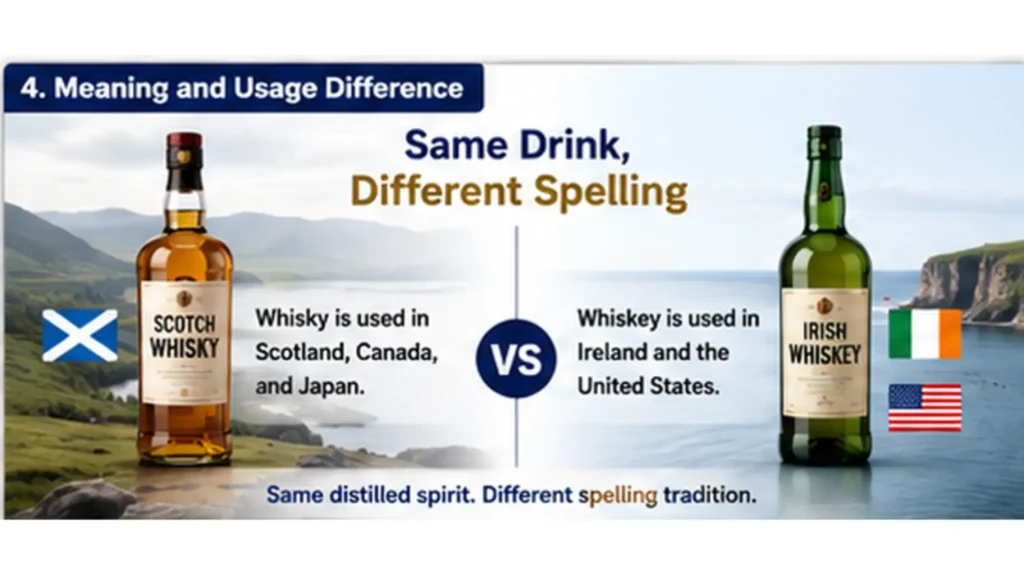
Although whisky and whiskey have different spellings, they refer to the same type of distilled alcoholic drink. The difference is not in the drink itself but in the spelling tradition followed by different countries and producers.
Whisky
Pronunciation: WISS-kee
Whisky is the standard spelling in Scotland, Canada, and Japan. You’ll also see it in many countries that follow the Scottish tradition of distilling.
The word refers to a distilled spirit made from fermented grain mash and aged in wooden barrels. Common grains include barley, corn, rye, and wheat.
You will commonly see whisky in:
- Scotch whisky labels
- Canadian whisky brands
- Japanese whisky brands
- British publications
- Travel guides about Scotland
- Articles discussing Scotch production
Examples of Whisky
- We toured a famous whisky distillery in Scotland.
- She enjoyed a glass of Japanese whisky with dinner.
- The guide explained how Scotch whisky is produced.
- Canadian whisky has a smooth flavor.
- He collected bottles of rare whisky from around the world.
- The museum displayed the history of Scottish whisky.
- They visited several whisky distilleries during their trip.
- This whisky spent twelve years aging in oak barrels.
Whiskey
Pronunciation: WISS-kee
Whiskey is the standard spelling in Ireland and the United States. Most American and Irish producers use this form on their product labels.
Like whisky, it refers to the same type of distilled alcoholic drink. The extra “e” reflects a regional spelling preference rather than a difference in meaning.
You will commonly see whiskey in:
- American whiskey labels
- Irish whiskey brands
- U.S. food and drink articles
- Cocktail recipes
- Restaurant menus
- American English publications
Examples of Whiskey
- He ordered a glass of Irish whiskey.
- Kentucky is famous for producing whiskey.
- The recipe calls for a small amount of whiskey.
- She bought a bottle of American whiskey as a gift.
- The bartender recommended a smooth Irish whiskey.
- They sampled several kinds of whiskey at the tasting event.
- His favorite drink is Tennessee whiskey.
- We learned how American whiskey differs from Scotch.
Side-by-Side Comparison
Notice how the spelling changes based on the country or product.
Whisky
- Scotland produces some of the world’s best-known whisky.
- Japanese whisky has become popular worldwide.
- The distillery exports premium whisky.
Whiskey
- Ireland produces high-quality whiskey.
- American whiskey comes in several styles.
- She prefers Irish whiskey over other varieties.
The drink is the same, but the spelling usually matches its country of origin.
Tone, Context, and Formality
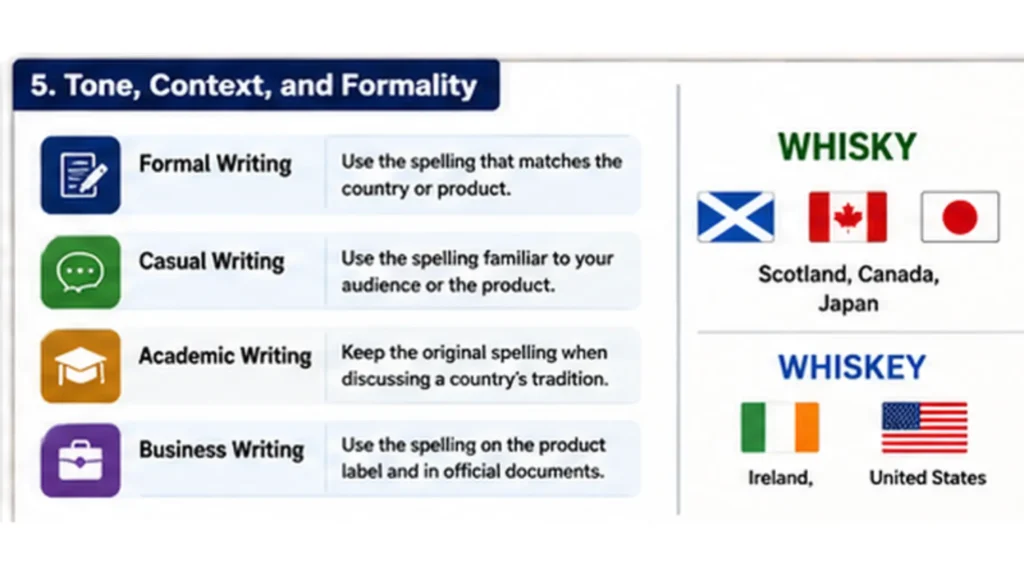
Both whisky and whiskey are correct in formal and informal English. The appropriate spelling depends on the audience, the publication style, or the product you are discussing.
Formal Writing
Use the spelling that matches the country or product.
Examples:
- Scotch whisky remains an important Scottish export.
- Irish whiskey has a long history of craftsmanship.
Academic articles, travel guides, and business publications generally follow this convention.
Casual Writing
In everyday conversations, people often use whichever spelling they see most often. However, matching the product’s label makes your writing more accurate.
Examples:
- I bought a bottle of Japanese whisky.
- My uncle enjoys American whiskey.
Academic Writing
Researchers and historians usually keep the original spelling when discussing a country’s distilling traditions.
Examples:
- The study examined the history of Scotch whisky production.
- The article compared Irish whiskey with American varieties.
Business Writing
Restaurants, retailers, importers, and beverage companies normally use the spelling found on the product label.
Examples:
- Our store now carries premium Scottish whisky.
- The company imports Irish whiskey from Dublin.
Using the correct spelling helps customers identify the product more easily.
American English Usage
In American English, whiskey is the standard spelling for most domestic products.
However, Americans still write Scotch whisky and Japanese whisky because those producers officially use that spelling.
Following the product’s official spelling is the most accurate approach.
Which One Should You Use?

Choose the spelling based on the product or the audience you’re writing for.
Use whisky when referring to products from:
- Scotland
- Canada
- Japan
Examples:
- We visited a famous whisky distillery in Scotland.
- Japanese whisky has won international awards.
Use whiskey when referring to products from:
- Ireland
- United States
Examples:
- He ordered a glass of Irish whiskey.
- Kentucky produces some of America’s best-known whiskey.
Simple Rules to Remember
- Use whisky for Scottish, Canadian, and Japanese products.
- Use whiskey for Irish and American products.
- Match the spelling printed on the bottle whenever possible.
- If you’re writing for an American audience, whiskey is generally the preferred spelling unless you’re referring to a product that officially uses whisky.
Easy Memory Trick
A simple memory trick can help you remember the difference.
- Whiskey has an extra “e.” Think of “E” for Emerald Isle (Ireland) and America, where whiskey is the common spelling.
- Whisky has no extra “e.” Think of Scotland, Canada, and Japan, which traditionally use whisky.
If you’re unsure, check the product’s label. Most producers use the spelling that reflects their country’s tradition, making it the easiest way to choose the correct form.
When One Choice Sounds Wrong
Because whisky and whiskey follow regional spelling traditions, using the wrong spelling may look inaccurate, especially when referring to a specific product or country. The meaning stays the same, but matching the official spelling makes your writing more precise.
Incorrect: Scotland is famous for its whiskey.
Correct: Scotland is famous for its whisky.
Why: Scottish producers traditionally use whisky.
Incorrect: Irish whisky is popular around the world.
Correct: Irish whiskey is popular around the world.
Why: Ireland traditionally uses the spelling whiskey.
Incorrect: The restaurant serves Japanese whiskey.
Correct: The restaurant serves Japanese whisky.
Why: Japanese producers generally follow the Scottish spelling.
Incorrect: He bought a bottle of Canadian whiskey.
Correct: He bought a bottle of Canadian whisky.
Why: Most Canadian brands use whisky.
Incorrect: Kentucky produces world-famous whisky.
Correct: Kentucky produces world-famous whiskey.
Why: American producers typically use whiskey.
Common Mistakes (and Quick Fixes)
Mistake 1
Incorrect: Every country spells the drink as whiskey.
Correct: Different countries use either whisky or whiskey.
Explanation: Both spellings are correct, depending on regional tradition.
Mistake 2
Incorrect: Scotch whiskey comes from Scotland.
Correct: Scotch whisky comes from Scotland.
Explanation: Scotland uses whisky without the extra “e.”
Mistake 3
Incorrect: Irish whisky has a long history.
Correct: Irish whiskey has a long history.
Explanation: Ireland traditionally uses whiskey.
Mistake 4
Incorrect: Japanese whiskey follows American spelling.
Correct: Japanese whisky follows the Scottish spelling tradition.
Explanation: Japanese producers generally use whisky.
Mistake 5
Incorrect: Whisky and whiskey describe different drinks.
Correct: Whisky and whiskey refer to the same type of distilled spirit. The spelling usually depends on the country of origin.
Explanation: The spelling changes, but the general meaning remains the same.
Everyday Examples
School
- Our geography class discussed why Scotland spells it whisky.
- The teacher explained that Ireland prefers whiskey.
Work
- The restaurant updated its menu to include Scottish whisky.
- The distributor imported American whiskey for local stores.
Home
- My father enjoys a small glass of whisky after dinner.
- My neighbor prefers Irish whiskey.
Business
- The company exports premium Scottish whisky worldwide.
- The retailer sells several brands of American whiskey.
Emails
- Please add the new Japanese whisky collection to our catalog.
- Our customer requested more Irish whiskey brands.
Social Media
- I finally visited a famous whisky distillery in Scotland!
- My favorite drink is Irish whiskey.
Everyday Conversations
- This Scottish whisky has a rich flavor.
- He ordered Tennessee whiskey with dinner.
- Japanese whisky has become very popular.
- Irish whiskey often has a smooth finish.
Dictionary-Style Word Details
Verb
Whisky
Not commonly used as a verb in standard English.
Whiskey
Not commonly used as a verb in standard English.
Both whisky and whiskey function as nouns, not verbs.
Noun
Whisky
Whisky is a noun. It refers to a distilled alcoholic drink made from fermented grains and aged in wooden barrels. Scotland, Canada, and Japan commonly use this spelling.
Whiskey
Whiskey is also a noun. It has the same meaning as whisky, but Ireland and the United States generally prefer this spelling.
Synonyms
Because whisky and whiskey already name a specific type of alcoholic beverage, there are very few true synonyms.
Closest alternatives include:
- Grain spirit
- Distilled spirit
- Aged spirit
These alternatives are broader terms and do not always refer specifically to whisky or whiskey.
Related terms:
- Scotch whisky
- Irish whiskey
- Bourbon
- Rye whiskey
- Canadian whisky
- Japanese whisky
Example Sentences
Whisky (8 Examples)
- We visited a historic whisky distillery in Scotland.
- Japanese whisky has earned international awards.
- The guide explained how whisky ages in oak barrels.
- Canadian whisky often has a smooth finish.
- He collects rare bottles of whisky from around the world.
- The restaurant offers several types of Scotch whisky.
- She bought a bottle of premium whisky as a gift.
- The museum celebrates the history of Scottish whisky.
Whiskey (8 Examples)
- He poured a glass of Irish whiskey after dinner.
- Kentucky produces some of America’s best-known whiskey.
- The bartender recommended a local whiskey.
- The recipe includes a splash of whiskey.
- She sampled several American whiskey brands.
- We toured a famous whiskey distillery in Tennessee.
- Irish whiskey remains popular around the world.
- The store received a shipment of premium whiskey today.
Word History
Whisky
The spelling whisky developed in Scotland and became the traditional form that Scottish distillers use. Countries such as Canada and Japan later adopted the same spelling because Scotland strongly influenced their distilling traditions.
Whiskey
The spelling whiskey became common in Ireland. Many Irish distillers added the extra “e” to separate their products from Scotch. Later, American producers adopted the Irish spelling and made whiskey the standard form in the United States.
Phrases Containing
Common Phrases with Whisky
- Scotch whisky
- Single malt whisky
- Blended whisky
- Japanese whisky
- Canadian whisky
- Whisky distillery
- Whisky tasting
- Whisky barrel
Common Phrases with Whiskey
- Irish whiskey
- American whiskey
- Rye whiskey
- Tennessee whiskey
- Bourbon whiskey
- Whiskey sour
- Whiskey glass
- Whiskey tasting
Frequently Asked Questions
What is the difference between whisky and whiskey?
Whisky and whiskey refer to the same type of distilled alcoholic drink. The main difference is regional spelling. Scotland, Canada, and Japan generally use whisky, while Ireland and the United States usually use whiskey. Choose the spelling that matches the product or your audience.
Which spelling is correct in American English?
American English generally uses “whiskey.” Most U.S. distilleries, including bourbon and Tennessee whiskey producers, choose the spelling with an “e.” However, Americans still use “Scotch whisky” and “Japanese whisky” because those products keep their official spellings.
Why does Scotland use whisky instead of whiskey?
Scotland has traditionally used the spelling whisky for centuries. Scottish distillers continue to use this form on their labels, and many countries influenced by Scottish distilling traditions, such as Canada and Japan, follow the same spelling.
Why does Ireland spell it whiskey?
Ireland traditionally uses whiskey with an extra “e.” Irish producers adopted this spelling as part of their own distilling tradition. Many American distilleries later followed the Irish style, making whiskey the standard spelling in the United States.
Is Japanese whisky spelled without the “e”?
Yes. Japanese producers generally spell the word whisky without the extra “e.” Japan’s whisky industry developed under strong Scottish influence, so it follows the same spelling tradition used in Scotland.
Are whisky and whiskey different drinks?
Not necessarily. Both words describe the same type of distilled spirit made from grains and aged in wooden barrels. While production methods and flavors vary by country and style, the spelling alone does not define a different drink.
Should I match the spelling on the bottle?
Yes. Matching the spelling printed on the bottle is the most accurate choice. For example, write Scotch whisky, Japanese whisky, Irish whiskey, and American whiskey to reflect each producer’s official spelling.
How do you pronounce whisky and whiskey?
People pronounce whisky and whiskey the same way: WISS-kee. The extra “e” changes the spelling but not the pronunciation, so listeners usually cannot tell which spelling you mean without seeing it in writing.
Can I use whisky and whiskey interchangeably?
Use either spelling when speaking because both words share the same pronunciation. In writing, choose the spelling that matches the country’s tradition or the product’s official label to keep your writing accurate.
Conclusion
The difference between whisky and whiskey comes down to regional spelling, not meaning. Both words refer to the same type of distilled alcoholic drink, but different countries prefer different spellings.
Use whisky when referring to products from Scotland, Canada, and Japan. Use whiskey when writing about products from Ireland and the United States. When discussing a specific brand, follow the spelling printed on the bottle.
A simple memory trick can help you remember the difference: whiskey includes an extra “e,” which you can associate with Ireland and America, while whisky without the “e” matches the traditional spelling used in Scotland, Canada, and Japan.
By matching the spelling to the product’s country of origin, you’ll write with greater accuracy and confidence every time.