

Many people mix up inpatient and impatient because the words look almost identical. A single missing letter changes the meaning completely. While they share similar spelling, they belong to different contexts and describe very different ideas.
Inpatient is a medical term. It refers to someone who stays in a hospital or healthcare facility for treatment, usually overnight or longer.
Impatient describes a person’s attitude or feeling. It means someone finds it difficult to wait calmly or becomes easily frustrated when things take too long.
Understanding this difference helps you choose the right word in emails, healthcare documents, school assignments, business writing, and everyday conversations.
Quick Answer
The difference is simple:
- ✅ Inpatient = A patient who stays in a hospital for treatment.
- Example: The doctor admitted the patient as an inpatient after surgery.
- ✅ Impatient = Unable to wait calmly; easily annoyed by delays.
- Example: The children became impatient while waiting for the bus.
Quick Comparison
| Word | Meaning | Example |
|---|---|---|
| Inpatient | A person receiving treatment while staying in a hospital | She remained an inpatient for three days. |
| Impatient | Feeling annoyed because something is taking too long | He grew impatient during the long meeting. |
Tip: If you’re talking about healthcare, use inpatient. If you’re describing feelings or behavior, use impatient.
Why People Confuse Them
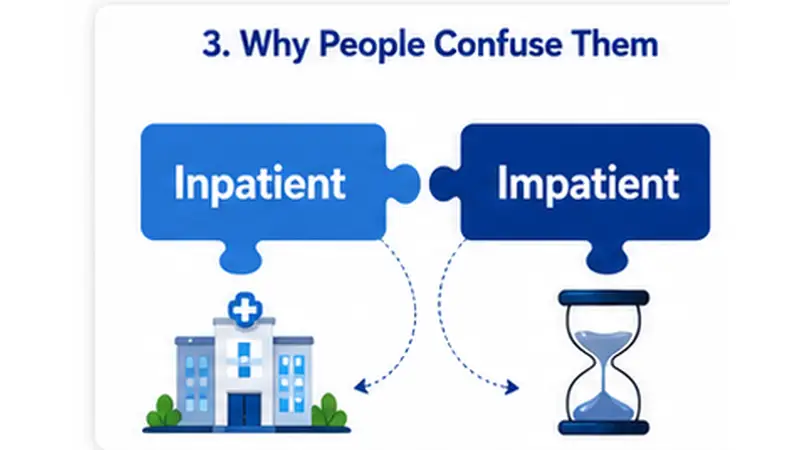
People often confuse inpatient and impatient because they differ by only one letter. When spoken quickly, they can also sound similar, especially for English learners.
Another reason is that many readers focus on the beginning and end of a word instead of every letter. Since both words start with “in” and end with “patient,” it is easy to overlook the extra “m” in impatient.
The shared word patient adds to the confusion. In inpatient, patient means a person receiving medical care. In impatient, the word comes from patient in the sense of remaining calm or willing to wait. Adding the prefix im- changes the meaning to not patient.
Learning the context is the easiest way to avoid mistakes. Hospital-related writing calls for inpatient, while conversations about emotions, waiting, or frustration require impatient.
Key Differences at a Glance
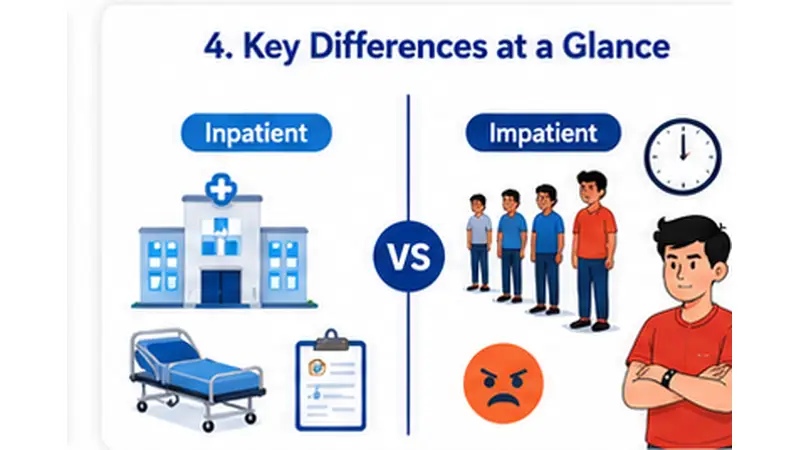
| Context | Best Choice | Why |
|---|---|---|
| Hospital admission | Inpatient | Refers to a patient staying in a healthcare facility. |
| Surgery recovery | Inpatient | Describes someone receiving treatment while admitted. |
| Medical records | Inpatient | Standard healthcare term used by hospitals and insurance providers. |
| Waiting in line | Impatient | Describes someone who struggles to wait calmly. |
| Delayed response | Impatient | Expresses frustration with slow progress. |
| Everyday conversations | Impatient | Refers to feelings or behavior rather than medical care. |
| Feature | Inpatient | Impatient |
|---|---|---|
| Meaning | A hospital patient who stays for treatment | Someone who cannot wait calmly |
| Part of Speech | Noun or adjective | Adjective |
| Main Context | Healthcare and medicine | Feelings, behavior, and attitudes |
| Related To | Hospital care | Patience and waiting |
| Common Use | Medical documents, hospitals, insurance | Everyday conversations, school, work, business writing |
| American English | Standard and widely used | Standard and widely used |
| Correct Spelling | ✅ Yes | ✅ Yes |
| Can They Replace Each Other? | ❌ No | ❌ No |
Meaning and Usage Difference
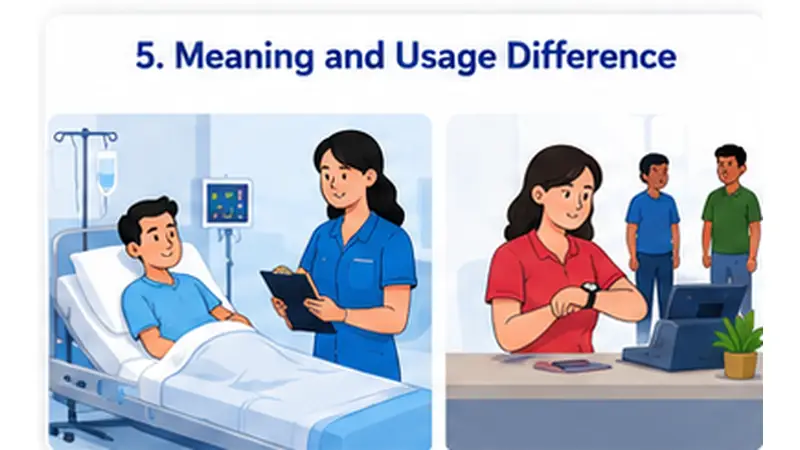
Although inpatient and impatient differ by only one letter, they have unrelated meanings.
Inpatient
Inpatient refers to a person who stays in a hospital or healthcare facility while receiving treatment. Doctors admit inpatients when they need medical care that cannot be completed during a single visit.
Healthcare professionals also use inpatient as an adjective.
Examples:
- The hospital admitted the inpatient for observation.
- Every inpatient received a treatment plan.
- The inpatient unit remained busy throughout the week.
- She spent five days as an inpatient after surgery.
You will usually see inpatient in:
- hospitals
- healthcare articles
- insurance documents
- medical reports
- nursing guidelines
Impatient
Impatient describes a person who becomes restless, annoyed, or frustrated because something takes too long.
It can also describe someone who wants immediate results.
Examples:
- The customers became impatient while waiting.
- He felt impatient during the traffic jam.
- She sounded impatient when nobody answered the phone.
- Children often become impatient before holidays.
You will commonly see impatient in:
- everyday conversations
- books
- news articles
- workplace communication
- school writing
Pronunciation
The pronunciation difference is small but noticeable.
- Inpatient: IN-pay-shunt
- Impatient: im-PAY-shunt
The stress remains similar, but the first syllable changes slightly.
Listening carefully to the beginning of each word can help you recognize the correct one.
Parts of Speech
Inpatient
Inpatient functions as both a noun and an adjective.
As a noun:
- The inpatient recovered quickly.
As an adjective:
- The hospital opened a new inpatient wing.
- The doctor recommended inpatient treatment.
Impatient
Impatient functions as an adjective.
Examples:
- She became impatient after waiting an hour.
- The coach grew impatient with repeated mistakes.
- We felt impatient because the flight was delayed.
A simple way to remember the difference:
- Inpatient = In a hospital
- Impatient = Unable to wait calmly
Tone, Context, and Formality

Both inpatient and impatient appear in formal and informal English, but writers use them in very different situations.
Inpatient belongs to medical and healthcare settings. You will often see it in hospital records, insurance documents, healthcare websites, and medical conversations.
Impatient appears in everyday English. People use it to describe feelings, attitudes, and behavior when someone struggles to wait calmly.
Understanding the context helps you choose the correct word.
Using Inpatient
Use inpatient when you talk about a person who stays in a hospital for treatment or services provided to hospitalized patients.
Common contexts include:
- hospitals
- clinics
- healthcare facilities
- insurance policies
- medical reports
- nursing care
Examples:
- The hospital admitted the inpatient for further testing.
- Doctors monitored every inpatient throughout the night.
- The insurance plan covers inpatient treatment.
- The new inpatient unit opened last month.
Using Impatient
Use impatient when you describe someone who cannot wait calmly or becomes frustrated by delays.
Common contexts include:
- everyday conversations
- workplace communication
- parenting
- school
- travel
- customer service
Examples:
- The children became impatient before the movie started.
- She looked impatient while waiting in line.
- He grew impatient during the long presentation.
- Customers became impatient after waiting for an hour.
Formal vs. Informal Writing
Both words work well in formal and informal writing.
Formal Examples
- The hospital expanded its inpatient services.
- The manager became impatient with repeated delays.
Informal Examples
- My grandfather stayed as an inpatient after his surgery.
- I get impatient when traffic stops moving.
Neither word sounds more formal than the other. The situation determines which word you need.
Which One Should You Use?
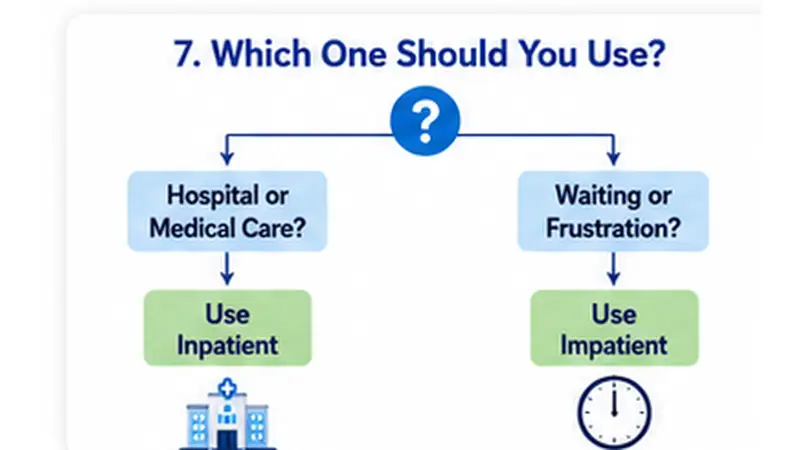
Ask yourself one simple question:
Does your sentence talk about a hospital or about someone’s attitude?
Choose inpatient if your sentence discusses:
- hospital care
- overnight treatment
- medical admission
- healthcare services
- hospitalized patients
Examples:
- The doctor admitted the inpatient yesterday.
- The hospital added more inpatient rooms.
- Nurses cared for every inpatient carefully.
Choose impatient if your sentence discusses:
- waiting
- frustration
- annoyance
- wanting quick results
- losing patience
Examples:
- The audience became impatient.
- She felt impatient during the delay.
- We grew impatient after waiting two hours.
A Simple Memory Trick
Try these easy memory tricks.
Inpatient = In the hospital
The word starts with in, which can remind you that the patient stays in the hospital.
Impatient = I’m out of patience
The prefix im- can remind you that someone has little or no patience left.
You can also remember:
- Hospital = Inpatient
- Waiting = Impatient
These simple connections make it easier to choose the correct word.
When One Choice Sounds Wrong
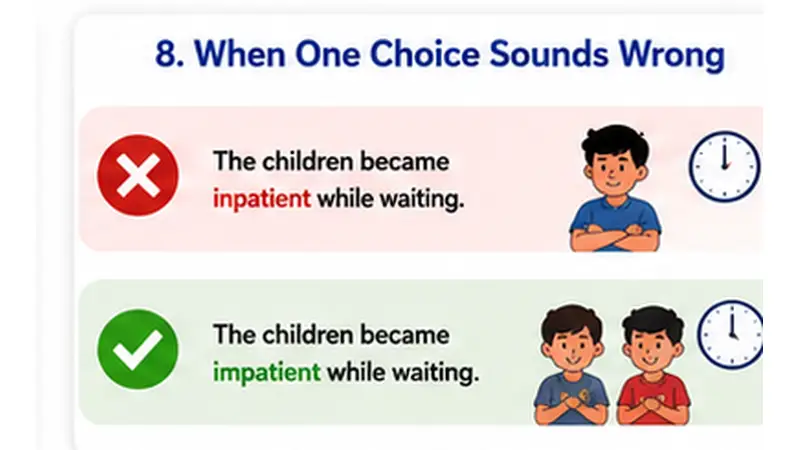
Using the wrong word changes the meaning of your sentence completely.
Incorrect:
- The doctor treated an impatient after surgery.
Correct:
- The doctor treated an inpatient after surgery.
The sentence talks about a hospitalized patient, not someone’s personality.
Incorrect:
- The children became inpatient while waiting.
Correct:
- The children became impatient while waiting.
The sentence describes feelings, not medical care.
Incorrect:
- The hospital built a new impatient wing.
Correct:
- The hospital built a new inpatient wing.
A hospital has an inpatient department, not an impatient department.
Common Mistakes (and Quick Fixes)
Mistake 1: Using “Inpatient” for Someone Who Cannot Wait
❌ She became inpatient after waiting.
✔ She became impatient after waiting.
Use impatient to describe feelings.
Mistake 2: Using “Impatient” for Hospital Care
❌ The nurse checked every impatient.
✔ The nurse checked every inpatient.
Use inpatient in medical settings.
Mistake 3: Forgetting the Context
Some writers focus on the spelling instead of the meaning.
Remember:
- Hospital = Inpatient
- Waiting = Impatient
Mistake 4: Assuming Both Words Mean the Same Thing
These words are not synonyms.
Inpatient refers to a hospitalized person.
Impatient describes someone’s attitude.
Mistake 5: Using the Wrong Word in Professional Writing
Medical documents should always use inpatient when referring to hospital patients.
General conversations should use impatient when describing frustration or a lack of patience.
Everyday Examples
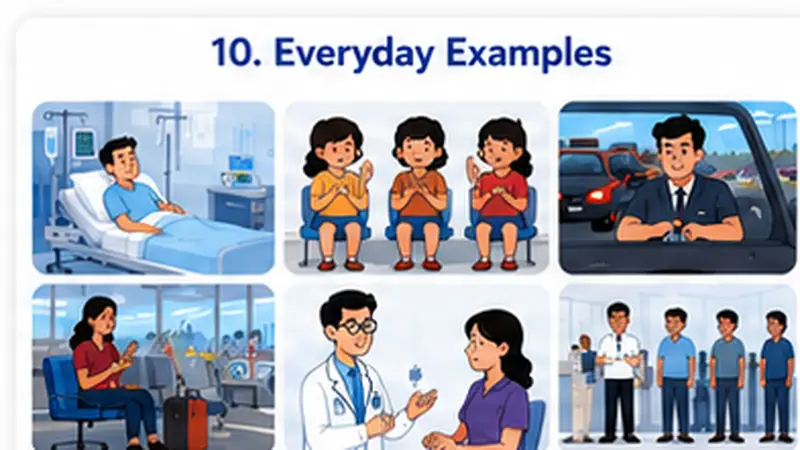
Using Inpatient
- The hospital admitted the inpatient for emergency treatment.
- Every inpatient received a medical examination.
- The doctor recommended inpatient rehabilitation.
- Nurses visited each inpatient several times a day.
- The insurance company approved inpatient care.
Using Impatient
- I became impatient while waiting for my order.
- The passengers grew impatient during the delay.
- She sounded impatient on the phone.
- The coach became impatient after repeated mistakes.
- Young children often become impatient before birthdays.
Side-by-Side Examples
| Situation | Correct Word | Example |
|---|---|---|
| Hospital admission | Inpatient | The inpatient stayed overnight for observation. |
| Medical treatment | Inpatient | The hospital expanded its inpatient services. |
| Waiting in line | Impatient | The customers became impatient after thirty minutes. |
| Feeling frustrated | Impatient | He grew impatient because the website loaded slowly. |
The easiest way to remember the difference is simple:
Choose “inpatient” for hospitals. Choose “impatient” for feelings about waiting.
Dictionary-Style Word Details
Verb
Inpatient:
Inpatient is not commonly used as a verb in standard American English.
Impatient:
Impatient is not commonly used as a verb in standard American English.
Noun
Inpatient:
Inpatient functions as a noun. It refers to a person who stays in a hospital or healthcare facility while receiving treatment.
Examples:
- The doctor examined every inpatient before surgery.
- The hospital discharged the inpatient after four days.
- Nurses cared for each inpatient around the clock.
- The inpatient responded well to treatment.
Impatient:
Impatient is not commonly used as a noun in standard American English. It functions as an adjective.
Synonyms
Inpatient
Closest plain alternatives:
- Hospital patient
- Admitted patient
- Resident patient
There is no exact everyday synonym for inpatient because it has a specific medical meaning.
Impatient
Closest plain alternatives:
- Restless
- Eager
- Anxious
- Irritable
- Agitated
- Frustrated
Antonyms
Inpatient:
There is no direct antonym. However, outpatient describes a patient who receives treatment without staying overnight.
Impatient:
Common antonyms include:
- Patient
- Calm
- Tolerant
- Relaxed
- Composed
Example Sentences
Inpatient
- The hospital admitted the inpatient for surgery.
- Every inpatient received excellent medical care.
- Doctors transferred the inpatient to a private room.
- The inpatient recovered faster than expected.
- Nurses checked each inpatient every few hours.
- The insurance policy covers inpatient treatment.
- The hospital expanded its inpatient department.
- The physician visited every inpatient before discharge.
Impatient
- The children became impatient before dinner.
- She looked impatient during the long meeting.
- He grew impatient while waiting for the results.
- Customers became impatient because of the delay.
- I felt impatient in the slow-moving traffic.
- The audience became impatient after the late start.
- My brother gets impatient when technology stops working.
- We became impatient after waiting for more than an hour.
Word History
Although inpatient and impatient look similar, they developed from different ideas.
Inpatient combines in and patient to describe someone who stays in a hospital while receiving treatment. Healthcare professionals have used this term for many years to distinguish patients who stay in a hospital from outpatients, who receive treatment without an overnight stay.
Impatient combines the prefix im-, meaning not, with patient. It describes someone who does not remain calm while waiting or dealing with delays.
Today, these words remain completely different in meaning:
- Inpatient = A hospitalized patient
- Impatient = Someone who lacks patience
Phrases Containing
Common phrases using inpatient include:
- inpatient care
- inpatient treatment
- inpatient services
- inpatient admission
- inpatient unit
- inpatient rehabilitation
- inpatient facility
- inpatient hospital stay
Examples:
- The insurance plan covers inpatient care.
- The hospital expanded its inpatient services.
Common phrases using impatient include:
- become impatient
- grow impatient
- feel impatient
- impatient customer
- impatient driver
- impatient child
- impatient tone
- impatient attitude
Examples:
- The passengers began to grow impatient.
- She spoke with an impatient tone.
Practice MCQs
1. Which sentence uses inpatient correctly?
A. The children became inpatient during the trip.
B. The hospital admitted the inpatient for surgery.
C. I felt inpatient while waiting.
D. She sounded inpatient on the phone.
Answer: B
2. Which word describes someone who cannot wait calmly?
A. Inpatient
B. Outpatient
C. Impatient
D. Hospital
Answer: C
3. Which sentence uses impatient correctly?
A. The doctor examined every impatient.
B. The impatient unit opened yesterday.
C. She became impatient after waiting an hour.
D. The hospital admitted an impatient.
Answer: C
4. Which word belongs in a hospital setting?
A. Impatient
B. Inpatient
C. Restless
D. Frustrated
Answer: B
5. Choose the correct sentence.
A. The nurse checked every impatient.
B. The audience became inpatient.
C. The doctor visited every inpatient.
D. We stayed impatient after the delay.
Answer: C
6. Which sentence is correct?
A. The passengers grew inpatient during the delay.
B. The passengers grew impatient during the delay.
C. The passengers admitted impatient.
D. The passengers entered inpatient.
Answer: B
7. Which word means a hospitalized patient?
A. Patient
B. Inpatient
C. Impatient
D. Outpatient
Answer: B
8. Which sentence talks about feelings?
A. The hospital expanded its inpatient unit.
B. Every inpatient received medication.
C. The children became impatient while waiting.
D. The doctor admitted the inpatient.
Answer: C
9. Which pair matches correctly?
A. Inpatient = Hospital patient
B. Inpatient = Restless person
C. Impatient = Hospital patient
D. Impatient = Medical treatment
Answer: A
10. Which sentence uses the correct word?
A. The inpatient became frustrated because of the delay.
B. The doctor admitted an impatient for surgery.
C. The insurance covers impatient treatment.
D. The hospital built an impatient ward.
Answer: A
Frequently Asked Questions
What is the difference between inpatient and impatient?
Inpatient refers to a person who stays in a hospital for treatment. Impatient describes someone who becomes annoyed or frustrated because they have to wait.
When should I use inpatient?
Use inpatient when you talk about someone receiving treatment while staying in a hospital or healthcare facility.
Example:
The hospital admitted the inpatient for observation.
When should I use impatient?
Use impatient when you describe someone who cannot wait calmly or wants something to happen sooner.
Example:
She became impatient after waiting for an hour.
Do inpatient and impatient mean the same thing?
No. Inpatient refers to medical care, while impatient describes a person’s attitude or behavior.
Can inpatient describe a person’s personality?
No. Inpatient refers only to hospital care or a hospitalized patient. Use impatient to describe someone’s behavior or feelings.
Can impatient describe a hospital patient?
No. Use inpatient when you talk about someone staying in a hospital for treatment.
How can I remember the difference between inpatient and impatient?
Use this simple memory trick:
Inpatient = In the hospital
Impatient = Lacking patience
This reminder makes it easy to choose the correct word.
Is inpatient a noun or an adjective?
Inpatient works as both a noun and an adjective.
Examples:
The inpatient recovered quickly. (noun)
The hospital offers inpatient treatment. (adjective)
Conclusion
Although inpatient and impatient differ by only one letter, they have completely different meanings.
Use inpatient when you talk about a person receiving treatment in a hospital or services provided inside a healthcare facility. Use impatient when you describe someone who struggles to wait calmly or becomes frustrated by delays.
A simple way to remember the difference is:
- Inpatient = In the hospital
- Impatient = Not patient
Choosing the correct word will make your writing clearer, more accurate, and easier for your readers to understand.