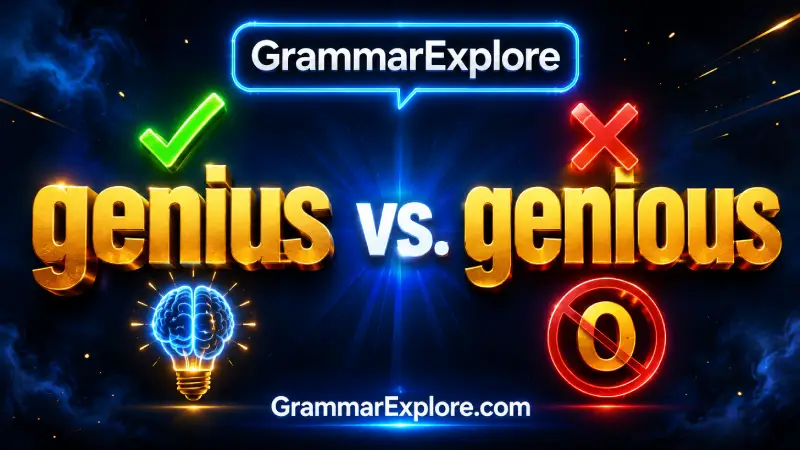
Is a highly intelligent person a genius or a genious? The correct standard spelling is genius. It can describe exceptional intellectual or creative ability, a person who has such ability, or someone who shows remarkable skill in a particular area.
Genious is a common misspelling. English contains many adjectives ending in -ious, including curious, serious, and obvious. This familiar pattern can make genious look correct even though the word genius ends in -ius.
Another word, ingenious, adds to the confusion. However, ingenious is a separate adjective meaning clever, inventive, or skillfully designed. It does not change the spelling of genius.
Use genius in American and British English. Whether you are writing about intelligence, creativity, talent, or a brilliant person, leave out the extra o.
Quick Answer
Genius is the correct spelling. It refers to exceptional intelligence or creativity, a person with remarkable ability, or an outstanding talent for something.
- Correct: Maya is a mathematical genius.
- Correct: The solution shows real genius.
- Incorrect: Maya is a mathematical genious.
Remember: genius ends in -ius, not -ious.
What Is the Difference Between “Genius” and “Genious”?
Genius is the correct spelling. It refers to a person with exceptional intelligence or talent, or to extraordinary ability. Genious is a common misspelling and is not a standard English word.
Examples:
- She is a musical genius.
- Genious is an incorrect spelling.
How Do British People Spell Genius?
British English and American English both use the spelling genius. There is no UK or US spelling difference for this word.
Examples:
- He is a genius at solving puzzles.
- Her genius impressed everyone.
Is Genious a Word?
No. Genious is not a standard English word. The correct spelling is genius.
Examples:
- Correct: genius
- Incorrect: genious
Why Say Ingenious Instead of Genius?
Ingenious and genius have different meanings. Ingenious describes something clever, creative, or inventive, while genius refers to a person with exceptional intelligence or talent.
Examples:
- It was an ingenious solution to the problem.
- She is a genius in mathematics.
Why People Confuse Them
Most writers choose genious because the incorrect form resembles familiar adjectives ending in -ious:
- curious
- serious
- obvious
- previous
- mysterious
The adjective ingenious creates even more confusion. Because ingenious describes a clever person, idea, or invention, writers may assume that genious is the adjective form of genius.
That assumption produces a spelling error. The words follow different spelling patterns:
- genius: exceptional ability or a remarkably gifted person
- ingenious: clever, original, or inventively designed
- genious: not a standard English word
Quick typing can also cause the error. A spellchecker will usually flag genious, but knowing the correct spelling helps you catch it yourself.
Key Differences At A Glance
| Feature | Genius | Genious |
|---|---|---|
| Standard English word | Yes | No |
| Correct spelling | Yes | No |
| Main meaning | Exceptional ability or a highly gifted person | No accepted standard meaning |
| Main part of speech | Noun; also an informal adjective | None in standard English |
| Pronunciation | JEEN-yus or JEE-nee-us | Usually an attempted spelling of genius |
| Plural | Geniuses | No standard plural |
| US and UK usage | Accepted in both | Incorrect in both |
| Example | She is a creative genius. | Incorrect spelling |
Meaning And Usage Difference
What Does Genius Mean?
Genius most commonly refers to exceptional natural intelligence, creativity, or ability.
It can name the ability itself:
- Her music reveals extraordinary genius.
- The invention required technical genius.
- His comic genius shaped the entire performance.
It can also identify a highly intelligent, creative, or talented person:
- The young programmer is a genius.
- Critics described the composer as a musical genius.
- She is a genius at solving complex problems.
The word does not always describe general intelligence. Someone can show exceptional ability in one specific area:
- a mathematical genius
- a scientific genius
- a creative genius
- a marketing genius
- a musical genius
- a comic genius
In casual speech, people also use genius to praise a clever action or idea:
- Whoever designed this storage system is a genius.
- Adding wheels to the table was genius.
- That shortcut is pure genius.
This informal use may involve ordinary cleverness rather than rare intellectual ability.
Is Genious A Word?
Genious is not the accepted spelling for genius in standard modern English. Treat it as a spelling mistake in schoolwork, business communication, articles, emails, and social posts.
Incorrect:
- Her plan was genious.
- He is a computer genious.
- The design shows creative genious.
Correct:
- Her plan was genius.
- He is a computer genius.
- The design shows creative genius.
The rule remains the same in American and British English. Genious is not a regional spelling of genius.
Genius As A Noun
The main grammatical role of genius is a noun.
It may refer to a person:
- Lena is a design genius.
- The team hired a financial genius.
- Everyone called the inventor a genius.
It may also refer to exceptional ability:
- The novel displays literary genius.
- Her genius for organization saved the project.
- His artistic genius appeared at an early age.
The expression a genius for something means a remarkable natural ability to do it:
- She has a genius for explaining difficult ideas.
- He has a genius for choosing the right colors.
- Our manager has a genius for resolving conflicts.
Genius As An Informal Adjective
Modern informal English sometimes uses genius as an adjective meaning brilliant, clever, or original:
- That is a genius idea.
- Her solution was absolutely genius.
- The campaign used a genius marketing strategy.
Major dictionaries recognize this informal use, but some readers still prefer ingenious, brilliant, or clever in formal prose.
More formal alternatives include:
- That is an ingenious idea.
- Her solution was brilliant.
- The campaign used a clever marketing strategy.
Using genius as a noun remains appropriate in every level of writing:
- The idea shows real genius.
- The designer is a genius.
Genius Versus Ingenious
Although the main comparison concerns genius and genious, understanding ingenious helps prevent the misspelling.
Genius is primarily a noun:
- She is a mechanical genius.
- The device shows creative genius.
Ingenious is an adjective meaning clever, inventive, or original:
- She developed an ingenious solution.
- The device uses an ingenious locking system.
Do not remove the first two letters of ingenious and assume the result should be genious. The correct standalone word is genius.
Pronunciation
American speakers commonly pronounce genius as JEEN-yus. A more fully articulated pronunciation may sound like JEE-nee-us.
The word usually has two syllables in natural speech:
JEEN-yus
It begins with the same sound heard at the start of gene. Its ending sounds like yus, not like the clearly separated ending in many -ious adjectives.
The pronunciation may contribute to the misspelling because listeners cannot easily hear whether an o belongs in the word. Memorizing the written ending provides a more reliable guide:
gen-ius
Tone, Context, And Formality
Genius works in formal and informal American English. Its strength depends on the context.
- In formal or academic writing, it usually describes truly exceptional intellectual or creative ability:
- The scientist’s genius transformed the field.
- Scholars continue to study the composer’s musical genius.
In professional writing, it may highlight remarkable skill:
Her strategic genius helped the company recover.
The engineer showed a genius for practical design.
In casual conversation, it often serves as enthusiastic praise:
- You remembered the extra charger? You’re a genius!
- Putting the snacks beside the entrance was genius.
- That idea is genius.
Sometimes people use it humorously or sarcastically:
- I locked my keys in the car. Genius.
- Nice move, genius—you deleted the wrong file.
Sarcasm reverses the literal meaning. The speaker suggests that the action was foolish rather than brilliant.
Genious remains incorrect regardless of tone. Informal writing does not make the extra o acceptable.
Which One Should You Use?
| Context | Best Choice | Why |
|---|---|---|
| A highly intelligent person | Genius | It is the correct noun |
| Exceptional creative ability | Genius | It names remarkable talent |
| Someone skilled in one field | Genius | It can describe specialized ability |
| A clever idea in casual speech | Genius | It has an accepted informal use |
| A clever invention in formal writing | Ingenious | This separate adjective fits naturally |
| School or academic writing | Genius | It is the standard spelling |
| American English | Genius | The spelling is accepted |
| British English | Genius | The spelling does not change |
| Any intended meaning of “brilliant person” | Never genious | The form is a misspelling |
If you mean extraordinary talent, intelligence, or a highly gifted person, choose genius.
When One Choice Sounds Wrong
Adding an o creates an error rather than a different meaning.
Incorrect:
- My sister is a musical genious.
Correct:
- My sister is a musical genius.
Incorrect:
- The architect’s genious appears in every detail.
Correct:
- The architect’s genius appears in every detail.
Incorrect:
- What a genious solution!
Correct:
- What a genius solution!
- What an ingenious solution!
Incorrect:
- Several scientific geniouses attended the conference.
Correct:
- Several scientific geniuses attended the conference.
The error becomes especially noticeable in professional or educational writing because genious is not an accepted alternative.
Common Mistakes And Quick Fixes
Mistake 1: Adding O Before The U
Incorrect:
- genious
Correct:
- genius
Quick fix: Divide the correct spelling into two visual parts:
gen + ius
Mistake 2: Copying The Ending Of Ingenious
Incorrect reasoning:
- ingenious → genious
Correct forms:
- genius
- ingenious
The two words have related ideas, but they are not interchangeable spellings.
Mistake 3: Using Genius And Ingenious Interchangeably
Awkward or incorrect:
- She is an ingenious at mathematics.
Correct:
- She is a genius at mathematics.
Also correct:
- She developed an ingenious mathematical method.
Use genius for the person and ingenious to describe a clever method, plan, object, or person.
Mistake 4: Writing The Plural As Genius’s
Incorrect:
- The group included three genius’s.
Correct:
- The group included three geniuses.
Geniuses is the usual plural when discussing brilliant or talented people. Genius’s is a singular possessive:
- The genius’s latest invention won an award.
Mistake 5: Using Genious As A Regional Variant
Genious is not a British alternative or an informal American variant. Standard English uses genius in every region.
Mistake 6: Confusing Genius With Generous
Genius describes exceptional intelligence or talent:
- She is a creative genius.
Generous means willing to give or share:
- She made a generous donation.
The words differ in spelling, pronunciation, and meaning.
Mistake 7: Overusing Genius
Calling every useful idea genius can weaken the word. In formal writing, choose a more precise alternative when the ability is impressive but not extraordinary:
- clever
- skillful
- inventive
- insightful
- effective
- original
Everyday Examples
Examples Referring To A Person
- The young engineer is a mechanical genius.
- Everyone considers her a genius with numbers.
- Our technician is a genius at finding hidden problems.
- The artist was recognized as a creative genius.
- You fixed it without any instructions? You’re a genius!
- He may be a business genius, but he struggles with technology.
- The chef is a genius with simple ingredients.
- A true genius can make a difficult idea seem clear.
Examples Referring To Ability
- Her genius became clear in her earliest paintings.
- The design demonstrates practical genius.
- His comic genius made the ordinary scene unforgettable.
- The solution required both patience and technical genius.
- She has a genius for bringing people together.
- The film revealed the director’s visual genius.
- His organizational genius kept the event on schedule.
- The beauty of the plan lies in its simplicity and genius.
Informal Examples
- Saving the instructions on your phone was genius.
- That little storage shelf is pure genius.
- Bringing an extra battery was a genius move.
- Whoever added the search feature is a genius.
- This recipe is genius because it uses only one pan.
- Your idea for avoiding traffic was absolutely genius.
Corrected Examples
- Incorrect: My teacher is a genious.
- Correct: My teacher is a genius.
- Incorrect: That was a genious invention.
- Correct: That was an ingenious invention.
- Incorrect: The team hired several geniouses.
- Correct: The team hired several geniuses.
- Incorrect: Her creative genious impressed everyone.
- Correct: Her creative genius impressed everyone.
Dictionary-Style Word Details
Verb
Genius: Not used as a standard verb in American English.
Genious: Not a standard word and therefore has no accepted verb use.
Do not write:
- She geniused her way through the problem.
Instead, write:
- She solved the problem brilliantly.
- She used her ingenuity to solve the problem.
Noun
Genius: A person with extraordinary intelligence or creative ability; exceptional natural talent or intellectual power.
Examples:
- She is a scientific genius.
- The painting displays artistic genius.
Genious: Not a standard noun. Use genius.
Adjective
Genius: Dictionaries recognize an informal adjective use meaning brilliant, clever, or original.
- That was a genius idea.
- His solution was genius.
In formal writing, ingenious, brilliant, or inventive may sound more natural.
Genious: Not an accepted adjective. It is often an incorrect attempt to spell either genius or ingenious.
Synonyms
Synonyms for genius when it refers to a highly gifted person include:
- mastermind
- prodigy
- brilliant thinker
- intellectual
- expert
- virtuoso
Closest alternatives for exceptional ability include:
- brilliance
- intellect
- creativity
- talent
- giftedness
- ingenuity
Possible opposites depend on the context. Words such as fool or idiot contrast with an intelligent person, but they can sound insulting. Ordinary ability or lack of talent may provide a more neutral contrast.
Genious has no synonyms because it has no standard meaning.
Example Sentences
Genius:
- Her scientific genius earned international recognition.
- The new employee has a genius for customer service.
- That simple adjustment was pure genius.
- Several musical geniuses influenced the composer.
- The genius’s notebooks contained hundreds of ideas.
- She designed an ingenious solution to the problem.
Genious:
- Genious is incorrect when you mean a brilliant person or exceptional ability.
- Replace genious with genius in standard writing.
Word History
Genius came into English from Latin. Its earlier senses referred to a guardian or guiding spirit associated with a person or place. Over time, English speakers used it for a person’s distinctive nature, natural ability, extraordinary creative power, and eventually a highly gifted individual.
The familiar modern meaning developed from the idea of an inborn guiding quality or special natural capacity.
Genious did not develop as a standard alternative spelling. Writers likely create it by copying the common -ious adjective pattern or confusing genius with ingenious.
Phrases Containing
Common expressions with genius include:
- creative genius
- artistic genius
- musical genius
- scientific genius
- mathematical genius
- comic genius
- technical genius
- marketing genius
- pure genius
- stroke of genius
- work of genius
- evil genius
- genius for something
- genius at something
- genius idea
- genius move
- genius level
No standard phrases use genious.
Plural And Possessive Forms
The usual plural of genius is geniuses:
- one genius
- two geniuses
- several creative geniuses
When referring to highly intelligent or talented people, geniuses is the correct modern plural.
The specialized plural genii appears mainly in historical senses involving guardian spirits or supernatural beings. Do not normally use it for brilliant people.
Singular possessive:
- the genius’s invention
- the genius’s unusual method
Plural possessive:
- the geniuses’ discoveries
- the young geniuses’ projects
Do not confuse the plural geniuses with the possessive genius’s.
How To Remember Genius vs Genious
Use this simple memory rule:
A genius has an IQ, and genius contains I before U.
Correct sequence:
gen-I-U-s
You can also remember:
Genius ends in -ius, not -ious.
Compare:
- genius
- radius
- stimulus
Although these words do not all follow the same grammatical pattern, their -ius endings can help you remember the appearance of genius.
Finally, separate genius from ingenious:
- A genius creates an ingenious solution.
- The genius is the person.
- The ingenious solution is clever.
FAQs
Is genius or genious correct?
Genius is correct. Genious is a common misspelling and is not an accepted alternative in standard English.
How do you spell genius?
Spell it g-e-n-i-u-s. The ending is -ius, not -ious.
What does genius mean?
Genius can mean extraordinary intellectual or creative ability. It can also refer to a person with exceptional intelligence, originality, or talent.
Is genious an American or British spelling?
No. Genious is incorrect in both American and British English. Both varieties use genius.
What is the plural of genius?
The usual plural is geniuses when referring to highly gifted people:
- The program supports young geniuses.
Genii belongs mainly to older or specialized meanings involving spirits.
What is the difference between genius and ingenious?
Genius is mainly a noun for exceptional ability or a highly gifted person. Ingenious is an adjective meaning clever, original, or inventive.
- She is a genius.
- She created an ingenious device.
Can genius be an adjective?
Yes, genius has an informal adjective use:
- That was a genius idea.
In formal writing, ingenious, brilliant, or clever may sound more appropriate.
Is it genius idea or ingenious idea?
Both can appear, but their tone differs. A genius idea sounds informal and enthusiastic. An ingenious idea is more traditional and means cleverly invented or original.
Is genius’s grammatically correct?
Yes. Genius’s is the singular possessive form:
- The genius’s latest invention
The plural is geniuses, and the plural possessive is geniuses’.
Conclusion
The correct choice in genius vs genious is always genius when you mean exceptional intelligence, creative ability, remarkable talent, or a highly gifted person.
Genious is not a regional variant or a separate modern word. It is usually a misspelling caused by the common -ious ending or confusion with ingenious.
Use these forms:
- genius
- geniuses
- genius’s
- ingenious
Avoid:
- genious
- geniouses
Remember the simplest rule: Genius ends in -ius, with no o.