
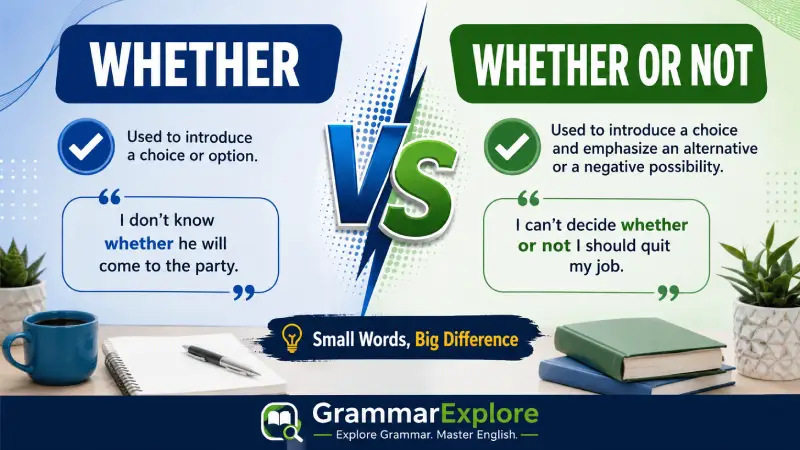
Many English learners wonder whether they should write whether or whether or not. The two expressions are closely related, and in many situations they mean the same thing. However, they are not always equally natural, and there are cases where one is preferred over the other.
Understanding the difference will help you write more clearly, avoid unnecessary words, and choose the expression that best fits your sentence.
Quick Answer
What’s the Difference Between Wether, Weather, and Whether?
Wether, weather, and whether have different meanings. Wether is a castrated male sheep, weather refers to atmospheric conditions, and whether introduces a choice or uncertainty.
What’s the Difference Between “Whether” and “Whether or Not”?
Whether is usually enough to express a choice. Whether or not adds emphasis, but in most cases, whether is the more natural choice.
In most sentences, whether is enough on its own.
Use whether or not only when you want to emphasize that both possible outcomes are included or when omitting or not could make the meaning less clear.
For example:
✅ I don’t know whether she will come.
✅ I don’t know whether or not she will come.
Both sentences are correct, but the first is usually more concise.
| Context | Best Choice | Why |
|---|---|---|
| Most writing | Whether | Clear and concise |
| Emphasizing both possibilities | Whether or not | Adds emphasis |
| Formal writing | Whether | Avoids unnecessary words |
| When clarity is important | Whether or not | Removes possible ambiguity |
Why People Confuse Them
The confusion happens because both expressions often appear in the same situations.
Many writers believe whether or not is always more correct because it sounds more complete. Others think or not should never be used.
Neither belief is accurate.
In many sentences, whether already implies both possibilities, making or not unnecessary.
For example:
We’re discussing whether the proposal should move forward.
The sentence already means that the proposal may or may not move forward.
Adding or not does not change the meaning significantly.
Key Differences At A Glance
| Feature | Whether | Whether Or Not |
|---|---|---|
| Meaning | Expresses uncertainty between alternatives | Expresses the same uncertainty with added emphasis |
| Word Count | Shorter | Longer |
| Everyday Usage | Very common | Common when emphasis is needed |
| Formal Writing | Usually preferred | Used when clarity requires it |
| Grammar | Standard | Standard |
The difference is usually one of style and emphasis rather than grammar.
Meaning And Usage Difference
Whether
Whether introduces a choice, uncertainty, or alternative. It often means if something happens or does not happen.
Examples:
- I haven’t decided whether to apply.
- She asked whether the meeting was canceled.
- We need to know whether the package arrived.
- He couldn’t remember whether he locked the door.
In these examples, whether alone communicates the complete meaning.
Whether Or Not
Whether or not also introduces uncertainty, but it places more emphasis on both possible outcomes.
Examples:
- We’ll go hiking whether or not it rains.
- The event will continue whether or not everyone arrives on time.
- She plans to graduate whether or not she receives financial aid.
In these examples, or not reinforces that the result does not depend on the second possibility.
Sometimes removing or not changes the emphasis or makes the sentence feel less complete.
Tone, Context, And Formality
Both expressions are appropriate in casual conversation, business writing, academic writing, and formal communication.
However, whether is generally the better choice when you want concise, natural writing.
Example:
Please let us know whether you can attend.
This is shorter and sounds natural.
Use whether or not when you intentionally want to stress that both possibilities are included.
Example:
The game will continue whether or not the weather improves.
Here, or not emphasizes that the outcome will stay the same regardless of the weather.
Which One Should You Use?
In most situations, whether is the better choice because it is shorter and already expresses uncertainty.
Use whether when the meaning is clear without adding extra words.
Examples:
- I don’t know whether he’ll accept the offer.
- We’re deciding whether to move.
- She asked whether the report was finished.
- Tell me whether you agree.
Use whether or not when you want to emphasize that both outcomes are included or when the sentence means regardless of the result.
Examples:
- We’ll leave whether or not you’re ready.
- The meeting will happen whether or not everyone attends.
- She plans to apply whether or not she receives a recommendation.
Quick Decision Guide
| Situation | Best Choice |
|---|---|
| General writing | Whether |
| Formal documents | Whether |
| Emails | Whether |
| Academic writing | Whether |
| Emphasizing both possibilities | Whether or not |
| Meaning “regardless” | Whether or not |
When One Choice Sounds Wrong
Sometimes adding or not makes a sentence unnecessarily wordy.
Less natural:
I wonder whether or not he called.
More natural:
I wonder whether he called.
The shorter version sounds smoother because the uncertainty is already clear.
However, there are situations where removing or not changes the emphasis.
Natural:
The race will continue whether or not it rains.
Here, or not highlights that rain will not affect the decision.
Although The race will continue whether it rains is understandable, whether or not more clearly emphasizes “regardless of the weather.”
Common Mistakes (And Quick Fixes)
Mistake 1: Adding “Or Not” Everywhere
Incorrect:
I don’t know whether or not she finished her homework.
Better:
I don’t know whether she finished her homework.
Quick Fix: If or not doesn’t add emphasis or clarity, leave it out.
Mistake 2: Using “If” Instead Of “Whether”
Incorrect:
She asked if we preferred coffee or tea.
Better:
She asked whether we preferred coffee or tea.
Quick Fix: Use whether when presenting alternatives or choices.
Mistake 3: Forgetting “Or Not” When Meaning “Regardless”
Less clear:
We’ll leave whether you’re ready.
Better:
We’ll leave whether or not you’re ready.
Quick Fix: When the meaning is regardless of the outcome, whether or not is usually the stronger choice.
Mistake 4: Repeating Both Expressions
Wordy:
We discussed whether or not we should whether postpone the event.
Better:
We discussed whether we should postpone the event.
Keep the sentence concise.
Everyday Examples
Asking About A Decision
- I haven’t decided whether to buy the car.
- She’s thinking about whether to accept the offer.
Seeking Information
- Please let me know whether you received my email.
- We need to know whether the shipment arrived.
Expressing “Regardless”
- We’ll finish the project whether or not we receive additional funding.
- The ceremony will continue whether or not it rains.
- He plans to travel whether or not his friends join him.
Formal Writing
- The committee will determine whether the proposal meets the requirements.
- The court must decide whether the evidence is admissible.
Everyday Conversation
- I’m not sure whether she’s home.
- We haven’t decided whether to order pizza tonight.
Dictionary-Style Word Details
Verb
- Whether: Not used as a verb in standard English.
- Whether or not: Not a verb. It is a conjunction phrase introducing alternatives or uncertainty.
Noun
- Whether: Not used as a noun.
- Whether or not: Not used as a noun.
Synonyms
Whether
Closest plain alternatives (depending on context):
- if (in some situations)
- regardless of whether
- in case (limited contexts)
Whether Or Not
Closest plain alternatives:
- regardless of whether
- no matter whether
- irrespective of whether
Exact replacements are not always possible because the meaning depends on the sentence.
Example Sentences
Whether
- Tell me whether you’re available tomorrow.
- We need to decide whether to hire another employee.
- Nobody knew whether the train would arrive on time.
Whether Or Not
- The event will continue whether or not you attend.
- She intends to graduate whether or not she receives financial assistance.
- We’ll support the plan whether or not everyone agrees.
Word History
Whether comes from Old English and has long been used to introduce alternatives or uncertainty.
Whether or not developed naturally as an expanded expression that emphasizes both possible outcomes. It does not create a different meaning; it simply adds emphasis when needed.
Phrases Containing
Common expressions include:
- whether to go
- whether to stay
- whether it works
- whether you agree
- whether or not possible
- whether or not necessary
- whether or not available
- whether or not successful
- whether or not approved
- whether or not eligible
Frequently Asked Questions
Is “whether” or “whether or not” correct?
Both are correct. In many sentences, whether is enough. Use whether or not when you want to emphasize both possible outcomes.
Can I remove “or not” after “whether”?
Often, yes. If removing or not doesn’t change the meaning or reduce clarity, whether alone is usually preferred.
When should I use “whether or not”?
Use it when you mean regardless of the outcome or when emphasizing that both possibilities are included.
Is “whether or not” more formal than “whether”?
No. Both are appropriate in formal writing. Whether is often preferred because it is more concise.
Is “whether” the same as “if”?
Not always. Whether is generally preferred when expressing alternatives or choices, while if often introduces conditions.
Can a sentence end with “whether or not”?
Yes, if it is grammatically complete and the context makes the meaning clear.
Which is better for academic writing?
In most cases, whether is preferred because it is concise. Use whether or not only when the added emphasis is necessary.
How can I remember the difference?
Remember this simple rule: If “or not” doesn’t add meaning, leave it out. If it emphasizes “regardless of the result,” keep it.
Conclusion
Both whether and whether or not are grammatically correct, but they are not always equally effective.
In most situations, whether is the better choice because it is concise and naturally expresses uncertainty without extra words.
Use whether or not when you want to emphasize that both possible outcomes are included or when the meaning is regardless of the result.
If you’re unsure which form to choose, remember this simple rule:
- Use whether for most sentences.
- Use whether or not only when the extra emphasis improves clarity or meaning.