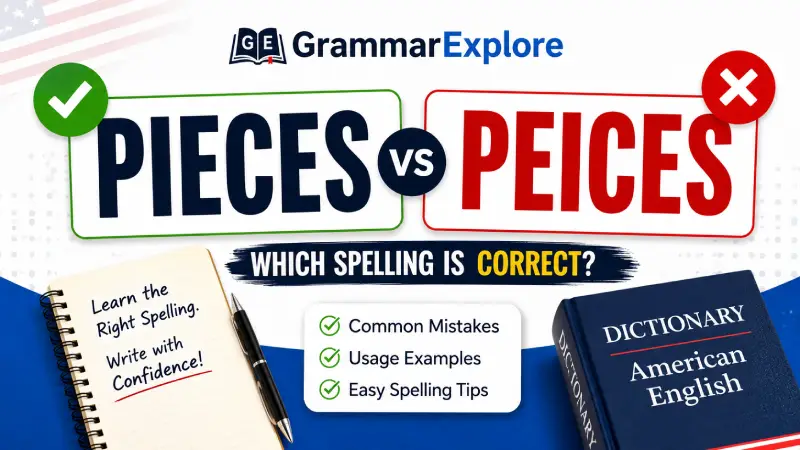
Many English learners, and even native speakers, accidentally type peices instead of pieces. Since the letters i and e appear together, it’s easy to reverse their order while typing or writing quickly.
If you’ve ever wondered whether pieces or peices is correct, the answer is simple:
Pieces is the correct spelling. Peices is always a spelling mistake.
This guide explains why people confuse these words, how to remember the correct spelling, and how to use pieces confidently in everyday English.
Is it Pieces or Peices?
Pieces is the correct spelling. Peices is a common misspelling caused by switching the letters i and e. In American English, always use pieces when referring to parts, portions, or individual items.
Why Do People Spell Pieces as Peices?
Many people write peices by mistake because the i and e are easy to reverse when typing or writing quickly. The correct spelling is always pieces, and peices is not recognized as a standard English word.
How Do You Spell Pieces Correctly?
The correct spelling is pieces (P-I-E-C-E-S). It is the standard spelling in both American and British English. If you write peices, it is considered a spelling error and should be corrected to pieces.
Why Do People Confuse Pieces and Peices?
The confusion usually happens because English contains many words with ie and ei letter combinations.
For example:
- believe
- field
- friend
- receive
- ceiling
Some words use ie, while others use ei, making it difficult to remember which pattern applies.
When writing quickly, many people accidentally switch the letters and type peices instead of pieces.
Fortunately, dictionaries recognize only pieces as the standard spelling.
Pieces vs Peices: At a Glance
| Feature | Pieces | Peices |
|---|---|---|
| Correct spelling | ✅ Yes | ❌ No |
| Found in dictionaries | ✅ Yes | ❌ No |
| Standard English | ✅ Yes | ❌ No |
| Appropriate for school and work | ✅ Yes | ❌ Never |
| Recommended in formal writing | ✅ Always | ❌ Never |
What Does “Pieces” Mean?
The word pieces is the plural form of piece.
It refers to separate parts, portions, objects, or items.
Examples
- The puzzle has 500 pieces.
- She bought three pieces of furniture.
- Please pick up the broken pieces of glass.
- He wrote several pieces for the local newspaper.
- The museum displayed rare art pieces.
In every example above, pieces is the correct spelling.
Is “Peices” Ever Correct?
No.
Peices is not a standard English word.
It appears because people accidentally reverse the letters i and e.
Spell-checkers, dictionaries, and grammar checkers all identify peices as incorrect.
Whenever you write peices, replace it with pieces.
How to Remember the Correct Spelling
A simple trick is to remember the singular word first.
- piece
- pieces
If you know that piece is spelled with ie, the plural naturally becomes pieces.
Another easy reminder:
Piece → Pieces
Never reverse the letters.
Reading books and writing regularly also helps make the correct spelling automatic.
Which Spelling Should You Use?
The answer is simple: always use pieces.
Whether you’re writing an email, a school paper, a text message, or a social media post, pieces is the only correct spelling in standard English.
Use pieces whenever you’re talking about:
- Parts of something larger
- Individual items in a set
- Portions of food
- Works of art, music, or writing
- Chess or game pieces
Avoid peices in every situation because it is simply a spelling error.
Quick Comparison
| Context | Best Choice | Why |
|---|---|---|
| School assignments | Pieces | Standard English spelling |
| Business emails | Pieces | Professional and correct |
| Text messages | Pieces | Correct spelling is still preferred |
| Social media posts | Pieces | Prevents spelling mistakes |
| Books and articles | Pieces | Accepted by all dictionaries |
Common Uses of “Pieces”
The word pieces appears in many everyday situations.
Parts of an Object
- The mirror broke into several pieces.
- She picked up the broken pieces carefully.
Portions of Food
- I’d like two pieces of pizza.
- He ate three pieces of fried chicken.
Clothing
- She bought two pieces of luggage.
- The store sells matching pieces for the bedroom.
Games
- Put all the chess pieces back in the box.
- The children lost several puzzle pieces.
Art and Writing
- The museum displayed famous art pieces.
- She published several opinion pieces this year.
When “Peices” Looks Wrong
Because peices isn’t a real English spelling, it immediately stands out in professional writing.
For example:
❌ The puzzle has 500 peices.
✅ The puzzle has 500 pieces.
❌ I ordered two peices of cake.
✅ I ordered two pieces of cake.
❌ She collected antique chess peices.
✅ She collected antique chess pieces.
Even if readers understand what you mean, using peices can make your writing appear less polished.
Common Mistakes (and Quick Fixes)
Here are some of the mistakes people make most often.
Mistake 1: Reversing the Letters
❌ peices
✅ pieces
Always remember that piece uses ie.
Mistake 2: Typing Too Quickly
Many spelling mistakes happen because people type fast without proofreading.
Take a second look before sending important emails or documents.
Mistake 3: Depending on Memory Alone
English spelling isn’t always predictable.
If you’re unsure, think of the singular form:
piece → pieces
Mistake 4: Ignoring Spell Check
Most spell checkers instantly recognize peices as incorrect.
If you see a red underline, double-check the word before continuing.
Everyday Examples
Here are realistic examples using the correct spelling.
- She cut the paper into small pieces.
- The children scattered puzzle pieces across the floor.
- I ordered two pieces of cheesecake.
- The mechanic replaced several damaged pieces.
- They collected broken pieces of glass after the storm.
- We packed all the chess pieces before leaving.
- The artist created beautiful ceramic pieces.
- He wrote several opinion pieces for the newspaper.
- The toy comes with dozens of small pieces.
- Please keep all the pieces together.
Tips to Remember the Correct Spelling
These simple tricks can help you avoid writing peices.
- Remember the singular word: piece.
- Just add -s to make it plural.
- Never switch the positions of i and e.
- Read your writing before submitting it.
- Let spell check catch typing mistakes, but don’t rely on it completely.
A good memory trick is:
If the singular is piece, the plural is pieces. The letters never change places.
Part 2 of 3 complete. In Part 3, I’ll cover the dictionary-style word details, FAQs, and a strong conclusion.
part 3
Dictionary-Style Word Details
Noun
Pieces
- Part of speech: Plural noun
- Meaning: More than one piece; separate parts, portions, items, or works.
- Examples:
- The vase shattered into many pieces.
- She bought three pieces of artwork.
- We need all the puzzle pieces to finish.
Peices
- Not a noun in standard English.
- It is a common misspelling of pieces and should not be used.
Verb
Pieces
The word pieces is not commonly used as a verb in standard American English. However, the base verb piece can mean to put together or to repair gradually.
Examples:
- We pieced the story together from several interviews.
- She pieced the quilt by hand.
Peices
- Not used as a verb in standard English.
Synonyms
Pieces
Closest plain alternatives depend on the context:
- Parts
- Portions
- Sections
- Fragments
- Chunks
- Segments
- Items
- Components
There is no single antonym because the opposite depends on the meaning. In some contexts, whole or entire object may be appropriate.
Peices
- No synonyms because it is not a correct English word.
Example Sentences
Pieces
- The children found all the missing puzzle pieces.
- Please throw the broken pieces into the trash.
- We ordered four pieces of sushi.
- The museum displayed several rare art pieces.
- The report was divided into three pieces for easier reading.
Peices
❌ The puzzle has many peices.
✅ The puzzle has many pieces.
❌ She bought two peices of cake.
✅ She bought two pieces of cake.
Word History
Pieces
The word pieces comes from the singular noun piece, which has been part of English for centuries. Over time, pieces became the standard plural form and remains the only accepted spelling in modern American English.
Peices
There is no separate word history because peices is simply a misspelling created by reversing the letters i and e.
Phrases Containing
Here are some common expressions that use pieces correctly:
- Pieces of cake
- Pieces of advice (use “pieces of advice,” not “advices”)
- Pieces of information
- Pieces of evidence
- Puzzle pieces
- Chess pieces
- Broken pieces
- Art pieces
- Centerpieces
- Piece by piece
You will not find standard English phrases that correctly use peices.
Frequently Asked Questions
Is pieces or peices correct?
Pieces is the correct spelling. Peices is a misspelling and should always be corrected.
Why do people spell pieces as peices?
People often reverse the letters i and e because many English words use similar letter combinations, making typing mistakes common.
Is peices a real English word?
No. Standard dictionaries do not recognize peices as a correct English word.
Can I use peices in formal writing?
No. Always use pieces in academic, professional, and everyday writing.
How do I remember the correct spelling?
Think of the singular word piece. The plural is simply pieces, with an -s added. The order of the letters never changes.
Does spell check recognize peices?
Yes. Most modern spell checkers flag peices as incorrect and suggest pieces as the correct spelling.
Final Comparison
| Feature | Pieces | Peices |
|---|---|---|
| Correct English spelling | ✅ Yes | ❌ No |
| Found in dictionaries | ✅ Yes | ❌ No |
| Standard American English | ✅ Yes | ❌ No |
| Appropriate for formal writing | ✅ Yes | ❌ Never |
| Should you use it? | ✅ Always | ❌ Never |
Conclusion
The choice between pieces and peices is straightforward. Pieces is the only correct spelling in standard English, while peices is a common misspelling caused by reversing the letters i and e.
Whether you’re writing an email, completing schoolwork, posting on social media, or preparing a professional document, always choose pieces. Using the correct spelling makes your writing clearer, more accurate, and more professional.
Whenever you’re unsure, remember this simple rule:
The singular is piece. The plural is pieces. The letters stay in the same order; you simply add -s.
By keeping this easy tip in mind, you’ll avoid one of the most common English spelling mistakes and write with greater confidence.