
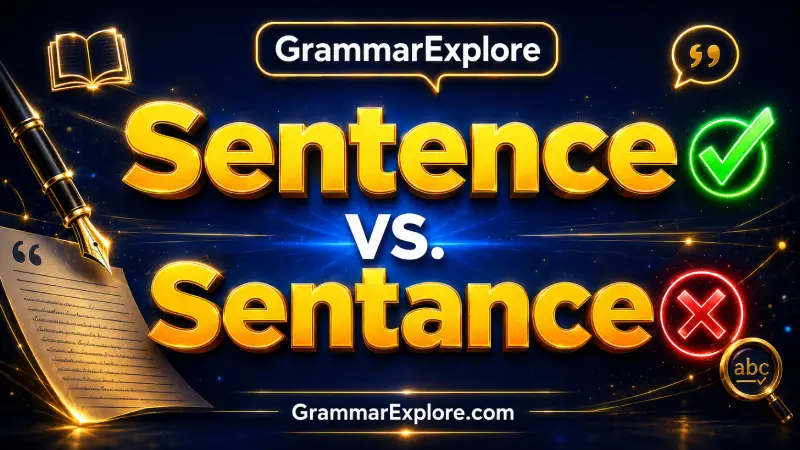
Sentence vs sentance is a spelling question with one clear answer: sentence is the correct spelling. Sentance is a common misspelling and should not be used in standard English.
The word sentence has several related uses. In grammar, it means a group of words that communicates a complete statement, question, command, or exclamation. In legal contexts, it refers to a punishment ordered by a court. It also functions as a verb meaning to officially impose that punishment.
Writers often choose sentance because the unstressed middle syllable can sound like “uh” in natural speech. That pronunciation may make the letter a seem reasonable, but the word is always spelled with an e in both American and British English.
Remember the basic rule: write sentence, not sentance, regardless of its meaning or grammatical role.
Quick Answer
Sentence is the only correct spelling. It can mean a complete grammatical unit or a punishment imposed by a court. As a verb, it means to formally give someone a legal punishment.
- Correct: Please write a complete sentence.
- Correct: The judge announced the sentence.
- Incorrect: Please write a complete sentance.
Always use sentence with an e in the final syllable.
Why People Confuse Them
The confusion usually comes from pronunciation. In American English, sentence is commonly pronounced SEN-tuhns. The vowel in the second syllable is weak and unstressed.
Because this vowel does not sound like a clear e, some writers spell the word according to how they hear it:
- sentance
- sentense
- sentince
These forms may look reasonable, but none is correct.
The spelling can also be confusing because the related verb form changes when -ing is added:
- sentence
- sentenced
- sentencing
The final silent e is removed before -ing, producing sentencing, not sentenceing.
Key Differences At A Glance
| Context | Best Choice | Why |
|---|---|---|
| A complete grammatical unit | Sentence | This is the correct spelling |
| A court-ordered punishment | Sentence | The noun keeps the same spelling |
| Giving someone a legal punishment | Sentence | The word also functions as a verb |
| School assignment | Sentence | Sentance is always incorrect |
| Professional writing | Sentence | It is the only standard form |
| American English | Sentence | Standard US spelling |
| British English | Sentence | The spelling does not change |
| Informal messages | Sentence | Sentance is still a misspelling |
A compact comparison:
- Sentence: Correct standard English word
- Sentance: Incorrect spelling with no separate standard meaning
Meaning And Usage Difference
There is no difference in meaning because sentance is not a standard alternative to sentence.
The correct word sentence has three common uses:
- a complete unit of language
- a punishment given by a court
- the act of officially imposing a legal punishment
Examples:
- This sentence needs a period.
- The defendant received a five-year sentence.
- The judge will sentence the defendant next month.
The spelling remains sentence in each meaning.
What Does Sentence Mean In Grammar?
In grammar, a sentence is a unit of language that expresses a complete statement, question, command, or exclamation.
In writing, a sentence normally begins with a capital letter and ends with appropriate punctuation, such as:
- a period
- a question mark
- an exclamation point
Examples:
- Statement: The library closes at six.
- Question: When does the library close?
- Command: Please close the door.
- Exclamation: What a beautiful day!
Many sentences contain a subject and a verb:
- Maya laughed.
- The children are playing.
- Our new computer works well.
However, some commands have an understood subject:
- Sit down.
- Please wait.
- Call me tomorrow.
The subject in these commands is the understood word you.
What Does Sentence Mean In Law?
In a legal context, a sentence is a punishment ordered by a court after a person or organization has been found guilty of an offense.
Examples:
- The judge imposed a six-month sentence.
- He is serving a prison sentence.
- The court reduced her sentence.
- The offense carries a maximum sentence of ten years.
- The attorney requested a lighter sentence.
The exact type of sentence depends on the case and applicable law. Common expressions include:
- prison sentence
- jail sentence
- life sentence
- suspended sentence
- maximum sentence
- minimum sentence
- five-year sentence
Notice the hyphens in five-year sentence. When a number and time unit work together before a noun, the time unit remains singular.
Correct:
- a five-year sentence
Incorrect:
- a five-years sentence
- a five year sentence
Sentence As A Verb
Sentence can also function as a transitive verb. It means to officially declare the legal punishment for a person or organization found guilty.
Examples:
- The judge will sentence him on Friday.
- The court sentenced her to community service.
- He was sentenced to three years in prison.
- The judge is expected to sentence the defendant next week.
- The court has not yet sentenced them.
Common verb forms include:
- Base form: sentence
- Third-person singular: sentences
- Past tense: sentenced
- Past participle: sentenced
- Present participle: sentencing
Correct:
- The judge is sentencing the defendant today.
Incorrect:
- The judge is sentenceing the defendant today.
- The judge is sentancing the defendant today.
Is Sentance Ever Correct?
No. Sentance is not an accepted spelling in standard American or British English.
Do not use it when referring to:
- grammar
- writing
- punctuation
- legal punishment
- the action of imposing punishment
Incorrect:
- Write a sentance about your family.
- The judge announced the sentance.
- He was sentanced to prison.
Correct:
- Write a sentence about your family.
- The judge announced the sentence.
- He was sentenced to prison.
A spell-checker should normally flag sentance, but writers should still learn the correct spelling instead of depending entirely on automatic correction.
Tone, Context, And Formality
Sentence is a neutral standard word. It appears naturally in formal and informal English.
In School And Academic Writing
Each paragraph should contain several complete sentences.
Revise the final sentence of your introduction.
The student combined the ideas into one sentence.
In Professional Writing
Please shorten the opening sentence.
The final sentence needs clarification.
Rewrite this sentence in plain language.
In Legal Writing And News
The court announced the sentence on Monday.
Prosecutors requested a longer sentence.
The judge sentenced the defendant after the hearing.
In Everyday Conversation
Can you use that word in a sentence?
I couldn’t finish my sentence.
That was a strange sentence.
The spelling never changes according to tone or formality.
Which One Should You Use?
Always use sentence.
Choose sentence when referring to:
- a grammatical statement
- a written question
- a command
- an exclamation
- a court punishment
- the action of imposing a punishment
Never choose sentance. It is not a regional spelling, casual form, historical variant, or British alternative.
Correct:
- Can you write a sentence with this word?
- Her opening sentence caught my attention.
- The judge reduced his sentence.
- The court will sentence him next week.
Incorrect:
- Can you write a sentance with this word?
- Her opening sentance caught my attention.
- The judge reduced his sentance.
- The court will sentance him next week.
When Sentance Looks Wrong
The misspelling becomes especially noticeable in formal or educational writing.
In A School Assignment
Incorrect:
- Every paragraph should include a topic sentance.
Correct:
- Every paragraph should include a topic sentence.
In A Professional Document
Incorrect:
- Please revise the first sentance of the report.
Correct:
- Please revise the first sentence of the report.
In Legal Writing
Incorrect:
- The court imposed a two-year sentance.
Correct:
- The court imposed a two-year sentence.
As A Verb
Incorrect:
- The judge will sentance the defendant tomorrow.
Correct:
- The judge will sentence the defendant tomorrow.
Common Mistakes And Quick Fixes
Mistake: Sentance
Incorrect:
- Write one sentance about your weekend.
Correct:
- Write one sentence about your weekend.
Mistake: Sentense
Incorrect:
- This sentense is too long.
Correct:
- This sentence is too long.
Mistake: Sentince
Incorrect:
- Add punctuation to the sentince.
Correct:
- Add punctuation to the sentence.
Mistake: Sentancing
Incorrect:
- The sentancing hearing begins tomorrow.
Correct:
- The sentencing hearing begins tomorrow.
The noun and adjective sentencing are spelled without the final e from sentence.
Mistake: Sentenceing
Incorrect:
- The judge is sentenceing the defendant.
Correct:
- The judge is sentencing the defendant.
Drop the final silent e before adding -ing.
Mistake: Sentanced
Incorrect:
- He was sentanced last week.
Correct:
- He was sentenced last week.
Sentence vs Phrase
A sentence expresses a complete thought in context. A phrase is a group of related words that does not necessarily communicate a complete thought.
Sentence:
- The dog slept under the table.
Phrases:
- under the table
- the sleepy dog
- after the meeting
- running down the street
A phrase can be part of a sentence:
- The dog slept under the table.
Not every group of words is a complete sentence.
Sentence vs Clause
A clause is a group of words containing a subject and a verb. An independent clause can stand alone as a sentence, while a dependent clause cannot.
Independent clause:
- The meeting ended.
This is also a complete sentence.
Dependent clause:
- Because the meeting ended
This is not complete by itself. It leaves the reader waiting for more information.
Complete sentence:
- Because the meeting ended early, we went out for lunch.
A sentence may contain one clause or several clauses.
Sentence vs Fragment
A sentence fragment is an incomplete group of words presented as though it were a complete sentence.
Fragment:
- Because the bus was late.
Complete sentence:
- We missed the opening because the bus was late.
Fragment:
- Walking through the empty building.
Complete sentence:
- The security guard was walking through the empty building.
Intentional fragments sometimes appear in advertisements, dialogue, and creative writing. In formal writing, however, most fragments should be revised into complete sentences.
The Four Main Types Of Sentences
Declarative Sentence
A declarative sentence makes a statement and usually ends with a period.
- The package arrived this morning.
- Our team won the game.
- I enjoy reading historical novels.
Interrogative Sentence
An interrogative sentence asks a question and ends with a question mark.
- Did the package arrive?
- Where are you going?
- Can you help me?
Imperative Sentence
An imperative sentence gives a command, instruction, request, or advice.
- Close the window.
- Please send me the report.
- Take the next exit.
The subject you is usually understood rather than written.
Exclamatory Sentence
An exclamatory sentence expresses strong emotion and ends with an exclamation point.
- What an incredible performance!
- That was a close call!
- We finally won!
Exclamation points should be used carefully in professional writing.
How To Spell Related Forms
All common forms keep the spelling pattern found in sentence.
| Form | Correct Spelling | Example |
|---|---|---|
| Singular noun | sentence | This sentence is clear. |
| Plural noun | sentences | The paragraph has five sentences. |
| Base verb | sentence | The judge will sentence him. |
| Past tense | sentenced | She was sentenced yesterday. |
| Present participle | sentencing | The sentencing hearing begins Friday. |
| Related adjective | sentential | The study examines sentential structure. |
The final e disappears in sentencing, but the middle vowel remains e.
Pronunciation Of Sentence
In American English, sentence is pronounced approximately:
SEN-tuhns
It has two syllables:
- SEN
- tuhns
The first syllable carries the stress. The second syllable is weak, which is why its vowel may be difficult to hear clearly.
The correct spelling cannot be reliably guessed from pronunciation alone. You must remember that both relevant vowels are e:
s-e-n-t-e-n-c-e
Everyday Examples
Grammar And Writing Examples
- Please write your answer in a complete sentence.
- The first sentence introduces the main idea.
- This sentence contains two independent clauses.
- Add a period at the end of the sentence.
- Her concluding sentence was memorable.
- Try to make the sentence shorter.
- Each sentence should support the paragraph’s main point.
- He used the vocabulary word in a sentence.
- The editor removed an unnecessary sentence.
- That sentence is grammatically correct.
- Begin every sentence with a capital letter.
- The quotation appears in the final sentence.
- Can you combine these two sentences?
- The paragraph contains one incomplete sentence.
- Read the sentence aloud before revising it.
Legal Examples
- The judge announced the sentence in court.
- She received a suspended sentence.
- The court imposed a five-year prison sentence.
- His attorney requested a lighter sentence.
- The defendant will be sentenced next month.
- The judge sentenced him to community service.
- She completed her sentence and was released.
- The offense carries a possible jail sentence.
- The court reduced the original sentence.
- The sentencing hearing lasted two hours.
Dictionary-Style Word Details
Verb
- Sentence: To officially impose a legal punishment on someone or an organization.
- Sentance: Not a standard English verb.
Example:
- The judge will sentence the defendant on Friday.
Noun
- Sentence: A grammatical unit that communicates a statement, question, command, or exclamation; it can also mean a punishment ordered by a court.
- Sentance: Not a standard English noun.
Examples:
- Write a complete sentence.
- He received a short prison sentence.
Synonyms
For a grammatical sentence, exact synonyms are limited. Depending on context, related alternatives include:
- statement
- expression
- utterance
- line
These terms are not interchangeable in every situation.
For a legal sentence, close alternatives may include:
- punishment
- penalty
- judgment
- prison term
For the verb sentence, possible alternatives include:
- condemn
- punish
- impose a penalty on
Each alternative carries its own meaning and should be selected carefully.
Example Sentences
- Sentence: The teacher asked us to write a complete sentence.
- Sentence: Her opening sentence immediately caught my attention.
- Sentence: The judge imposed a ten-year sentence.
- Sentence: The court will sentence him next week.
- Sentance: Incorrect spelling; replace it with sentence.
Word History
The English word sentence came through French from a Latin word connected with feeling, opinion, or judgment. Its meanings developed to include an expressed thought, a grammatical unit, and a court’s judgment.
The form sentance is not a separate historical word with a different modern meaning. It is simply a spelling error.
Phrases Containing
Common grammar phrases include:
- complete sentence
- topic sentence
- opening sentence
- concluding sentence
- simple sentence
- compound sentence
- complex sentence
- declarative sentence
- interrogative sentence
- imperative sentence
- exclamatory sentence
- sentence fragment
- sentence structure
- sentence example
Common legal phrases include:
- prison sentence
- jail sentence
- life sentence
- death sentence
- suspended sentence
- maximum sentence
- minimum sentence
- serve a sentence
- impose a sentence
- reduce a sentence
- sentencing hearing
All these expressions use sentence, never sentance.
How To Remember The Correct Spelling
Remember that sentence contains the word ten:
sen-TEN-ce
You can use this memory sentence:
Write ten words in a sentence.
Another useful pattern is:
s + ent + ence = sentence
You can also remember that the word contains three e’s:
sEntEncE
There is no a anywhere in sentence.
Frequently Asked Questions
Is it sentence or sentance?
Sentence is correct. Sentance is a misspelling and should be corrected in academic, professional, legal, and informal writing.
Why do people spell sentence as sentance?
The second syllable has a weak vowel sound in natural speech. Because it may sound like “uh,” some writers incorrectly choose a instead of e.
How do you spell sentence in American English?
The American English spelling is sentence. The same spelling is used in British English.
What are the two main meanings of sentence?
In grammar, a sentence is a unit of words expressing a complete statement, question, command, or exclamation. In law, a sentence is a punishment ordered by a court.
Can sentence be a verb?
Yes. As a verb, sentence means to officially impose a legal punishment.
- The judge will sentence him tomorrow.
- She was sentenced to community service.
Is sentance an alternative British spelling?
No. Sentance is not a British spelling. Both American and British English use sentence.
What is the plural of sentence?
The plural is sentences.
- This paragraph has one sentence.
- That paragraph has five sentences.
Is it sentenced or sentanced?
Sentenced is correct. Sentanced is a misspelling.
- Correct: The defendant was sentenced on Monday.
- Incorrect: The defendant was sentanced on Monday.
Is it sentencing or sentenceing?
Sentencing is correct. Drop the final silent e before adding -ing.
- sentence + ing = sentencing
Does every sentence need a subject and verb?
Most complete sentences contain a subject and verb. Commands may have an understood subject, as in “Sit down,” where the subject you is implied.
Conclusion
The choice between sentence vs sentance has one straightforward answer: sentence is correct, and sentance is a spelling mistake.
Use sentence for a complete grammatical unit, a punishment imposed by a court, or the act of officially assigning that punishment. The spelling remains the same in American and British English.
Remember:
- Correct: sentence
- Incorrect: sentance
- Past tense: sentenced
- Present participle: sentencing
- Plural: sentences
A simple memory trick is to notice the three e’s in sEntEncE. If you see an a, correct it before publishing.


