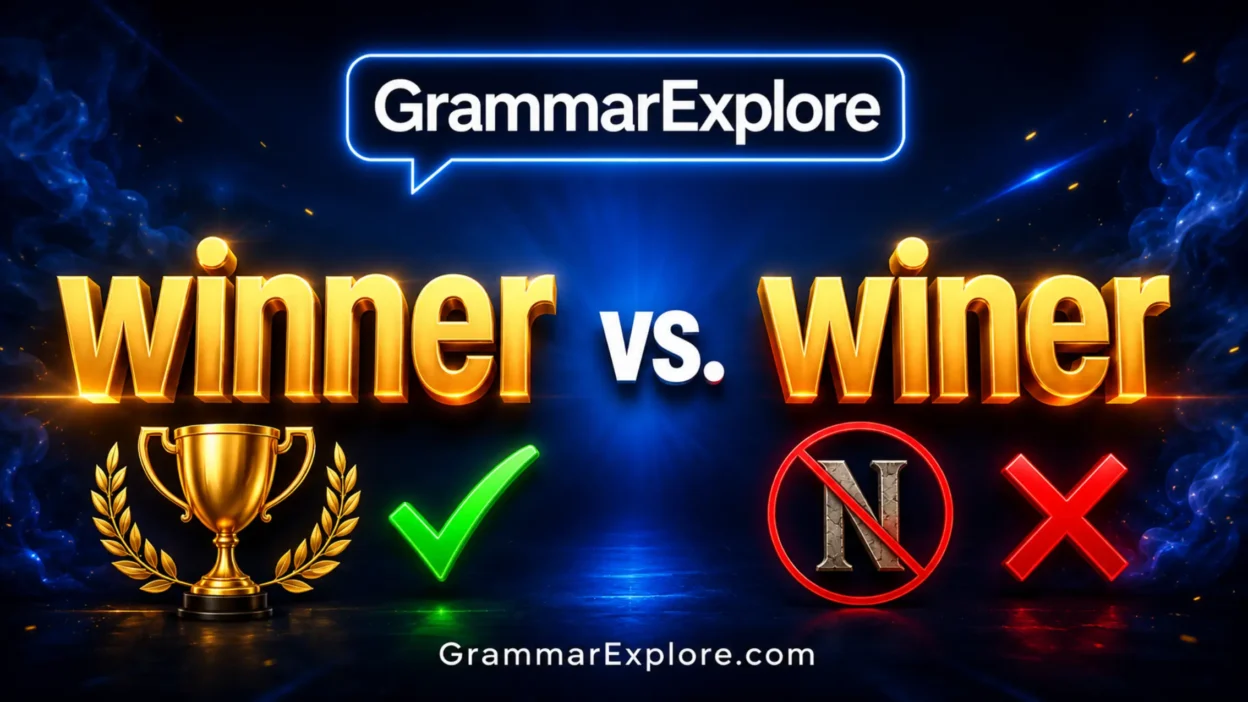
Is the person who wins a contest the winner or the winer? In standard English, winner is the correct spelling. It refers to a person, team, animal, or entry that wins a competition, election, game, or prize.
The spelling winer is usually a mistake when the intended meaning is “someone who wins.” The double n in winner follows a common spelling pattern: when English adds -er to the short, one-syllable verb win, it doubles the final consonant.
Although winer has appeared as a rare term connected with wine and also exists as a surname, those uses do not make it an alternative spelling of winner. If you are writing about victory, success, or someone receiving a prize, use winner.
Quick Answer
Use winner for a person or thing that wins:
- Ava was the winner of the spelling contest.
- The judges announced the winning team.
Do not use winer with this meaning:
- Incorrect: Ava was the winer.
- Correct: Ava was the winner.
The spelling comes from win + -er = winner, with two n’s.
Is It Winer or Winner?
Winner is the correct spelling for a person who wins a game, competition, or contest. Winer is a real word, but it usually refers to a person who makes or sells wine and is much less common.
Examples:
- She was the winner of the race.
- The winer produced high-quality wine.
What Does “Winer” Mean?
Winer is a noun that refers to a person who makes, sells, or deals in wine. It is uncommon in modern English, where winemaker is more widely used.
Examples:
- The winer supplied local restaurants.
- The family worked as winers for generations.
Who Is a Winer?
A winer is someone who makes or sells wine. If you mean a person who wins a competition, the correct word is winner.
Examples:
- The winner received a gold medal.
- The winer owned a small vineyard.
Which Is Correct, Wining or Winning?
Both wining and winning are correct, but they have different meanings. Winning is the present participle of win, while wining relates to serving or entertaining someone with wine.
Examples:
- She is winning the match.
- They were wining and dining their guests.
Why People Confuse Them
Most people confuse these forms because winer looks as though it could be the simple result of adding -er to win. However, English spelling often doubles a final consonant when a suffix beginning with a vowel follows a short, stressed vowel.
Consider these examples:
- win + er = winner
- run + er = runner
- swim + er = swimmer
- big + er = bigger
- hot + er = hotter
Without the second n, winer also resembles a word formed from wine. That visual connection changes its likely pronunciation and meaning.
Typing errors cause many cases of winer as well. Someone may press n only once while writing quickly. A spellchecker may catch the mistake, but writers should still know which form expresses victory.
Key Differences At A Glance
| Feature | Winner | Winer |
|---|---|---|
| Standard meaning | A person or thing that wins | A rare term associated with wine |
| Correct for someone who wins? | Yes | No |
| Common in modern US English? | Yes | No |
| Formation | win + -er | Usually understood as wine + -er |
| Pronunciation | WIN-er | Usually WINE-er if used |
| Example | The winner received a trophy. | Not the standard word for a victor |
The practical distinction is simple: winner relates to winning, while the rare form winer relates to wine, not victory.
Meaning And Usage Difference
What Does Winner Mean?
Winner is a countable noun. Its primary meaning is a person, team, animal, or entry that wins a contest or competition.
Examples include:
- the winner of an election
- a tournament winner
- an award winner
- the winning horse
- the winner of a scholarship
- a prize winner
The word can refer to a thing as well as a person. A recipe, product, plan, or performance may be called a winner when it succeeds or receives strong approval.
For example:
- The new menu item is already a winner with customers.
- Her proposal looks like a winner.
- That final design was the clear winner.
In tennis and similar sports, winner can also name a shot that scores because the opponent cannot return it:
- She ended the match with a forehand winner.
All these meanings share the idea of success.
What Does Winer Mean?
Winer is not the standard spelling for a person who wins. In most everyday writing, it appears because the writer accidentally left out the second n in winner.
Some historical and specialized dictionaries record winer as a rare noun associated with wine, such as a person who drinks wine. It may also appear in narrowly defined commercial or legal language concerning wine production. These uses remain uncommon in modern American English.
Winer also exists as a family name. When it serves as a surname, it should retain the spelling used by that person or family.
These limited uses do not make the following sentence correct:
- Incorrect: Carlos was the winer of the race.
- Correct: Carlos was the winner of the race.
When the meaning involves winning, always write winner.
Why Does Winner Have Two N’s?
The verb win has one syllable, one short vowel sound, and one final consonant. When a vowel-starting suffix such as -er or -ing follows this pattern, English normally doubles the final consonant.
Therefore:
- win + er = winner
- win + ing = winning
- win + able = winnable
The second n preserves the short vowel sound in win. Compare winning with wining, which comes from wine and has a different vowel sound.
This distinction helps readers recognize the intended base word:
- winner comes from win
- winer, in its rare literal use, comes from wine
Pronunciation
Winner is pronounced WIN-er. Its first syllable sounds like win, in, or pin.
The rare word winer would normally be pronounced WINE-er because it comes from wine. Its first syllable rhymes with line and fine.
Therefore, the two forms are not true homophones:
- winner: WIN-er
- winer: WINE-er
If you mean someone who wins, the word should sound like WIN-er and contain two n’s.
Tone, Context, And Formality
Winner works in formal, informal, academic, professional, and conversational English. The surrounding sentence determines its tone.
In a formal announcement:
- The committee will announce the scholarship winner on Friday.
- In sports reporting:
- The division winner will advance to the playoffs.
- In casual conversation:
That chocolate cake is a real winner.
In business writing:
Customer testing identified the blue package as the clear winner.
The word can sound neutral when it identifies the result of a competition. It can also sound enthusiastic when it praises a person, plan, or product.
Winer does not work as an informal or regional alternative to winner. A casual message may contain the misspelling, but informality does not make it correct. Use winner in text messages, social posts, school assignments, business documents, and published writing.
Which One Should You Use?
| Context | Best Choice | Why |
|---|---|---|
| A person wins a race | Winner | It names the person who won |
| A team wins a championship | Winner | It identifies the successful team |
| Someone receives an award | Winner | It refers to the selected recipient |
| A product becomes successful | Winner | It can describe a successful thing |
| A sports shot cannot be returned | Winner | This is an established sports meaning |
| A rare reference to a wine drinker | Winer | This uncommon form derives from wine |
| A person’s family name is Winer | Winer | Proper names keep their established spelling |
For nearly every ordinary comparison involving these spellings, winner will be the right choice.
Ask yourself one question: Does the sentence involve winning?
If the answer is yes, write winner.
When One Choice Sounds Wrong
Replacing winner with winer produces an obvious spelling error when the sentence refers to success or victory.
Incorrect:
- The winer will receive two free tickets.
Correct:
- The winner will receive two free tickets.
Incorrect:
- Our team was declared the regional winer.
Correct:
- Our team was declared the regional winner.
Incorrect:
- This product could become a market winer.
Correct:
- This product could become a market winner.
The error can also appear in compounds:
- Incorrect: award-winer
- Correct: award winner
- Incorrect: prize-winer
- Correct: prizewinner or prize winner
- Incorrect: breadwiner
- Correct: breadwinner
The correct form retains the double n even when another word joins it.
Common Mistakes And Quick Fixes
Mistake 1: Adding -er Without Doubling the N
Incorrect:
- Mia is the winer of the art contest.
Correct:
- Mia is the winner of the art contest.
Quick fix: Break the word into win + n + er.
Mistake 2: Assuming Winer Is an Informal Spelling
Incorrect:
- Congrats to today’s winer!
Correct:
- Congrats to today’s winner!
Informal writing may allow contractions, abbreviations, or a relaxed tone. It does not change the standard spelling of winner.
Mistake 3: Writing Winer Because Win Has One N
The base verb has one n, but the derived noun has two:
- win
- wins
- won
- winning
- winner
This change follows the consonant-doubling pattern.
Mistake 4: Confusing Winner With Winer in Pronunciation
Winner begins with the short vowel in win. A word derived from wine would have the long vowel sound heard in fine.
Say the sentence aloud:
- The WIN-er accepted the medal.
If you pronounce the word with win, spell it with two n’s.
Mistake 5: Dropping an N in Related Words
The same spelling applies to common compounds and possessive forms:
- winners
- winner’s trophy
- winners’ circle
- award winner
- prizewinner
- breadwinner
- winner-take-all
Check these longer forms carefully because the double n can be easy to overlook.
Everyday Examples
Winner In Competitions
The winner crossed the finish line three seconds ahead of everyone else.
Each category winner received a certificate and a cash prize.
Voters will choose the winner during the final round.
The tournament winner will represent the state next month.
The judges selected Jordan as the overall winner.
Last year’s winner returned to present the trophy.
No one could predict the winner before the final vote.
The winner of the raffle donated the prize to a local shelter.
Winner In Sports
The division winner earned a place in the postseason.
Her final serve set up a clean backhand winner.
The game winner came with two seconds left on the clock.
Coaches congratulated the winner and encouraged the other finalists.
The defending winner struggled during the opening round.
Winner For A Successful Idea Or Product
The smaller laptop was a winner with frequent travelers.
Everyone agreed that the updated logo was the clear winner.
This quick dinner recipe is a winner for busy families.
The new safety feature could make the model a winner.
His practical proposal looks like a winner.
That color combination is a definite winner.
Winner In School And Work
- Our teacher will announce the essay winner tomorrow.
- The hiring panel considered all three candidates, but one emerged as the clear winner.
- The winning department received a team lunch.
- Customer feedback helped us choose the winner.
- The science fair winner designed a low-cost water filter.
Dictionary-Style Word Details
Verb
- Winner: Not commonly used as a verb in standard US English. Use win for the action: “The team hopes to win.”
- Winer: Not commonly used as a verb. Wine can function as a verb in expressions about drinking or entertaining someone with wine and food.
Do not write “She winnered the contest.” Write “She won the contest.”
Noun
- Winner: A person, team, animal, or thing that wins. It can also describe something considered successful or appealing.
- Winer: A rare noun historically connected with drinking or producing wine. It is not the standard noun for someone who wins.
Examples:
- The winner held up the trophy.
- The new sandwich has become a winner with customers.
Adjective
Neither winner nor winer normally functions as a standard adjective.
English often places the noun winner before another noun in expressions such as winner selection or winner announcement. In these structures, winner modifies the following noun, but dictionaries still classify its main role as a noun.
Use winning when you need the usual adjective:
- a winning team
- a winning smile
- the winning entry
- a winning strategy
Synonyms
Synonyms for winner depend on the context.
For a person who wins:
- champion
- victor
- first-place finisher
- prizewinner
- titleholder
For a successful idea or product, the closest plain alternatives include:
- success
- hit
- standout
- strong choice
Possible opposites include:
- loser
- losing entry
- unsuccessful choice
However, runner-up is not an exact opposite. A runner-up performs well but finishes behind the winner.
Because winer has no common modern meaning related to victory, it has no relevant synonyms in this comparison.
Example Sentences
Winner:
- The contest winner will appear in next month’s magazine.
- Our coach praised both the winner and the runner-up.
- The red package was the clear winner in customer testing.
- She hit a forehand winner down the line.
- Every regional winner will compete in the national event.
- The judges chose a winner after reviewing 200 entries.
Winer:
- Winer is incorrect when you mean someone who wins.
- The family name Winer should retain its established spelling.
- A rare historical use of winer may refer to someone associated with wine.
Word History
Winner developed from the verb win and the noun-forming suffix -er. This suffix often identifies a person or thing that performs an action. A runner runs, a teacher teaches, and a winner wins.
The double n reflects the spelling pattern used when a suffix beginning with a vowel follows a one-syllable word with a short vowel and a final consonant.
Winer, in its rare dictionary use, comes from wine plus -er. Because the final silent e in wine disappears before the suffix, the result has one n. This formation gives it a different meaning and pronunciation from winner.
Phrases Containing
Common expressions with winner include:
- clear winner
- overall winner
- award winner
- prizewinner
- contest winner
- race winner
- game winner
- division winner
- likely winner
- deserving winner
- eventual winner
- winner’s circle
- winner takes all
- pick a winner
- come out a winner
- emerge as the winner
- breadwinner
The rare form winer does not appear in common expressions about success or competition.
How To Remember Winner vs Winer
Use this short memory aid:
A winner wins, so keep “win” inside “winner.”
Then remember that winner needs one extra n before -er:
WIN + N + ER = WINNER
You can also connect the two n’s with two signs of success:
- one n for the win
- one n for the next round
The first method reflects the actual spelling pattern, while the second gives you an easy visual reminder.
Another useful comparison is:
- win → winner
- run → runner
- swim → swimmer
If you remember runner and swimmer, spelling winner becomes much easier.
FAQs
Is winner or winer correct?
Winner is correct when you mean a person, team, animal, or thing that wins. Winer is not an alternative spelling with that meaning.
How do you spell winner?
Spell it w-i-n-n-e-r. The word has two n’s.
Why does winner have two n’s?
English doubles the final n in win before adding the vowel-starting suffix -er. Therefore, win + -er becomes winner.
Is winer a real word?
Some dictionaries record winer as a rare noun related to wine, and it also occurs as a surname. However, it does not mean someone who wins.
Can I use winer for someone who wins?
No. Use winner for someone who wins a race, contest, election, game, award, or prize.
Are winner and winer pronounced the same way?
No. Winner is pronounced WIN-er. The rare wine-related form winer would normally be pronounced WINE-er.
What is the plural of winner?
The plural is winners:
- Both winners advanced to the final round.
What is the possessive form of winner?
Use winner’s for one winner and winners’ for more than one:
- The winner’s medal
- The winners’ photographs
Is winner only used for people?
No. It can refer to a person, team, animal, object, plan, design, or other successful choice:
- The judges selected the blue design as the winner.
What is the difference between winner and winning?
Winner is primarily a noun that names the successful person or thing. Winning can describe the act of achieving victory or function as an adjective:
- The winner accepted the trophy.
- The winning team celebrated.
Conclusion
Use winner when referring to a person, team, animal, or thing that wins. It can also describe a successful idea, product, performance, or choice.
Winer is not a valid alternative spelling with that meaning. It survives only in rare wine-related usage and as a proper name.
Remember the basic formation:
win + -er = winner
If your sentence involves victory, success, a prize, or first place, choose winner with two n’s.