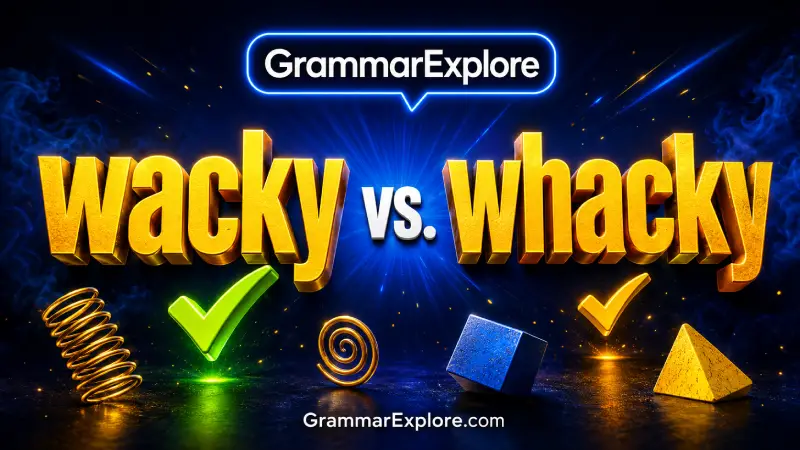
Both wacky and whacky are recognized spellings, but wacky is the preferred form in modern American English. It describes someone or something as amusingly strange, silly, eccentric, or unpredictable.
Whacky has the same meaning. Some dictionaries list it as a valid variant, but it appears much less often and may look like a spelling mistake. It does not carry a separate meaning or a different level of formality.
For example, most American writers would choose a wacky idea, a wacky costume, or a wacky comedy. Use whacky only when you need to preserve an official name, title, quotation, or deliberate spelling choice.
Quick Answer
Use wacky in almost every situation:
- The movie has a wacky sense of humor.
- She wore a wacky costume to the party.
Whacky is a less common variant with the same meaning:
- The movie has a whacky sense of humor.
The second sentence is not necessarily incorrect, but wacky looks more natural to most US readers.
What Does “Whacky” Mean?
Whacky is a variant spelling of wacky, which means strange, unusual, silly, or amusingly odd. Wacky is the more common spelling in modern English.
Examples:
- He has a wacky sense of humor.
- The movie has a whacky storyline.
What Does “Whacky” Mean in Slang?
In slang, whacky usually means something that is crazy, bizarre, or unexpected. It can describe a person, idea, style, or situation that seems unusual.
Examples:
- That is a wacky idea.
- His wacky jokes made everyone laugh.
Is Whack the Same as Wacky?
No. Whack and wacky have different meanings. Wacky means unusual or silly, while whack can mean a hit, a try, or (in slang) something strange or poor-quality depending on the context.
Examples:
- She wore a wacky outfit.
- He gave the ball a whack.
What Is Wackie?
Wackie is not a standard English spelling. It may appear as an informal variation or a name, but the correct spelling for the adjective meaning strange or silly is wacky.
Examples:
- Correct: wacky
- Incorrect: wackie (for standard English)
Why People Confuse Them
Writers often connect whacky with the word whack, which means to hit something sharply. Because whack contains an h, adding -y and writing whacky may seem logical.
However, modern American usage strongly favors wacky without the h.
Pronunciation adds to the confusion. Both spellings usually sound like:
WAK-ee
Because speakers do not normally pronounce the spellings differently, hearing the word does not reveal whether it contains an h.
The safest memory rule is simple:
Use wacky for strange, silly, or playfully unusual.
Key Differences At A Glance
| Feature | Wacky | Whacky |
|---|---|---|
| Standard Dictionary Form | Yes | Yes, as a variant |
| Preferred In US English | Yes | No |
| Meaning | Amusingly strange or eccentric | Same meaning |
| Pronunciation | WAK-ee | Usually WAK-ee |
| Tone | Informal and playful | Informal and playful |
| Best For Edited Writing | Yes | Usually no |
| Comparative | Wackier | Whackier, but less common |
| Superlative | Wackiest | Whackiest, but less common |
The difference concerns spelling preference and frequency. It does not involve meaning.
Meaning And Usage Difference
What Does Wacky Mean?
Wacky is an informal adjective that describes something unusual, silly, eccentric, or amusingly unpredictable.
- The show features a group of wacky characters.
- We tried a wacky idea for the school fundraiser.
- His office contains several wacky decorations.
- The game has a wacky set of rules.
The word often suggests that the unusual quality feels entertaining rather than frightening or harmful.
For example:
- a wacky comedy
- a wacky costume
- a wacky invention
- a wacky personality
- a wacky adventure
Depending on context, the word can also express mild criticism:
- That sounds like a wacky conspiracy theory.
- The proposal includes several wacky assumptions.
In those sentences, wacky suggests that the idea seems unreasonable or hard to take seriously.
What Does Whacky Mean?
Whacky means the same thing as wacky. It does not describe a stronger, stranger, or more humorous quality.
- Preferred: The artist has a wacky style.
- Less common: The artist has a whacky style.
Both sentences communicate the same idea. The first uses the spelling most readers expect.
Pronunciation Of Wacky And Whacky
American speakers usually pronounce both words as:
WAK-ee
The first syllable rhymes with back, and the second sounds like the end of happy.
The spelling whacky does not require a separate h sound. In ordinary speech, listeners usually cannot tell which spelling a speaker has in mind.
Since pronunciation offers little help, remember the preferred written form:
w-a-c-k-y
Tone, Context, And Formality
Both spellings have an informal tone. Wacky works best in casual, humorous, creative, or conversational writing.
Common contexts include:
- entertainment reviews
- advertising
- social posts
- children’s content
- comedy
- informal conversations
- descriptions of clothes or decorations
Examples:
- The episode follows the family on a wacky road trip.
- Our team suggested a wacky theme for the event.
- The store sells colorful, wacky gifts.
The word may sound too casual or imprecise in legal, academic, medical, or highly formal business writing.
Informal:
- The report produced a wacky result.
More precise:
- The report produced an unexpected result.
Informal:
- The manager proposed a wacky strategy.
More formal:
- The manager proposed an unconventional strategy.
Choose a more exact word when the situation requires a serious tone.
Which One Should You Use?
| Context | Best Choice | Why |
|---|---|---|
| Everyday US writing | Wacky | It is the preferred spelling |
| School assignments | Wacky | Readers recognize it immediately |
| Entertainment writing | Wacky | It suits humorous, informal descriptions |
| Business marketing | Wacky | Use it when a playful tone fits |
| Formal reports | A more precise word | “Wacky” may sound too casual |
| An official title using “Whacky” | Whacky | Preserve the official spelling |
| A direct quotation | Original spelling | Exact quotations retain their wording |
| An ordinary sentence using “whacky” | Wacky | The shorter spelling is more familiar |
If you have no special reason to keep the h, choose wacky.
When One Choice Sounds Wrong
Whacky may attract attention for the wrong reason in ordinary US writing:
- Less natural: The restaurant has a whacky interior.
- Preferred: The restaurant has a wacky interior.
- Less natural: She suggested a whacky marketing idea.
- Preferred: She suggested a wacky marketing idea.
- Less natural: That was the whackiest ending possible.
- Preferred: That was the wackiest ending possible.
However, do not change the spelling when it belongs to an official name:
- The event is officially called “Whacky Hat Wednesday.”
In that case, replacing Whacky could make the name inaccurate.
Also avoid confusing wacky with whack:
- Wacky describes something strange or silly.
- Whack usually means to hit something sharply.
Examples:
- The show has a wacky plot.
- He used a stick to whack the ball.
Common Mistakes And Quick Fixes
Mistake: Treating Whacky As A Different Meaning
- Incorrect idea: Wacky means funny, while whacky means irrational.
- Correct explanation: Both spellings have the same meaning.
Mistake: Calling Whacky Completely Incorrect
Saying that whacky is never a word goes too far. Dictionaries recognize it as a variant. However, wacky remains the better default for US writing.
Mistake: Mixing The Spellings
- Inconsistent: The wacky show featured several whacky characters.
- Consistent: The wacky show featured several wacky characters.
Use one style throughout ordinary prose.
Mistake: Adding H Because Whack Has One
The related spelling whack does not require the preferred adjective to keep the h:
- whack
- wacky
- wackier
- wackiest
- wackiness
Mistake: Using Wacky In Serious Writing
- Too casual: The patient showed a wacky response to the medication.
- Better: The patient showed an unexpected response to the medication.
A more precise word protects the serious tone.
Comparative And Superlative Forms
The preferred comparative form is wackier. Use it when comparing two people, things, or ideas:
- This episode is wackier than the last one.
- Her second costume looked even wackier.
The preferred superlative form is wackiest. Use it for the highest degree:
- That was the wackiest idea in the meeting.
- He chose the wackiest shirt in the store.
The spelling changes as follows:
- wacky
- wackier
- wackiest
Change the final y to i before adding -er or -est.
The forms whackier and whackiest exist alongside whacky, but they remain less common. Use wackier and wackiest in standard US writing.
Everyday Examples
Examples With Wacky
- The comedian created several wacky characters.
- That is a wacky idea, but it might work.
- She wore wacky socks to the office.
- The movie combines action with wacky humor.
- We saw a wacky sculpture outside the museum.
- His wacky dance made everyone laugh.
- The restaurant uses wacky names for its desserts.
- They planned a wacky team-building activity.
- The book follows a wacky group of space travelers.
- Her wacky personality makes the show entertaining.
- The game becomes wackier with each round.
- That was the wackiest commercial of the night.
Examples Discussing Whacky
- Her draft used “whacky,” but the editor preferred “wacky.”
- The poster kept “Whacky Weekend” because it was the event’s official name.
- Some dictionaries list “whacky” as a variant of “wacky.”
- The old shop sign reads “Whacky Gifts.”
These examples preserve whacky because they discuss, quote, or reproduce the spelling.
Choosing A More Precise Alternative
Wacky covers several shades of meaning. A more specific word may communicate your idea better.
| Alternative | Best Use |
|---|---|
| Goofy | Silly and harmless |
| Zany | Energetic, comic, and exaggerated |
| Quirky | Unusual in a charming way |
| Eccentric | Unconventional, especially about a person |
| Offbeat | Different from what people normally expect |
| Absurd | Illogical or ridiculous |
| Bizarre | Extremely strange |
| Unconventional | Different from accepted customs |
| Unexpected | Surprising but not necessarily silly |
| Irrational | Not based on clear reasoning |
Compare:
- She wore a wacky outfit.
- She wore a quirky outfit.
- She wore a bizarre outfit.
The first sounds playful. The second may sound charming. The third suggests something much stranger.
Dictionary-Style Word Details
Verb
- Wacky: Not commonly used as a verb in standard US English.
- Whacky: Not commonly used as a verb.
Do not confuse these adjectives with the verb whack:
- He whacked the piñata with a stick.
Noun
- Wacky: Not normally used as a noun in standard modern English.
- Whacky: Not normally used as a noun.
The usual noun form is wackiness:
- The show’s wackiness appeals to younger viewers.
A wacky person uses the word as an adjective because it describes the noun person.
Synonyms
Close alternatives for both wacky and whacky include:
- zany
- goofy
- quirky
- eccentric
- offbeat
- silly
- odd
- unconventional
These words do not match every meaning perfectly.
Helpful opposites include:
- ordinary
- conventional
- normal
- predictable
- serious
- sensible
Example Sentences
Wacky:
- The children invented a wacky new game.
- His wacky tie became a conversation starter.
- The comedy has a fast and wacky plot.
- This plan sounds wacky, but the numbers support it.
Whacky:
- “Whacky” is a less common spelling of “wacky.”
- The business kept “Whacky Wheels” as its registered name.
Word History
The spelling has a historical connection with whack and older informal expressions. That connection helps explain why whacky developed with an h.
Modern usage gradually favored wacky as the main spelling. Dictionaries now commonly present wacky first and identify whacky as an alternative or less common form.
The two spellings do not represent different meanings or separate word histories in current usage.
Phrases Containing
Common expressions with wacky include:
- wacky idea
- wacky character
- wacky comedy
- wacky costume
- wacky adventure
- wacky invention
- wacky personality
- wacky sense of humor
- weird and wacky
- wild and wacky
- wacky world
- wacky plan
The same phrases can technically use whacky, but the spelling will look less familiar to most American readers.
Frequently Asked Questions
Is wacky or whacky correct?
Both spellings appear in dictionaries, but wacky is the preferred form. Whacky is a less common variant with the same meaning.
Is whacky a real word?
Yes. Whacky is a recognized variant of wacky. However, many readers may mistake it for an error, so use wacky unless you have a specific reason not to.
Do wacky and whacky mean the same thing?
Yes. Both describe something or someone as amusingly strange, silly, eccentric, or irrational. There is no reliable difference in meaning.
Is whacky the British spelling?
Not exactly. Whacky may appear in British writing, but it is not a direct regional equivalent like colour and color. Wacky remains widely accepted in both US and UK English.
What are the comparative forms of wacky?
The preferred forms are wackier and wackiest:
- This idea is wackier.
- That was the wackiest costume.
Is wacky appropriate for formal writing?
Usually, wacky sounds informal. In formal writing, choose a more precise alternative such as unconventional, unexpected, eccentric, or irrational.
Conclusion
Both wacky and whacky are accepted spellings, but wacky is the clear choice for modern American English.
Use it for something amusingly strange, silly, eccentric, or unpredictable:
- a wacky idea
- a wacky costume
- a wacky comedy
Choose whacky only when preserving an official name, title, quotation, or deliberate style. It carries the same meaning, but its uncommon spelling may distract readers.
When in doubt, leave out the h and write wacky.