
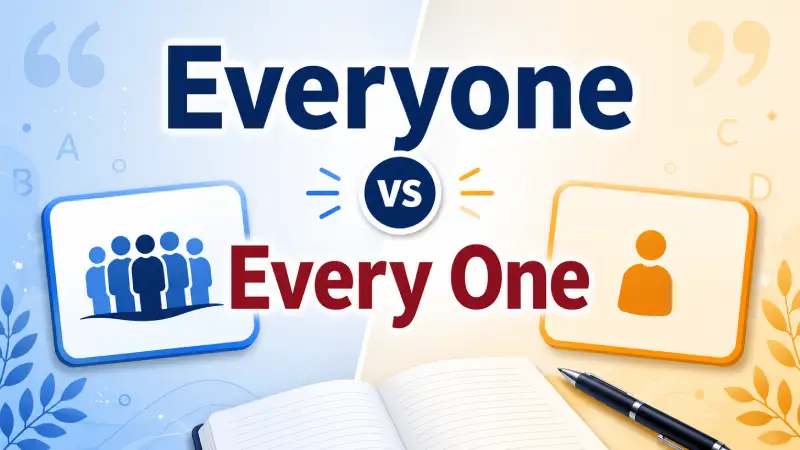
Everyone and every one sound nearly identical, but they do not always serve the same grammatical purpose.
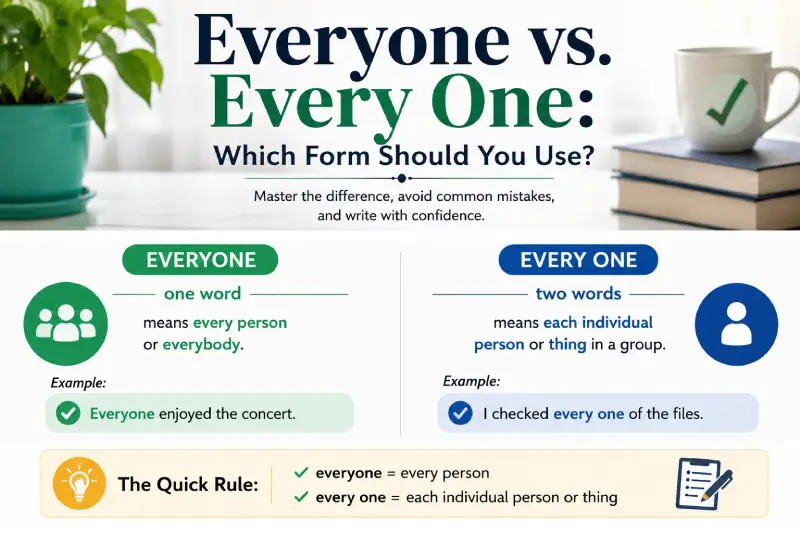
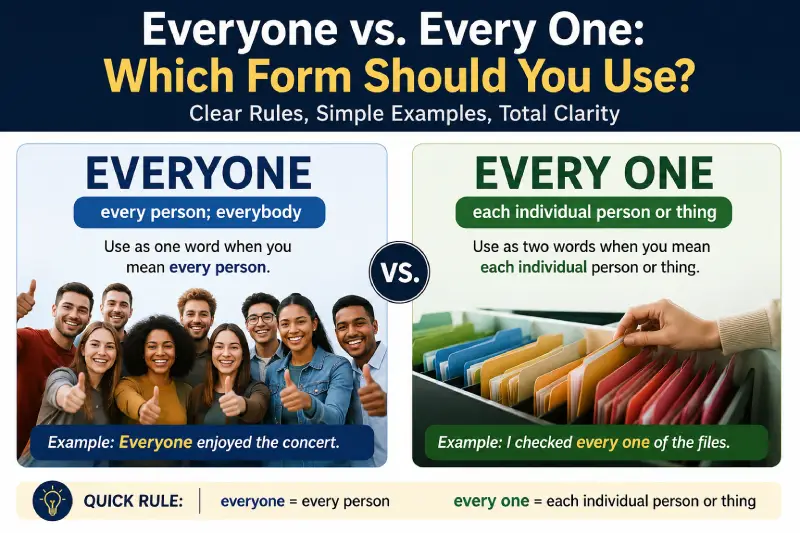
Use everyone as one word when you mean every person or everybody:
Everyone enjoyed the concert.
Use every one as two words when you mean each individual person or thing in a group:
I checked every one of the files.
The quickest rule is:
everyone = every person
every one = each individual person or thing
Everyone vs. Every One: The Quick Difference
| Form | Meaning | Example |
|---|---|---|
| everyone | every person; everybody | Everyone is ready. |
| every one | each individual person or thing | I checked every one of the files. |
The two forms are easy to confuse because they contain the same words and usually sound almost the same. The difference becomes clear when you look at what the expression means in the sentence.
What Does Everyone Mean?

Everyone is a one-word indefinite pronoun that means every person or everybody.
Use it when you are talking about all the people in a group or all people generally.
Examples Of Everyone
- Everyone enjoyed the party.
- Everyone in the office received an email.
- Is everyone ready to leave?
- Everyone deserves a fair opportunity.
- Not everyone agrees with the decision.
In each sentence, everyone refers to people. You can usually replace it with everybody without changing the basic meaning:
Everyone enjoyed the party.
Everybody enjoyed the party.
That replacement test is one of the easiest ways to recognize everyone.
What Does Every One Mean?
Every one is written as two words when one refers to each individual member or item in a group.
Unlike everyone, every one can refer to people or things.
Examples Of Every One
- I read every one of the reports.
- She thanked every one of her guests.
- We checked every one of the boxes.
- He answered every one of the questions.
- I had ten messages and responded to every one.
In the final example, the word one refers back to the ten messages. The meaning is each individual message.
The Most Common Pattern: Every One Of
The two-word form commonly appears in the structure:
every one of + noun or pronoun
Common examples include:
- every one of them
- every one of us
- every one of you
- every one of the students
- every one of the books
- every one of the applications
Examples:
I reviewed every one of the applications.
Every one of them was carefully labeled.
The teacher spoke with every one of the students.
Because every one of means each individual one of, you cannot normally replace it with everyone of.
Everyone Of Or Every One Of?
The correct form is usually every one of, not everyone of, when you mean each individual person or thing in a group.
Incorrect
I checked everyone of the documents.
Correct
I checked every one of the documents.
Similarly:
Every one of them received a certificate.
She contacted every one of her clients.
The word everyone already functions as a complete pronoun meaning every person. The phrase every one of has a different structure because one acts as the individual item being identified.
Can Every One Be Used Without Of?
Yes. Every one does not always need to be followed by of.
Use it without of when the group has already been mentioned or is clear from the context.
I bought twelve cookies and ate every one.
Here, every one means each individual cookie.
The team submitted five proposals, and the committee reviewed every one.
Here, every one refers back to the five proposals.
However, when you mean every person without focusing on individual items, everyone is usually the correct choice:
Everyone arrived on time.
Everyone Refers To People; Every One Can Refer To Things
This is one of the clearest differences between the two forms.
Use everyone for people:
Everyone at the meeting voted.
Use every one for individual things:
I inspected every one of the machines.
You can also use every one for people:
She thanked every one of the volunteers.
Therefore:
- everyone → people only
- every one → individual people or things
Compare:
Everyone was invited to the wedding.
This means every person was invited.
I sent invitations to every one of the guests.
This emphasizes each individual guest in a known group.
Everyone vs. Every One In Similar Sentences
Seeing the two forms side by side makes the distinction easier.
Everyone Means Every Person
Everyone at the restaurant ordered dessert.
Meaning: every person at the restaurant ordered dessert.
Every One Means Each Individual Person Or Thing
Every one of the customers ordered dessert.
Meaning: each individual customer in the identified group ordered dessert.
Here is another comparison:
Everyone agreed with the decision.
This means every person agreed.
The committee considered five proposals and discussed every one.
This means each individual proposal received attention.
Everyone vs. Everybody
Everyone and everybody have the same basic meaning: every person.
Everyone is welcome.
Everybody is welcome.
Both sentences are correct.
The choice between everyone and everybody usually depends on personal preference and context rather than a difference in basic meaning. The important distinction is between everyone as one word and every one as two words.
Every One vs. Each One
Every one and each one can often express a similar idea when you mean individual members or things.
I read every one of the articles.
I read each one of the articles.
Both sentences mean that the articles were considered individually.
However, everyone cannot always replace each one:
I checked each one of the boxes.
I checked everyone of the boxes. ❌
The correct form is:
I checked every one of the boxes.
This is why the space matters.
Verb Agreement With Everyone And Every One
Both everyone and every one normally take a singular verb when they function as the subject of a sentence.
Everyone Is Singular
Everyone is ready.
Everyone has a copy.
Everyone wants to participate.
Not:
Everyone are ready. ❌
Everyone have a copy. ❌
Although everyone refers to many people, the pronoun takes a singular verb.
Every One Is Also Singular
Every one of the students has a textbook.
Every one of the files is important.
Every one of the applicants was interviewed.
The phrase focuses on each individual person or thing, so the verb is singular.
Everyone And Singular They
When everyone refers to people and the person’s gender is unknown or irrelevant, modern English commonly uses they, them, or their to refer back to the pronoun.
Everyone should bring their own lunch.
Everyone should check their email.
This does not change the fact that everyone takes a singular verb:
Everyone is responsible for their own work.
The verb is singular, while their is used as a gender-neutral pronoun.
Common Mistakes With Everyone And Every One
Mistake 1: Writing Everyone Of
Incorrect:
Everyone of the employees attended the meeting.
Correct:
Every one of the employees attended the meeting.
Mistake 2: Using Every One When You Mean Every Person
Less natural for the intended meaning:
Every one was excited about the announcement.
If you mean every person, write:
Everyone was excited about the announcement.
Mistake 3: Writing Every Of
Incorrect:
Every of them received a ticket.
Correct:
Every one of them received a ticket.
Mistake 4: Using A Plural Verb With Everyone
Incorrect:
Everyone are welcome.
Correct:
Everyone is welcome.
Mistake 5: Using Everyone For Things
Incorrect:
I opened everyone of the boxes.
Correct:
I opened every one of the boxes.
Because the sentence refers to individual boxes, use every one.
A Simple Test For Choosing The Correct Form
Ask what the expression means.
If You Mean Every Person, Use Everyone
Everyone enjoyed the show.
You could replace everyone with everybody:
Everybody enjoyed the show.
If You Mean Each Individual Person Or Thing, Use Every One
I checked every one of the receipts.
You could replace every one with each one:
I checked each one of the receipts.
This test works especially well when you are deciding between everyone and every one of.
More Examples Of Everyone
- Everyone in the class passed the test.
- Does everyone understand the instructions?
- Everyone deserves to be treated fairly.
- Everyone at the event received a name tag.
- Everyone has their own opinion.
- Not everyone likes spicy food.
- Everyone was surprised by the result.
- Everyone in our department joined the meeting.
In every example, everyone means every person.
More Examples Of Every One
- I read every one of the chapters.
- She answered every one of the questions.
- We inspected every one of the products.
- He thanked every one of the volunteers.
- The manager reviewed every one of the applications.
- I opened the boxes and checked every one.
- They tested five machines and repaired every one that had a problem.
- The teacher collected the assignments and graded every one.
In these examples, every one focuses on individual people or things in a defined group.
Everyone vs. Every One: Quick Reference
Use everyone when:
- You mean every person.
- You can replace the word with everybody.
- You are using it as a one-word pronoun.
Use every one when:
- You mean each individual person or thing.
- You are referring to an identified group.
- The phrase is followed by of + noun or pronoun.
- You are referring back to a group already mentioned.
Practice Quiz
Choose everyone or every one in each sentence.
- ________ at the meeting received a copy.
- I checked ________ of the files.
- ________ should bring their identification.
- The store displayed ten products, and I examined ________.
- She thanked ________ of the volunteers.
Answers
- Everyone , every person at the meeting.
- Every one , each individual file.
- Everyone , every person.
- every one , each individual product.
- every one, the structure is every one of + noun.
Frequently Asked Questions
Is everyone one word or two words?
Everyone is one word when it means every person or everybody. Every one is two words when it means each individual person or thing in a group.
Is everyone of correct?
Usually, no. When you mean each individual member of a group, use every one of: Every one of the students passed the test.
What Is The Difference Between Everyone And Every One?
Everyone means every person. Every one means each individual person or thing in a group. For example, Everyone is ready means every person is ready, while I checked every one of the files means I checked each individual file.
Can Every One Refer To Things?
Yes. Every one can refer to people or things: Every one of the books was damaged. Everyone refers to people.
Does Everyone Take A Singular Verb?
Yes. Use a singular verb with everyone: Everyone is ready and Everyone has a ticket.
Can Every One Be Used Without Of?
Yes. If the group has already been mentioned, you can write: I reviewed the reports and read every one.
Is Every One The Same As Each One?
They can have similar meanings when you refer to individual members or things in a group. For example, I checked every one of the boxes and I checked each one of the boxes are both correct.
Conclusion
The difference between everyone and every one is mainly a matter of meaning and grammatical structure.
Use everyone as one word when you mean every person or everybody:
Everyone is invited.
Use every one as two words when you mean each individual person or thing in an identified group:
I checked every one of the documents.
Remember the simplest rule:
everyone = every person
every one = each individual person or thing
If everybody works as a replacement, choose everyone. If you are talking about each individual member or item in a group, choose every one.