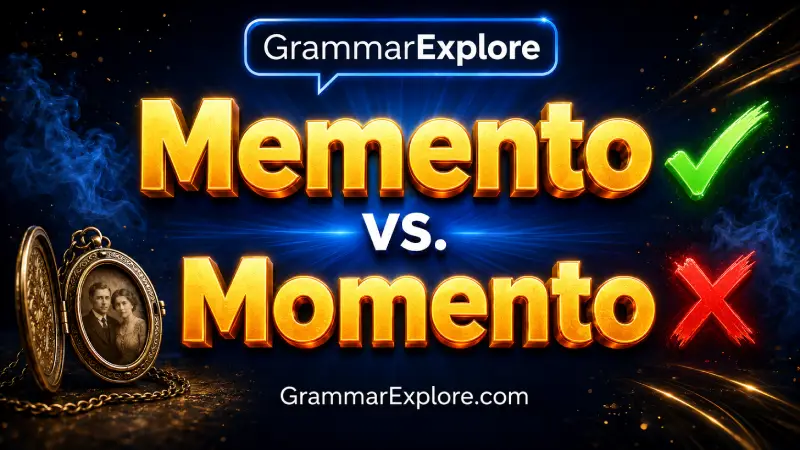
In the memento vs momento choice, memento is the preferred spelling in standard English. It means an object kept as a reminder of a person, place, experience, or event. Momento appears often enough that some dictionaries record it as a variant, but many editors and usage guides still treat it as an error.
For example, you might keep a concert ticket as a memento of a special night. The word connects with memory and remembering, not with the word moment, even though a keepsake may remind you of an important moment.
The similar pronunciation makes the spelling easy to confuse. In addition, momento means “moment” in languages such as Spanish and Italian, which can influence English writers.
For clear, polished American English, always choose memento. It is the established spelling, works in every context, and avoids unnecessary questions about correctness.
Quick Answer
Memento is the preferred standard English spelling. It means a keepsake or reminder of a person, place, or event.
Momento appears as a recorded variant in some dictionaries, but many readers and editors consider it a misspelling.
- Preferred: She kept the shell as a memento.
- Best avoided: She kept the shell as a momento.
Is Memento Going Backwards?
No. Memento does not mean going backwards. It refers to an object kept as a reminder of a person, place, event, or experience.
Examples:
- She kept the postcard as a memento of her trip.
- The medal is a memento of his achievement.
What Does “Momento” Mean?
Momento is usually a misspelling of memento. In standard English, memento is the correct word for a keepsake or reminder.
Examples:
- Correct: She bought a memento from the museum.
- Incorrect: She bought a momento from the museum.
Is Momento a Real Word?
No. Momento is not a standard English word. It is generally considered a spelling mistake. The correct spelling is memento.
Examples:
- Correct: memento
- Incorrect: momento
What Is a Personal Memento?
A personal memento is an item that reminds someone of a special person, memory, or event. It often has sentimental value rather than financial value.
Examples:
- He kept his grandfather’s watch as a personal memento.
- The photograph became a treasured memento of their vacation.
Why People Confuse Them
A memento often reminds someone of a memorable moment. This connection encourages people to replace the first e with an o:
- moment → momento
- memory → memento
However, the English word does not come from moment. It comes from a Latin form associated with remembering.
The words also sound similar in everyday speech:
- Memento: muh-MEN-toh
- Momento: often pronounced moh-MEN-toh or muh-MEN-toh
During a fast conversation, the first unstressed vowel may sound unclear. A listener may therefore hear memento and imagine the spelling momento.
Other languages add to the confusion. Momento means “moment” in Spanish and Italian. Writers familiar with those languages may carry that spelling into English, even though English uses memento for a keepsake.
Key Differences At A Glance
| Feature | Memento | Momento |
|---|---|---|
| Preferred English spelling | Yes | No |
| Meaning in English | A keepsake or reminder | Recorded by some dictionaries as a variant of memento |
| Editorial acceptance | Widely accepted | Often treated as an error |
| Best choice in US writing | Yes | Best avoided |
| Pronunciation | muh-MEN-toh | May sound nearly identical |
| Connection | Memory and remembering | Often influenced by moment |
| Common plural | Mementos or mementoes | Avoid by using mementos |
| Example | A memento of our trip | Usually changed to memento |
Meaning And Usage Difference
What Does Memento Mean?
A memento is an object that helps someone remember a person, place, experience, or event. It may have little financial value but great personal or emotional importance.
Common mementos include:
- photographs
- letters
- ticket stubs
- postcards
- medals
- seashells
- jewelry
- signed programs
- small gifts
- travel souvenirs
Examples:
- She kept the ticket as a memento of their first concert.
- The watch became a memento of his grandfather.
- We brought home a small memento from our vacation.
- Each guest received a memento from the wedding.
- He saved the handwritten note as a personal memento.
A memento does not need to come from a vacation. Any object can become one if it preserves a meaningful memory.
Is A Memento The Same As A Souvenir?
The words overlap, but they can carry slightly different emphasis.
A souvenir usually comes from a place, trip, attraction, or event:
- She bought a souvenir at the museum.
- We brought back souvenirs from Hawaii.
A memento emphasizes personal remembrance:
- She kept her father’s watch as a memento.
- The photograph served as a memento of their friendship.
The same object can be both:
- I bought a postcard as a souvenir of our trip.
- Years later, the postcard became a treasured memento.
A souvenir may begin as a purchased travel item. A memento often gains meaning through its connection to a memory.
What Does Momento Mean In English?
Some English dictionaries record momento as a variant spelling of memento because writers have used it for a long time. However, dictionary recognition does not mean that every editor or reader accepts it equally.
Many usage guides still describe momento as a common error. In careful American writing, it may distract readers or make the text look unedited.
Less suitable:
- She kept the photograph as a momento.
Preferred:
- She kept the photograph as a memento.
Therefore, momento can be understood, and some dictionaries recognize it. Still, memento remains the safest and most widely accepted choice.
Does Momento Mean Moment?
In Spanish and Italian, momento means “moment.” However, English normally uses moment, not momento, for a short period of time.
English:
- Please wait a moment.
- That was a memorable moment.
Spanish or Italian:
- momento
Do not use momento as a decorative or more formal spelling of the English word moment unless it appears in a foreign-language expression, quotation, title, or proper name.
Can A Memory Be A Memento?
A memento is usually a physical object that produces or preserves a memory. The memory itself is not normally called a memento.
Natural:
- The photograph is a memento of our trip.
- The ring serves as a memento of her grandmother.
Less natural:
- My memory of the trip is a memento.
A better version would be:
- My memory of the trip remains vivid.
- The photograph is a memento of the trip.
The distinction is simple: the memory exists in your mind, while the memento helps you recall it.
Can A Memento Be Digital?
Yes. Modern mementos do not always need a traditional physical form. A digital photograph, saved voice message, video, email, or scanned letter can serve as a memento.
- She saved the voice message as a memento.
- The digital album became a memento of their college years.
- He kept a copy of the email as a personal memento.
The important feature is not the object’s physical form. Its connection to remembrance gives it the meaning.
Tone, Context, And Formality
Memento works in formal and informal English. It often carries a sentimental, respectful, or reflective tone.
In personal writing:
I kept the bracelet as a memento of our friendship.
This photograph is my favorite memento from childhood.
In formal ceremonies:
The organization presented her with a memento of appreciation.
Each retiring employee received a commemorative memento.
In historical writing:
The letter remained a memento of the family’s journey.
The medal served as a wartime memento.
In everyday conversation, keepsake may sound warmer and more familiar:
She keeps the necklace as a family keepsake.
Souvenir sounds especially natural for travel or events:
We bought a souvenir at the national park.
Memento emphasizes the act of remembering, so it often feels more personal than souvenir.
Momento does not express a different tone or level of formality. When English speakers use it for a keepsake, they generally intend the same meaning as memento.
Which One Should You Use?
| Context | Best Choice | Why |
|---|---|---|
| A keepsake from a trip | Memento | It is the preferred standard spelling. |
| An object connected with a loved one | Memento | It emphasizes personal remembrance. |
| A gift marking a retirement | Memento | It serves as a reminder of the occasion. |
| A formal article or report | Memento | Editors widely accept this form. |
| School or academic writing | Memento | It avoids a commonly flagged spelling. |
| A phrase such as memento mori | Memento | This is the established Latin form. |
| A Spanish or Italian word meaning “moment” | Momento | The word belongs to those languages. |
| A proper title or name spelled Momento | Momento | Preserve the official spelling. |
| General American English | Memento | It is the safest and clearest choice. |
When writing in English, use memento unless you have a specific reason to preserve momento in a foreign phrase, quotation, title, or name.
When One Choice Sounds Wrong
Momento In Edited English
Many readers will view this sentence as misspelled:
- She kept the flower as a momento of the ceremony.
Use the preferred form:
- She kept the flower as a memento of the ceremony.
Although some dictionaries record momento, it remains much more likely to attract correction.
Memento For A Period Of Time
Incorrect:
- Please wait a memento.
Correct:
- Please wait a moment.
A moment is a brief period of time. A memento is an object associated with memory.
Momento In The Latin Phrase
Incorrect:
- The painting contains a momento mori symbol.
Correct:
- The painting contains a memento mori symbol.
The established phrase is memento mori, not momento mori.
Using Memento For Every Purchased Object
Not every souvenir automatically carries the emotional force of a memento.
Possible:
- I bought a souvenir keychain at the airport.
More personal:
- Years later, the keychain became a memento of our first family trip.
The difference depends on the object’s role and emotional connection.
Common Mistakes And Quick Fixes
Connecting The Word With Moment
Incorrect:
- The ticket is a momento of our trip.
Correct:
- The ticket is a memento of our trip.
Think of memory, not moment.
Writing Momento Mori
Incorrect:
- The skull is a traditional momento mori.
Correct:
- The skull is a traditional memento mori.
The Latin expression always uses memento.
Using Moment Instead Of Memento
Incorrect:
- She kept the ring as a moment of her grandmother.
Correct:
- She kept the ring as a memento of her grandmother.
A moment is time; a memento is a reminder.
Using An Apostrophe In The Plural
Incorrect:
- She collected several memento’s from the trip.
Correct:
- She collected several mementos from the trip.
A normal plural does not need an apostrophe.
Use memento’s only to show possession:
- The memento’s sentimental value was greater than its price.
That sentence is grammatically possible, though a smoother version would be:
- The sentimental value of the memento was greater than its price.
Assuming Momento Is The British Spelling
Incorrect belief:
- Americans write memento, while British writers use momento.
- Memento is the preferred spelling in both American and British English.
Using Memento When Keepsake Sounds More Natural
Formal or literary:
- The child kept the toy as a memento of her grandfather.
Warm and conversational:
- The child kept the toy as a keepsake from her grandfather.
Both sentences are correct. Choose the word that fits the tone.
Everyday Examples
Correct Examples With Memento
- She kept the concert ticket as a memento.
- The seashell became a memento of our beach vacation.
- He carries the photograph as a memento of his parents.
- We received a small memento after the ceremony.
- The medal serves as a memento of her military service.
- I saved the postcard as a memento of our trip.
- The watch is a treasured family memento.
- Each graduate received a memento from the school.
- He kept the signed baseball as a childhood memento.
- The dried flower became a memento of their wedding.
- Her journal is a personal memento of college.
- The chef framed the menu as a memento of opening night.
- They gave the retiring teacher a memento of appreciation.
- A small stone served as a memento of the mountain hike.
- The saved voice message became a precious memento.
Incorrect And Correct Comparisons
- Incorrect: She kept the ticket as a momento.
- Correct: She kept the ticket as a memento.
- Incorrect: This photograph is a momento of our friendship.
- Correct: This photograph is a memento of our friendship.
- Incorrect: He bought a small momento at the museum.
- Correct: He bought a small memento at the museum.
- Incorrect: The ring remains a family momento.
- Correct: The ring remains a family memento.
- Incorrect: The painting includes a momento mori.
- Correct: The painting includes a memento mori.
Memento, Souvenir, Keepsake, And Moment
- We bought a souvenir from the gift shop.
- The souvenir later became a treasured memento.
- She stores family keepsakes in a wooden box.
- That photograph captured a joyful moment.
- The photograph became a memento of that moment.
Dictionary-Style Word Details
Verb
- Memento: Not commonly used as a verb in standard English. It functions as a noun.
- Momento: Not commonly used as a verb in standard English.
Use verbs such as remember, commemorate, preserve, or memorialize when describing an action:
- The gift commemorates her years of service.
- The photograph preserves a special memory.
- We remember the occasion through this keepsake.
Noun
- Memento: An object kept as a reminder of a person, place, experience, or event.
- Momento: A recorded variant spelling of memento in some dictionaries, though many editors still consider it an error.
Examples:
- The letter is a memento of their friendship.
- She brought home a memento from the museum.
- His medal became a treasured memento.
For reliable standard English, choose memento.
Synonyms
Close alternatives for memento include:
- keepsake
- souvenir
- reminder
- token
- remembrance
- memorial
- commemorative object
These terms do not always carry exactly the same meaning.
A keepsake is an object kept because of personal or sentimental value:
- She kept the locket as a family keepsake.
A souvenir usually comes from a place, trip, or event:
- We purchased a souvenir at the museum.
A token may express affection, thanks, respect, or remembrance:
- They gave him a watch as a token of appreciation.
A reminder can be an object, message, event, or thought:
- The photograph is a reminder of our childhood.
No direct antonym fits every meaning of memento.
Example Sentences
Memento:
- She kept the ribbon as a memento of the event.
- The photograph became a treasured memento.
- We bought a small memento from the historic site.
- He carries the coin as a memento of his grandfather.
- Each guest received a memento from the celebration.
- The old letter remains a memento of their friendship.
Momento:
Some dictionaries record this variant, but standard edited English favors memento:
- Less suitable: She saved the shell as a momento.
- Preferred: She saved the shell as a memento.
Word History
Memento comes from Latin and carries the idea of “remember.” That connection also appears in the well-known phrase memento mori, which serves as a reminder of mortality.
The spelling momento likely became common partly because people associated a keepsake with a memorable moment. Spanish and Italian also use momento for “moment,” which may reinforce the substitution.
Although writers have used momento for a long time and some dictionaries include it, memento remains the historically grounded and editorially preferred English spelling.
Phrases Containing
Common phrases with memento include:
- a memento of the trip
- a personal memento
- a treasured memento
- a family memento
- a wedding memento
- a small memento
- a lasting memento
- a permanent memento
- a historical memento
- a sentimental memento
- keep as a memento
- give as a memento
- serve as a memento
- memento of friendship
- memento of appreciation
- memento mori
Avoid changing the spelling in established phrases:
- Correct: memento mori
- Incorrect: momento mori
How To Remember Memento vs Momento
Connect memento with words about remembering:
- memory
- remember
- memorial
- memento
All four words contain mem.
Use this short memory sentence:
A memento helps preserve a memory.
You can also separate three similar words:
- Moment: A brief period of time
- Memento: A keepsake that preserves a memory
- Momento: A variant best avoided in standard English
If you can replace the word with keepsake, choose memento.
FAQs
Which is correct, memento or momento?
Memento is the preferred standard spelling. Some dictionaries list momento as a variant, but many editors and readers still consider it an error. Use memento in polished English.
What does memento mean?
A memento is an object kept as a reminder of a person, place, event, or experience. Photographs, letters, jewelry, ticket stubs, and souvenirs can all become mementos.
Is momento a real English word?
Some dictionaries record momento as a variant of memento because it has appeared frequently in English writing. However, it remains controversial and often receives correction. Memento is the safer choice.
Is momento the American spelling?
No. Memento is preferred in both American and British English. Momento is not a standard regional alternative comparable to pairs such as color and colour.
How do you pronounce memento?
Pronounce memento approximately as muh-MEN-toh. Speakers may vary slightly in the first unstressed vowel, but the stress normally falls on the second syllable.
What is the plural of memento?
Both mementos and mementoes are accepted plurals. Mementos is the simpler and more common modern form:
- One memento
- Several mementos
Is it memento mori or momento mori?
The correct phrase is memento mori. It comes from Latin and serves as a reminder of human mortality. Do not replace the first e with an o.
What is the difference between a memento and a souvenir?
A souvenir usually comes from a trip, place, or event. A memento emphasizes personal memory. One object can be both a souvenir and a memento.
Can a photograph be a memento?
Yes. A photograph can serve as a memento when someone keeps it to remember a person, place, relationship, or experience.
Can a memento be digital?
Yes. Digital photographs, videos, emails, voice recordings, and saved messages can serve as mementos if they preserve meaningful memories.
Conclusion
In the memento vs momento comparison, memento is the preferred spelling for clear, standard English. It describes a keepsake or reminder connected with a person, place, experience, or event.
Some dictionaries recognize momento as a variant because writers have used it for many years. However, many readers and editors continue to treat it as a spelling error. Choosing memento avoids that problem.
Remember the connection between memento, memory, and remember. All contain mem. If an object helps preserve a memory, call it a memento.